One-Sentence Answer
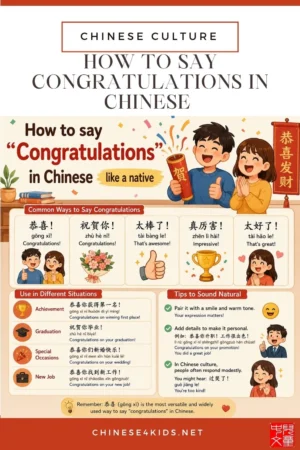
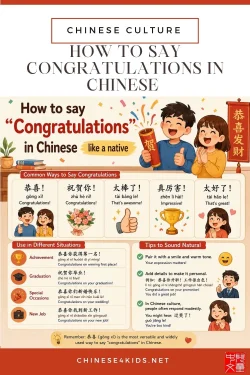
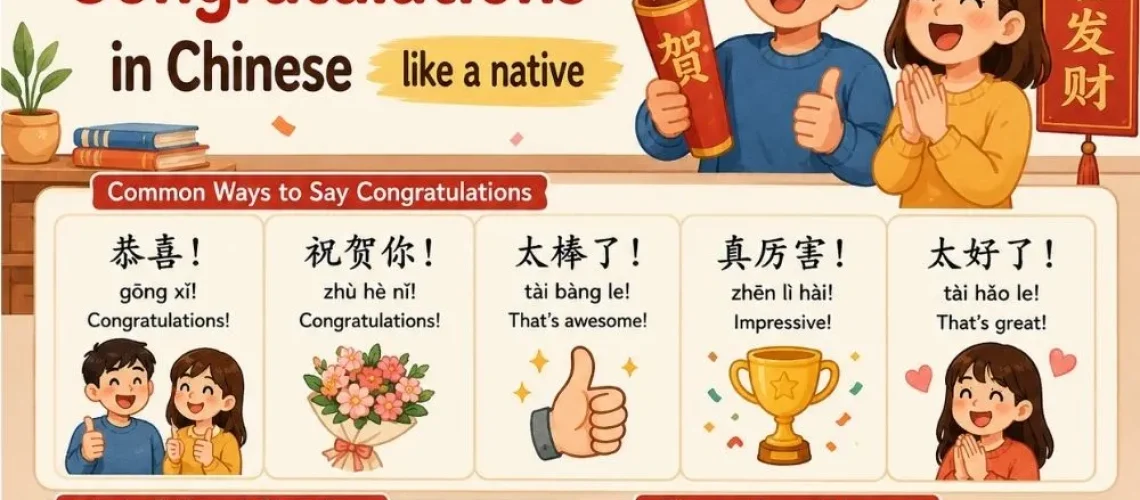
The two main ways to say congratulations in Chinese are 恭喜 (gōng xǐ) for informal occasions and 祝贺 (zhù hè) for formal ones — but native speakers also use many occasion-specific phrases.
Why “Congratulations” in Chinese Is More Than One Phrase
In English, you can say “Congratulations!” to almost anyone in almost any situation. Chinese works differently.
Native speakers choose their congratulations phrase based on:
- Who they are talking to (friend, elder, colleague, official)
- What the occasion is (graduation, wedding, new baby, Chinese New Year)
- How formal the situation is
This is not complicated. Once you know the patterns, it feels natural. And children who grow up hearing the right phrases for the right moments develop a cultural fluency that goes far beyond vocabulary.
This guide covers every major congratulations phrase in Chinese — with pinyin, example sentences, and the situations where each one belongs.
The Two Core Expressions
恭喜 (gōng xǐ) — Informal Congratulations
恭喜 is the everyday word for congratulations. Use it with friends, family, and people you know well.
- Characters: 恭喜
- Pinyin: gōng xǐ
- Literal meaning: respectful joy
- Register: informal to neutral
Example sentences:
恭喜!
Gōng xǐ!
Congratulations!恭喜你考上大学。
Gōng xǐ nǐ kǎo shàng dàxué.
Congratulations on getting into university.恭喜你找到了工作。
Gōng xǐ nǐ zhǎo dào le gōngzuò.
Congratulations on finding a job.恭喜你生了宝宝。
Gōng xǐ nǐ shēng le bǎo bao.
Congratulations on your new baby.
You will often hear 恭喜 said twice: 恭喜恭喜 (gōng xǐ gōng xǐ). Repeating it adds warmth and emphasis. It is also the name of a famous Chinese New Year song — so the phrase has a festive ring to it.
祝贺 (zhù hè) — Formal Congratulations
祝贺 is the formal expression. Use it in professional settings, official communications, or when writing a congratulations card for someone you do not know well.
- Characters: 祝贺
- Pinyin: zhù hè
- Literal meaning: to wish and celebrate
- Register: formal
Example sentences:
祝贺您荣升总经理。
Zhù hè nín róng shēng zǒng jīng lǐ.
Congratulations on your promotion to General Manager.祝贺贵公司开业大吉。
Zhù hè guì gōng sī kāi yè dà jí.
Congratulations on the opening of your company.祝贺你获得这个奖项。
Zhù hè nǐ huò dé zhège jiǎng xiàng.
Congratulations on winning this award.
Note: 您 (nín) is the formal/respectful “you”. Use it with elders and people of higher status. With friends and peers, use 你 (nǐ).
Quick Reference: 恭喜 vs 祝贺
-
恭喜
恭喜 is an informal expression of “congratulations”. It is often used as blessings to a happy event. It is mostly used with people.
-
祝贺
祝贺 is a formal expression of “congratulations”. It is often used to congratulate people or companies on their achievements.
| 恭喜 (gōng xǐ) | 祝贺 (zhù hè) | |
| Register | Informal / everyday | Formal / professional |
| Used with | Friends, family, peers | Superiors, officials, companies |
| In speech | ✅ Common | ✅ Common |
| In writing | ✅ Common | ✅ Very common |
| Doubled (恭喜恭喜) | ✅ Sounds warm | ❌ Not typically doubled |
Occasion-Specific Congratulations Phrases
Chinese has rich, occasion-specific expressions for every milestone. These go far beyond a generic “congratulations.” Learning them makes your Chinese sound truly native.
Graduation (毕业 — bì yè)
Graduation is a major milestone, especially in Chinese culture. Education is deeply valued.
恭喜毕业!Gōng xǐ bì yè!
Congratulations on your graduation!祝贺你顺利毕业。
Zhù hè nǐ shùn lì bì yè.
Congratulations on graduating smoothly.前途无量!
Qián tú wú liàng!
You have limitless potential ahead! (a common follow-up after graduation wishes)鹏程万里!
Péng chéng wàn lǐ!
May your journey be as grand as the soaring of the Peng bird! (classical expression meaning great future success)
For children receiving school awards or finishing a level of study, 恭喜 + a specific achievement works well:
恭喜你考了一百分!(Gōng xǐ nǐ kǎo le yī bǎi fēn!) — Congratulations on scoring 100%!
For a full guide including 骊歌 (the traditional graduation song), graduation vocabulary, farewell phrases, and what graduation looks like in Chinese culture, see Graduation in Chinese — Vocabulary, Phrases, and Traditions.
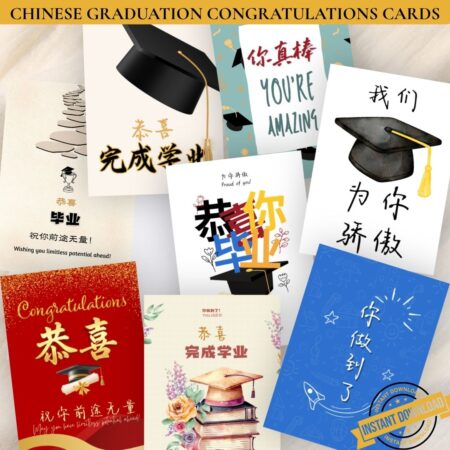
Want to send congratulations to graduates? Here are 8 designs for you. Each design features a unique Chinese and English message, from 恭喜毕业 to 祝你前途无量. Print at home, fold, and give. Perfect for heritage families, Chinese school graduations, and Mandarin immersion classrooms.
New Baby (新生儿 — xīn shēng ér)
The arrival of a baby is celebrated with phrases that wish health and good fortune for both baby and family.
恭喜添丁!
Gōng xǐ tiān dīng!
Congratulations on the new addition to your family! (丁 traditionally referred to a son but is now used for any new child)恭喜得子!
Gōng xǐ dé zǐ!
Congratulations on the birth of your son!恭喜得女!
Gōng xǐ dé nǚ!
Congratulations on the birth of your daughter!祝宝宝健康成长!
Zhù bǎo bao jiàn kāng chéng zhǎng!
Wishing your baby healthy growth!母婴平安!
Mǔ yīng píng ān!
Wishing mother and baby peace and safety!
Wedding (婚礼 — hūn lǐ)
Chinese wedding congratulations are rich with traditional phrases wishing the couple a harmonious and lasting marriage.
新婚快乐!
Xīn hūn kuài lè!
Happy marriage! / Congratulations on your wedding!百年好合!
Bǎi nián hǎo hé!
May you have a harmonious union for a hundred years!白头偕老!
Bái tóu xié lǎo!
May you grow old together with white hair! (the most beloved Chinese wedding blessing)永结同心!
Yǒng jié tóng xīn!
May you always be united in heart!早生贵子!
Zǎo shēng guì zǐ!
May you soon be blessed with children! (traditional, use with awareness of context)
For more on Chinese celebrations and the vocabulary that goes with them, see our guide to Celebrations, Festivals, and Special Occasions in Chinese Culture.
Birthday (生日 — shēng rì)
Birthday congratulations in Chinese go beyond the song. There are phrases that reflect Chinese cultural values of longevity and good health.
生日快乐!
Shēng rì kuài lè!
Happy Birthday!祝你生日快乐,健康长寿!
Zhù nǐ shēng rì kuài lè, jiànkāng cháng shòu!
Happy birthday, wishing you health and long life!长命百岁!
Cháng mìng bǎi suì!
May you live a hundred years! (for elders especially)越来越年轻!
Yuè lái yuè niáng qīng!
May you grow younger and younger! (playful, for adults)万事如意!
Wàn shì rú yì!
May all your wishes come true!
For a full guide including birthday customs, gift taboos (why you should never give a clock), and age-specific phrases, see our article Birthday Wishes in Chinese.
Chinese New Year (春节 — chūn jié)
Chinese New Year has its own set of congratulations phrases — the 吉祥话 (jí xiáng huà), or lucky phrases. 恭喜发财 is the most famous.
恭喜发财!
Gōng xǐ fā cái!
Wishing you happiness and prosperity! (the classic New Year greeting)新年快乐!
Xīn nián kuài lè!
Happy New Year!万事如意!
Wàn shì rú yì!)
May all go well with you!心想事成!
Xīn xiǎng shì chéng!
May all your wishes come true!大吉大利!
Dà jí dà lì!
Great luck and great profit!
The child-friendly add-on that children love:
恭喜发财,红包拿来!
Gōng xǐ fā cái, hóng bāo ná lái!
Wishing you prosperity — and give me a red envelope!
For a full list of Chinese New Year lucky phrases with pinyin, see Lucky Phrases for Chinese New Year and Chinese Lucky Phrases That Start with Numbers.
Promotion and Professional Achievement (升职 — shēng zhí)
In Chinese professional culture, promotions and business milestones are congratulated with specific formal phrases.
恭喜升职!
Gōng xǐ shēng zhí!
Congratulations on your promotion!步步高升!
Bù bù gāo shēng!
May you rise higher and higher step by step!祝事业顺利!
Zhù shì yè shùn lì!
Wishing you success in your career!大展宏图!
Dà zhǎn hóng tú!
May you realise your great ambitions!
House / Moving (乔迁 — qiáo qiān)
乔迁之喜!
iáo qiān zhī xǐ!
Congratulations on your new home! (a classical four-character expression specifically for moving)恭喜乔迁!
Gōng xǐ qiáo qiān!
Congratulations on moving house!祝新居愉快!
Zhù xīn jū yú kuài!
Wishing you happiness in your new home!
Expressing Your Happiness for Someone
In addition to congratulations, Chinese has warm phrases to express that you share in someone’s joy. These are often used alongside 恭喜 or 祝贺.
| Chinese | Pinyin | English |
| 我为你骄傲。 | Wǒ wèi nǐ jiāo’ào. | I am proud of you. |
| 我替你高兴。 | Wǒ tì nǐ gāo xìng. | I am happy for you. |
| 你真棒! | Nǐ zhēn bàng! | You’re amazing! |
| 你太厉害了! | Nǐ tài lì hai le! | You’re incredible! |
| 做得好! | Zuò de hǎo! | Well done! |
| 太好了! | Tài hǎo le! | Wonderful! / That’s great! |
| 真不错! | Zhēn bú cuò! | Really impressive! |
For more encouraging phrases to use with children specifically, see our article on Positive Things to Say to Kids in Chinese and Chinese Compliment Phrases for Kids and Beginners.
How to Respond to Congratulations in Chinese
Chinese culture values modesty. When someone congratulates you, a simple 谢谢 (xièxiè — thank you) is always correct. But native speakers often add a humble deflection:
| Chinese | Pinyin | English |
| 谢谢! | Xièxiè! | Thank you! |
| 哪里哪里。 | Nǎ lǐ nǎ lǐ. | You’re too kind. / Not really. |
| 过奖了。 | Guò jiǎng le. | You flatter me. |
| 还差得远呢。 | Hái chà de yuǎn ne. | I still have a long way to go. |
| 大家一起努力。 | Dà jiā yī qǐ nǔ lì. | We all worked hard together. |
For a deeper look at the cultural nuance around 谢谢 and how to say thank you like a native, see 4 Different Ways of Saying Thank You in Chinese.
How to Write Congratulations in Chinese
For cards, messages, and social media, the structure is simple:
Formula: 恭喜 / 祝贺 + [person] + [specific achievement/occasion]
恭喜你考上名校! — Congratulations on getting into a prestigious school!
恭喜你们成为新婚夫妻! — Congratulations on becoming a newly married couple!
祝贺贵校成立十周年! — Congratulations on the school’s 10th anniversary!
For Chinese New Year cards, the classic format is:
[recipient’s name],新年快乐,恭喜发财,万事如意!
For a birthday card:
[recipient’s name],生日快乐!祝你心想事成,健康长寿!
The 四字吉祥话: Four-Character Lucky Expressions
Many of the most powerful congratulations phrases in Chinese are 四字成语 (sì zì chéng yǔ) — four-character classical expressions. These carry cultural weight far beyond their literal meaning.
| Expression | Pinyin | Meaning | Use |
| 恭喜发财 | gōng xǐ fā cái | Wishing you prosperity | New Year, any happy occasion |
| 万事如意 | wàn shì rú yì | May all go as you wish | Any occasion |
| 心想事成 | xīn xiǎng shì chéng | May all your wishes come true | Birthdays, New Year, graduation |
| 百年好合 | bǎi nián hǎo hé | Harmonious union for a hundred years | Weddings |
| 白头偕老 | bái tóu xié lǎo | Grow old together | Weddings |
| 鹏程万里 | péng chéng wàn lǐ | Limitless future | Graduation, new beginnings |
| 步步高升 | bù bù gāo shēng | Rise higher and higher | Promotions, career |
| 大展宏图 | dà zhǎn hóng tú | Realise your great ambitions | Career, new ventures |
| 乔迁之喜 | qiáo qiān zhī xǐ | The joy of moving to a new home | Moving house |
| 龙凤呈祥 | lóng fèng chéng xiáng | Dragon and phoenix bring good fortune | Weddings |
| 五福临门 | wǔ fú lín mén | Five blessings come to the door | New Year, any joyful event |
These expressions are excellent for older children and teenagers to learn. They appear in cards, banners, and text messages — and knowing them signals genuine cultural literacy.
Teaching Congratulations Phrases to Children
Children learn congratulations phrases most naturally in context — when there is actually something to celebrate.
Here are five ways to introduce these phrases at home or in the classroom:
1. Use them at real moments.
When a child finishes a puzzle, learns a new character, or performs in a concert, say 恭喜!or 你真棒! The phrase sticks because it is tied to a real feeling.
2. Role-play scenarios.
Set up pretend situations: a graduation ceremony, a new-year greeting, a birthday party. Children say the phrase in character. Even young children can learn 恭喜 and 生日快乐 this way.
3. Match cards to occasions.
Make a simple matching game: cards with occasions (wedding, graduation, new baby) and cards with phrases. Children match them. This works well as a classroom warmup.
4. Practise the response too.
Do not teach only the congratulations phrase — teach the reply. 谢谢!哪里哪里。 Make it a dialogue.
5. Write a congratulations card in Chinese.
Give children a real occasion — a classmate’s birthday, a teacher’s award, Chinese New Year — and have them write a card using the phrases they have learned.
What Your Child Is Really Learning
When children learn how to say congratulations in Chinese, they are learning more than vocabulary. They are learning:
- Social register — when to be formal, when to be warm
- Cultural values — longevity, family, modesty in receiving praise
- 四字成语 — a window into classical Chinese thought
- How to participate in real-life Chinese cultural moments — not just classroom exercises
This is exactly what distinguishes children raised with living Chinese from those who only learn Chinese as a school subject.
Using These Phrases in Daily Life — The Bigger Picture
Learning to say congratulations is one piece of a much larger picture: helping children use Chinese in real situations, with real people, for real occasions.
If you are a parent looking to use more spoken Chinese in your home — not just for celebrations, but for daily routines — our Speak Chinese with Kids course is built exactly for this. It covers 13 everyday scenarios with 30 natural phrases each, all with audio and printable scripts. You do not need to be fluent. You just need a starting point.
For more on building a Chinese-speaking home environment, see our guide Chinese Immersion at Home: Easy Daily Routines for Kids.
Free Download: Top 100 Chinese Characters
Many of the characters in the congratulations phrases above — 你, 好, 快, 乐, 年, 大, 心, 成 — are among the 100 most-used Chinese characters.
Our free Top 100 Chinese Characters printable is a great starting point for any beginner. Print it, put it on the wall, and your child will start recognising the building blocks of these phrases in weeks.
FAQ: Congratulations in Chinese
What is the most common way to say congratulations in Chinese?
恭喜 (gōng xǐ) is the most common everyday expression. 恭喜恭喜 (said twice) adds extra warmth.
What does 恭喜发财 mean?
It means “Wishing you happiness and prosperity.” It is most associated with Chinese New Year but can be used at any joyful occasion.
Is 恭喜 or 祝贺 more formal?
祝贺 is more formal. Use it in professional or official contexts. 恭喜 suits friends and family.
How do you congratulate someone in Chinese on a wedding?
The most traditional phrases are 百年好合 (bǎi nián hǎo hé — harmonious union for a hundred years) and 白头偕老 (bái tóu xié lǎo — grow old together).
How do you respond when someone congratulates you in Chinese?
Say 谢谢!(xièxiè — thank you) and add 哪里哪里 (nǎ lǐ nǎ lǐ — you’re too kind) for the modest, culturally natural response.
Can children learn these phrases?
Yes. Children as young as 4–5 can learn 恭喜, 生日快乐, and 你真棒 through role-play and real occasions. Older children (9+) can begin learning the four-character expressions.
Related Reading on Chinese4kids
- Graduation in Chinese — Vocabulary, Phrases, and Traditions — full graduation guide: 毕业 vocabulary, 骊歌, 四字成语, and level-by-level wishes
- Hello in Chinese: How to Say Hello Like a Native — the companion greeting article in this series
- How to Say Thank You in Chinese Like a Native — complete guide to 谢谢 and its variants
- 30 Child-friendly Survival Chinese Phrases — the first phrases every child needs
- Positive Things to Say to Kids in Chinese — praise and encouragement phrases
- Chinese Compliment Phrases for Kids and Beginners — how to give compliments in Chinese
- Birthday Wishes in Chinese — full birthday guide with customs and gift taboos
- Celebrations, Festivals, and Special Occasions in Chinese Culture — the cultural backdrop for all major occasions
- Lucky Phrases for Chinese New Year — full list of 吉祥话 for Spring Festival
- Chinese Lucky Phrases That Start with Numbers — poetic number-based good wishes
- How to Praise a Child in Chinese — praise phrases and the psychology of encouragement
If you like this post, PIN IT