Quick Answer
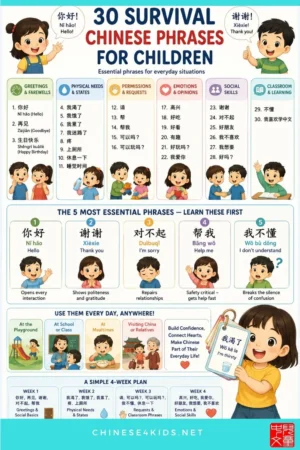
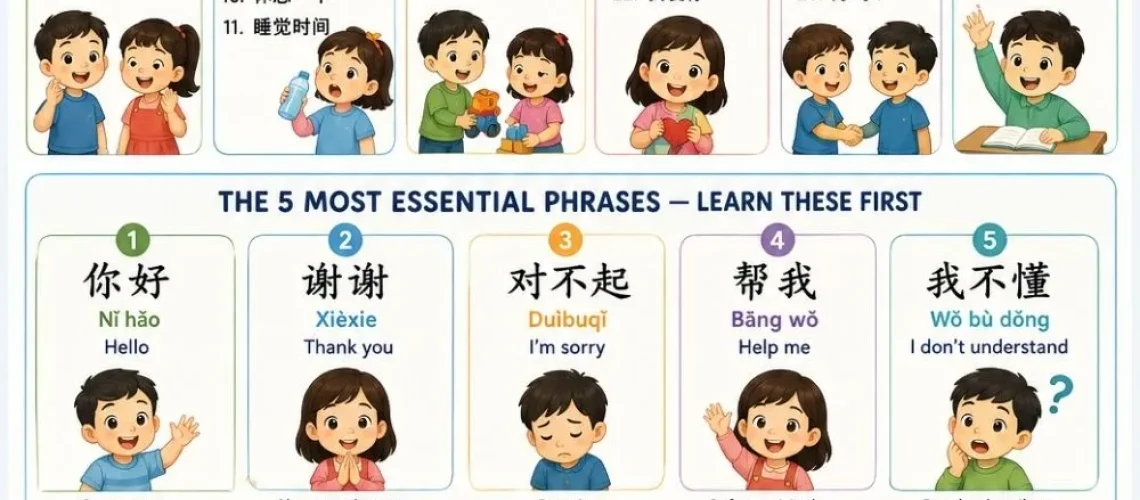
The 30 most important survival Chinese phrases for children fall into six functional groups: greetings and farewells, physical needs and states, permissions and requests, emotions and opinions, social skills, and classroom and safety language. The single most important phrases to learn first are 你好, 谢谢, 对不起, 帮我, and 我不懂 — these five cover the vast majority of a child’s daily communication needs in a Chinese-speaking environment.
The 30 most important survival Chinese phrases for children fall into six functional groups: greetings and farewells, physical needs and states, permissions and requests, emotions and opinions, social skills, and classroom and safety language. The single most important phrases to learn first are 你好, 谢谢, 对不起, 帮我, and 我不懂 — these five cover the vast majority of a child’s daily communication needs in a Chinese-speaking environment.
When children have the language to express their basic needs, something shifts. They stop waiting for adults to interpret their silence. They ask for water, admit they’re lost, say they’re tired, accept a compliment, apologise when they’ve made a mistake. These aren’t academic milestones. They’re moments of genuine communication. In a second language, every one of them matters.
These 30 survival Chinese phrases for kids aren’t a vocabulary list. They’re a functional toolkit. Each phrase does a specific job. A child who knows all 30 can navigate most ordinary childhood situations in Mandarin — even if their overall Chinese level is still developing.
How these phrases were chosen
These phrases weren’t selected because they’re common vocabulary. They were chosen because they help children do things: ask for help, express feelings, stay safe, and connect with people. After years of teaching young Mandarin learners, I’ve found that children who can ask for help and show how they feel gain confidence much faster than children who start with isolated word lists. That’s the selection principle behind every phrase here.
These phrases weren’t selected because they’re common vocabulary. They were chosen because they help children do things: ask for help, express feelings, stay safe, and connect with people. After years of teaching young Mandarin learners, I’ve found that children who can ask for help and show how they feel gain confidence much faster than children who start with isolated word lists. That’s the selection principle behind every phrase here.
Contents
hide
What Makes a Phrase a “Survival” Phrase?
Not all phrases are equal. Some are nice to know. Survival phrases are different — they’re essential to know.
The difference is function. “I like dinosaurs” is interesting. But it doesn’t help a child who is thirsty, confused, lost, or hurting. 帮我 (help me) works in dozens of real situations. It can be said in one second. It gets a response every time.
A survival phrase passes three tests:
- Does it solve a real problem a child faces? (thirst, pain, confusion, needing the toilet)
- Does it work across many situations? 帮我 works at home, at school, in a shop, at a grandparent’s house.
- Can a child say it quickly under pressure? Short phrases that come automatically are more useful than longer ones that need thinking.
That’s why “I like learning Chinese” is in this list but “I like dinosaurs” isn’t. One builds a relationship with the language. The other doesn’t generalise.
The 30 Phrases at a Glance
| Category | Phrases (number) | Primary use context | Priority |
|---|---|---|---|
| Greetings & Farewells | 你好, 再见, 生日快乐 (3) | Meeting people, daily arrivals and departures, celebrations | ⭐⭐⭐ Learn first |
| Physical Needs & States | 我渴了, 我饿了, 我累了, 我迷路了, 疼, 上厕所, 休息一下, 睡觉时间 (8) | Communicating body signals, safety, basic daily care | ⭐⭐⭐ Learn first |
| Permissions & Requests | 请, 帮, 帮我, 可以吗?, 可以玩吗? (5) | Asking adults and peers for things, getting help, negotiating play | ⭐⭐⭐ Learn first |
| Emotions & Opinions | 高兴, 好吃, 好看, 有趣, 好玩吗?, 我爱你 (6) | Expressing feelings, giving opinions, emotional connection with family | ⭐⭐ Second tier |
| Social Skills | 谢谢, 对不起, 好朋友, 我不喜欢, 我想要, 好吗? (6) | Politeness, friendship, expressing preferences and checking in | ⭐⭐⭐ Learn first |
| Classroom & Learning | 不懂, 我喜欢学中文 (2) | Communicating comprehension in class, expressing attitude toward learning | ⭐⭐ Second tier |
| Phrase | Pinyin | Meaning | Why it’s essential |
|---|---|---|---|
| 你好 | Nǐ hǎo | Hello | Opens every interaction. The first Chinese phrase almost every child learns — and the one that makes the best first impression every time it’s used correctly. |
| 谢谢 | Xièxiè | Thank you | Social glue. A child who says 谢谢 spontaneously is seen as polite and aware — it signals that Chinese is not just being studied but genuinely used. |
| 对不起 | Duìbuqǐ | I’m sorry | Repairs relationships. Children who can apologise in Chinese navigate conflicts without adult intervention — a significant social skill in bilingual settings. |
| 帮我 | Bāng wǒ | Help me | Safety critical. A child who can ask for help in Chinese is never truly stuck. This phrase works in any situation where a child needs adult assistance. |
| 我不懂 | Wǒ bù dǒng | I don’t understand | Breaks the silence of confusion. Children who don’t know this phrase often nod along when lost — a habit that delays learning. Saying 我不懂 invites the teacher to rephrase or repeat. |
Best starting set for ages 3–5
你好, 再见, 谢谢, 帮我, 我饿了, 我渴了, 疼.
Seven phrases covering greetings, help, and body signals — enough for a full day at preschool or with family.
Best starting set for ages 6–9
Add 对不起, 我不懂, 可以吗?, 我累了, 上厕所, 我迷路了.
Twelve phrases total — enough to navigate a school day and communicate in social situations with peers.
Best for classroom teachers
Prioritise: 我不懂, 请, 可以吗?, 休息一下, 帮我, 对不起.
These six cover the teacher-student interactions that arise every lesson — comprehension, requests, and social repair.
Best for building emotional connection
我爱你, 高兴, 好朋友, 好吃.
Use these four consistently at home — during meals, bedtime, and play — to make Mandarin feel warm and emotionally associated, not just academic.
A Simple 4-Week Plan: Where to Start
| Week | Phrases to introduce | Focus | How to practise |
|---|---|---|---|
| Week 1 | 你好, 再见, 谢谢, 对不起, 帮我 | Greetings and social basics | Use at the door every morning and evening. Say 谢谢 every time something is given. Don’t drill — just use. |
| Week 2 | 我渴了, 我饿了, 我累了, 疼, 上厕所 | Physical needs | Say the phrase together in the moment it applies. When your child is hungry, say 我饿了 before getting food. Repeat the next time. Let the situation do the teaching. |
| Week 3 | 请, 可以吗?, 可以玩吗?, 我不懂, 休息一下 | Requests and classroom phrases | Introduce 请 at mealtimes. Use 可以吗? when your child wants something. Teach 我不懂 actively — tell your child it’s the most important phrase in any Chinese lesson. |
| Week 4 | 高兴, 好吃, 我爱你, 好朋友, 我想要, 我不喜欢 | Emotions and opinions | Use during meals (好吃), bedtime (我爱你), and play (好朋友). These phrases build the emotional connection to Chinese. They matter more than they might look. |
After four weeks, most children will have 20–25 phrases in regular use. The remaining phrases (我迷路了, 睡觉时间, 好看, 有趣, 好玩吗?, 好吗?, 我喜欢学中文) can be introduced as they naturally arise — there’s no rush. In my classes, I’ve found that phrases introduced this way — in context, over time — stick far better than phrases taught in one intensive session. Every child’s pace is different. What matters is consistency, not speed.
All 30 Phrases — Organised by Function
Each phrase below includes the Chinese character, pinyin, English meaning, and a complete example sentence showing the phrase in natural context. The example sentences show the phrase doing its job in a real situation — not just a word in isolation.Thirty phrases can feel like a lot. They don’t have to be learned all at once. Here’s a simple sequence that works well for most families and classrooms.
Category 1 — Greetings & Farewells
你好
Nǐ hǎo
Hello你好,小朋友!
Nǐ hǎo, xiǎo péngyǒu!
Hello, little friend!再见
Zàijiàn
Goodbye再见,明天见!
Zàijiàn, míngtiān jiàn!
Goodbye, see you tomorrow!生日快乐
Shēngrì kuàilè
Happy Birthday生日快乐!这是你的蛋糕。
Shēngrì kuàilè! Zhè shì nǐ de dàngāo.
Happy birthday! Here’s your cake.
📌 Teaching tip
Greetings are the easiest win. Practise them at the door every single day — say 你好 when your child wakes up and 再见 when they leave for school. Consistency at transition points makes these phrases automatic within two to three weeks, without any formal study.
Greetings are the easiest win. Practise them at the door every single day — say 你好 when your child wakes up and 再见 when they leave for school. Consistency at transition points makes these phrases automatic within two to three weeks, without any formal study.
Category 2 — Physical Needs & States
These phrases are survival language in the truest sense — they allow a child to communicate body signals that adults need to respond to. In a Chinese-speaking environment (community school, holiday with relatives, Chinese-speaking childcare), a child who cannot express physical needs is genuinely vulnerable. These eight phrases remove that vulnerability.
我渴了
Wǒ kě le
I’m thirsty妈妈,我渴了,可以给我一杯水吗?
Māmā, wǒ kě le, kěyǐ gěi wǒ yī bēi shuǐ ma?
Mum, I’m thirsty, can you give me a glass of water?我饿了
Wǒ è le
I’m hungry爸爸,我饿了,可以吃点零食吗?
Bàba, wǒ è le, kěyǐ chī diǎn língshí ma?
Dad, I’m hungry, can I have a snack?我累了
Wǒ lèi le
I’m tired爸爸,我累了,可以坐下吗?
Bàba, wǒ lèi le, kěyǐ zuò xià ma?
Dad, I’m tired, can I sit down?我迷路了
Wǒ mílù le
I’m lost我迷路了,你能帮助我吗?
Wǒ mílù le, nǐ néng bāngzhù wǒ ma?
I’m lost, can you help me?疼
Téng
It hurts妈妈,我手疼。
Māmā, wǒ shǒu téng.
Mum, my hand hurts.上厕所
Shàng cèsuǒ
Go to the toilet老师,我要上厕所。
Lǎoshī, wǒ yào shàng cèsuǒ.
Teacher, I need to go to the toilet.休息一下
Xiūxí yīxià
Take a break老师,我们可以休息一下吗?
Lǎoshī, wǒmen kěyǐ xiūxí yīxià ma?
Teacher, can we take a break?睡觉时间
Shuì jiào shíjiān
Bedtime现在是睡觉时间了。
Xiànzài shì shuì jiào shíjiān le.
It’s bedtime now.
📌 Teaching tip
Pair each physical-state phrase with its natural moment: say 我渴了 together when offering water, 我累了 when sitting down to rest, 疼 when a child grazes a knee. Children don’t need to study these phrases — they need to hear them used correctly in the moment they apply. After three or four repetitions in context, most children start producing the phrase independently.
Pair each physical-state phrase with its natural moment: say 我渴了 together when offering water, 我累了 when sitting down to rest, 疼 when a child grazes a knee. Children don’t need to study these phrases — they need to hear them used correctly in the moment they apply. After three or four repetitions in context, most children start producing the phrase independently.
Category 3 — Permissions & Requests
This group forms the grammatical backbone of children’s Chinese. 可以 (kěyǐ — can/may) and 帮 (bāng — help) are among the highest-frequency structures in spoken Mandarin. A child who understands these two words can construct dozens of requests beyond the five listed here.
请
Qǐng
Please
请给我一杯果汁。Qǐng gěi wǒ yī bēi guǒzhī.
Please give me a glass of juice.帮
Bāng
Help (verb)妈妈,可以帮我系鞋带吗?
Māmā, kěyǐ bāng wǒ xì xié dài ma?
Mum, can you help me tie my shoelaces?帮我
Bāng wǒ
Help me哥哥,帮我拿这个玩具。
Gēgē, bāng wǒ ná zhège wánjù.
Big brother, help me get this toy.可以吗?
Kěyǐ ma?
Is that okay? / May I?妈妈,可以吃巧克力吗?
Māmā, kěyǐ chī qiǎokèlì ma?
Mum, may I have some chocolate?可以玩吗?
Kěyǐ wán ma?
Can I play?妈妈,可以玩积木吗?
Māmā, kěyǐ wán jīmù ma?
Mum, can I play with building blocks?
📌 Language note for parents
Notice that 帮 and 帮我 appear separately — 帮 is the verb “to help” (used in constructions like 帮我系鞋带 = help me tie shoelaces), while 帮我 as a standalone phrase means “help me” as a direct appeal. Teaching children both forms gives them flexible, natural-sounding Chinese rather than frozen phrases that only work in one configuration.
Notice that 帮 and 帮我 appear separately — 帮 is the verb “to help” (used in constructions like 帮我系鞋带 = help me tie shoelaces), while 帮我 as a standalone phrase means “help me” as a direct appeal. Teaching children both forms gives them flexible, natural-sounding Chinese rather than frozen phrases that only work in one configuration.
Category 4 — Emotions & Opinions
Children who can express emotions in Chinese are far more motivated to use the language. When Mandarin becomes the language for saying “I’m happy,” “I love you,” and “this is delicious,” it moves from a school subject into an emotional home. That shift — from studied language to felt language — is one of the most significant milestones in heritage language development.
高兴
Gāoxìng
Happy看到彩虹,我感到很高兴。
Kàndào cǎihóng, wǒ gǎndào hěn gāoxìng.
I feel happy when I see a rainbow.好吃
Hǎo chī
Delicious / Tastes good妈妈做的饺子真好吃!
Māmā zuò de jiǎozi zhēn hǎo chī!
The dumplings mum made are really delicious!好看
Hǎo kàn
Beautiful / Nice-looking妹妹,你的裙子好看!
Mèimei, nǐ de qúnzi hǎo kàn!
Little sister, your dress is lovely!有趣
Yǒuqù
Interesting / Fun这个故事很有趣。
Zhège gùshì hěn yǒuqù.
This story is very interesting.好玩吗?
Hǎo wán ma?
Is it fun?这个游乐园好玩吗?
Zhège yóulèyuán hǎo wán ma?
Is this playground fun?我爱你
Wǒ ài nǐ
I love you妈妈,我爱你!
Māmā, wǒ ài nǐ!
Mum, I love you!
📌 Teaching tip
好吃, 好看, and 有趣 all follow the same pattern: 好/有 + an adjective of experience. Once children notice this pattern — and they do, remarkably quickly — they start constructing new evaluative phrases independently. 好喝 (tastes good to drink), 好听 (sounds good), 好玩 (fun to play with) follow naturally. This is the point where survival phrases become generative grammar.
好吃, 好看, and 有趣 all follow the same pattern: 好/有 + an adjective of experience. Once children notice this pattern — and they do, remarkably quickly — they start constructing new evaluative phrases independently. 好喝 (tastes good to drink), 好听 (sounds good), 好玩 (fun to play with) follow naturally. This is the point where survival phrases become generative grammar.
Category 5 — Social Skills
These six phrases govern the social fabric of children’s interactions — how they connect, repair, express preference, and negotiate. Children who have these phrases in their Chinese vocabulary can participate in Chinese-speaking peer groups as full social members, not just language learners on the periphery.
谢谢
Xièxiè
Thank you谢谢你的礼物。
Xièxiè nǐ de lǐwù.
Thank you for the gift.对不起
Duìbuqǐ
I’m sorry对不起,我打翻了牛奶。
Duìbuqǐ, wǒ dǎ fānle niúnǎi.
I’m sorry, I spilled the milk.好朋友
Hǎo péngyǒu
Good friend好朋友总是在一起玩。
Hǎo péngyǒu zǒng shì zài yīqǐ wán.
Good friends always play together.我不喜欢
Wǒ bù xǐhuān
I don’t like我不喜欢吃青菜。
Wǒ bù xǐhuān chī qīngcài.
I don’t like eating vegetables.我想要
Wǒ xiǎng yào
I want我想要一本漫画书。
Wǒ xiǎng yào yī běn mànhuà shū.
I want a comic book.好吗?
Hǎo ma?
Is that okay? / Alright?我们可以一起玩吗?好吗?
Wǒmen kěyǐ yīqǐ wán ma? Hǎo ma?
Can we play together? Is that okay?
Category 6 — Classroom & Learning
不懂
Bù dǒng
I don’t understand老师,我听不懂。
Lǎoshī, wǒ tīng bù dǒng.
Teacher, I don’t understand.我喜欢学中文
Wǒ xǐhuān xué zhōngwén
I like learning Chinese我喜欢学中文,因为它很有趣。
Wǒ xǐhuān xué zhōngwén, yīnwèi tā hěn yǒuqù.
I like learning Chinese because it’s fun.
📌 Teaching insight
我喜欢学中文 is unusual in this list because it’s the only phrase that’s about the language itself rather than about daily needs. I use it with children as an identity statement rather than a factual claim — a way of positioning Chinese learning as something they own and choose, not something done to them. Children who say “I like learning Chinese” in Chinese, even if prompted at first, often begin to believe it. Language identity is partly constructed through language use.
我喜欢学中文 is unusual in this list because it’s the only phrase that’s about the language itself rather than about daily needs. I use it with children as an identity statement rather than a factual claim — a way of positioning Chinese learning as something they own and choose, not something done to them. Children who say “I like learning Chinese” in Chinese, even if prompted at first, often begin to believe it. Language identity is partly constructed through language use.
Real-Life Situations These Phrases Actually Solve
Survival phrases earn their name in specific moments. Here are the most common situations children face — and which phrases from this list solve them.
🛝 At the playground
可以玩吗? (Can I play?)
好朋友 (Good friend)
帮我 (Help me)
好玩吗? (Is it fun?)
🏫 At Chinese school or class
我不懂 (I don’t understand)
我渴了 (I’m thirsty)
上厕所 (Toilet please)
休息一下 (Can we take a break?)
🍜 At mealtimes with family
好吃 (Delicious!)
我饿了 (I’m hungry)
请 (Please)
谢谢 (Thank you)
✈️ Visiting China or relatives
我迷路了 (I’m lost)
帮我 (Help me)
谢谢 (Thank you)
对不起 (I’m sorry)
Survival Phrases vs Other Types of Chinese Learning
Parents often ask how survival phrases fit alongside other Chinese learning approaches. Here’s a straight answer.
Survival phrases vs HSK vocabulary
HSK vocabulary is chosen to cover the broadest range of topics for exam purposes. Survival phrases are chosen because they solve real problems for real children. There’s good overlap — 帮我, 谢谢, 请, and 我不懂 all appear in HSK 1–2. But HSK also includes vocabulary that isn’t useful for a five-year-old in daily life. Survival phrases and HSK work well together. Start with survival phrases first. They build the spoken confidence that makes formal vocabulary study feel achievable, not overwhelming. Once children have these 30 phrases in active use, a structured vocabulary course is a natural next step.
Survival phrases vs conversational Chinese
Survival phrases are the foundation of conversation, not a replacement for it. A child who can say 我不懂, 可以吗?, and 我想要 is already having micro-conversations. Those phrases invite responses. Responses create exchanges. Exchanges build fluency. The goal isn’t to stay at survival level — it’s to use survival phrases as the springboard. For parents who want to create more Chinese conversation at home, our guide to Chinese conversation activities shows how to extend these phrases into genuine dialogue.
Why functional language comes before grammar
Some parents want to teach Chinese grammar rules first, then vocabulary, then sentences. This is the reverse of how children actually learn their first language. Children learn what to say to get things done long before they understand why sentences are structured the way they are. Survival phrases work because they’re functional first. Grammar understanding follows naturally once the child has real language to analyse. Don’t wait until your child understands sentence structure before teaching them to say 我饿了. Teach 我饿了 now. The grammar will become visible later.
How to Teach These Phrases: Strategies That Actually Work
The goal isn’t memorisation. It’s automatic use in real situations. A child who can recite 我迷路了 from a list but freezes when actually lost hasn’t learned the phrase usefully. These strategies bridge the gap.
Strategy 1: Teach in the moment, not before it
When your child is thirsty, say 我渴了 together before getting water. When they bump themselves, say 疼 while acknowledging the hurt. The phrase arrives exactly when the child needs it. That connection — words meeting experience — is what makes language stick. In my classes, most children begin using 我渴了 independently after hearing it naturally in context for one to two weeks. The exact timing varies, but using it in real moments consistently works far better than practising from flashcards. For guidance on pronouncing these phrases correctly, our Chinese pronunciation guide covers the sounds most commonly mispronounced by children and parents.
Strategy 2: One category at a time
Thirty phrases at once is too many. Start with Physical Needs — they arise every day and children feel the urgency immediately. Once that category is comfortable (usually two to three weeks of consistent use), add a second. Many children begin using phrases confidently across several categories after six to eight weeks of regular practice, though the pace varies depending on age and how often the language comes up at home.
Strategy 3: Use phrase cards as environmental prompts
Place a 我渴了 card near the water dispenser. An 上厕所 card near the bathroom. Cards placed where the phrase is needed become a natural prompt — children see them, read them, and use them without being asked. The environment does the teaching.
💡 Classroom strategy I return to every year
At the start of each term, I give each child a phrase card set in a small lanyard holder. For the first two weeks, they can read from their cards when speaking Chinese — no memorisation required. By week three, most children have stopped needing the cards for the phrases they use most. The cards become a scaffold, not a crutch. Gradually, the cards are needed less. That transition — from reading to remembering — happens naturally through use.
At the start of each term, I give each child a phrase card set in a small lanyard holder. For the first two weeks, they can read from their cards when speaking Chinese — no memorisation required. By week three, most children have stopped needing the cards for the phrases they use most. The cards become a scaffold, not a crutch. Gradually, the cards are needed less. That transition — from reading to remembering — happens naturally through use.
Strategy 4: Create “Chinese-only” moments
Choose specific daily moments for specific phrases. Mealtimes for 好吃, 我饿了, 请. Bedtime for 我累了, 睡觉时间, 我爱你. Consistent context helps. A phrase used in the same situation every day is acquired faster than one used occasionally across many different settings.
Strategy 5: Let children teach
Once a child knows a phrase, deliberately “forget” it. Say “I’m thirsty” in English during a meal. Your child says 我渴了. This role reversal gives the child authority over the language — powerful for motivation — and requires active recall rather than passive recognition. Children often remember phrases better when they have had the chance to teach someone else.
Common Mistakes When Teaching Survival Phrases to Children
Mistake 1: Introducing too many phrases at once
Thirty phrases shown together creates cognitive overload and a sense that Chinese is impossibly large. Better approach: Five phrases per week, chosen from the same functional category, introduced only in the contexts where they naturally arise. By the end of six weeks, children have 30 phrases that feel manageable because they were acquired gradually and genuinely used.
Mistake 2: Drilling in isolation rather than in context
A child who can say 我饿了 when asked “what does hungry mean in Chinese?” is not the same as a child who says 我饿了 when they are actually hungry. Context-free drilling produces context-free knowledge. Better approach: Always pair the phrase with the situation it describes. Never separate the words from their purpose.
Mistake 3: Accepting English when Chinese is available
In homes and classrooms where Chinese is explicitly valued, accepting an English version of a phrase the child already knows in Chinese sends the message that Chinese is optional. Better approach: When a child uses English for a phrase they know in Chinese, model the Chinese version warmly and wait. Don’t demand a repeat, but don’t move on without offering the Chinese alternative. Most children will pick it up naturally.
Mistake 4: Treating these phrases as a completed task
Parents sometimes feel that once a child “knows” these 30 phrases, the work is done. In reality, survival phrases are a foundation, not a ceiling. Better approach: Use the patterns inside the phrases to generate new language. 我想要 becomes 我想要去公园 (I want to go to the park). 我不喜欢 becomes 我不喜欢下雨 (I don’t like rain). The phrases are doors — push them open.
💡 One phrase to handle carefully
我不喜欢 (I don’t like) is a healthy phrase for children to know — expressing preferences is important. However, some children use it reflexively to avoid any unfamiliar food, activity, or situation. If you notice this pattern, pair the phrase with gentle encouragement: “你说了我不喜欢。要不要试试看?” (You said you don’t like it. Do you want to try it?) The goal is honest expression of preference, not avoidance as a habit.
我不喜欢 (I don’t like) is a healthy phrase for children to know — expressing preferences is important. However, some children use it reflexively to avoid any unfamiliar food, activity, or situation. If you notice this pattern, pair the phrase with gentle encouragement: “你说了我不喜欢。要不要试试看?” (You said you don’t like it. Do you want to try it?) The goal is honest expression of preference, not avoidance as a habit.
Frequently Asked Questions
Can my child survive with only these 30 phrases?
In a Chinese-speaking environment — a community school, a holiday with grandparents, a class with a Chinese-speaking teacher — yes, these 30 phrases cover the vast majority of what a child genuinely needs to communicate. They won’t be able to hold a full conversation. But they can ask for help, express basic needs, stay safe, be polite, and participate in simple social exchanges. That’s real functional language, and it builds confidence fast.
What Chinese phrase should my child learn first?
帮我 (help me). It’s short, works in any situation, gets an immediate adult response, and gives the child agency. After 帮我, add 你好 and 谢谢. These three phrases alone cover greetings, help, and politeness — the foundation of almost every interaction a young child has in Chinese.
How many Chinese phrases does a preschooler really need?
Seven to ten is enough for a preschooler to feel genuinely functional. The Physical Needs set (我渴了, 我饿了, 疼, 我累了, 上厕所) plus 你好, 再见, and 帮我 covers most of what a three to five year old actually communicates in a day. Keep it small and use it consistently. Ten phrases used daily beat thirty phrases studied once.
Which phrases are most useful when visiting China or Chinese-speaking relatives?
我迷路了 (I’m lost), 帮我 (help me), 谢谢 (thank you), 对不起 (sorry), 我渴了 and 我饿了 (thirsty and hungry), and 上厕所 (toilet). These seven cover safety and basic needs in an unfamiliar environment. 好吃 (delicious) is also worth knowing — saying it to a grandparent or host who has cooked for the child is culturally meaningful and always warmly received.
Can non-Chinese-speaking parents teach these phrases?
Yes. You don’t need to be fluent. The YouTube video in this article provides clear audio for all 30 phrases. Learn one phrase at a time alongside your child. Your willingness to try — even imperfectly — sends a powerful message: Chinese is worth the effort. Children take their cues from parents. A parent who says 我渴了 at the dinner table, even with an imperfect tone, makes Chinese feel like a real family language, not just a school subject.
What age should children start learning survival Chinese phrases?
Children can begin acquiring functional phrases from around age two to three, particularly physical needs and greetings. At this age, it happens through hearing and repetition in context — not formal instruction. Older children (five and up) can be introduced to phrases more deliberately, with example sentences and simple explanations. There’s no upper limit. Children up to twelve acquire new functional language quickly when phrases are taught in meaningful, real contexts.
Do I need to speak fluent Mandarin to teach these phrases?
No. The YouTube video provides clear audio for all 30 phrases. The phrase cards include pinyin to help with pronunciation. You can model the phrases alongside the video, and your child benefits from hearing you attempt the language together. For specific sounds that are difficult for English speakers, our Chinese pronunciation guide explains exactly what to listen and practise for.
My child already speaks some Chinese. Are these phrases still useful?
Often yes. Even children with conversational Chinese sometimes lack specific functional phrases — particularly classroom language (不懂, 休息一下), social repair language (对不起, 好吗?), and emotional vocabulary (高兴, 有趣). Going through this list systematically can fill gaps that more informal acquisition has missed.
Key Takeaways
- 30 phrases in six categories: Greetings, Physical Needs, Permissions, Emotions, Social Skills, Classroom. Learn in that order.
- Learn 帮我 first. It works in any situation. Add 你好 and 谢谢 immediately after.
- Survival phrases pass three tests: they solve a real problem, they work across many situations, and a child can say them quickly under pressure.
- Teach in the moment, not before it. 我渴了 said while getting water sticks. 我渴了 drilled from a list often doesn’t.
- Ten phrases used daily beat thirty phrases studied once.
- 好, 有趣, and 可以 are patterns, not just phrases — children who understand them can build new language independently.
- After survival phrases, a structured vocabulary course is the natural next step toward reading and more formal Chinese.
If you want to go further
If you’d like to make these phrases part of your daily routine without creating materials yourself, I’ve put together a set of printable phrase cards and matching example sentence cards that you can use straight away at home or in the classroom. All 30 phrases and 30 sentences, colour-coded so children can match the phrase to its example. They’re sized to carry around — in a pocket, a lanyard, a school bag. Instant download, €5. There’s also a companion video to go with the cards.
Speak Chinese with Kids course complements the rhymes by teaching you (the parent) how to create a Chinese-language-rich environment at home—even if you don’t speak fluent Chinese yourself. The course includes daily scene-based dialogue scripts with audio, so you can model spoken Chinese naturally during feeding, dressing, bathtime, and playtime. When combined with these rhymes, the course ensures your child hears consistent, comprehensible Chinese input throughout the day, dramatically accelerating phonetic learning and confidence-building before kindergarten entry.
Further Reading
- 📖 Building a Chinese immersion environment at home
- 📖 How to teach a toddler Chinese
- 📖 Chinese conversation activities for kids — 15 fun ways to get children speaking
- 📖 Chinese pronunciation guide for parents
- 📖 5 Chinese nursery rhymes to prepare your child for kindergarten