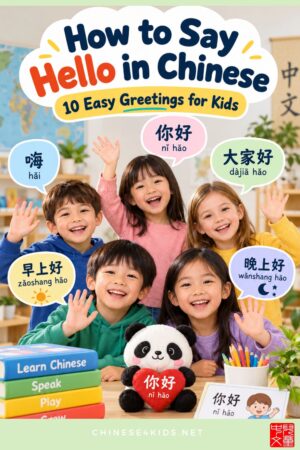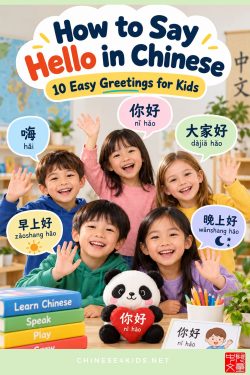
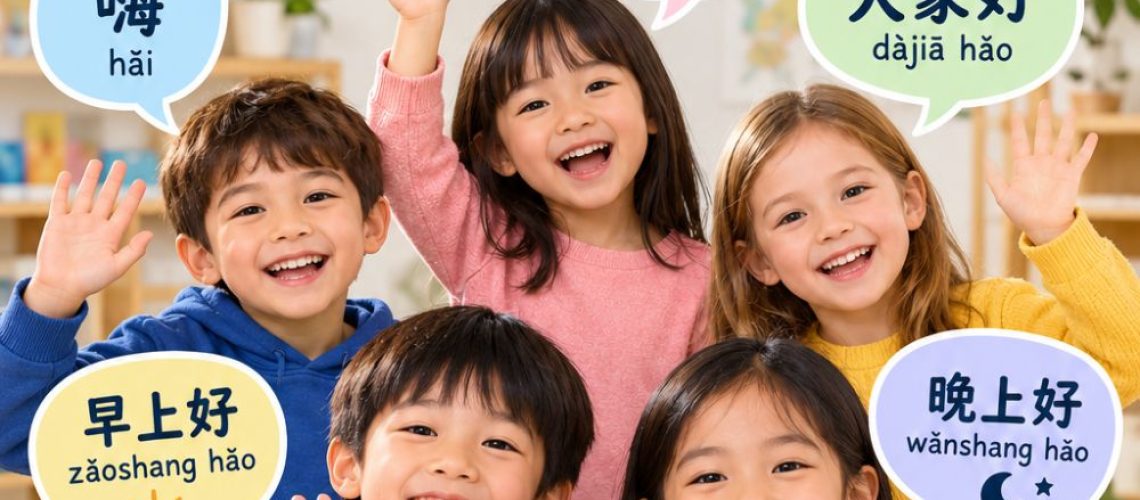
The easiest way to say hello in Chinese is 你好 (nǐ hǎo). Kids can learn it in minutes. This guide shows you 10 simple Mandarin greetings, with characters, pinyin, meanings and short dialogues. Parents and teachers will also find easy activities to practise at home or in class.
Quick Answer: How Do You Say Hello in Chinese?
Say 你好 (nǐ hǎo). It is a common Mandarin greeting that works in many everyday situations.
Say 你好 (nǐ hǎo). It is a common Mandarin greeting that works in many everyday situations.
- 你好 (nǐ hǎo): Hello. Use it with one person.
- 您好 (nín hǎo): Hello. A polite greeting for teachers and elders.
- 大家好 (dàjiā hǎo): Hello, everyone. Use it with a group.
- 嗨 (hāi): Hi. A casual greeting for friends.
- 早上好 (zǎoshang hǎo): Good morning.
10 Easy Ways to Say Hello in Chinese
Here is a quick table. Start with the first three greetings. Add the others later.
| Chinese | Pinyin | English | When to Use It |
|---|---|---|---|
| 你好 | nǐ hǎo | Hello | Greeting one person |
| 您好 | nín hǎo | Hello (polite) | Teachers, elders, and people you wish to address politely |
| 大家好 | dàjiā hǎo | Hello, everyone | A class, a group, a video |
| 你们好 | nǐmen hǎo | Hello, you all | Greeting a group face to face |
| 嗨 | hāi | Hi | Friends, casual chats |
| 哈喽 | hālóu | Hello | Friends, casual chats |
| 早上好 | zǎoshang hǎo | Good morning | In the morning |
| 下午好 | xiàwǔ hǎo | Good afternoon | In the afternoon |
| 晚上好 | wǎnshang hǎo | Good evening | In the evening |
| 喂 | wéi | Hello (phone) | Answering a phone call |
How to Use 你好, 您好, 你们好 and 大家好
These four greetings look alike. Each one has a slightly different job.
你好 (nǐ hǎo): Hello
你好 is the standard greeting for one person. Use it with classmates, friends, family and teachers.
小明,你好!
Xiǎomíng, nǐ hǎo!
Hello, Xiaoming!
您好 (nín hǎo): A Polite Hello
您 (nín) is a polite way to say “you”. 您好 is a respectful greeting often used with teachers, elders, or people you wish to address politely.
王老师,您好!
Wáng lǎoshī, nín hǎo!
Hello, Teacher Wang!
你们好 (nǐmen hǎo): Hello, You All
你们 means “you” for more than one person. Use 你们好 when you speak straight to a group of friends or students.
同学们,你们好!
Tóngxuémen, nǐmen hǎo!
Hello, classmates!
大家好 (dàjiā hǎo): Hello, Everyone
大家 means “everyone”. Use 大家好 to start a talk, a class or a video.
大家好!我叫安娜。
Dàjiā hǎo! Wǒ jiào Ānnà.
Hello, everyone! My name is Anna.
Teaching tip:
What is the difference between 你们好 and 大家好?
Both greet a group. 大家好 sounds natural for a class or an audience. 你们好 speaks directly to the people in front of you. Kids can use either one.
Casual Ways to Say Hello in Chinese
Friends often use short, relaxed greetings.
- 嗨 (hāi): Hi. It comes from English “hi”. Example: 嗨,小美!(Hāi, Xiǎoměi!) Hi, Xiaomei!
- 哈喽 (hālóu): Hello. It also comes from English. Example: 哈喽!你来了!(Hālóu! Nǐ lái le!) Hello! You’re here!
- 喂 (wéi): Hello on the phone. Example: 喂,你好!(Wéi, nǐ hǎo!) Hello!
喂 is for phone calls. Do not use it to greet someone in person. For beginners, 你好 is a good general-purpose greeting.
Good Morning, Good Afternoon and Good Evening in Chinese
| Chinese | Pinyin | English |
|---|---|---|
| 早上好 | zǎoshang hǎo | Good morning |
| 下午好 | xiàwǔ hǎo | Good afternoon |
| 晚上好 | wǎnshang hǎo | Good evening |
早上好 is the most useful one. People also say 上午好 (shàngwǔ hǎo) for late morning. You do not need to change your greeting all day. 你好 works at any time.
Try it at home: Say 早上好 to your child at breakfast. Let your child answer 早上好 or 你好. Do it again tomorrow.
How to Say 你好 Correctly
你好 has two characters:
- 你 (nǐ) means “you”.
- 好 (hǎo) means “good”.
On its own, the third tone is taught as a low, dipping sound. In real speech, the tone changes with the words around it. When two third-tone syllables come together, the first syllable is usually pronounced with a rising tone. That is why 你好 sounds like ní hǎo in connected speech, although the pinyin is still written nǐ hǎo. Don’t overthink it. Children copy this sound easily when they listen and repeat.
A Simple Way to Practise
- Say 你 slowly.
- Say 好 slowly.
- Join them: 你好. Let the first sound go up.
- Repeat three times, then say it with a smile.
Want to understand the sounds behind the pinyin? Read An Introduction to Hanyu Pinyin.
Is 你好 the Same as 你好吗?
| Chinese | Pinyin | Meaning |
|---|---|---|
| 你好 | nǐ hǎo | Hello |
| 你好吗? | nǐ hǎo ma? | How are you? |
你好 is a greeting. 你好吗? is a question about how someone feels. It is correct, but people do not ask it every time they meet. Often a simple 你好 is enough.
A short chat for beginners:
A: 你好吗?
Nǐ hǎo ma?
How are you?B: 我很好,谢谢。你呢?
Wǒ hěn hǎo, xièxie. Nǐ ne?
I’m very well, thank you. And you?A: 我也很好。
Wǒ yě hěn hǎo.
I’m very well too.
Next, learn how to say thank you in Chinese.
Three Short Chinese Greeting Dialogues for Kids
1: Meeting a Friend
A: 你好!
Nǐ hǎo!
Hello!B: 你好!
Nǐ hǎo!
Hello!A: 你叫什么名字?
Nǐ jiào shénme míngzi?
What is your name?B: 我叫丽丽。
Wǒ jiào Lìli.
My name is Lili.
2: Greeting a Teacher
Student: 王老师,您好!
Wáng lǎoshī, nín hǎo!
Hello, Teacher Wang!Teacher: 你好!
Nǐ hǎo!
Hello!
3: Greeting the Whole Class
Teacher: 大家好!
Dàjiā hǎo!
Hello, everyone!Students: 老师好!
Lǎoshī hǎo!
Hello, teacher!
Use these for role-play, pair work or a class warm-up. Ask children to speak clearly, not fast.
4 Easy Activities to Practise Chinese Greetings
Children remember words they use. Keep each activity short.
1: The Hello Circle
Sit in a circle. One child says 你好 to the next child. That child says 你好 back and greets the next one. Later, add 您好 for the teacher and 大家好 for the whole group.
2: Greeting Cards
Make cards for 你好, 您好, 大家好, 早上好 and 再见. Write pinyin and English on the back. Each child picks a card and acts out when to use it.
3: Three Scenes
Act out three scenes: meeting a friend, greeting a teacher, and starting a presentation. Ask children to pick the right greeting. Swap roles so everyone speaks.
4: One Greeting a Day
Pick one moment each day. Say 早上好 at breakfast or 你好 when your child comes home. Short and daily beats long and rare. For more ideas, see how to bring Chinese into your kids’ day.
Common Mistakes When Saying Hello in Chinese
- Using 喂 face to face. 喂 is for the phone. Use 你好 in person.
- Asking 你好吗 every time. A simple 你好 is usually enough.
- Choosing the right level of politeness. 你好 works in many everyday situations. Use 您好 when you want to show extra respect.
- Saying both syllables flat. Let the first sound go up: ní hǎo.
- Changing the greeting by the clock. Kids do not need three greetings a day. 你好 works at any time.
What Should Children Learn After Hello?
| Chinese | Pinyin | English |
|---|---|---|
| 再见 | zàijiàn | Goodbye |
| 谢谢 | xièxie | Thank you |
| 不客气 | bú kèqi | You’re welcome |
| 请 | qǐng | Please |
| 对不起 | duìbuqǐ | Sorry |
These five phrases turn single words into small conversations. For listening and speaking practice, watch our Chinese learning videos for kids.
Frequently Asked Questions
What is the most common way to say hello in Chinese?
你好 (nǐ hǎo). It is the standard Mandarin greeting and the best first phrase for beginners.
How do you say hello politely in Chinese?
Say 您好 (nín hǎo). Use it with teachers, elders and people you want to treat with respect.
How do you say hello to a group in Chinese?
Say 大家好 (dàjiā hǎo) or 你们好 (nǐmen hǎo).
How do you say hi in Chinese?
Say 嗨 (hāi). It is casual and friendly.
How do you say hello on the phone in Chinese?
Say 喂 (wéi) when you answer. Then you can add 你好.
Is 你好 formal or informal?
It is neutral. It works in most daily situations. Choose 您好 when you want to sound more respectful.
Do Chinese people always say 你好 when they meet?
No. People often use a name, a short question or another phrase. 你好 is a clear, safe greeting for learners.
Can kids learn Chinese greetings without knowing characters?
Yes. Start by listening and speaking, with pictures and pinyin to help. Add the characters step by step.
Start Speaking Chinese Today
Start with 你好. Add 您好 and 大家好 when your child feels ready. Use each greeting in a real moment, keep it short, and repeat it often. Small conversations build big confidence.
For parents: You do not need to speak fluent Chinese to start. Speak Chinese with Kids gives you everyday conversations with audio, video and printable scripts, so you can simply repeat after the recording.
For teachers: Want ready-to-use classroom material? Browse our Lesson Plans for step-by-step Chinese lessons you can teach right away.
If you like this article, share it