Quick answer
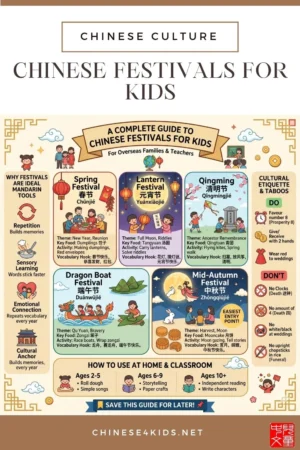
The five major Chinese festivals for kids to learn about are Spring Festival, Lantern Festival, Qingming, Dragon Boat Festival, and Mid-Autumn Festival. Each is rooted in family reunion, seasonal change, or ancestor remembrance. Each one carries vocabulary, foods, and customs that make ideal anchors for Chinese learning at home or in the classroom.
Why festivals are one of the best Chinese learning tools
For children growing up outside China, festivals do something no textbook can. They give the language a reason to exist in daily life.
A child who makes dumplings before Spring Festival, carries a lantern at Mid-Autumn, or hears the story of Qu Yuan at Dragon Boat is not just learning vocabulary. They are building memories that make the language feel like home.
Festivals also repeat every year. The same words come back at the same emotional moment. That is exactly the kind of repetition that makes new words stick.
Three things to keep in mind:
- Simple is enough. One meal, one story, one song per festival is plenty. You do not need a full programme.
- Consistency beats scale. A small activity every year is worth more than one big celebration every three years.
- Vocabulary is the hook. Each festival section below includes the key words your child should hear and say. Start there.
The 5 Major Traditional Chinese Festivals for Kids
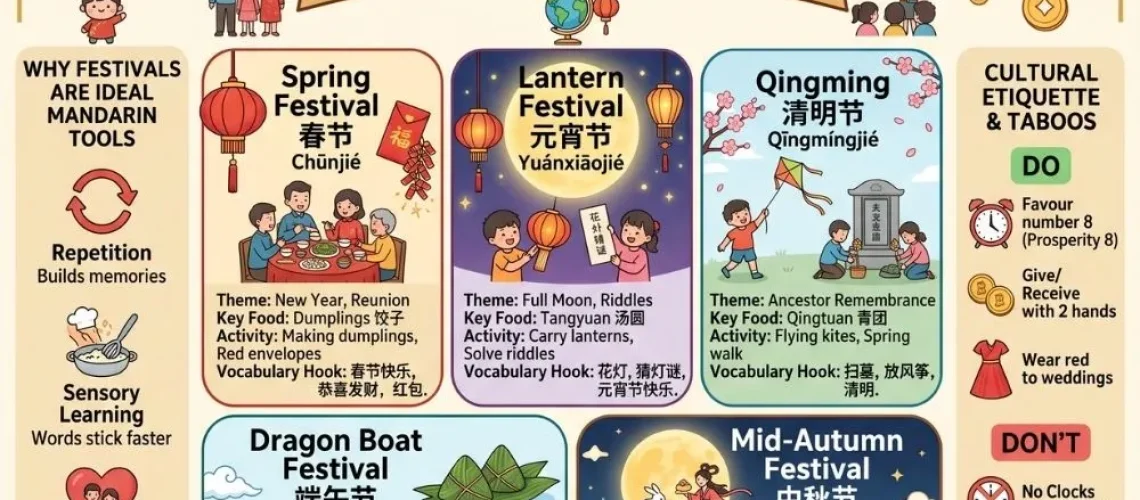
1. Spring Festival 春节 Chūnjié
Spring Festival is the most important celebration in the Chinese calendar. It marks the start of the lunar new year. The 年夜饭 (nián yè fàn) — the reunion dinner on New Year’s Eve — is the heart of the whole occasion.
Families clean their homes before the festival to sweep out bad luck. Red decorations, red lanterns, and red envelopes (红包 hóngbāo) appear everywhere. Red is protective: it is said to ward off the mythical beast 年 (Nián), which feared loud noises and bright colours.
FUN FACT
Spring Festival triggers the largest annual human migration on earth. Around 3 billion journeys are made across China in the weeks around the holiday as families travel home for the reunion dinner.
Spring Festival triggers the largest annual human migration on earth. Around 3 billion journeys are made across China in the weeks around the holiday as families travel home for the reunion dinner.
Key vocabulary:
春节快乐 (Chūnjié kuàilè — Happy Spring Festival),
恭喜发财 (Gōngxǐ fācái — wishing you wealth),
红包 (hóngbāo — red envelope),
饺子 (jiǎozi — dumplings),
年糕 (niángāo — sticky rice cake).
LEARNING TIP:
Make dumplings together and speak Chinese the whole time: 擀皮儿 (roll the wrapper), 包饺子 (wrap the dumpling), 下锅 (into the pot). Kitchen vocabulary sticks fast because children are using their hands.
Make dumplings together and speak Chinese the whole time: 擀皮儿 (roll the wrapper), 包饺子 (wrap the dumpling), 下锅 (into the pot). Kitchen vocabulary sticks fast because children are using their hands.
Related resource
Looking for ready-made Spring Festival materials? The Special Events section of the shop includes vocabulary flashcards, activity sheets, and printables for Spring Festival — ready to print and use at home or in class.
2. Lantern Festival 元宵节 Yuánxiāojié
Lantern Festival falls on the 15th day of the first lunar month — the first full moon of the new year. It marks the end of the Spring Festival period.
Families carry lanterns, solve riddle games written on paper, and eat 汤圆 (tāngyuán) — sweet sticky-rice balls filled with sesame paste or red bean. The round shape represents family wholeness.
FUN FACT
The tradition of lantern riddles (灯谜 dēngmí) dates back to the Song Dynasty (960–1279 CE). It has been played by Chinese children for over a thousand years.
The tradition of lantern riddles (灯谜 dēngmí) dates back to the Song Dynasty (960–1279 CE). It has been played by Chinese children for over a thousand years.
Key vocabulary:
花灯 (huādēng — decorative lantern),
猜灯谜 (cāi dēngmí — solve lantern riddles),
汤圆 (tāngyuán — sweet rice balls),
元宵节快乐 (Yuánxiāojié kuàilè — Happy Lantern Festival).
LEARNING TIP:
Lantern riddles are brilliant for ages 6 and up. Children solve a puzzle to find the word — that problem-solving moment makes vocabulary stick far better than a flashcard. See the Chinese riddles guide for ready-to-use examples.
Lantern riddles are brilliant for ages 6 and up. Children solve a puzzle to find the word — that problem-solving moment makes vocabulary stick far better than a flashcard. See the Chinese riddles guide for ready-to-use examples.
3. Qingming Festival 清明节 Qīngmíngjié
Qingming falls in early April (usually April 4th or 5th). It is a day for remembering ancestors. Families visit graves, clean the headstones, and leave offerings of food and paper goods.
Qingming is also a spring celebration. The name means “clear and bright.” Families often fly kites (放风筝 fàng fēngzheng) after visiting graves. For young children, framing it as a “family memory day” makes it easy to understand.
FUN FACT
The Tang Dynasty poet Du Mu wrote the famous poem 清明 over 1,200 years ago. Chinese children still recite it today: 清明时节雨纷纷,路上行人欲断魂。
The Tang Dynasty poet Du Mu wrote the famous poem 清明 over 1,200 years ago. Chinese children still recite it today: 清明时节雨纷纷,路上行人欲断魂。
Key vocabulary:
扫墓 (sǎomù — tomb sweeping),
放风筝 (fàng fēngzheng — fly a kite),
祭祖 (jì zǔ — honour ancestors),
清明 (qīngmíng — clear and bright).
4. Dragon Boat Festival 端午节 Duānwǔjié
Dragon Boat Festival falls on the 5th day of the 5th lunar month (May or June). It honours the poet Qu Yuan (屈原), who drowned himself in protest at government corruption in 278 BCE. Villagers raced boats to save him and threw rice into the river to protect his body. Those customs became the dragon boat races and zongzi we know today.
FUN FACT
Dragon boat racing is now a recognised international sport. The International Dragon Boat Federation has members in over 80 countries. Many overseas Chinese communities organise their own races — check whether there is one near you.
Dragon boat racing is now a recognised international sport. The International Dragon Boat Federation has members in over 80 countries. Many overseas Chinese communities organise their own races — check whether there is one near you.
Key vocabulary:
龙舟 (lóngzhōu — dragon boat),
粽子 (zòngzi — sticky rice dumpling in bamboo leaves),
赛龙舟 (sài lóngzhōu — dragon boat racing),
端午节快乐 (Duānwǔjié kuàilè — Happy Dragon Boat Festival).
LEARNING TIP:
Making 粽子 is a hands-on vocabulary lesson. Even a simple version — sticky rice and red beans wrapped in foil — introduces the full vocabulary in a sensory, memorable way.
Making 粽子 is a hands-on vocabulary lesson. Even a simple version — sticky rice and red beans wrapped in foil — introduces the full vocabulary in a sensory, memorable way.
Related resource
Find the full story of Qu Yuan, vocabulary worksheets, and Dragon Boat activities in the Dragon Boat Festival guide and the Special Events shop.
5. Mid-Autumn Festival 中秋节 Zhōngqiūjié
Mid-Autumn Festival falls on the 15th day of the 8th lunar month (September or October) — always on a full moon night. Families gather to gaze at the moon, eat mooncakes (月饼 yuèbǐng), and tell the story of 嫦娥 (Cháng’é), the moon goddess who drank an immortality potion and floated to the moon.
For families far from China, the shared full moon is a powerful symbol of connection. The same moon is visible everywhere in the world on the same night.
FUN FACT
During the Yuan Dynasty (1271–1368), revolutionaries are said to have hidden messages inside mooncakes to coordinate an uprising against Mongol rule. The mooncake has been a symbol of secrecy and solidarity ever since.
During the Yuan Dynasty (1271–1368), revolutionaries are said to have hidden messages inside mooncakes to coordinate an uprising against Mongol rule. The mooncake has been a symbol of secrecy and solidarity ever since.
Key vocabulary:
月饼 (yuèbǐng — mooncake),
赏月 (shǎng yuè — moon gazing),
嫦娥 (Cháng’é — moon goddess),
玉兔 (yù tù — jade rabbit),
中秋节快乐 (Zhōngqiūjié kuàilè — Happy Mid-Autumn Festival).
Related resource
For a full guide to Mid-Autumn — including the Chang’e story, crafts, and printable activities — see the Mid-Autumn Festival for kids guide and Mid-Autumn Festival activities for children.
The five major festivals at a glance
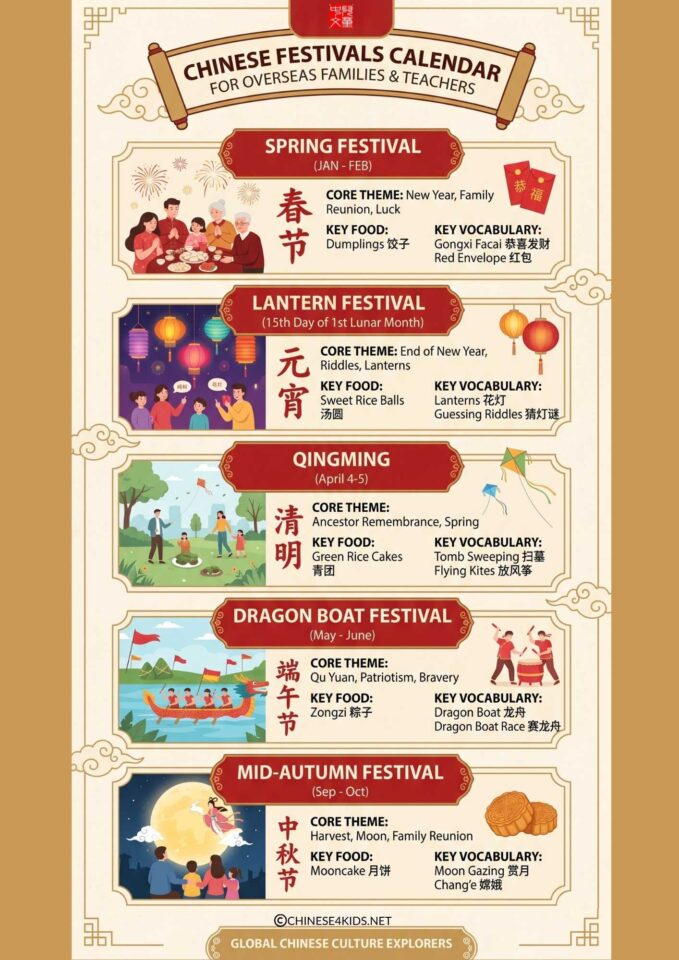
| Festival | Chinese | When (approx.) | Core theme | Key food | Key vocabulary |
|---|---|---|---|---|---|
| Spring Festival | 春节 | Jan – Feb | New year, family reunion, luck | Dumplings 饺子 | 恭喜发财, 红包 |
| Lantern Festival | 元宵节 | 15th day of 1st lunar month | End of New Year, riddles, lanterns | Sweet rice balls 汤圆 | 花灯, 猜灯谜 |
| Qingming | 清明节 | April 4–5 | Ancestor remembrance, spring | Green rice cakes 青团 | 扫墓, 放风筝 |
| Dragon Boat Festival | 端午节 | May – June | Qu Yuan, patriotism, bravery | Zongzi 粽子 | 龙舟, 赛龙舟 |
| Mid-Autumn Festival | 中秋节 | Sep – Oct | Harvest, moon, family reunion | Mooncake 月饼 | 赏月, 嫦娥 |
Important life milestones in Chinese culture
Beyond the seasonal calendar, Chinese culture marks personal milestones with specific customs. Knowing these helps children participate and feel connected to their heritage.
Birthdays 生日 shēngrì
The traditional birthday food is 长寿面 (chángshòu miàn) — longevity noodles. Never cut the noodle. Eating it whole symbolises a long, unbroken life. Peach-shaped steamed buns (寿桃 shòutáo) are a classic gift for elderly family members.
The number 8 (八 bā) sounds like prosperity (发 fā). It is the luckiest number in Chinese culture. The number 4 (四 sì) sounds like death (死 sǐ) and is avoided in floor numbers, phone numbers, and gift amounts.
Graduation and achievement 毕业 bìyè
Graduation is celebrated with family meals and gifts. The phrase 学业有成 (xuéyè yǒu chéng — may your studies bear fruit) is a standard blessing for students. See the graduation congratulations guide for vocabulary and card-writing phrases.
Teacher’s Day 教师节 Jiàoshījié — September 10
Teacher’s Day reflects the deep Confucian respect for educators in Chinese culture. Children make handmade cards with the phrase 辛苦了 (xīnkǔ le — thank you for your hard work). Chinese language teachers in the West can mark this day with their classes.
100-day celebration 百日宴 bǎirìyàn
The 100th day after a baby’s birth is celebrated with a family feast and gifts. Red eggs symbolise happiness and new life. This day marks the point when a newborn was historically considered to have safely passed the most vulnerable stage of infancy.
Chinese celebration etiquette: what every family should know
Knowing the customs matters as much as knowing the vocabulary. These rules apply to weddings, birthdays, baby banquets, and any formal gathering. Children who grow up knowing them will feel confident in Chinese social settings.
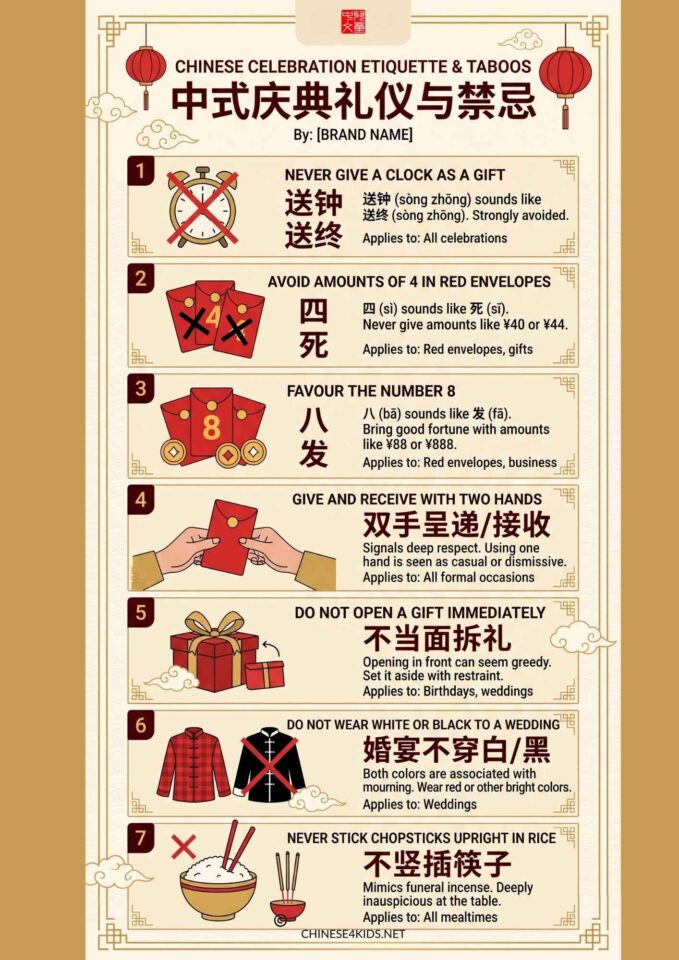
| Rule | Why it matters | Applies to |
|---|---|---|
| Never give a clock as a gift | 送钟 (sòng zhōng — give a clock) is homophonous with 送终 (sòng zhōng — attend a funeral) | All celebrations |
| Avoid amounts of 4 in red envelopes | 四 (sì — four) sounds like 死 (sǐ — death). Never give ¥40, ¥44, $4 etc. | Red envelopes, gifts |
| Favour the number 8 | 八 (bā — eight) sounds like 发 (fā — prosperity). ¥88 or ¥888 are auspicious gift amounts. | Red envelopes, business |
| Give and receive with two hands | Using both hands to give a gift, red envelope, or business card signals deep respect. One hand is considered casual or dismissive. | All formal occasions |
| Do not open a gift immediately | Opening a gift in front of the giver can seem greedy. Set it aside to open later as an act of restraint and respect. | Birthdays, weddings |
| Do not wear white or black to a wedding | Both colours are associated with mourning in traditional Chinese culture. Wear red, pink, or any other bright colour instead. | Weddings |
| Never stick chopsticks upright in a bowl of rice | This mimics the incense sticks burned at funerals. It is considered deeply inauspicious at the dinner table. | All mealtimes |
How to use festivals as a Chinese learning resource
Festivals work as language anchors because they carry emotion. Here are five approaches that work at any age — followed by age-specific tips below.
- Build a vocabulary bank. Introduce 5–8 key words before each festival. Use them all week, not just on the day itself.
- Tell the story. Every festival has a story — Qu Yuan, Chang’e, the Nian beast. Stories activate memory better than word lists.
- Cook something together. The kitchen is the best Chinese classroom in an overseas home. Every action and ingredient is a word.
- Sing a festival song. Melody and rhythm make words easier to recall. Many festival songs are short enough for young children.
- Write a greeting card in Chinese. Even one line — 中秋节快乐! — gives a child the experience of Chinese as a real, living tool.
LEARNING TIP:
One small activity for each of the five festivals means festival vocabulary comes back ten or more times a year. That is more input than many weekly classes provide.
One small activity for each of the five festivals means festival vocabulary comes back ten or more times a year. That is more input than many weekly classes provide.
By age: what works best at each stage
Ages 2–5
- Sensory activities — roll dumpling dough, colour a lantern, feel a mooncake
- Simple songs with actions
- Listen to the story read aloud in Chinese
- 3–5 vocabulary words maximum per festival
Ages 6–9
- Read or act out the festival story (Chang’e, Qu Yuan)
- Solve lantern riddles together
- Write a greeting card with a simple phrase
- Easy crafts — paper lantern, paper boat
Ages 10+
- Read a short festival text independently
- Write characters for festival words
- Research one aspect of the festival and share it
- Solve harder character riddles (字谜)
Frequently asked questions
What do you write inside a Chinese red envelope?
You do not need to write anything — the envelope itself is the blessing. If you want to add a phrase, try 恭喜发财 (Gōngxǐ fācái — wishing you wealth) for Spring Festival, 身体健康 (shēntǐ jiànkāng — good health) for an elder, or 学业进步 (xuéyè jìnbù — progress in your studies) for a child.
What is the most important Chinese festival?
Spring Festival (春节) is the most important. It is the longest holiday period. The Mid-Autumn Festival is the second most significant for overseas families because of its emotional connection to home.
How do Chinese people celebrate birthdays?
Traditionally with a bowl of longevity noodles (长寿面). Never cut the noodle — eating it whole symbolises a long life. For elders, peach-shaped steamed buns (寿桃) are a classic gift. Western-style cakes are now also common.
Do all these festivals follow the lunar calendar?
Most do. Spring Festival, Lantern Festival, Dragon Boat Festival, and Mid-Autumn Festival all follow the lunar calendar — so their dates shift each year. Qingming is different. It is a solar term and always falls on April 4th or 5th.
How do I explain Qingming to young children?
Call it a “family memory day.” It is a time to remember people who are no longer here — often followed by kite flying and a walk in the spring countryside. The outdoor activity makes it gentle and accessible for young children.
Are these festivals relevant for non-Chinese-heritage families?
Yes. Cultural context deepens language learning for all children. Non-heritage families studying Mandarin benefit from the same cultural anchors as heritage families. Festivals give the language a living context that word lists alone cannot provide.
What is the easiest festival to start with?
Mid-Autumn Festival. It needs very little preparation. Go outside at night, look at the moon, eat a mooncake, and tell the story of 嫦娥. The vocabulary is small. The memory lasts a long time.
Key takeaways
- Five major festivals, five vocabulary anchors — Spring Festival, Lantern Festival, Qingming, Dragon Boat, Mid-Autumn. Do one small activity for each and Chinese vocabulary repeats itself ten or more times a year.
- Most follow the lunar calendar and shift dates every year. Qingming is the exception — it always falls on April 4th or 5th.
- Etiquette matters as much as vocabulary. No clocks as gifts, no amounts of 4, give with two hands. Children who know these rules feel confident in Chinese social settings.
- Age shapes the activity, not the festival. Ages 2–5 need sensory and song. Ages 6–9 need story and craft. Ages 10+ can read, write characters, and research.
- Mid-Autumn is the easiest entry point for families just starting. Spring Festival has the richest vocabulary. Dragon Boat has the best story for the classroom.
Best-for summary
Best festival to start with (beginners)
Mid-Autumn Festival. Minimal prep, single iconic food (mooncake), one unforgettable story (Chang’e), and a shared full moon that works anywhere in the world.
Best festival for vocabulary learning
Spring Festival. The richest vocabulary set, the longest preparation period, and the most activities (cleaning, cooking, red envelopes, decorations) for natural language use.
Best festival for classroom use
Dragon Boat Festival. Clear historical narrative (Qu Yuan), dramatic activity (boat racing), and a concrete food craft (zongzi). The story structure maps well onto lesson-plan formats.
Best festival for connecting with heritage
Qingming. The ancestor-remembrance element directly connects children to their specific family history. Personal stories replace general cultural knowledge.
Further reading on Chinese4kids.net
→ Mid-Autumn Festival for Kids — full vocabulary guide and activity ideas
→ Mid-Autumn Festival Activities for Children — crafts, games, and printables
→ Duanwu Jie — Dragon Boat Festival — history, vocabulary, and activities
→ Qingming Festival — how to talk about Qingming with children
→ Graduation and Congratulations in Chinese — phrases and card-writing guide
→ Chinese Riddles for Kids — lantern riddles and how to use them
Product note
The Special Events Chinese Learning Materials in the shop include festival-themed packs for Spring Festival, Mid-Autumn Festival, Dragon Boat Festival, and more — with vocabulary flashcards, activity sheets, and printables ready to use for each occasion. These sit outside the editorial content above and are included here for readers who want ready-made resources rather than DIY activities.
if you like this article, share it