
One-Sentence Answer
The Chinese word for graduation is 毕业 (bì yè), and the most common congratulations phrase is 恭喜毕业 (gōng xǐ bì yè) — but Chinese has a rich set of graduation wishes, farewell expressions, and cultural traditions that go far deeper than that single phrase.
毕业 — The Chinese Word for Graduation
毕业 (bì yè) is the core word for graduation or to graduate.
- 毕 (bì) — to finish, to complete
- 业 (yè) — studies, work, career
Together they mean “to complete one’s studies.”
毕业 functions as both a noun and a verb in Chinese. It does not change form.
As a verb:
我毕业了。
Wǒ bì yè le.
I have graduated.她今年毕业。
Tā jīn nián bì yè.
She is graduating this year.你从哪个学校毕业?
Nǐ cóng nǎ ge xué xiào bì yè?
Which school did you graduate from?
As a noun/modifier:
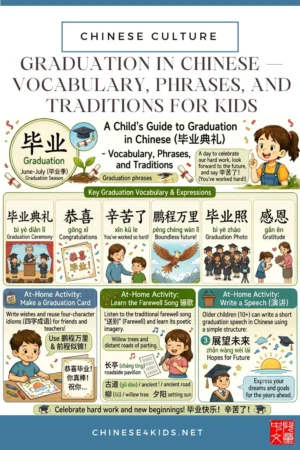
- 毕业典礼 (bì yè diǎn lǐ) — graduation ceremony
- 毕业证书 (bì yè zhèng shū) — graduation certificate / diploma
- 毕业生 (bì yè shēng) — graduate
- 毕业照 (bì yè zhào) — graduation photo
- 毕业班 (bì yè bān) — graduating class
- 毕业旅行 (bì yè lǚ xíng) — graduation trip
The 了 (le) pattern:
Note that 毕业了 uses 了 to mark a completed change. This is a natural place to introduce the 了 grammar pattern to children — spring graduation, finished school, something has changed.
Core Graduation Vocabulary
| Chinese | Pinyin | English |
|---|---|---|
| 毕业 | bì yè | graduation / to graduate |
| 毕业典礼 | bì yè diǎn lǐ | graduation ceremony |
| 毕业证书 | bì yè zhèng shū | diploma / graduation certificate |
| 毕业生 | bì yè shēng | graduate |
| 毕业班 | bì yè bān | graduating class |
| 毕业照 | bì yè zhào | graduation photo |
| 毕业旅行 | bì yè lǚ xíng | graduation trip |
| 学位 | xué wèi | academic degree |
| 校长 | xiào zhǎng | headteacher / principal |
| 老师 | lǎo shī | teacher |
| 演讲 | yǎn jiǎng | speech |
| 学生 | xué shēng | student |
| 同学 | tóng xué | classmate |
| 毕业歌 | bì yè gē | graduation song |
| 未来 | wèi lái | future |
| 梦想 | mèng xiǎng | dream / ambition |
| 成功 | chéng gōng | success |
| 努力 | nǔ lì | to work hard / effort |
| 感谢 | gǎn xiè | to thank / gratitude |
Graduation Congratulations Phrases
Everyday Congratulations
The simplest, most natural way to congratulate a graduate:
恭喜毕业!
Gōng xǐ bì yè!
Congratulations on graduating!恭喜你顺利毕业!
Gōng xǐ nǐ shùn lì bì yè!
Congratulations on graduating smoothly!祝贺你完成学业!
Zhù hè nǐ wán chéng xué yè!
Congratulations on completing your studies!毕业快乐!
Bì yè kuài lè!
Happy graduation! (informal, modelled on 生日快乐)
For a full guide to 恭喜 vs 祝贺 and when to use each, see How to Say Congratulations in Chinese Like a Native.
Wishing Future Success
Chinese graduation wishes look forward. The emphasis is on what comes next — not just finishing, but launching.
前途无量!
Qián tú wú liàng!
You have limitless potential ahead!前程似锦!
Qián chéng sì jǐn!
Your future is as bright as brocade!大展宏图!
Dà zhǎn hóng tú!
May you realise your great ambitions!鹏程万里!
Péng chéng wàn lǐ!
May your journey be as grand as the Peng bird’s flight across ten thousand li!一帆风顺!
Yī fān fēng shùn!
May you have smooth sailing!学有所成!
Xué yǒu suǒ chéng!
May your studies bear fruit!金榜题名!
Jīn bǎng tí míng!
May your name appear on the golden list!
(classical — refers to passing imperial exams; used today for exam success and graduation honours)
Expressing Pride and Happiness
These phrases are used by parents, teachers, and classmates alongside 恭喜.
我为你骄傲。
Wǒ wèi nǐ jiāo’ào.
I am proud of you.我替你高兴。
Wǒ tì nǐ gāo xìng.
I am happy for you.你真棒!
Nǐ zhēn bàng!
You’re amazing!你太厉害了!
Nǐ tài lì hai le!
You’re incredible!你做到了!
Nǐ zuò dào le!
You did it!辛苦了!
Xīn kǔ le!
You’ve worked so hard!
(acknowledges the effort, not just the achievement — deeply meaningful in Chinese culture)
辛苦了 deserves special attention. It literally means “you have suffered bitterness.” In context, it is one of the most affirming things you can say — it recognises the hard work and sacrifice behind the achievement. Parents say it to children; teachers say it to students; it is the acknowledgement that the journey was real and difficult.
For more praise phrases suitable for children, see Positive Things to Say to Kids in Chinese and Chinese Compliment Phrases for Kids and Beginners.
Farewell and Goodbye Phrases for Graduation
Graduation is also a farewell. In Chinese, the most poetic farewells are used at exactly this moment — when people are not sure they will see each other again soon.
一路顺风!
Yī lù shùn fēng!)
Have a smooth journey! / Bon voyage!
保持联系!
Bǎo chí lián xì!
Keep in touch!
后会有期!
Hòu huì yǒu qī!
We will meet again!
珍重!
Zhēn zhòng!
Take care of yourself! (formal, warm)
青山不改,绿水长流,后会有期。
Qīng shān bù gǎi, lǜ shuǐ cháng liú, hòu huì yǒu qī.
The green mountains won’t change, the turquoise water flows on — we shall meet again.
(classical farewell; commonly used at graduation)
For the full set of Chinese farewell expressions, see How to Say Goodbye in Chinese Like a Native.
The Four-Character Expressions of Graduation (四字成语)
Classical four-character expressions (四字成语, sì zì chéng yǔ) are the language of formal occasions in Chinese. They appear on graduation banners, in speeches, on cards, and in the ceremonies themselves. Knowing them is a marker of true cultural literacy.
| Expression | Pinyin | Meaning | Notes |
|---|---|---|---|
| 鹏程万里 | péng chéng wàn lǐ | Boundless future | Most beloved graduation wish |
| 前程似锦 | qián chéng sì jǐn | Future as bright as brocade | Common on cards and banners |
| 大展宏图 | dà zhǎn hóng tú | Realise your grand ambitions | For career beginnings |
| 学有所成 | xué yǒu suǒ chéng | Learning bears fruit | Specifically about academic achievement |
| 金榜题名 | jīn bǎng tí míng | Name on the golden list | For exam success and graduation honours |
| 一帆风顺 | yī fān fēng shùn | Smooth sailing ahead | General good wishes for what lies ahead |
| 步步高升 | bù bù gāo shēng | Rise higher with every step | For career and professional progression |
| 万事如意 | wàn shì rú yì | May all go as you wish | Any occasion, very versatile |
| 天道酬勤 | tiān dào chóu qín | Heaven rewards the diligent | Acknowledges hard work — meaningful at graduation |
For children: Start with 鹏程万里 and 前程似锦. These two are the most frequently written on graduation cards and banners, and recognising them gives children an immediate sense of cultural participation.
Graduation by Level — What to Say at Each Stage
Chinese education has distinct milestones. The right phrase varies slightly by level.
Kindergarten Graduation (幼儿园毕业 — yòu’er yuán bì yè)
Kindergarten graduation is a joyful celebration in Chinese culture. Parents dress children in tiny gowns. There are songs, performances, and much photographing.
恭喜宝宝幼儿园毕业了!
Gōng xǐ bǎo bao yòu’er yuán bì yè le!
Congratulations to our little one on graduating from kindergarten!你长大了!
Nǐ zhǎng dà le!
You’ve grown up!
小学,我们来了!
Xiǎo xué, wǒ men lái le!
Primary school, here we come!
Primary School Graduation (小学毕业 — xiǎo xué bì yè)
恭喜小学毕业!
Gōng xǐ xiǎo xué bì yè!
Congratulations on finishing primary school!你真的长大了。
Nǐ zhēn de zhǎng dà le.
You’ve really grown up.中学加油!
Zhōng xué jiā yóu!
Work hard in secondary school! (加油 — “add fuel,” the standard encouragement phrase)
Secondary School Graduation (中学毕业 — zhōng xué bì yè)
Secondary graduation in Chinese-speaking countries is heavily associated with the 中考 (zhōng kǎo — junior high school exam) or 高考 (gāo kǎo — university entrance exam). These exams are the defining milestone.
恭喜高中毕业!(Gōng xǐ gāo zhōng bì yè!) — Congratulations on finishing senior high school! 高考加油!(Gāo kǎo jiā yóu!) — Work hard for the 高考! 金榜题名!(Jīn bǎng tí míng!) — May you pass with flying colours! 梦想成真!(Mèng xiǎng chéng zhēn!) — May your dreams come true!
University Graduation (大学毕业 — dà xué bì yè)
恭喜大学毕业!
Gōng xǐ dà xué bì yè!
Congratulations on graduating from university!学有所成,前途无量!
Xué yǒu suǒ chéng, qián tú wú liàng!
Your studies have borne fruit — your future is limitless!鹏程万里!
Péng chéng wàn lǐ!
Boundless future ahead!踏上社会,一帆风顺!
Tà shàng shè huì, yī fān fēng shùn!
As you step into society, smooth sailing!
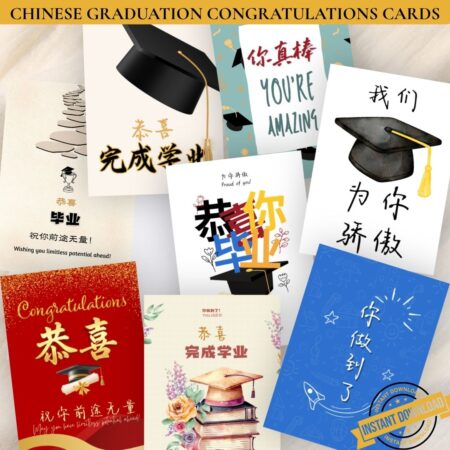
Want to send congratulations to graduates?
Here are 8 designs for you. Each design features a unique Chinese and English message, from 恭喜毕业 to 祝你前途无量. Print at home, fold, and give. Perfect for heritage families, Chinese school graduations, and Mandarin immersion classrooms.
Chinese Graduation Traditions — Cultural Background
Understanding the cultural context makes vocabulary meaningful. Here is what graduation looks like in Chinese-speaking communities.
The Graduation Ceremony (毕业典礼)
Chinese graduation ceremonies are formal events. They typically include:
- 校长演讲 (xiào zhǎng yǎn jiǎng) — the principal’s speech
- 颁发证书 (bān fā zhèng shū) — presenting diplomas
- 代表发言 (dài biǎo fā yán) — a speech by a student representative
- 毕业歌 (bì yè gē) — the graduation song (often 骊歌, lí gē — a farewell song)
- 毕业照 (bì yè zhào) — group graduation photos, taken very seriously
骊歌 — The Graduation Song
骊歌 (lí gē) literally means “farewell song.” The name refers to any parting song, but in Chinese schools and overseas Chinese communities, it has become almost synonymous with one specific song: 送别 (Sòng Bié — Farewell), written by 李叔同 (Lǐ Shūtóng) in the early Republic era.
The melody comes from American songwriter J.P. Ordway’s 1851 song, via a Japanese arrangement. Li Shutong wrote the Chinese lyrics around 1914–1915 as a farewell to a close friend. Within years it had spread to schools across China. Today it is sung at graduation ceremonies, school farewells, and year-end events throughout Taiwan, Hong Kong, and overseas Chinese communities worldwide.
The song is so associated with ending and parting that 骊歌 has become a synonym for graduation itself. If your child attends a Chinese community school, they will very likely sing it at their graduation ceremony.
送别 — What the Song Is About
词:李叔同 (1880–1942) | 曲:J.P. Ordway, 1851
送别 has two or three verses depending on the version sung. The full lyrics are widely available online and in any Chinese school songbook.
Verse 1 opens at a roadside pavilion (长亭) outside an ancient city gate — the classical Chinese setting for farewells. The imagery is spare: a path, green grass stretching to the horizon, an evening wind moving through willow trees, a flute fading, the sun setting behind mountain after mountain.
Verse 2 shifts from landscape to people. Friends are now scattered to the edges of the earth (天之涯,地之角 — tiān zhī yá, dì zhī jiǎo). A rough jar of wine holds all the remaining joy of the evening. The verse ends with the image of a farewell dream that will be cold tonight. Its central line — 知交半零落 (zhī jiāo bàn líng luò, “close friends have half scattered”) — is the one every graduating class feels most acutely.
Verse 3 (in some versions) returns to the opening landscape, then closes with the most quoted thought in the song: that true reunion is rare in life, and only partings are many (人生难得是欢聚,惟有别离多 — rén shēng nán dé shì huān jù, wéi yǒu bié lí duō).
Vocabulary in 送别
| Chinese | Pinyin | English |
|---|---|---|
| 长亭 | cháng tíng | roadside pavilion (traditional farewell spot) |
| 古道 | gǔ dào | ancient road |
| 芳草 | fāng cǎo | fragrant grass |
| 晚风 | wǎn fēng | evening breeze |
| 拂 | fú | to brush / to stroke gently |
| 柳 | liǔ | willow tree |
| 笛声 | dí shēng | sound of a flute |
| 夕阳 | xī yáng | setting sun |
| 天涯 | tiān yá | edge of the sky / far away |
| 知交 | zhī jiāo | close friends / kindred spirits |
| 零落 | líng luò | scattered / fallen apart |
| 别梦 | bié mèng | farewell dream |
| 寒 | hán | cold (here: lonely, desolate) |
Why This Song at Graduation
Several images in 送别 carry deep cultural resonance:
长亭 (the roadside pavilion) — in classical Chinese poetry, the 长亭 is the traditional place to say goodbye. Friends would walk a departing traveller to the pavilion outside the city gate and part there. Choosing this image places graduation in a 2,000-year tradition of farewell.
折柳 (breaking a willow branch) — the willow (柳, liǔ) sounds like 留 (liú — to stay, to linger). Giving someone a willow branch was a traditional gesture of farewell, expressing the wish that they would stay. The image of the evening wind in the willows carries all of this.
知交半零落 (close friends half scattered) — this line is the emotional core of why the song resonates at graduation. A class that has been together for years is about to scatter. Half will go one way; half another. The phrase says exactly what every student feels but cannot quite put into words.
For older children and teenagers, spending time with this vocabulary — and understanding why each image was chosen — is a genuine encounter with classical Chinese poetic thinking.
The Importance of 感恩 (gǎn ēn) — Gratitude
Chinese graduation culture places strong emphasis on gratitude — to parents, to teachers, to the school.
感谢老师的教导!
Gǎn xiè lǎo shī de jiào dǎo!
Thank you for your teaching, teacher!感谢父母的支持!
Gǎn xiè fù mǔ de zhī chí!
Thank you for your support, parents!
This is also why 辛苦了 (you’ve worked so hard) is said to the graduate — because the graduate’s hard work is seen as a gift to the family.
高考 and Its Cultural Weight
For overseas Chinese families, the 高考 (university entrance exam) is widely known even if children don’t sit it. Understanding it gives context for why graduation from secondary school carries such weight in Chinese culture. The phrase 十年寒窗 (shí nián hán chuāng — ten years of study by a cold window) captures the cultural understanding of the years of effort that lead to this moment.
Graduation Vocabulary for Different Degrees
| Degree | Chinese | Pinyin |
|---|---|---|
| Kindergarten diploma | 幼儿园毕业证 | yòu’er yuán bì yè zhèng |
| Primary school certificate | 小学毕业证书 | xiǎo xué bì yè zhèng shū |
| Secondary school diploma | 中学毕业证书 | zhōng xué bì yè zhèng shū |
| Bachelor’s degree | 学士学位 | xué shì xué wèi |
| Master’s degree | 硕士学位 | shuò shì xué wèi |
| Doctorate / PhD | 博士学位 | bó shì xué wèi |
| Honour roll | 荣誉榜 | róng yù bǎng |
| Valedictorian | 毕业生代表 | bì yè shēng dài biǎo |
Teaching Graduation Vocabulary to Children — 5 Activities
1. Make a Graduation Card in Chinese
Give children a card template. They write a congratulations message to a classmate, teacher, or family member using the phrases from this article. Even very simple:
恭喜毕业!你真棒!祝你鹏程万里!
This builds writing, practises vocabulary, and creates a real cultural artefact.
2. Role-Play the Ceremony
Set up a classroom or living-room ceremony. One child is the principal, one gives the speech, others receive “diplomas.” All communication happens in Chinese:
请[name]上台领取证书。
Qǐng [name] shàng tái lǐng qǔ zhèng shū.
Please [name] come up to receive the certificate.恭喜!
Gōng xǐ!
Congratulations!谢谢!
Xièxiè!
Thank you!
3. Graduation Wishes Matching Game
Write the 四字成语 on one set of cards and their meanings in English on another. Children match them. Works well as a classroom warmup or a family game.
4. Write a Speech (演讲)
Older children (10+) can write a short graduation speech in Chinese using a simple structure:
- 感谢老师 — thank the teachers
- 感谢同学 — thank the classmates
- 展望未来 — hopes for the future
Even three sentences per section is enough. Reading it aloud in Chinese is excellent speaking practice.
5. Learn 骊歌
Sing or listen to the graduation song 骊歌 together. Discuss what the words mean. This is particularly meaningful for children attending Chinese community schools — it gives them the language and context for a ceremony they will participate in.
What Your Child Is Really Learning
When children learn graduation vocabulary in Chinese, they are learning far more than a word list. They are learning:
- The value of education in Chinese culture — why graduation is such a significant moment
- How to express pride and gratitude — 辛苦了, 我为你骄傲, 感谢
- Four-character expressions — an entry point into classical Chinese thought and language
- Social register — formal ceremony language versus warm family expressions
- The arc of a life milestone — how Chinese culture marks endings and new beginnings
This kind of cultural vocabulary does something that a flashcard cannot. It gives children a role in a shared cultural moment.
Product Integration: Speaking Chinese at Milestone Moments
Knowing the vocabulary is step one. The harder step for many overseas parents is actually saying these things out loud — in the moment, naturally, without hesitation.
Our Speak Chinese with Kids course is designed for exactly this: parents who want to use more Chinese in real family moments, but need the phrases, the audio, and the confidence to start. Graduation phrases, praise phrases, encouragement phrases — these are the spoken Chinese that makes your home feel Chinese, not just your bookshelves.
If your child is at the vocabulary-building stage, our Vocabulary Made Easy course covers the 300 most common Chinese words — including the high-frequency characters that appear throughout this article (大, 成, 学, 年, 你, 好, 来, 了, 我, 前, 万).
Free Download: Top 100 Chinese Characters
Many of the characters in graduation phrases — 你, 好, 我, 大, 成, 学, 来, 了, 前, 万 — appear in the Top 100 most-used Chinese characters. Our free printable gives children a starting point for recognising these essential building blocks.
👉 Download the free Top 100 Chinese Characters here
FAQ: Graduation in Chinese
How do you say graduation in Chinese?
毕业 (bì yè). It functions as both a noun and a verb.
What is the best graduation congratulations phrase in Chinese?
恭喜毕业 (gōng xǐ bì yè) is the most straightforward. For something more classical and memorable, 鹏程万里 (péng chéng wàn lǐ — boundless future ahead) is the most beloved graduation wish.
What does 鹏程万里 mean?
Literally “the Peng bird’s journey of ten thousand li.” The Peng (鹏) is a mythical giant bird from the classical text Zhuangzi, which flies so high and far that nothing can stop it. The phrase means: your future is limitless and magnificent.
What do you say to a child graduating from kindergarten in Chinese?
恭喜宝宝幼儿园毕业了!(Congratulations on graduating from kindergarten!) and 你长大了!(You’ve grown up!) are both natural and warm.
What is 骊歌?
骊歌 (lí gē) is the traditional Chinese graduation song — a farewell song sung at the end of school. It is set to the tune of Auld Lang Syne with Chinese lyrics about leaving school, gratitude, and hopes for the future. It is widely used in Taiwan and overseas Chinese communities.
What does 辛苦了 mean at graduation?
辛苦了 (xīn kǔ le) means “you’ve worked so hard.” It acknowledges the years of effort behind the achievement. Saying it to a graduate is deeply meaningful in Chinese culture — it recognises the whole journey, not just the result.
How is graduation different in Chinese culture?
Graduation in Chinese culture carries significant weight because of the deep cultural value placed on education. The 高考 university entrance exam is one of the most important life events. Even at younger levels, graduation ceremonies are formal, photographic occasions with strong emphasis on gratitude to teachers and parents.
Related Reading on Chinese4kids
- How to Say Congratulations in Chinese Like a Native — the full guide to 恭喜 and 祝贺
- How to Say Goodbye in Chinese Like a Native — farewell phrases including graduation classics
- Positive Things to Say to Kids in Chinese — praise and encouragement for everyday moments
- Chinese Compliment Phrases for Kids and Beginners — how to give compliments in Chinese
- 4 Different Ways of Saying Thank You in Chinese — gratitude vocabulary that pairs with graduation phrases
- Hello in Chinese: How to Say Hello Like a Native
- 30 Child-friendly Survival Chinese Phrases
- Celebrations, Festivals, and Special Occasions in Chinese Culture
- Birthday Wishes in Chinese
- Lucky Phrases for Chinese New Year
- Vocabulary Made Easy — 300 Core Words
- Speak Chinese with Kids Course
If you like this article, share it