One of the most common things overseas Chinese-learning families hear is this: the best way to learn a language is immersion.
Which is true. And also, for most families living outside of China, completely impractical as advice.
Full immersion — the kind where a child is surrounded by Chinese at school, in the street, on television, with friends — simply isn’t available to a family in London, Sydney, Toronto, or Amsterdam. You can’t manufacture a Chinese-speaking world around your child just by wanting one.
But here’s what you can do: engineer the moments you already have.
A typical day is full of small windows — morning routines, mealtimes, car journeys, bath time, bedtime — that currently happen in English by default, simply because no one has thought to change that. Those windows, taken together, add up to far more Chinese exposure time than most families realise. And unlike a structured lesson, they require no scheduling, no preparation, and no extra time.
This article maps your day from morning to night and shows you exactly where the Chinese opportunities are hiding.
Already familiar with the idea but looking for specific tactics? Check out our companion article From Breakfast to Bedtime: How to Sneak Chinese into Your Kid’s Day for a collection of quick, playful ideas to use at each part of the day.
Contents
hide
Why Daily Exposure Matters More Than Weekly Lessons
Before we get into the practical breakdown, it’s worth understanding why this approach works.
Language acquisition research is consistent on one point: frequency of exposure matters more than intensity. A child who hears Chinese for 10 minutes every day will develop stronger language instincts than a child who attends a two-hour class once a week — even though the total time is similar.

The reason is consolidation. The brain processes and reinforces language during the gaps between exposures. Daily contact keeps Chinese active in a child’s working memory. Weekly contact allows it to fade significantly between sessions, meaning a large portion of each lesson is spent recovering ground rather than gaining it.
This is why the goal isn’t to find more hours in the day for Chinese. It’s to make Chinese presentin the hours that already exist.
Before the Day Begins: Making the Space Feel Chinese
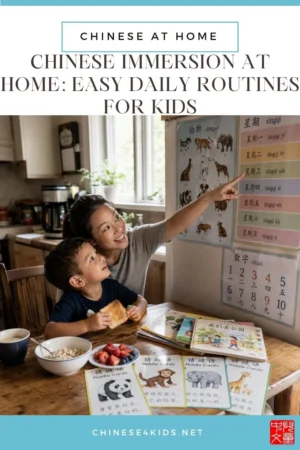
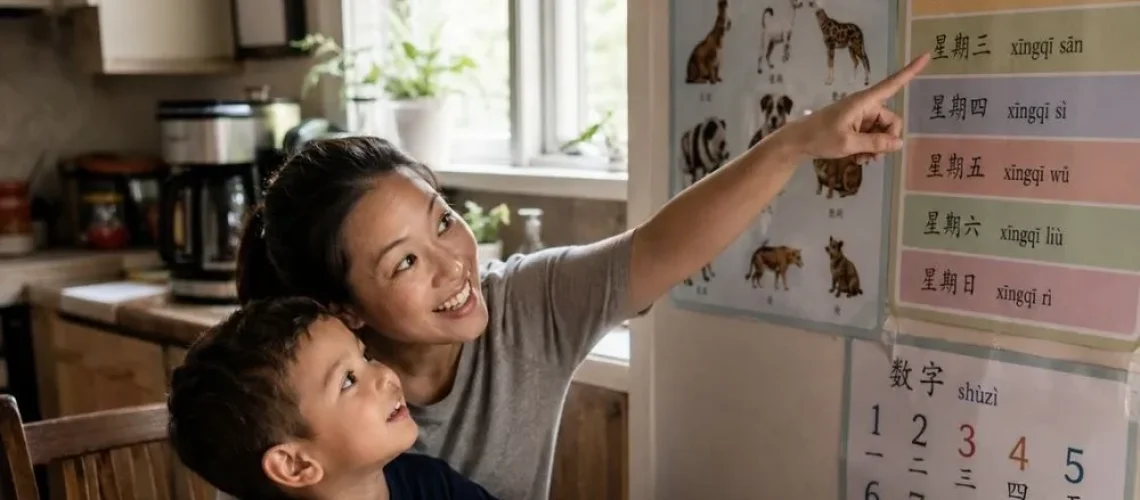
One of the most underrated tools in home immersion isn’t a course or a programme — it’s the physical environment. What a child sees on the walls, on the fridge, on the back of the bedroom door, shapes what feels normal to them. A home where Chinese is visible is a home where Chinese is present, even in silence.
Simple printed posters covering everyday vocabulary — numbers, colours, days of the week, months of the year, shapes, seasons — placed where a child naturally looks (next to the breakfast table, on the wall beside the desk, in the hallway) create constant low-level exposure without any effort on anyone’s part. A child who sees the days of the week in Chinese every morning while eating breakfast will absorb that vocabulary long before anyone explicitly teaches it to them.
The 9 Chinese Learning Posters for Homeschool and Classroom pack covers exactly these foundational topics — weekdays, months, time, seasons, colours, numbers, and shapes — in a clean, illustrated format that works equally well on a bedroom wall or in a dedicated learning corner. Each poster comes with a pinyin version and a characters-only version, so you can match the display to where your child currently is in their learning. Available in three sizes (8×10″, 11×14″, 16×20″), they’re easy to print and swap out as your child progresses.
For families who have set up a more dedicated home learning space — or for Chinese teachers setting up a classroom — the Chinese Classroom Setup Pack goes further, with bilingual welcome buntings, classroom rules posters, subject labels, reward charts, and more. It’s designed to make a space look and feel like a Chinese learning environment from the moment a child walks in — which, in itself, shifts expectations about what language belongs in that space.
Morning: 7 Minutes That Set the Tone
The morning routine — waking up, getting dressed, eating breakfast, getting out of the door — is one of the most consistent parts of any family’s day. It happens in roughly the same order, in the same places, with the same people, every single weekday. That consistency makes it ideal for language habit-building.
The vocabulary that belongs to this part of the day is some of the most useful Chinese a child can learn, precisely because it’s so repeatable. Our Day 30: Daily Routine Actions post covers 10 of the most essential daily routine verbs that map directly onto this window:
- 起床 (qǐchuáng) — to get up
- 洗脸 (xǐliǎn) — to wash face
- 刷牙 (shuāyá) — to brush teeth
- 吃饭 (chīfàn) — to eat a meal
- 喝水 (hē shuǐ) — to drink water
- 上学 (shàngxué) — to go to school
These aren’t random vocabulary items — they’re the actions that happen in your home every morning, already. Swapping the English commentary for Chinese doesn’t add time. It just changes the language.
Breakfast is one of the richest language moments in the day. Food vocabulary, quantity words, preferences, simple questions — 你想吃什么?(nǐ xiǎng chī shénme — what do you want to eat?), 喝牛奶还是果汁?(hē niúnǎi háishi guǒzhī — milk or juice?)— all arise naturally without forcing it.
Getting out of the door provides another cluster of repeatable phrases: 背书包 (bēi shūbāo — put on your backpack), 走了 (zǒu le — let’s go), 快一点 (kuài yīdiǎn — hurry up).
None of this requires a script or a lesson plan. It just requires deciding that these moments happen in Chinese, and having the phrases ready.
The School Run: 10–15 Minutes of Pure Listening Time
The commute to school — whether by car, bus, or on foot — is one of the most underused Chinese learning opportunities in a family’s day. The child has nothing else to do. There’s no screen competing for attention. The journey is long enough to get through several songs, a short story, or a vocabulary episode.
Chinese children’s songs played through the car speakers work particularly well. Repetitive, melodic, and absorbed without effort — children who hear the same songs dozens of times begin to anticipate the words, which is exactly how vocabulary builds naturally. Audiobooks or read-along recordings of simple picture books are another strong option, especially for children who already know the book and can follow along by ear.
The school run happens five days a week. Over a year, that’s hundreds of hours of potential Chinese listening time — currently going to English radio by default. The choice is simply whether to change that default.
After School: The Riddle Window
The period immediately after school is not the time for Chinese lessons. A child returning from a full day of English-language school is tired and resistant to anything that feels like more work.
But it is a good time for low-demand, playful Chinese input — and this is where Chinese riddles (谜语) come into their own.
Chinese riddles are short, self-contained, and inherently motivating — children want to figure out the answer. They naturally reinforce vocabulary (the riddle has to be understood to be solved), practise listening and tonal recognition, and introduce cultural understanding, all without feeling like instruction. Posing a riddle over the after-school snack — “我每天晚上出来,照亮黑夜… 是什么?” — requires no setup and takes two minutes.
The printable Chinese Riddle Cards make this practical: a ready deck of illustrated riddle cards covering nature, animals, food, and objects, designed for kids and beginners. Keep them in the kitchen. Pull one out at snack time. The child who groans at the idea of Chinese practice will happily wrestle with a riddle.
Background audio also works well during this window. A familiar Chinese cartoon playing in the background while a child has a snack, or Chinese music while they decompress, keeps the language present without requiring active engagement.
Mealtimes: The Richest Language Environment in the Day
If there is one moment in the day to prioritise for Chinese conversation, it’s the family meal.
Mealtimes are structured, regular, and involve everyone in the family. The topics — food, the day’s events, plans, opinions — are naturally rich in vocabulary. And crucially, the context is emotionally warm, which research consistently identifies as one of the most important factors in language acquisition. Children learn language more readily in settings that feel safe, connected, and enjoyable.
The mealtime language landscape includes requesting and offering food (再来一碗 — another bowl, 够了 — that’s enough, 好吃吗?— is it good?), talking about the day (今天学了什么?— what did you learn today?), and expressing preferences (我喜欢… 我不喜欢…).
The challenge for many overseas families is not knowing how to sustain this. Parents who aren’t fully fluent in Mandarin often find that mealtimes in Chinese run out of steam quickly — they use the same five phrases, struggle to respond when the child says something unexpected, and default back to English out of necessity.
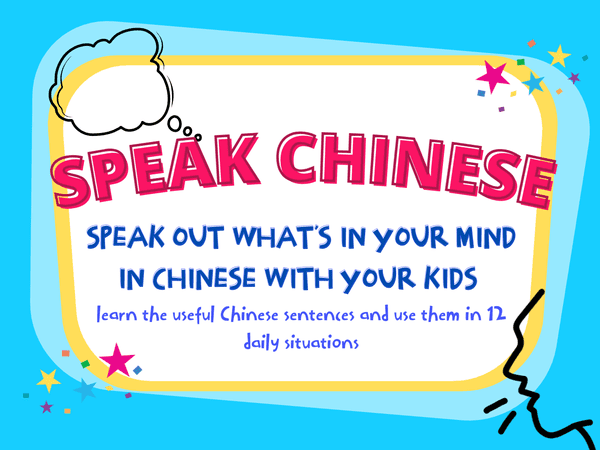
This is one of the specific problems that Speak Chinese with Kidswas built around. The course is organised by the everyday scenes of family life — and mealtimes are one of its core modules. Each scene provides 30 natural, ready-to-use phrases with full audio, video demonstrations, and printable scripts. The idea isn’t to script your family’s conversations, but to give parents enough language for each context that the conversation doesn’t hit a wall. With 30 mealtime phrases available, dinner in Chinese becomes sustainable rather than strained.
Bath Time and Bedtime: The Slowest, Richest Window of the Day
The evening routine — bath, getting ready for bed, storytime, lights out — is the most naturally immersive part of the day for young children. The pace is slower. The mood is calm. The child is physically close and emotionally receptive. And the language involved is intimate in a way that classroom language simply isn’t.
Bath time offers body vocabulary, action verbs, and simple commentary: 洗头发 (xǐ tóufa — wash your hair), 洗手 (xǐ shǒu — wash your hands), 水太热了 (shuǐ tài rè le — the water is too hot).
Bedtime story time is arguably the single most powerful Chinese learning activity available to overseas families. A parent reading a Chinese picture book aloud — even imperfectly, even with pinyin support — provides connected, contextualised, emotionally engaged language input. The child associates the warmth of that moment with Chinese.
The Chinese4kids levelled readers are designed specifically for this — original stories at four levels (aa through C), written for overseas learners, with vocabulary that builds gradually and language patterns that repeat across books.
Saying goodnight is one of the simplest and most consistent Chinese habits a family can build: 晚安 (wǎn’ān — goodnight), 做个好梦 (zuò gè hǎo mèng — sweet dreams), 我爱你 (wǒ ài nǐ — I love you). These phrases cost nothing to learn and create a daily moment of Chinese that happens regardless of how the rest of the day went.
Weekends: Going Deeper Without Pressure
Weekends offer longer, less structured time. Without the natural routine anchors of weekdays, Chinese can easily disappear entirely — or expand into richer territory.
Cooking together in Chinese is one of the most naturally immersive activities available. Following a simple recipe using Chinese food vocabulary, describing what you’re doing, tasting and commenting — food and language have a deep connection in Chinese culture, and the kitchen is one of the most memorable language classrooms there is.
Chinese cultural celebrations give language a real context and a reason to exist. The Special Events section of the Chinese4kids shop has themed learning materials for festivals and seasonal occasions — Spring Festival, Mid-Autumn Festival, Dragon Boat Festival and more — that bring the cultural calendar into your home. When a child makes a paper lantern for 元宵节 (Yuánxiāojié) while talking about the festival in Chinese, the vocabulary doesn’t feel like vocabulary. It feels like part of something real.
Video calls with Chinese-speaking relatives provide authentic, emotionally meaningful input that no classroom resource can replicate. Even a 15-minute call once a week is significant. Even if the conversation is simple — what the child had for lunch, what they’re looking forward to — it’s Chinese in a real relationship, which is the most powerful kind.
The One Thing That Makes All of This Possible
Every scene described in this article has one thing in common: it requires a parent who is willing and able to use Chinese in that moment.
And this is where many families genuinely get stuck. Not because they don’t want to — but because they don’t feel confident enough. They run out of things to say. They try Chinese during breakfast and freeze when their child asks something they can’t answer. They slip back into English, again.
This is a resource problem, not a character flaw. Speak Chinese with Kids was designed for exactly this situation — giving parents a ready toolkit of natural, practical Mandarin for the scenes described in this article: morning routines, mealtimes, bath time, bedtime, getting out of the door. Each scene has 30 phrases delivered through audio and video, with printable scripts so the language is always within reach. You don’t need to be fluent. You need to be consistently present.
Start With One Scene, Not All of Them
If this article has made one thing clear, it’s that the opportunities are everywhere. But that doesn’t mean you should try to change everything at once.
Pick one scene — ideally one that’s already consistent in your family’s routine — and make it Chinese. Breakfast. The school run. Bedtime. Just one. Do it long enough for it to feel natural, and then add another.
The goal isn’t a perfectly immersive Chinese household by next week. It’s a home where Chinese is gradually, persistently, naturally more present than it was before — until one day your child answers you in Chinese without thinking about it, and you realise the language has found its own place in the fabric of your family’s life.
That’s what immersion at home actually looks like. Not a classroom without walls. Just a family, making space.
Resources from Chinese4kids to Get You Started
For your learning environment:
- 🖼️ 9 Chinese Learning Posters for Homeschool and Classroom — numbers, colours, weekdays, months, shapes and more; with and without pinyin
- 🏫 Chinese Classroom Setup Pack — bilingual printables to make any space feel like a Chinese learning environment
For the daily routine:
- 📅 Day 30: Daily Routine Actions — 10 essential daily routine verbs with video and activity pack
- 🗣️ Speak Chinese with Kids — 30 ready-to-use phrases per scene, with audio, video and printable scripts
For low-pressure fun:
- 🃏 Chinese Riddle Cards — printable riddle cards for after-school snack time or car journeys
- 🎊 Special Events Chinese Learning Materials — festival and seasonal themed packs to bring the cultural calendar into your home
For further reading:
- 📖 From Breakfast to Bedtime: How to Sneak Chinese into Your Kid’s Day — a companion article with playful, practical ideas for every part of the day
- 📖 5 Pillars for Raising a Happy Chinese Learner — the philosophy behind building a lasting relationship with Chinese at home
Ready to make Chinese a natural part of your family’s daily scenes? Speak Chinese with Kids gives parents 30 ready-to-use phrases for every everyday moment — morning, mealtimes, bath time, bedtime — with audio, video, and printable scripts so you always know what to say.
If you like this article, share it