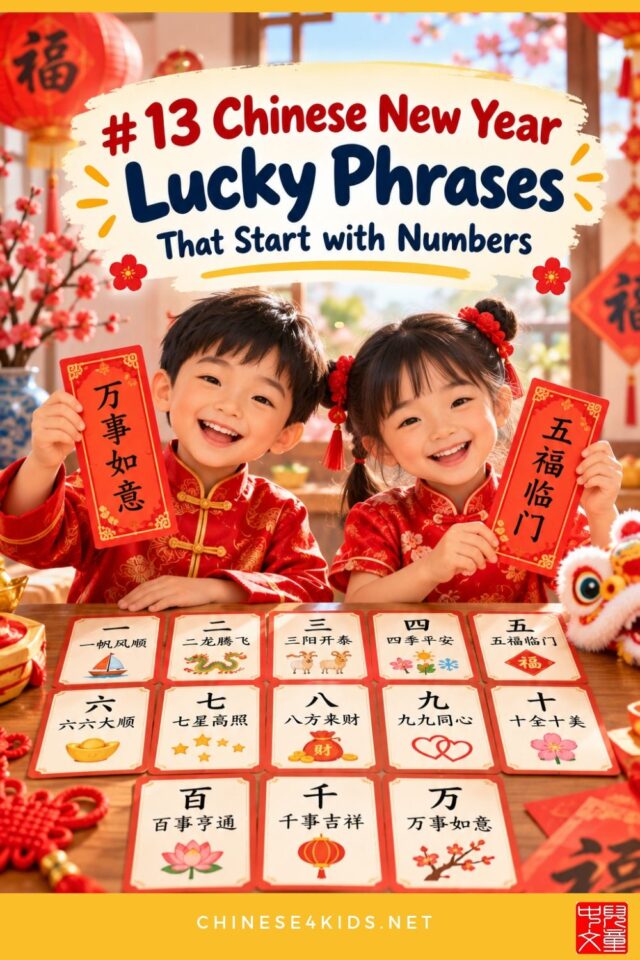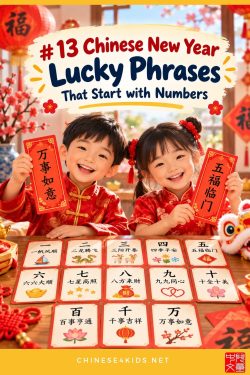
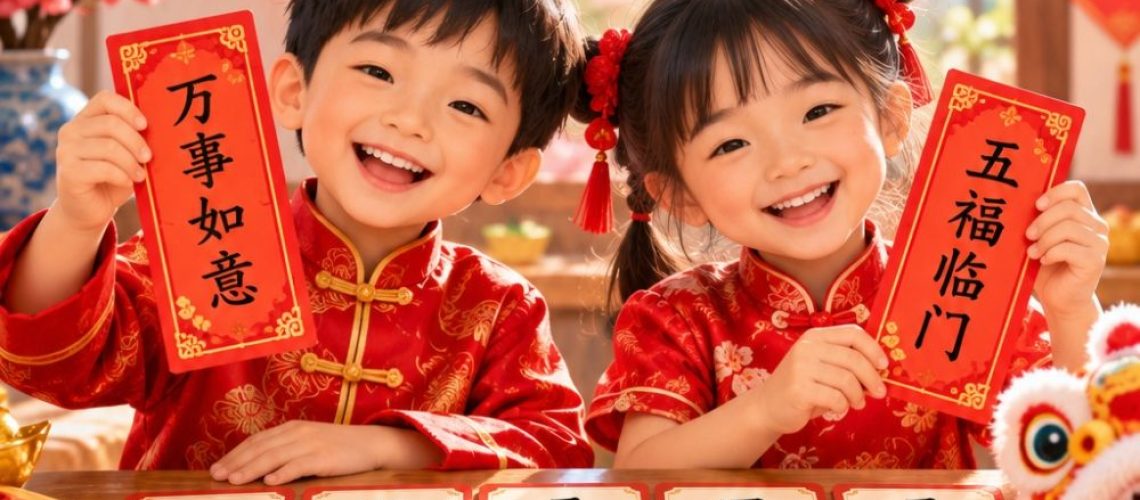
Quick answer: Chinese New Year lucky phrases with numbers are four-character wishes that follow a number pattern. They run from 一 to 十, then continue with 百, 千 and 万. Two examples are 一帆风顺 (yīfān fēngshùn), “smooth sailing,” and 五福临门 (wǔfú línmén), “five blessings come to your door.” Below are 13 you may see on cards and decorations. They’re also a fun way for children to practice counting while they discover Chinese New Year traditions.
During Chinese New Year, people share good wishes called 吉祥话 (jíxiánghuà), or lucky phrases. Some of the most fun ones start with a number. Together they count from one to ten, then jump to a hundred, a thousand and ten thousand. That makes them a natural fit for kids who are learning numbers in Mandarin.
Not all 13 are equally well known, though. Some, such as 万事如意, 十全十美, 五福临门 and 四季平安, are established idioms. Others, like 九九同心 and 千事吉祥, are festive phrases made to fit the number pattern, and you’ll see them less often. So don’t be surprised if a card looks a little different from the list below.
The 13 Lucky Phrases at a Glance
| Number | Phrase | Pinyin | What it means |
|---|---|---|---|
| 一 (1) | 一帆风顺 | yīfān fēngshùn | Smooth sailing. May your journey go well. |
| 二 (2) | 二龙腾飞 | èrlóng téngfēi | Two dragons soaring. May your success take off. |
| 三 (3) | 三阳开泰 | sānyáng kāitài | Good luck is arriving. May the year start well. |
| 四 (4) | 四季平安 | sìjì píng’ān | Safe and peaceful in all four seasons. |
| 五 (5) | 五福临门 | wǔfú línmén | Five blessings come to your door. |
| 六 (6) | 六六大顺 | liùliù dàshùn | Everything goes very smoothly. |
| 七 (7) | 七星高照 | qīxīng gāozhào | Lucky stars shine down on you. |
| 八 (8) | 八方来财 | bāfāng láicái | Wealth comes from every direction. |
| 九 (9) | 九九同心 | jiǔjiǔ tóngxīn | Hearts united, for a long time. |
| 十 (10) | 十全十美 | shíquán shíměi | Perfect in every way. |
| 百 (100) | 百事亨通 | bǎishì hēngtōng | A hundred things go well. May everything go smoothly. |
| 千 (1,000) | 千事吉祥 | qiānshì jíxiáng | A thousand things bring luck. |
| 万 (10,000) | 万事如意 | wànshì rúyì | May everything go as you wish. |
 Click on the image Above to have list sent to you in your Inbox!
How to Use These Phrases
To turn a phrase into a wish, put 祝你 (zhù nǐ) in front. For example, 祝你万事如意 (zhù nǐ wànshì rúyì) means “I wish that everything goes the way you hope.” With grandparents, teachers and other elders, say 祝您 (zhù nín) instead, since 您 is the polite way to say “you.” You can also say a phrase on its own, which is common on cards and in group greetings.
If you only learn one phrase, make it 万事如意. It’s widely used in New Year greetings, so it’s a handy place to start.
A quick note on tones: we write 一 as yī in this post. In everyday speech, though, it often changes, so 一帆风顺 usually sounds like yìfān fēngshùn. It’s nothing to worry about at first. Listening and repeating will help it feel natural.
The Stories Behind the Numbers
Some of these phrases have especially interesting stories behind them.
三阳开泰 (sānyáng kāitài)
it has a story that goes back a long way. It comes from traditional Chinese cosmology and the Yijing (I Ching), where the Tai hexagram (泰) stands for a favorable time of harmony and renewal. People link it to the end of winter and the arrival of spring.
There’s also a fun play on words. 阳 (yáng), meaning yang energy, and 羊 (yáng), meaning goat, are both pronounced yáng. That’s why you may see three goats on New Year decorations with the phrase written as 三羊开泰. The picture stands for good fortune and a hopeful new start. Curious about the goat and the other 11 animals? Take a look at our Chinese zodiac for kids guide.
二龙腾飞 (èrlóng téngfēi)
People say good things come in pairs (好事成双, hǎoshì chéngshuāng), so two is a lucky number. Dragons stand for power and good fortune. Put them together, and the phrase pictures success taking off.
五福临门 (wǔfú línmén)
This wishes five blessings into your home. Traditionally, these are long life, wealth, health and peace, good character, and a peaceful end to a full life. Some modern lists are simpler, but the idea is the same: a life full of blessings.
六六大顺 (liùliù dàshùn)
Six is a lucky number too, because it suggests things flowing smoothly. Repeating it strengthens the wish.
七星高照 (qīxīng gāozhào)
The seven stars usually mean the Big Dipper (北斗七星, běidǒu qīxīng), which people have long linked with protection and good luck.
八方来财 (bāfāng láicái)
八方 means “eight directions,” or really “from everywhere.” Eight is a favorite number as well, because 八 (bā) sounds like 发 (fā), as in 发财 (fācái), “to get rich.”
九九同心 (jiǔjiǔ tóngxīn)
九 (jiǔ) sounds like 久 (jiǔ), which means “long-lasting.” So the phrase hints at hearts that stay together for a long time.
十全十美 and 万事如意
They are classic idioms (成语, chéngyǔ). You can use them all year, not just at New Year.
Easy Ways to Practice with Kids
1. Count up the wishes
Write the 13 phrases on cards, or print the list. Mix them up, then ask your kids to put them in order from 一 to 万. As they go, they read each phrase aloud.
2. Roll and wish
Roll a die and say the phrase that matches the number. A 3 gives you 三阳开泰, and a 5 gives you 五福临门. Then add 祝你 and make the wish for someone in the room.
3. Pick a wish
Ask your child, “Which phrase would you give to Grandma? To your teacher? To your best friend?” It gets them thinking about what each wish really means.
Common Questions
What are Chinese New Year lucky phrases?
They’re short sayings called 吉祥话 (jíxiánghuà). People use them to wish each other health, luck and happiness during the 15 days of Chinese New Year. For everyday greetings like 新年快乐 and 恭喜发财, see our guide to Chinese New Year lucky phrases.
Why is 三阳开泰 sometimes written 三羊开泰?
The traditional phrase uses 阳. Because 阳 and 羊 are both pronounced yáng, people often swap in 羊 for fun, especially in Goat years. You may see it on cards and decorations.
Are all 13 expressions traditional idioms?
No. Some, like 万事如意 and 十全十美, are classic idioms. Others are festive phrases that follow the number pattern, so different cards may show slightly different versions.
Keep Learning
If your child is still learning to count, start with our guide to Chinese numbers for kids. It will make these phrases much easier to read.
And if you’d like to use more Chinese at the New Year table, the Speak Chinese with Kids course gives parents ready-made phrases for everyday scenes, with audio and video. For printable Chinese New Year activities and vocabulary, browse the Special Events section of our shop.
If you like this article, share it