Quick answer
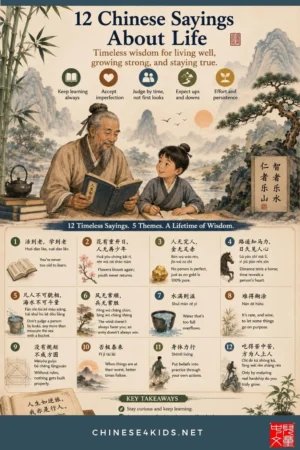
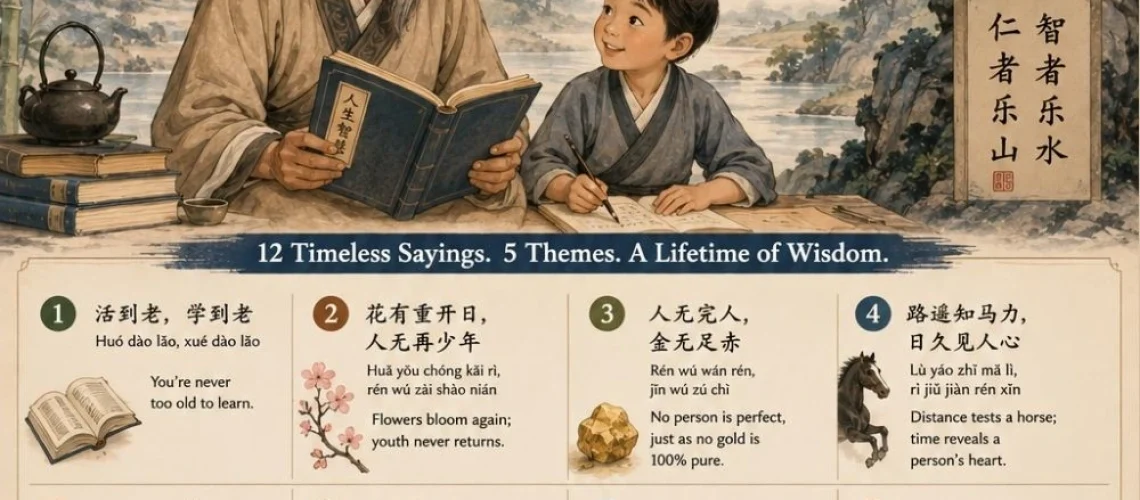
Chinese sayings about life circle around a few consistent ideas: keep learning no matter your age, accept that nothing and no one is perfect, judge people by time rather than first impressions, and expect life to have natural ups and downs. Below are 12 genuine Chinese sayings, each with the Chinese, pinyin, meaning, source, and a practical way to use it with a child.
Chinese sayings about life circle around a few consistent ideas: keep learning no matter your age, accept that nothing and no one is perfect, judge people by time rather than first impressions, and expect life to have natural ups and downs. Below are 12 genuine Chinese sayings, each with the Chinese, pinyin, meaning, source, and a practical way to use it with a child.
How do you look at life — as something sweet, something hard, or a bit of both? Chinese thought has been wrestling with that question for centuries, in Song dynasty poems, Yuan dynasty plays, and lines from Confucius and Mencius that are still quoted today.
These aren’t abstract philosophy. Each saying below started as a real line — in a poem, a play, a piece of calligraphy — and stuck around because it says something true in very few words. That makes them useful for parents and teachers looking for a short, memorable way to talk about patience, character, and resilience with a child, rather than a long lecture.
Each saying comes with the Chinese, the pinyin, a plain meaning, its source, and a practical tip. Every one was checked against its earliest identifiable source — where a saying is genuine folk wisdom without one fixed text, we’ve said so rather than guessing at a source that isn’t real.
What do Chinese sayings say about life?
- Learning has no age limit — it’s never too late to start.
- Nobody and nothing is perfect, and expecting perfection causes more harm than the flaw itself.
- A person’s real character shows over time, not in a first impression.
- Life naturally has ups and downs — that’s not a personal failure, it’s just how life works.
- Effort and consistent practice matter more than talent or a strong start.
What is the most famous Chinese saying about life?
One of the most quoted is 活到老,学到老 (huó dào lǎo, xué dào lǎo) — “live to old age, learn to old age,” or “you’re never too old to learn.” It’s short, it rhymes in Chinese, and it sums up a value that runs through almost every other saying on this list: life is a process, not a finish line.
What Is a Chinese Saying?
A Chinese saying is a short expression that carries practical wisdom about life, relationships, learning, or character. Some are traditional folk proverbs (谚语), passed down through generations without one named author. Others come straight from classical literature, poems, or philosophical texts like the Analects, Mencius, or the I Ching.
Both types are still quoted today — in family conversations, classrooms, and everyday speech across the Chinese-speaking world.
Chinese Sayings vs. Chinese Proverbs
| Chinese saying | Chinese proverb |
|---|---|
| Can come from literature, history, philosophy, or everyday speech | Usually folk wisdom passed down through generations |
| May include idioms, poem lines, or direct quotations | Usually practical, plain-spoken advice |
| The broader category | One type of Chinese saying |
In practice, every proverb on this list is also a saying — but not every saying here is a folk proverb. 否极泰来, for example, comes from the I Ching rather than folk tradition, which makes it a saying rooted in philosophy more than in everyday proverb culture.
12 Chinese Sayings, Quotes and Proverbs About Life
| Chinese | Pinyin | Meaning in one line | Theme | Source |
|---|---|---|---|---|
| 活到老,学到老 | Huó dào lǎo, xué dào lǎo | You’re never too old to learn. | Lifelong learning | Long-standing Chinese folk saying |
| 花有重开日,人无再少年 | Huā yǒu chóng kāi rì, rén wú zài shào nián | Flowers bloom again; youth never returns. | Time & youth | Chen Zhu (Song); popularized by Guan Hanqing (Yuan) |
| 人无完人,金无足赤 | Rén wú wán rén, jīn wú zú chì | No person is perfect, just as no gold is 100% pure. | Accepting imperfection | Dai Fugu (Song dynasty poet) |
| 路遥知马力,日久见人心 | Lù yáo zhī mǎ lì, rì jiǔ jiàn rén xīn | Distance tests a horse; time reveals a person’s heart. | Seeing people truly | Yuan dynasty drama |
| 凡人不可貌相,海水不可斗量 | Fán rén bù kě mào xiàng, hǎi shuǐ bù kě dǒu liàng | Don’t judge a person by looks, any more than you’d measure the sea with a bucket. | Seeing people truly | Ming dynasty vernacular fiction |
| 风无常顺,兵无常胜 | Fēng wú cháng shùn, bīng wú cháng shèng | The wind doesn’t always favor you; an army doesn’t always win. | Life’s natural ups and downs | Feng Menglong, Stories to Awaken the World (Ming) |
| 水满则溢 | Shuǐ mǎn zé yì | Water that’s too full overflows. | Life’s natural ups and downs | Classical Chinese wisdom tradition |
| 难得糊涂 | Nán dé hútu | It’s rare, and wise, to let some things go on purpose. | Wisdom & restraint | Zheng Banqiao (Qing dynasty calligrapher) |
| 没有规矩不成方圆 | Méiyǒu guīju bù chéng fāngyuán | Without rules, nothing gets built properly. | Structure enables freedom | Mencius (孟子) |
| 否极泰来 | Pǐ jí tài lái | When things are at their worst, better times follow. | Life’s natural ups and downs | I Ching / Book of Changes (易经) |
| 身体力行 | Shēntǐ lìxíng | Put beliefs into practice through your own actions. | Effort & integrity | Classical Chinese idiom |
| 吃得苦中苦,方为人上人 | Chī dé kǔ zhōng kǔ, fāng wéi rén shàng rén | Only by enduring real hardship do you truly grow. | Effort & integrity | Ming-Qing folk proverb tradition |
Where These Sayings Come From
This set turned out to be more solidly sourced than it first looks.
- 花有重开日,人无再少年 traces to a Song dynasty poem by Chen Zhu, later made famous when the Yuan dynasty playwright Guan Hanqing used it in his classic drama The Injustice to Dou E (窦娥冤).
- 人无完人,金无足赤 comes from another Song poet, Dai Fugu, in his poem 寄兴.
- 没有规矩不成方圆 echoes Mencius directly: “不以规矩,不能成方圆” — without a compass and square, you cannot draw a circle or a square.
- 否极泰来 comes from the hexagram structure of the I Ching.
- And 风无常顺,兵无常胜 is a direct line from Feng Menglong’s Ming dynasty story collection, Stories to Awaken the World.
- 难得糊涂 has the richest story of all — see below.
Do People Still Use These Sayings Today?
Yes, regularly. Parents use lines like 人无完人,金无足赤 to encourage a child after a mistake.
Teachers open a lesson with 活到老,学到老 as a classroom motto.
Grandparents quote 路遥知马力,日久见人心 when giving advice about who to trust.
Some — like 没有规矩不成方圆 and 人无完人,金无足赤 — show up constantly in everyday speech. Others, like 否极泰来 and 身体力行, appear a bit more often in writing, speeches, and calligraphy than in casual conversation, though everyone still recognizes them instantly.
The Story Behind 难得糊涂
难得糊涂 was written as a piece of calligraphy by Zheng Banqiao (郑板桥), a Qing dynasty painter, poet, and calligrapher — one of the famous “Eight Eccentrics of Yangzhou.” The common English translation “where ignorance is bliss” doesn’t quite capture it — Zheng wasn’t praising actual ignorance. He meant something closer to: a genuinely clever person sometimes chooses not to notice, argue, or correct every small thing. Letting go on purpose, he suggested, takes more wisdom than always being right.
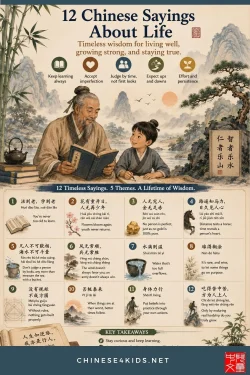
12 Chinese Proverbs on Life Posters in A4 and A3 format
12 Chinese Sayings About Life, Explained
Saying 01 · Lifelong learning
活到老,学到老
Huó dào lǎo, xué dào lǎo
Live to old age, learn to old age. You’re never too old to learn something new.
In one sentence: learning doesn’t have a retirement age.
Origin: a long-standing, widely used Chinese folk saying, not traced to one classical text.
Practical tip
Let your child see you learning something new yourself — a few Chinese words, a skill, anything. It makes the saying real rather than just something adults say to kids.
Let your child see you learning something new yourself — a few Chinese words, a skill, anything. It makes the saying real rather than just something adults say to kids.
Saying 02 · Time & youth
花有重开日,人无再少年
Huā yǒu chóng kāi rì, rén wú zài shào nián
Flowers that fall will bloom again. A person who grows old never gets to be young again.
In one sentence: some things return, but time only moves one way.
Origin: a Song dynasty poem by Chen Zhu (陈著), later popularized by the Yuan dynasty playwright Guan Hanqing (关汉卿) in his famous drama The Injustice to Dou E (窦娥冤).
Practical tip
A gentle one for talking about why “right now” matters — not to create pressure, but to explain why you’re encouraging a child to make the most of a season of life, whether that’s early language learning or just childhood itself.
A gentle one for talking about why “right now” matters — not to create pressure, but to explain why you’re encouraging a child to make the most of a season of life, whether that’s early language learning or just childhood itself.
Saying 03 · Accepting imperfection
人无完人,金无足赤
Rén wú wán rén, jīn wú zú chì
No person is perfect, just as no gold is ever 100% pure. Expecting perfection from anyone — including yourself — isn’t realistic.
In one sentence: nobody is flawless, and that’s a normal, not a disappointing, fact.
Origin: Song dynasty poet Dai Fugu (戴复古), from his poem 寄兴 (“黄金无足色,白璧有微瑕…”).
Practical tip
Useful when a child is frustrated with their own mistake — in Chinese class or anywhere else. Perfection was never the standard; showing up and trying again is.
Useful when a child is frustrated with their own mistake — in Chinese class or anywhere else. Perfection was never the standard; showing up and trying again is.
Saying 04 · Seeing people truly
路遥知马力,日久见人心
Lù yáo zhī mǎ lì, rì jiǔ jiàn rén xīn
A long road tests a horse’s strength; a long time reveals a person’s true heart. Character shows itself over time, not in one moment.
In one sentence: you learn who someone really is by knowing them for a while, not by a first impression.
Origin: a well-known line from Yuan dynasty drama, widely quoted since.
Practical tip
Good for reassuring a child who’s slow to make friends — a real friendship, like this saying suggests, is proven over time rather than in the first week.
Good for reassuring a child who’s slow to make friends — a real friendship, like this saying suggests, is proven over time rather than in the first week.
Saying 05 · Seeing people truly
凡人不可貌相,海水不可斗量
Fán rén bù kě mào xiàng, hǎi shuǐ bù kě dǒu liàng
An ordinary person can’t be judged by their looks, any more than the sea can be measured with a small grain-bucket. Don’t underestimate people based on first appearances.
In one sentence: what someone looks like tells you nothing about what they’re capable of.
Origin: Ming dynasty vernacular fiction, part of the same storytelling tradition as 风无常顺,兵无常胜 below.
Practical tip
A good one for talking about not judging classmates — or themselves — by first impressions, grades, or how confident someone looks on the outside.
A good one for talking about not judging classmates — or themselves — by first impressions, grades, or how confident someone looks on the outside.
Saying 06 · Life’s natural ups and downs
风无常顺,兵无常胜
Fēng wú cháng shùn, bīng wú cháng shèng
The wind doesn’t always blow the way you want; an army doesn’t win every battle. Setbacks are a normal part of any long effort, not a sign something’s wrong.
In one sentence: nobody wins every time, and that’s not a personal failure.
Origin: Feng Menglong (冯梦龙), Stories to Awaken the World (醒世恒言), Ming dynasty.
Practical tip
Useful after a bad test, a lost game, or a frustrating Chinese lesson. One setback doesn’t undo the pattern of effort — it’s just part of it.
Useful after a bad test, a lost game, or a frustrating Chinese lesson. One setback doesn’t undo the pattern of effort — it’s just part of it.
Saying 07 · Life’s natural ups and downs
水满则溢
Shuǐ mǎn zé yì
Water, once too full, overflows. Often paired with 月盈则亏 (“the moon wanes once it’s full”) — a reminder that anything pushed past its natural limit tips over into loss.
In one sentence: too much of a good thing eventually tips into a bad one.
Origin: part of a broader classical Chinese idea about balance and moderation, rather than one single fixed text.
Practical tip
A gentle way to talk about overdoing it — too much screen time, over-scheduling, or pushing too hard on homework. Balance isn’t a punishment; it’s how things stay stable.
A gentle way to talk about overdoing it — too much screen time, over-scheduling, or pushing too hard on homework. Balance isn’t a punishment; it’s how things stay stable.
Saying 08 · Wisdom & restraint
难得糊涂
Nán dé hútu
It’s rare — and wise — to let some things go on purpose. Not every mistake needs correcting, and not every argument needs winning. See the full story above.
In one sentence: real wisdom sometimes means choosing not to notice.
Origin: Zheng Banqiao (郑板桥), Qing dynasty painter and calligrapher, one of the “Eight Eccentrics of Yangzhou.”
Practical tip
Useful for a perfectionist child — or a perfectionist parent. Not every small mistake in a Chinese lesson needs to be corrected in the moment; some things are fine to let go.
Useful for a perfectionist child — or a perfectionist parent. Not every small mistake in a Chinese lesson needs to be corrected in the moment; some things are fine to let go.
Saying 09 · Structure enables freedom
没有规矩不成方圆
Méiyǒu guīju bù chéng fāngyuán
Without a compass and square, you can’t draw a proper circle or square. Without agreed rules or structure, nothing gets built well.
In one sentence: good structure isn’t the enemy of freedom — it’s what makes real progress possible.
Origin: Mencius (孟子·离娄上): “不以规矩,不能成方圆.”
Practical tip
Handy when explaining why a home Chinese-learning routine has rules — a set practice time, a consistent order — rather than being freeform. The structure is what makes the freedom to actually improve possible.
Handy when explaining why a home Chinese-learning routine has rules — a set practice time, a consistent order — rather than being freeform. The structure is what makes the freedom to actually improve possible.
Saying 10 · Life’s natural ups and downs
否极泰来
Pǐ jí tài lái
When bad fortune reaches its extreme, good fortune follows. Named after two opposite hexagrams in the I Ching — 否 (stagnation) and 泰 (peace).
In one sentence: the lowest point is often closer to a turnaround than it feels.
Origin: I Ching / Book of Changes (易经), from the structure of its 64 hexagrams.
Practical tip
A comforting one during a genuinely hard stretch — a rough school term, a plateau in Chinese learning. It frames a low point as temporary, not permanent.
A comforting one during a genuinely hard stretch — a rough school term, a plateau in Chinese learning. It frames a low point as temporary, not permanent.
Saying 11 · Effort & integrity
身体力行
Shēntǐ lìxíng
To put something into practice with your own body, not just your words. The common English gloss is “practice what you preach,” but the fuller sense is broader — personally acting on your beliefs and leading by example, not only avoiding hypocrisy.
In one sentence: actions carry more weight than good intentions.
Origin: a well-established classical Chinese idiom (成语), used since at least the Han dynasty philosophical tradition.
Practical tip
If you want your child to value Chinese, this is the one to live by — sit down and practice alongside them sometimes, rather than only asking them to.
If you want your child to value Chinese, this is the one to live by — sit down and practice alongside them sometimes, rather than only asking them to.
Saying 12 · Effort & integrity
吃得苦中苦,方为人上人
Chī dé kǔ zhōng kǔ, fāng wéi rén shàng rén
Only by enduring the hardest hardship does a person truly rise above. A classic “no pain, no gain” sentiment about the value of real, sustained effort.
In one sentence: real growth usually costs real effort — there’s rarely a shortcut.
Origin: a long-standing Chinese folk proverb, part of the same Ming-Qing proverb-collection tradition as many well-known Chinese sayings.
A modern note
The literal phrase “人上人” (“a person above other people”) reflects an older, more hierarchical way of framing success. Most modern parents use this saying for its core message — effort matters — without the status-ranking part. Worth keeping in mind if you’re explaining the literal wording to an older child.
The literal phrase “人上人” (“a person above other people”) reflects an older, more hierarchical way of framing success. Most modern parents use this saying for its core message — effort matters — without the status-ranking part. Worth keeping in mind if you’re explaining the literal wording to an older child.
Practical tip
Use the spirit of this one, not the literal ranking — effort is worth it for its own sake, not to end up “above” anyone else.
Use the spirit of this one, not the literal ranking — effort is worth it for its own sake, not to end up “above” anyone else.
Who Gets the Most Out of These Sayings
Parents navigating a hard season
否极泰来 and 风无常顺,兵无常胜 both offer a calm, non-dramatic way to talk about setbacks and low points.
Teachers building classroom culture没有规矩不成方圆 explains classroom structure in a way that lands better than a rules list — and 活到老,学到老 makes a great motto for a learning-focused classroom.
Perfectionist kids (or parents)
人无完人,金无足赤 and 难得糊涂 both push back gently against the pressure to get everything right.
Heritage families passing down values
These sayings carry the same kind of everyday wisdom parents already try to teach — just with centuries of Chinese literary history behind them.
How to Actually Use These Sayings
Like any saying, these only help if they leave the page. Here’s where they work best in real family or classroom life.
| Setting | How to use it | Good saying to start with |
|---|---|---|
| After a setback or bad day | Use it to normalize the dip, not to minimize how the child feels. | 风无常顺,兵无常胜 |
| Explaining household or classroom rules | Frame structure as what makes progress possible, not just a list of restrictions. | 没有规矩不成方圆 |
| A child frustrated by their own mistake | Normalize imperfection before problem-solving the mistake itself. | 人无完人,金无足赤 |
| A long rough patch — schoolwork, a plateau | Use to offer hope without promising a specific timeline. | 否极泰来 |
| Modeling a habit you want your child to adopt | Say it while actually doing the thing, not instead of doing it. | 身体力行 |
Say it once, let it sit
Most of these land better as a quiet aside in the moment than a planned lesson.
Use the real story where there is one
难得糊涂 and 花有重开日 both have real historical stories behind them — tell the short version, it’s more memorable than the line alone.
Let older kids push back
吃得苦中苦,方为人上人 is a good one to discuss critically with a teen, not just accept at face value.
Pair with a real moment
否极泰来 means more said quietly during an actual hard week than as a general life lesson out of context.
Quick Pick: Best Saying for the Moment
| Situation | Recommended saying |
|---|---|
| Child made a mistake | 人无完人,金无足赤 |
| Child feels discouraged | 否极泰来 |
| Teaching perseverance | 活到老,学到老 or 吃得苦中苦,方为人上人 |
| Talking about trust or friendship | 路遥知马力,日久见人心 |
| Teaching resilience after a setback | 风无常顺,兵无常胜 |
How to Read the Pinyin
Every saying above includes pinyin — the standard system for writing Mandarin sounds using the Roman alphabet. The small marks over vowels show tone:
ā — high, level tone
á — rising tone
ǎ — dipping tone (falls, then rises)
à — sharp falling tone
You don’t need perfect pronunciation to start appreciating these sayings — reading them aloud, even imperfectly, is still a good way to make them stick.
Frequently Asked Questions
What are the most well-known Chinese sayings about life?
Some of the most quoted are 活到老,学到老 (“you’re never too old to learn”), 人无完人,金无足赤 (“nobody is perfect”), and 否极泰来 (“after the worst comes better times”). All 12 are listed above with pinyin and meaning.
Are these genuine Chinese proverbs, or modern sayings?
Genuinely Chinese, and better documented than you might expect. Several trace to named sources — Song dynasty poems, a Yuan dynasty play, Mencius, the I Ching, and a famous piece of Qing dynasty calligraphy. A few are long-standing folk sayings without one fixed text, and we’ve said so plainly rather than guessing at a source.
What does 难得糊涂 actually mean?
Literally, “hard to attain, muddled” — but it doesn’t mean real ignorance. Written by the Qing dynasty artist Zheng Banqiao, it means choosing, on purpose, not to notice or correct every small thing. See the full story above.
Can these sayings help a child going through a hard time?
Yes — pick the one that matches the situation rather than reading through all 12. 风无常顺,兵无常胜 works well right after a setback; 否极泰来 works better for a longer rough patch that needs a bit of hope.
What’s the difference between 谚语 (yànyǔ) and 成语 (chéngyǔ)?
谚语 are full, plain-spoken sentences of folk wisdom — most of the longer sayings on this list. 成语 are compact four-character idioms, often drawn from a specific classical story — 否极泰来 and 身体力行 are both examples.
Are these sayings relevant for heritage kids growing up outside China?
Very much so. They carry the same everyday wisdom many parents already try to pass on — patience, resilience, not judging by appearances — just backed by centuries of Chinese literary history, which gives it extra weight with older kids especially.
Where can I find more Chinese quotes and sayings for kids?
See our full Chinese Quotes collection, our China and Chinese Culture category, and our companion pieces on Chinese proverbs on teaching and learning and Chinese proverbs on friendship.
Which Chinese saying teaches perseverance?
Several do: 活到老,学到老 (never too old to learn), 吃得苦中苦,方为人上人 (real growth takes real effort), and 身体力行 (put your beliefs into action rather than just talking about them).
What is the oldest Chinese saying about life on this list?
否极泰来 and 没有规矩不成方圆 are the oldest, rooted in the I Ching and Mencius respectively — both over 2,000 years old. Most of the others date to the Song, Yuan, or Ming dynasties, roughly 700–1,000 years old.
In summary
Chinese sayings about life teach resilience, lifelong learning, humility, patience, and moderation. Some come from folk wisdom, others from classical poems, plays, and philosophy — but all of them are still quoted today because the advice still holds up in modern family life, education, and personal growth.
Key takeaways
- These 12 sayings group into 8 themes: lifelong learning, time, accepting imperfection, seeing people truly, life’s ups and downs, wisdom and restraint, structure, and effort.
- Most trace to a real, named source — Song poems, a Yuan drama, Mencius, the I Ching, and a famous Qing calligrapher — better documented than a typical “list of Chinese quotes.”
- 难得糊涂 has the richest backstory here and is commonly mistranslated — it means choosing not to notice, not real ignorance.
- The core message across all 12: life has natural ups and downs, nobody is perfect, and steady effort over time matters more than a strong start or a flawless record.
- One saying (吃得苦中苦,方为人上人) carries an old hierarchical framing worth being aware of — most people today use it for the effort message alone.
Explore More
- 16 Chinese Proverbs on Teaching and Learning Our companion piece on classroom and study wisdom — also available as a printable A4/A3 poster set.
- 12 Chinese Proverbs on Friendship Genuine Chinese proverbs and the story of Guan Zhong and Bao Shuya — also available as a printable poster set.
- Chinese Proverbs Wall Posters: Teaching & Learning Printable A4/A3 posters from our companion article, ready for a classroom or home wall.
- Chinese Proverbs Wall Posters: Friendship Printable A4/A3 posters featuring the 12 proverbs on friendship.
- Chinese Quotes Collection More Chinese sayings and quotes, organised by theme.
- China and Chinese Culture More on the history and culture behind the language.
If you like this article, share it