Quick answer
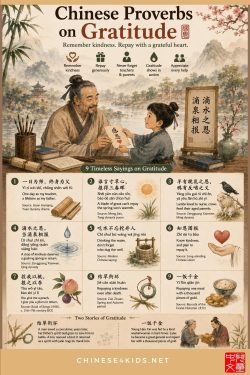
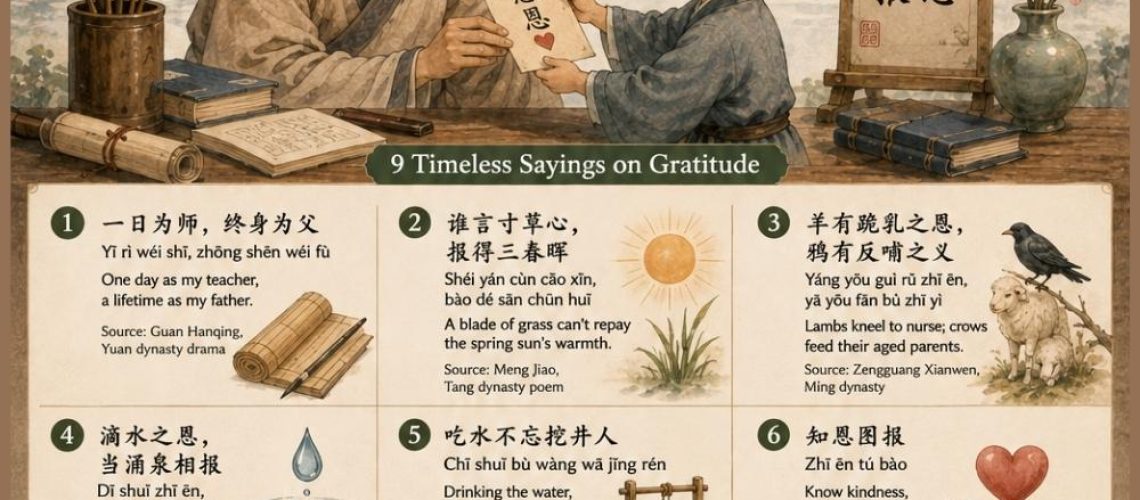
Chinese proverbs on gratitude focus on a few consistent ideas: remember who helped you, repay kindness generously rather than exactly, and never forget a teacher or parent who shaped who you became. Below are 9 genuine Chinese sayings on gratitude, each with the Chinese, pinyin, meaning, source, and a practical way to use it.
Chinese proverbs on gratitude focus on a few consistent ideas: remember who helped you, repay kindness generously rather than exactly, and never forget a teacher or parent who shaped who you became. Below are 9 genuine Chinese sayings on gratitude, each with the Chinese, pinyin, meaning, source, and a practical way to use it.
Gratitude runs deep in Chinese culture — toward parents, toward teachers, and toward anyone who helps you when you needed it. These sayings come from a wide span of Chinese history: a Tang dynasty poem about a mother sewing her son’s clothes, a Han dynasty general repaying an old kindness a thousand times over, and a Qing dynasty proverb collection still quoted today.
Each saying below comes with the Chinese, the pinyin, a plain meaning, its source, and a practical tip. We checked each one against its earliest identifiable source, and we’ve been upfront about the one saying here with a specific modern history worth knowing about.
What do Chinese proverbs say about gratitude?
- A teacher’s influence lasts a lifetime, even from a single lesson.
- A parent’s care can never be fully repaid, only appreciated.
- Kindness should be repaid generously, not just evenly.
- Remember the source of what you now have, even once it feels ordinary.
- Real gratitude shows up in action, not just words.
What is the most famous Chinese proverb on gratitude?
谁言寸草心,报得三春晖 (shéi yán cùn cǎo xīn, bào dé sān chūn huī) — “who can say a blade of grass repays the spring sun’s warmth?” — comes from one of the most beloved poems in Chinese literature, 游子吟 (“Song of the Wandering Son”) by the Tang poet Meng Jiao, about a mother’s love.
9 Chinese Proverbs and Sayings on Gratitude
| Chinese | Pinyin | Meaning in one line | Who it’s about | Source |
|---|---|---|---|---|
| 一日为师,终身为父 | Yī rì wéi shī, zhōng shēn wéi fù | One day as my teacher, a lifetime as my father. | Teachers | Guan Hanqing (关汉卿), Yuan dynasty drama |
| 谁言寸草心,报得三春晖 | Shéi yán cùn cǎo xīn, bào dé sān chūn huī | A blade of grass can’t repay the spring sun’s warmth. | Parents | Meng Jiao (孟郊), Tang dynasty poem |
| 羊有跪乳之恩,鸦有反哺之义 | Yáng yǒu guì rǔ zhī ēn, yā yǒu fǎn bǔ zhī yì | Lambs kneel to nurse; crows feed their aged parents. | Parents | Zengguang Xianwen (增广贤文), Ming dynasty |
| 滴水之恩,当涌泉相报 | Dī shuǐ zhī ēn, dāng yǒng quán xiāng bào | A drop of kindness deserves a gushing spring in return. | Anyone who helps you | Zengguang Xianwen (增广贤文), Qing dynasty folk collection |
| 吃水不忘挖井人 | Chī shuǐ bù wàng wā jǐng rén | Drinking the water, don’t forget who dug the well. | Whoever made your life easier | Modern Chinese saying — see note below |
| 知恩图报 | Zhī ēn tú bào | Know kindness, and plan to repay it. | General principle | Long-standing Chinese idiom |
| 投我以桃,报之以李 | Tóu wǒ yǐ táo, bào zhī yǐ lǐ | You give me a peach, I give you a plum in return. | Mutual kindness | Book of Songs (诗经), c. 11th–7th century BCE |
| 结草衔环 | Jié cǎo xián huán | Repaying a kindness even after death. | Deep, lasting loyalty | Zuo Zhuan (左传), Spring and Autumn period |
| 一饭千金 | Yī fàn qiān jīn | Repaying one meal with a thousand pieces of gold. | A life-changing kindness | Records of the Grand Historian (史记) |
Two New Stories Worth Knowing
The original version of this article had 6 short lines with no context. We’ve kept all 6 (with two small fixes — see the checklist at the end) and added two more, each with one of the richest gratitude stories in Chinese history.
结草衔环 — Devotion That Outlasts a Lifetime
📖 The story
This idiom actually combines two separate stories. In 结草 (“tying grass”), recorded in the Zuo Zhuan, a man spared his father’s concubine from being buried alive with his father, as tradition demanded. Years later, in battle, an old man’s ghost tied the grass into knots to trip up his enemy’s horse — the concubine’s late father, repaying the kindness from beyond the grave. In 衔环 (“holding a ring in the mouth”), a boy named Yang Bao nursed an injured yellow sparrow back to health; the sparrow later returned as a spirit, bringing him four jade rings as thanks, said to bring good fortune to his descendants for generations.
一饭千金 — Han Xin and the Washerwoman
📖 The story
As a poor young man, the future general Han Xin (韩信) was so hungry that an elderly washerwoman shared her own meager food with him for days, asking nothing in return. Years later, Han Xin became one of the most celebrated generals in Chinese history. When he returned to his hometown, he sought her out and rewarded her with a thousand pieces of gold — a debt of a few meals, repaid a thousand times over.
Which Saying Fits Your Situation?
Which Chinese proverb best expresses gratitude?
滴水之恩,当涌泉相报 is the broadest and most quoted — it captures the whole idea of repaying kindness generously, in any context.
Which proverb thanks a teacher?
一日为师,终身为父 is the clear choice — even a single day of teaching earns lifelong respect.
Which proverb is best for Mother’s Day?
谁言寸草心,报得三春晖, from Meng Jiao’s Tang dynasty poem about a mother’s love, is the most beautiful and most widely quoted option.
Which Chinese saying teaches children gratitude?
知恩图报 is the simplest starting point — four characters, easy to remember, and a clear first vocabulary word for the whole idea.
9 Chinese Proverbs on Gratitude, Explained
Saying 01 · Teachers
一日为师,终身为父
Yī rì wéi shī, zhōng shēn wéi fù
Even a single day as your teacher earns them a lifetime of respect, like a father. A strong statement about how seriously Chinese culture treats the teacher-student relationship.
In one sentence: a teacher’s impact deserves lifelong respect, however brief the lesson.
Origin: Guan Hanqing (关汉卿), Yuan dynasty playwright, in his drama Jade Mirror Stand (玉镜台); later made even more famous through the Ming novel Journey to the West (西游记). The saying itself is Yuan dynasty, but respecting teachers as deeply as parents is a much older Confucian idea.
Practical tip
A natural line for a teacher-appreciation card or Teachers’ Day message — genuinely more meaningful than a generic “thank you,” since it’s rooted in real cultural weight.
Saying 02 · Parents
谁言寸草心,报得三春晖
Shéi yán cùn cǎo xīn, bào dé sān chūn huī
Who can say a blade of grass repays the warmth of spring sunlight? A child’s gratitude, however heartfelt, can never fully repay a mother’s care.
In one sentence: some kindness — like a parent’s — is simply too large to repay evenly.
Origin: Meng Jiao (孟郊), Tang dynasty poet, from his poem Song of the Wandering Son (游子吟) — one of the most beloved poems in Chinese literature.
Practical tip
A beautiful one for Mother’s Day, or any moment a child wants to say thank you to a parent without it sounding generic.
Saying 03 · Parents
羊有跪乳之恩,鸦有反哺之义
Yáng yǒu guì rǔ zhī ēn, yā yǒu fǎn bǔ zhī yì
Lambs kneel to nurse from their mothers; crows feed their aged parents in return. Even animals show gratitude to their parents — so people certainly should too.
In one sentence: gratitude toward parents is treated as natural, not optional — even animals show it.
Origin: Zengguang Xianwen (增广贤文), Ming dynasty folk proverb collection. The crow detail also appears separately in Li Shizhen’s Ming-era natural history text, Compendium of Materia Medica (本草纲目).
Practical tip
A vivid, image-based one for young children — easy to draw, easy to remember, and a gentle way to introduce the idea that caring for aging parents is part of the whole cycle of family gratitude.
Saying 04 · Anyone who helps you
滴水之恩,当涌泉相报
Dī shuǐ zhī ēn, dāng yǒng quán xiāng bào
A drop of kindness should be repaid with a gushing spring. Even small favors deserve a generous, not just an equal, response.
In one sentence: repay kindness generously, not just evenly.
Origin: first written down in the Zengguang Xianwen (增广贤文), a Qing dynasty folk proverb collection; originally an older spoken saying.
Practical tip
A good one for teaching kids that “thank you” is a start, not the whole response — a small act of helping back means more.
Saying 05 · Whoever made your life easier
吃水不忘挖井人
Chī shuǐ bù wàng wā jǐng rén
When you drink the water, don’t forget who dug the well. A reminder not to take for granted the people whose past effort made your present life easier.
In one sentence: comfort you didn’t build yourself still came from somewhere.
Origin: a modern Chinese saying, best known through a story taught in Chinese elementary school textbooks since the 1950s, about a community well dug in a Jiangxi village in the 1930s to solve a local water shortage. See the note below. Outside mainland China, many Chinese speakers use it more broadly, simply to mean remembering whoever’s past effort benefits you today.
Practical tip
Useful for talking about infrastructure or effort a child benefits from but didn’t see — the person who built the school, planted the tree that gives shade, or wrote the book they’re reading.
Saying 06 · General principle
知恩图报
Zhī ēn tú bào
Recognize kindness, and plan to repay it. This four-character idiom reminds us that gratitude should lead to action, not just good feelings.
In one sentence: gratitude isn’t complete until it turns into action.
Origin: a long-standing Chinese idiom (成语), in wide everyday use; not traced to one specific classical text.
Practical tip
A simple, memorable phrase to teach young kids as a starting vocabulary word for the whole idea of gratitude.
Saying 07 · Mutual kindness
投我以桃,报之以李
Tóu wǒ yǐ táo, bào zhī yǐ lǐ
You give me a peach, I give you a plum. A gentle image of kindness exchanged between equals, back and forth.
In one sentence: kindness between friends and neighbors is meant to flow both ways.
Origin: Book of Songs (诗经·大雅·抑), one of the oldest surviving collections of Chinese poetry, roughly 11th–7th century BCE.
Practical tip
A good one for friendships — returning a favor, a playdate, or a kind gesture doesn’t need to be identical, just genuine.
Saying 08 · Deep, lasting loyalty
结草衔环
Jié cǎo xián huán
Tying grass, holding a ring — repaying a kindness so deeply it lasts even beyond death. See the two full stories above.
In one sentence: real gratitude can outlast the person who felt it.
Origin: Zuo Zhuan (左传), Spring and Autumn period, for 结草; the 衔环 half comes from a later Six Dynasties-era story about Yang Bao.
Practical tip
A rich one for older kids — use it to talk about gratitude that shows up in how someone lives, not just what they say, long after the original kindness.
Saying 09 · A life-changing kindness
一饭千金
Yī fàn qiān jīn
Repaying a single meal with a thousand pieces of gold. See the Han Xin story above — one of the most famous gratitude stories in Chinese history.
In one sentence: a kindness given with nothing expected in return can still be repaid generously, years later.
Origin: Records of the Grand Historian (史记·淮阴侯列传), Han dynasty.
Practical tip
Tell the full Han Xin story before introducing the four characters — it’s a genuinely moving one, and it lands better as a story than as a line to memorize.
Who Gets the Most Out of These Sayings
Teacher-appreciation notes and gifts
一日为师,终身为父 gives a card genuine cultural weight, not just a generic “thanks.”
一日为师,终身为父 gives a card genuine cultural weight, not just a generic “thanks.”
Mother’s Day or Father’s Day
谁言寸草心,报得三春晖 is one of the most beautiful, most quoted lines about parental love in Chinese literature.
谁言寸草心,报得三春晖 is one of the most beautiful, most quoted lines about parental love in Chinese literature.
Teaching young kids the idea of gratitude
知恩图报 and 滴水之恩,当涌泉相报 are simple and memorable starting points.
知恩图报 and 滴水之恩,当涌泉相报 are simple and memorable starting points.
Older kids and teens who enjoy a good story
结草衔环 and 一饭千金 both carry real historical stories with genuine emotional weight.
结草衔环 and 一饭千金 both carry real historical stories with genuine emotional weight.
How to Actually Use These Sayings
| Setting | How to use it | Good saying to start with |
|---|---|---|
| A card or message for a teacher | Use as the closing line, with a short personal note above it. | 一日为师,终身为父 |
| Mother’s Day / Father’s Day | Say it out loud, or write it inside a card. | 谁言寸草心,报得三春晖 |
| Teaching a young child to say thank you meaningfully | Pair the phrase with one small action, not just words. | 知恩图报 |
| Talking about not taking things for granted | Ask who “dug the well” for something the child uses every day. | 吃水不忘挖井人 |
| Bedtime or classroom storytelling | Tell the full story first, then introduce the four-character idiom. | 结草衔环 or 一饭千金 |
Tell the Story First, Teach the Saying Second
Stories are what make these sayings memorable — for teachers, because stories stick; for parents, because they naturally start a conversation. Tell the story, then ask one open question before revealing the four-character idiom.
One discussion question per saying
| Saying | Discussion question |
|---|---|
| 一日为师,终身为父 | Who is a teacher you’ll remember for the rest of your life? |
| 谁言寸草心,报得三春晖 | What’s one thing your mom or dad does for you that you don’t always notice? |
| 羊有跪乳之恩,鸦有反哺之义 | How could you take care of your parents the way they took care of you? |
| 滴水之恩,当涌泉相报 | Is saying “thank you” enough? What else could you do? |
| 吃水不忘挖井人 | Can you think of someone who “dug the well” for you today? |
| 知恩图报 | What is one kind thing someone has done for you this week? |
| 投我以桃,报之以李 | Have you ever done something kind for a friend just because they were kind to you first? |
| 结草衔环 | Why do you think people still tell this story, even though it’s thousands of years old? |
| 一饭千金 | Why did Han Xin remember the washerwoman for so many years? |
Classroom Extensions
For teachers who want to turn a saying into a short lesson rather than just a quote on the wall.
| Saying | Key vocabulary | Grammar focus | Writing task |
|---|---|---|---|
| 知恩图报 | 恩 (ēn, kindness) · 报 (bào, repay) | 知 + noun + 图 + verb pattern | Write two sentences using 知恩图报. |
| 一日为师,终身为父 | 师 (shī, teacher) · 父 (fù, father) | 一 + measure word + 为 + noun (temporary role) | Write a two-sentence thank-you note to a teacher. |
| 滴水之恩,当涌泉相报 | 恩 (ēn) · 报 (bào) — same pair as 知恩图报, reinforcing the character | 当……相…… (should, in return) | Describe one small kindness and how you’d repay it “like a spring.” |
5 Easy Ways to Teach Gratitude Through Chinese Sayings
Read one at bedtime
Pick a saying with a story — 结草衔环 or 一饭千金 — and tell it as a bedtime story, not a lesson.
Pick a saying with a story — 结草衔环 or 一饭千金 — and tell it as a bedtime story, not a lesson.
Connect it to today
Ask what happened today that the saying could apply to — a friend’s favor, a teacher’s patience.
Ask what happened today that the saying could apply to — a friend’s favor, a teacher’s patience.
Draw the story
Younger kids especially respond to drawing the lamb kneeling, or Han Xin meeting the washerwoman again.
Younger kids especially respond to drawing the lamb kneeling, or Han Xin meeting the washerwoman again.
Act it out
A simple two-person skit of 投我以桃,报之以李 — one child offers something, the other offers something back.
A simple two-person skit of 投我以桃,报之以李 — one child offers something, the other offers something back.
Write a real thank-you note
Use one saying as the closing line of an actual note to a real person — a teacher, a grandparent, a friend.
Use one saying as the closing line of an actual note to a real person — a teacher, a grandparent, a friend.
Frequently Asked Questions
What are the most well-known Chinese proverbs about gratitude?
Among the most quoted are 谁言寸草心,报得三春晖 (a child’s gratitude can’t repay a mother’s care), 滴水之恩,当涌泉相报 (repay kindness generously), and 一日为师,终身为父 (respect a teacher for life). All 9 are listed above with pinyin and meaning.
Are these genuine Chinese sayings?
Yes. Most trace to a named source — the Book of Songs, a Tang dynasty poem, the Zuo Zhuan, the Records of the Grand Historian, and a Yuan dynasty drama. Two (知恩图报 and 滴水之恩,当涌泉相报) are long-standing idioms and folk sayings, and we’ve labeled them as such rather than inventing a source.
What’s the story behind 吃水不忘挖井人?
It refers to a well dug in the 1930s in a Jiangxi village facing a water shortage, an effort associated with Mao Zedong during his time there. The story has been taught in Chinese elementary school textbooks since the 1950s. It’s worth knowing this saying carries a specific modern historical and political association, unlike the older classical sayings on this list.
What’s the story behind 一饭千金?
It comes from the life of Han Xin, a famous Han dynasty general. As a poor young man, he was fed by an elderly washerwoman with nothing expected in return. Years later, as a celebrated general, he repaid her with a thousand pieces of gold. See the full story above.
Are these sayings suitable for children?
Yes, especially with the plain-English meaning explained alongside. 结草衔环 and 一饭千金 work particularly well told as short stories, with the four-character idiom introduced at the end.
Where can I find more Chinese quotes and sayings for kids?
See our Chinese Quotes collection, or our companion pieces on Confucius Sayings on Education, Chinese proverbs on friendship, Chinese sayings about life, Chinese Proverbs about Teaching and Learning, Chinese proverbs on time, and 7 wise Chinese sayings worth knowing.
Key takeaways
- 9 genuine Chinese sayings on gratitude, spanning the Book of Songs (c. 11th century BCE) to a modern 20th-century saying.
- 谁言寸草心,报得三春晖 (Meng Jiao’s Tang poem about a mother’s love) is likely the single most beautiful and most quoted.
- 结草衔环 and 一饭千金 both carry rich, genuinely moving stories worth telling in full, not just quoting.
- 吃水不忘挖井人 carries a specific modern political and historical association — flagged honestly rather than glossed over.
- The throughline across all 9: remember who helped you, and repay it generously, not just evenly.
A note on resources
Gratitude toward teachers is a natural theme for a classroom, not just a single lesson. Our Chinese Lesson Plans give teachers ready-made, theme-based material if you’d like to build a full lesson around any of these sayings. If you want a hands-on way to turn “write a thank-you note” (from the section above) into something real, our Chinese Thank-You Coloring Cards give kids a ready-made 谢谢 card to color and give.
If you like this article, share it
Explore More on Chinese4kids
- How to Say Thank You in Chinese Like a Native The everyday spoken side of gratitude — natural phrases, not just proverbs.
- Thank You: A Chinese Children’s Song A song version of gratitude, for younger kids who learn best through music.
- 12 Chinese Proverbs on Friendship Including 管鲍之交, one of the richest friendship stories in Chinese history.
- 12 Chinese Sayings About Life More genuine Chinese wisdom, on lifelong learning and life’s natural ups and downs.
- 8 Confucius Sayings on Education Every line traced to its exact chapter in the Analects.
- Chinese Proverbs about Teaching and Learning capture centuries of practical wisdom — that growth takes time, that method matters more than answers, and that effort beats talent.
- How to Say Congratulations in Chinese Like a Native Another everyday-phrase companion piece, for a different social moment.