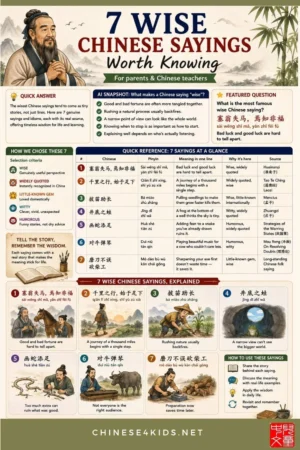
Quick answer
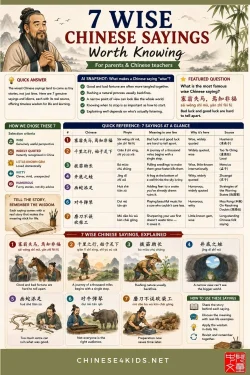
The wisest Chinese sayings tend to come as tiny stories, not just lines — a farmer who ruins his crop by rushing it, a horse that turns bad luck into good, a musician playing beautiful music to an uninterested cow. Below are 7 genuine Chinese sayings and idioms, each verified against its real source, chosen for being wise, widely quoted, cleverly told, or all three.
The wisest Chinese sayings tend to come as tiny stories, not just lines — a farmer who ruins his crop by rushing it, a horse that turns bad luck into good, a musician playing beautiful music to an uninterested cow. Below are 7 genuine Chinese sayings and idioms, each verified against its real source, chosen for being wise, widely quoted, cleverly told, or all three.
Chinese idioms work differently from a lot of Western quotes. Instead of a single clever line, most carry a whole compressed story — a farmer, a snake-drawing contest, a musician and a cow — that gives the four characters their punch. That makes them unusually good material for parents and teachers: tell the story once, and the saying sticks for good.
Contents
hide
What makes a Chinese saying “wise”?
- Good and bad fortune are often more tangled together than they first appear.
- Rushing a natural process to “help” it usually backfires.
- A narrow point of view can look like the whole world, to whoever’s stuck in it.
- Knowing when to stop is as important as knowing how to start.
- Explaining something well depends on who’s actually listening.
What is the most famous wise Chinese saying?
塞翁失马,焉知非福 (sài wēng shī mǎ, yān zhī fēi fú) — “When the old man at the frontier lost his horse, how could he know it wasn’t good fortune?” — is one of the most quoted Chinese sayings about fortune and misfortune, built on one of the best-loved short stories in Chinese folklore.
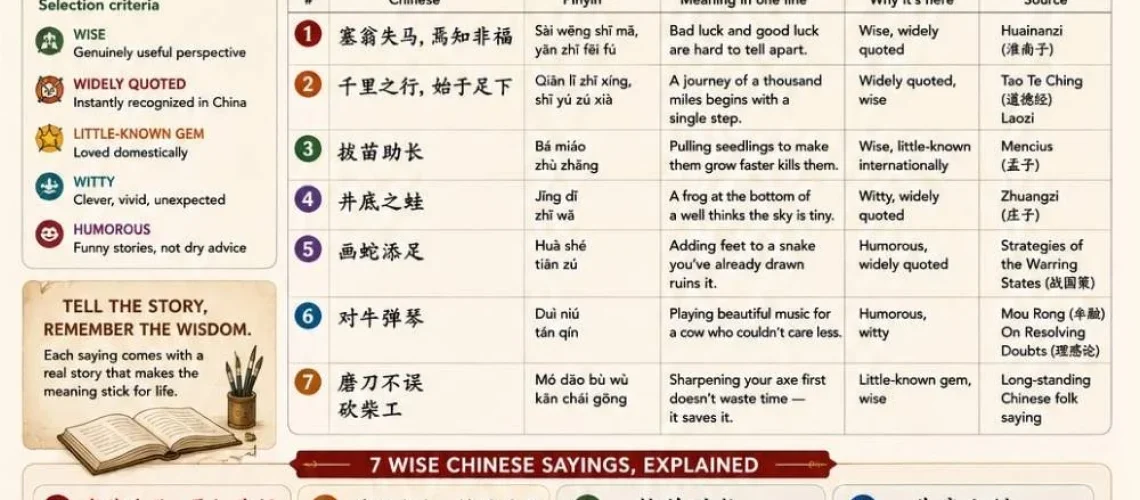
How We Chose These 7 Sayings
We looked for sayings that hit at least one of these marks — several hit three or four:
- Wise genuinely useful perspective, not just a nice-sounding line
- Widely quoted sayings a Chinese speaker would instantly recognize
- Little-known gem less famous internationally, but well loved domestically
- Witty clever, vivid, or unexpected in how it makes its point
- Humorous genuinely funny stories, not just dry advice
Every saying below is also independently verified against a real source — a classical text, a specific author, or (for the one folk saying on this list) an honest label that it doesn’t trace to a single text.
7 Wise Chinese Sayings and Idioms
| Chinese | Pinyin | Meaning in one line | Why it’s here | Source |
|---|---|---|---|---|
| 塞翁失马,焉知非福 | Sài wēng shī mǎ, yān zhī fēi fú | Bad luck and good luck are hard to tell apart. | Wise, widely quoted | Huainanzi (淮南子) |
| 千里之行,始于足下 | Qiān lǐ zhī xíng, shǐ yú zú xià | A journey of a thousand miles begins with a single step. | Widely quoted, wise | Tao Te Ching (道德经), Laozi |
| 拔苗助长 | Bá miáo zhù zhǎng | Pulling seedlings to make them grow faster kills them. | Wise, little-known internationally | Mencius (孟子) |
| 井底之蛙 | Jǐng dǐ zhī wā | A frog at the bottom of a well thinks the sky is tiny. | Witty, widely quoted | Zhuangzi (庄子) |
| 画蛇添足 | Huà shé tiān zú | Adding feet to a snake you’ve already drawn ruins it. | Humorous, widely quoted | Strategies of the Warring States (战国策) |
| 对牛弹琴 | Duì niú tán qín | Playing beautiful music for a cow who couldn’t care less. | Humorous, witty | Mou Rong (牟融), On Resolving Doubts (理惑论) |
| 磨刀不误砍柴工 | Mó dāo bù wù kǎn chái gōng | Sharpening your axe first doesn’t waste time — it saves it. | Little-known gem, wise | Long-standing Chinese folk saying |
7 Wise Chinese Sayings, Explained
Saying 01 · Wise, widely quoted
塞翁失马,焉知非福
Sài wēng shī mǎ, yān zhī fēi fú
When the old man at the frontier lost his horse, how could he know it wasn’t good fortune? A reminder that what looks like bad luck in the moment can turn out well — and vice versa.
In one sentence: you often can’t tell if something is good or bad luck until much later.
Origin: Huainanzi (淮南子·人间训), a 2nd-century BCE philosophical text.
📖 The story
An old man living near the northern frontier lost his horse — his neighbors offered sympathy, but he said, “who’s to say this isn’t good luck?” Months later, the horse returned, bringing a fine wild horse with it. Neighbors congratulated him — he said, “who’s to say this isn’t bad luck?” His son later broke his leg riding the wild horse. Neighbors offered sympathy again — same response. When war broke out, every able-bodied young man was drafted and most died in battle — but the son, with his broken leg, stayed home and survived.
Practical tip
Use this the next time a setback happens — a bad grade, a cancelled plan. You genuinely don’t know yet how it fits into the bigger picture.
Use this the next time a setback happens — a bad grade, a cancelled plan. You genuinely don’t know yet how it fits into the bigger picture.
Saying 02 · Widely quoted
千里之行,始于足下
Qiān lǐ zhī xíng, shǐ yú zú xià
A journey of a thousand miles begins with a single step. Possibly the most internationally recognized Chinese saying, often quoted (and sometimes misattributed) in English, but genuinely from Laozi.
In one sentence: any huge goal is really just a first small step, repeated.
Origin: Tao Te Ching (道德经), chapter 64, attributed to Laozi (老子).
Practical tip
Genuinely useful for a child overwhelmed by “learning Chinese” as a giant goal. Reframe it as today’s one small step — five new characters, one sentence — not the whole mountain at once.
Genuinely useful for a child overwhelmed by “learning Chinese” as a giant goal. Reframe it as today’s one small step — five new characters, one sentence — not the whole mountain at once.
Saying 03 · Wise, especially for parents
拔苗助长
Bá miáo zhù zhǎng
Pulling seedlings up to help them grow faster. A warning against rushing a natural process — the “help” actually kills it.
In one sentence: forcing progress faster than it can naturally go usually destroys it.
Origin: Mencius (孟子·公孙丑上), Warring States period.
📖 The story
A farmer in the state of Song was frustrated that his rice seedlings weren’t growing fast enough. So he went out to the field and physically pulled each one up a little, to “help” it along. Exhausted, he came home and proudly told his family he’d helped the crop grow taller that day. His son ran out to check — every seedling had died.
Practical tip
Worth remembering for any parent pushing a child to speak or read Chinese faster than feels natural. This 2,300-year-old farmer’s mistake is a strikingly modern parenting warning.
Worth remembering for any parent pushing a child to speak or read Chinese faster than feels natural. This 2,300-year-old farmer’s mistake is a strikingly modern parenting warning.
Saying 04 · Witty, widely quoted
井底之蛙
Jǐng dǐ zhī wā
A frog living at the bottom of a well. To the frog, the small circle of sky above the well looks like the entire sky — because it’s never seen more.
In one sentence: a narrow view of the world can feel complete to whoever’s stuck inside it.
Origin: Zhuangzi (庄子·秋水), Warring States period.
📖 The story
A frog living in a shallow well boasts to a passing sea turtle about how wonderful his small world is — the water, the mud, the little patch of sky above. When the turtle tries to describe the vastness of the ocean, the frog can’t even fit the idea in his head. The well itself becomes the joke: the frog isn’t wrong about what he’s seen, just about how much there is he hasn’t.
Practical tip
A gentle way to talk about why travel, books, or meeting new people matter — not to make a child feel small, but to explain why “the world is bigger than what I already know” is worth staying curious about.
A gentle way to talk about why travel, books, or meeting new people matter — not to make a child feel small, but to explain why “the world is bigger than what I already know” is worth staying curious about.
Saying 05 · Humorous, widely quoted
画蛇添足
Huà shé tiān zú
Drawing a snake, then adding feet to it. Doing extra, unnecessary work that ends up ruining something that was already finished.
In one sentence: knowing when to stop is its own skill.
Origin: Strategies of the Warring States (战国策·齐策二).
📖 The story
A group of men were given a jug of wine, with the rule that whoever finished drawing a snake first would win it. One man finished well ahead of everyone else — and, seeing he had time to spare, decided to show off by adding feet to his snake. While he was still drawing, another man finished his own (foot-less) snake and grabbed the wine, pointing out: “snakes don’t have feet — so this was never your snake to begin with.”
Practical tip
A genuinely funny one to use when a child (or a parent) keeps “improving” homework that was already done well. Sometimes finished really is finished.
A genuinely funny one to use when a child (or a parent) keeps “improving” homework that was already done well. Sometimes finished really is finished.
Saying 06 · Humorous, witty
对牛弹琴
Duì niú tán qín
Playing a beautiful melody on the guqin for a cow, who keeps right on grazing. Explaining something well to the wrong audience is a waste of the explanation, not a failure of the explainer.
In one sentence: the best explanation still fails if it’s aimed at the wrong listener.
Origin: Mou Rong (牟融), On Resolving Doubts (理惑论), Han dynasty — later collected in the Hongming Ji (弘明集).
📖 The story
The musician Gongming Yi once played an elegant, refined melody for a grazing cow, hoping to share something beautiful. The cow didn’t look up — it just kept eating. Mou Rong used this story to explain why he taught Confucian scholars using ideas they already knew, rather than unfamiliar Buddhist concepts they had no context for: matching the message to the listener isn’t a compromise, it’s the whole point.
Practical tip
Useful for teachers pitching a lesson at the wrong level — the content might be excellent, but if it’s above or below where a child actually is, restructure the explanation, not the child’s attention span.
Useful for teachers pitching a lesson at the wrong level — the content might be excellent, but if it’s above or below where a child actually is, restructure the explanation, not the child’s attention span.
Saying 07 · Little-known gem, practical
磨刀不误砍柴工
Mó dāo bù wù kǎn chái gōng
Sharpening your axe doesn’t delay the work of chopping wood — it makes the actual chopping faster. Time spent preparing isn’t wasted time.
In one sentence: good preparation speeds things up, it doesn’t slow them down.
Origin: a long-standing Chinese folk saying, in everyday use across mainland China and Taiwan; not traced to a single classical text.
Practical tip
A good one for study habits — five minutes organizing what to review before a Chinese lesson usually saves far more than five minutes once the lesson actually starts.
A good one for study habits — five minutes organizing what to review before a Chinese lesson usually saves far more than five minutes once the lesson actually starts.
Who Gets the Most Out of These Sayings
- Parents feeling impatient with progress
拔苗助长 and 磨刀不误砍柴工 both speak directly to the temptation to rush a child’s learning. - Teachers wanting classroom stories, not just quotes
画蛇添足, 对牛弹琴, and 井底之蛙 all come with a genuinely tellable short story, not just a line to memorize. - Kids going through a setback
塞翁失马,焉知非福 is one of the gentlest, most reassuring sayings on this list for a hard day. - Older kids and teens who enjoy wit
画蛇添足 and 对牛弹琴 both reward genuine amusement, not just moral-of-the-story reading.
How to Actually Use These Sayings
| Setting | How to use it | Good saying to start with |
|---|---|---|
| After bad news or a setback | Use to open a calm, non-dismissive conversation about the situation. | 塞翁失马,焉知非福 |
| A big goal feels overwhelming | Reframe the goal as today’s single next step. | 千里之行,始于足下 |
| You’re tempted to push too hard | A quiet personal check before pressuring a child further. | 拔苗助长 |
| Classroom storytelling time | Tell the full story, then reveal the four-character idiom at the end. | 画蛇添足 or 对牛弹琴 |
| Before starting homework or a lesson | Use as a reason to spend a few minutes preparing first. | 磨刀不误砍柴工 |
Frequently Asked Questions
What are the wisest Chinese sayings?
Among the most quoted are 塞翁失马,焉知非福 (fortune and misfortune are hard to tell apart), 千里之行,始于足下 (a journey begins with one step), and 拔苗助长 (rushing growth backfires). All 7 in this article are listed above with pinyin, meaning, and source.
Are these genuine Chinese sayings?
Yes — each one is verified against a real source: the Huainanzi, the Tao Te Ching, Mencius, Zhuangzi, the Strategies of the Warring States, and a Han dynasty essay. One (磨刀不误砍柴工) is an honest folk saying without a single fixed text, and we’ve labeled it as such.
What’s the difference between a Chinese saying and a Chinese idiom (chengyu)?
Chengyu (成语) are compact, usually four-character idioms that compress a whole story into a short phrase — 拔苗助长, 井底之蛙, and 画蛇添足 are all chengyu. Longer sayings like 塞翁失马,焉知非福 are closer to full proverbs (谚语), even though they carry a story too.
Which of these sayings is funniest?
画蛇添足 (adding feet to a finished snake drawing) and 对牛弹琴 (playing beautiful music for an indifferent cow) are both genuinely funny stories, not just morals dressed up as jokes.
Are these sayings suitable for young children?
Yes, especially the ones with a full story — 塞翁失马, 拔苗助长, 井底之蛙, 画蛇添足, and 对牛弹琴 all work well told as short stories, with the four-character idiom introduced at the end.
Where can I find more Chinese quotes and sayings for kids?
See our Chinese Quotes collection, or our companion pieces on Chinese sayings about life, Chinese proverbs on friendship, and 8 Confucius sayings on education.
Key takeaways
- All 7 new sayings are verified genuine Chinese, most from named classical texts (Huainanzi, Tao Te Ching, Mencius, Zhuangzi, Strategies of the Warring States, a Han dynasty essay).
- 5 of the 7 come with a real, tellable short story — better for classroom or bedtime storytelling than a bare quote.
- 拔苗助长 and 磨刀不误砍柴工 speak directly to parents tempted to rush a child’s learning.
- 塞翁失马,焉知非福 is the single most useful one for reframing a setback without dismissing how it feels.
A note on resources
Idiom stories like these work especially well as classroom material, since the story does most of the teaching. Our Chinese Lesson Plans give teachers ready-made, theme-based content if you’d like to build a full storytelling lesson around one of these rather than starting from scratch. For a broader, ongoing supply of classroom and home-learning material, our Chinese Teaching Made Easy Membership covers character and culture topics like these alongside core vocabulary.
If you like this post, share it
Explore More on Chinese4kids
- 12 Chinese Sayings About Life More genuine Chinese wisdom, on lifelong learning, imperfection, and life’s natural ups and downs.
- 12 Chinese Proverbs on Friendship Including 管鲍之交, one of the richest friendship stories in Chinese history.
- 8 Confucius Sayings on Education Every line traced to its exact chapter in the Analects.
- 16 Chinese Proverbs on Teaching and Learning A broader collection spanning classical texts and folk wisdom.
- China and Chinese Culture More on the history and culture behind the language.