Quick answer
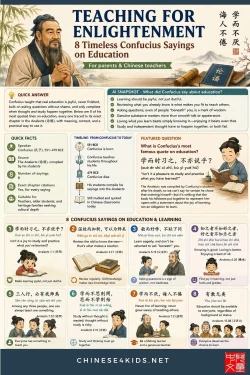
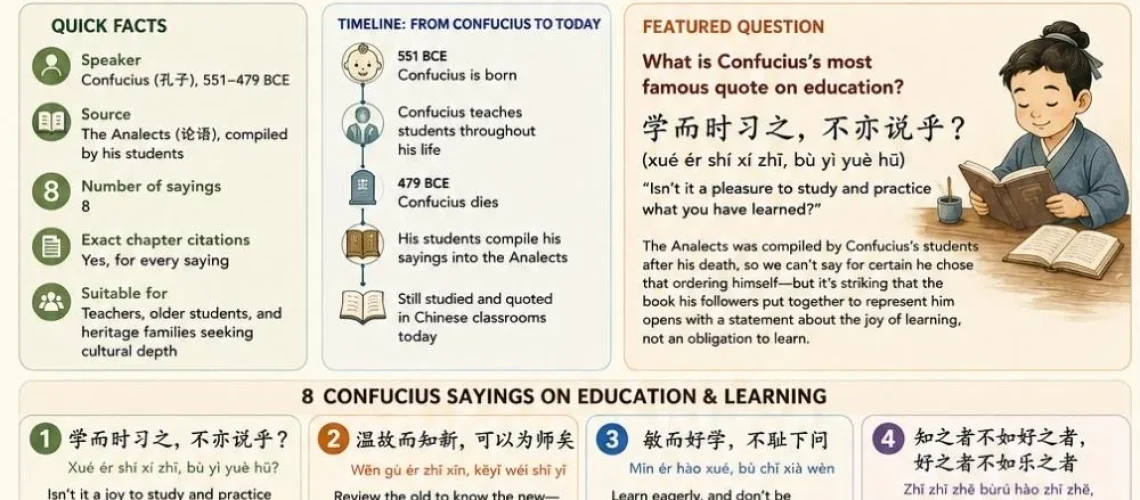
Confucius taught that real education is joyful, never finished, built on asking questions without shame, and only complete when thought and study happen together. Below are 8 of his most quoted lines on education, every one traced to its exact chapter in the Analects (论语), with meaning, context, and a practical way to use it.
Confucius taught that real education is joyful, never finished, built on asking questions without shame, and only complete when thought and study happen together. Below are 8 of his most quoted lines on education, every one traced to its exact chapter in the Analects (论语), with meaning, context, and a practical way to use it.
Confucius (孔子), also called Kong Fuzi (孔夫子) or Master Kong, lived from 551 to 479 BCE, during China’s Spring and Autumn period. Unlike most of the sayings on Chinese4kids, every line in this article comes from a single named source: the Analects (论语), a record of his conversations compiled by his students after his death.
That single source is what makes this collection different from our other proverb roundups — instead of drawing from many centuries and authors, every saying below can be traced to an exact chapter and verse, and several come with a real story behind them.
What did Confucius say about education?
- Learning should be joyful, not just dutiful.
- Reviewing what you already know is what makes you fit to teach others.
- Asking questions, even of people “beneath” you, is a mark of wisdom, not weakness.
- Genuine substance matters more than smooth talk or a polished appearance.
- Loving what you learn beats simply knowing it — and enjoying it beats even that.
- Study and independent thought have to happen together, or both fail.
Featured question · What is Confucius’s most famous quote on education?
The opening line of the entire Analects is about education: 学而时习之,不亦说乎 (xué ér shí xí zhī, bù yì yuè hū) — “Isn’t it a pleasure to study and practice what you have learned?” The Analects was compiled by Confucius’s students after his death, so we can’t say for certain he chose that ordering himself — but it’s striking that the book his followers put together to represent him opens with a statement about the joy of learning, not an obligation to learn.
Quick facts
| Speaker | Confucius (孔子), 551–479 BCE |
|---|---|
| Source | The Analects (论语), compiled by his students |
| Number of sayings | 8 |
| Includes exact chapter citations | Yes, for every saying |
| Suitable for | Teachers, older students, and heritage families wanting deeper cultural context |
Who Was Confucius?
Brief background
Confucius was a philosopher, teacher, and political figure who lived during China’s Spring and Autumn period. His ideas became the foundation of Confucianism — a system of thought built around moral character, filial piety, respect, and the deliberate cultivation of virtue.
He wasn’t a distant, abstract philosopher. He was a working teacher, and education — what it’s for, how to do it well, what makes a good student and a good teacher — was one of his most consistent subjects. The Analects is our earliest and most important source for his teachings, gathered by his students after he died.
A note about these sayings
These lines were written more than 2,000 years ago, in Classical Chinese — a language that packs a lot of meaning into very few characters. Because of that, different English translations of the same line can look quite different from each other, and none of them is the single “correct” one. The translations below aim to stay close to the original meaning while reading naturally for parents, teachers, and older children. If you come across a different translation elsewhere, that’s normal, not a mistake.
Timeline: from Confucius to today
551 BCE — Confucius is born
↓
Confucius teaches students throughout his life
↓
479 BCE — Confucius dies
↓
His students compile his sayings into the Analects
↓
Still studied and quoted in Chinese classrooms today
Why Are Confucius’s Educational Ideas Still Relevant Today?
Although Confucius lived more than 2,500 years ago, many of his ideas still match modern teaching. Regular review, curiosity, asking questions, and enjoying learning are all supported by today’s educational research — under different names, like retrieval practice, spaced practice, reflective learning, and metacognition.
That doesn’t mean nothing has changed. Modern classrooms also value things Confucius’s era didn’t emphasize the same way — individual learning differences, structured feedback, and evidence-based teaching methods among them. The overlap is real, but it’s worth treating as a striking resonance rather than a claim that Confucius anticipated modern pedagogy.
Common Misunderstandings About Confucius Quotes
Confucius didn’t invent every proverb attributed to him.
Many popular “Confucius says” quotes online are folk sayings, mistranslations, or invented entirely — not from the Analects at all.
Not every quote attributed to Confucius is authentic, even in Chinese-language sources.
Some lines get attached to his name simply because they sound wise. Every saying in this article is checked against its actual Analects chapter.
Different English translations are normal, not a sign of error.
Classical Chinese is intentionally concise, and translators make real interpretive choices — there’s rarely one single “correct” English version.
Classical Chinese reads very differently from modern Mandarin.
A line like 学而时习之 uses grammar and vocabulary a modern Chinese speaker wouldn’t use in daily conversation, even though every character is still recognizable.
Quick Reference: 8 Confucius Quotes on Education and Learning
| Chinese | Pinyin | Meaning in one line | Analects source |
|---|---|---|---|
| 学而时习之,不亦说乎? | Xué ér shí xí zhī, bù yì yuè hū? | Isn’t it a joy to study and practice what you’ve learned? | 1.1 (学而) — the opening line of the book |
| 温故而知新,可以为师矣 | Wēn gù ér zhī xīn, kěyǐ wéi shī yǐ | Review the old to know the new — that’s what makes a teacher. | 2.11 (为政) |
| 敏而好学,不耻下问 | Mǐn ér hào xué, bù chǐ xià wèn | Learn eagerly, and don’t be ashamed to ask people “beneath” you. | 5.15 (公冶长) |
| 知之者不如好之者,好之者不如乐之者 | Zhī zhī zhě bùrú hào zhī zhě, hào zhī zhě bùrú lè zhī zhě | Knowing beats nothing; loving beats knowing; enjoying beats loving. | 6.20 (雍也) |
| 三人行,必有我师焉 | Sān rén xíng, bì yǒu wǒ shī yān | Among any three people, one can always teach me something. | 7.22 (述而) |
| 学而不思则罔,思而不学则殆 | Xué ér bù sī zé wǎng, sī ér bù xué zé dài | Study without thought is wasted; thought without study is risky. | 2.15 (为政) |
| 学而不厌,诲人不倦 | Xué ér bù yàn, huì rén bù juàn | Never tire of learning; never grow weary of teaching others. | 7.2 (述而) |
| 有教无类 | Yǒu jiào wú lèi | Everyone deserves an education, regardless of background. | 15.38 (卫灵公) |
A note on overlap: two of these — 三人行,必有我师焉 and 学而不思则罔,思而不学则殆 — also appear in our 16 Chinese Proverbs on Teaching and Learning article, since they’re among the most quoted lines in Chinese education culture. This article’s angle is different: every single saying here comes from one named source, with an exact chapter citation and, where one exists, the real story behind it — rather than a broader mix of classical and folk sayings.
8 Confucius Sayings on Education, Explained
Saying 01 · The joy of learning
学而时习之,不亦说乎?
Xué ér shí xí zhī, bù yì yuè hū?
Isn’t it a pleasure to study something and then practice it? The very first line of the Analects frames learning as a source of joy, not a chore.
In one sentence: real learning should feel good, not just necessary.
Source: Analects 1.1 (学而篇) — the opening line of the entire book.
💡 In Today’s Classroom
Notice when your child is genuinely enjoying a Chinese lesson, not just completing it, and say so out loud. It reinforces that the goal is enjoyment, not just correctness. With younger or beginner learners, it’s usually more effective to introduce the modern-English idea first, and bring in the original Classical Chinese wording later, once reading confidence has grown.
Notice when your child is genuinely enjoying a Chinese lesson, not just completing it, and say so out loud. It reinforces that the goal is enjoyment, not just correctness. With younger or beginner learners, it’s usually more effective to introduce the modern-English idea first, and bring in the original Classical Chinese wording later, once reading confidence has grown.
Saying 02 · Learning as an ongoing practice
温故而知新,可以为师矣
Wēn gù ér zhī xīn, kěyǐ wéi shī yǐ
By reviewing what’s old, you come to understand what’s new — and that’s what qualifies someone to teach.
In one sentence: real understanding comes from returning to material, not just moving past it.
Source: Analects 2.11 (为政篇).
💡 In Today’s Classroom
Build five minutes of review into every lesson before new material. It’s not wasted time — by this saying’s logic, it’s what makes new learning actually stick.
Build five minutes of review into every lesson before new material. It’s not wasted time — by this saying’s logic, it’s what makes new learning actually stick.
Saying 03 · Humility in learning
敏而好学,不耻下问
Mǐn ér hào xué, bù chǐ xià wèn
Be quick and eager to learn, and don’t be ashamed to ask questions of people with less status or knowledge than you.
In one sentence: asking a “beneath you” question is a sign of wisdom, not weakness.
Source: Analects 5.15 (公冶长篇).
📖 Historical Background
Confucius’s student Zigong once asked why a Wei dynasty official, Kong Wenzi, had been given the posthumous title “文” (cultured, learned) — an unusually high honor. Confucius’s answer was this line: Kong Wenzi earned it because he stayed eager to learn and was never too proud to ask questions of people below his own rank.
💡 In Today’s Classroom
Model asking your child a genuine question about something they know better than you — a game, a show, a Chinese word you’re unsure of. It shows humility in learning isn’t just for kids.
Model asking your child a genuine question about something they know better than you — a game, a show, a Chinese word you’re unsure of. It shows humility in learning isn’t just for kids.
Saying 04 · Loving what you learn
知之者不如好之者,好之者不如乐之者
Zhī zhī zhě bùrú hào zhī zhě, hào zhī zhě bùrú lè zhī zhě
Those who merely know something aren’t as good as those who love it. Those who love it aren’t as good as those who genuinely enjoy it.
In one sentence: enjoyment is a deeper form of mastery than knowledge alone.
Source: Analects 6.20 (雍也篇).
💡 In Today’s Classroom
If a child “knows” their Chinese vocabulary but doesn’t enjoy using it, that’s worth addressing directly — find one activity (a game, a show, a food) that makes the language something to enjoy, not just something to know.
If a child “knows” their Chinese vocabulary but doesn’t enjoy using it, that’s worth addressing directly — find one activity (a game, a show, a food) that makes the language something to enjoy, not just something to know.
Saying 05 · Learning from everyone
三人行,必有我师焉
Sān rén xíng, bì yǒu wǒ shī yān
Among any three people walking together, one of them can always teach me something. Full line continues: “I follow what’s good in them, and correct in myself what’s not.”
In one sentence: everyone you meet has something to teach you, if you’re paying attention.
Source: Analects 7.22 (述而篇).
💡 In Today’s Classroom
Pair kids up for peer teaching in class, or ask siblings to teach each other a phrase at home — this line is practically an instruction to do exactly that.
Pair kids up for peer teaching in class, or ask siblings to teach each other a phrase at home — this line is practically an instruction to do exactly that.
Saying 06 · Balancing thought and study
学而不思则罔,思而不学则殆
Xué ér bù sī zé wǎng, sī ér bù xué zé dài
Studying without thinking leaves you lost. Thinking without studying is dangerous. The two have to happen together.
In one sentence: input without reflection is as incomplete as reflection without input.
Source: Analects 2.15 (为政篇).
💡 In Today’s Classroom
After a lesson, ask one open “why” or “what do you think” question, not just a recall question — it turns passive study into the kind of thinking Confucius is pointing at here.
After a lesson, ask one open “why” or “what do you think” question, not just a recall question — it turns passive study into the kind of thinking Confucius is pointing at here.
Saying 07 · The teacher’s side of learning
学而不厌,诲人不倦
Xué ér bù yàn, huì rén bù juàn
Never grow tired of learning, and never grow weary of teaching others. One of the most quoted lines in Chinese education, balancing the two roles Confucius held at once — lifelong student and tireless teacher.
In one sentence: being a good teacher means staying a genuine learner too.
Source: Analects 7.2 (述而篇): “默而识之,学而不厌,诲人不倦,何有于我哉?”
💡 In Today’s Classroom
A good motto for a teacher’s own practice, not just a lesson for students — model staying curious about Chinese yourself, not only requiring curiosity from your child or class.
A good motto for a teacher’s own practice, not just a lesson for students — model staying curious about Chinese yourself, not only requiring curiosity from your child or class.
Saying 08 · Education for everyone
有教无类
Yǒu jiào wú lèi
Education should be available to everyone, regardless of background or status. Arguably Confucius’s single most influential educational principle — in his own time, education had mostly belonged to the nobility.
In one sentence: the right to learn shouldn’t depend on where you started.
Source: Analects 15.38 (卫灵公篇) — numbered 15.39 in some editions.
💡 In Today’s Classroom
Worth sharing directly with heritage families who worry their child is “behind” or doesn’t have the right background for Chinese — this is a 2,500-year-old Chinese answer to that exact worry.
Worth sharing directly with heritage families who worry their child is “behind” or doesn’t have the right background for Chinese — this is a 2,500-year-old Chinese answer to that exact worry.
Which sayings work best by age or role
| Audience | Best-fit sayings |
|---|---|
| 🟢 Ages 6–8 | 学而时习之,不亦说乎 — simple, positive, easy to explain with a story rather than the quote itself |
| 🔵 Ages 9–12 | 敏而好学,不耻下问 and 三人行,必有我师焉 — concrete enough to discuss with real classroom or friend examples |
| 🟣 Teenagers | 学而不思则罔,思而不学则殆 and 知之者不如好之者,好之者不如乐之者 — reward genuine discussion and even disagreement |
| 👩🏫 Teachers | 温故而知新,可以为师矣 — a natural motto for review-based teaching practice |
| 👨👩👧 Parents | 敏而好学,不耻下问 — the Kong Wenzi story works well for parents modeling humility in learning alongside their child |
Who Gets the Most Out of These Sayings
- Teachers wanting classroom mottos with real depth: Every line here has an exact citation and, for several, a real story — stronger material for a classroom wall than an unsourced quote.
- Older students and teens: These reward a bit of discussion and pushback, especially 学而不思则罔,思而不学则殆 and 知之者不如好之者,好之者不如乐之者.
- Heritage families wanting cultural depth: Confucius and the Analects are foundational to Chinese culture — this is a natural way to introduce that context alongside language.
- Parents building a home-classroom identity: 学而时习之,不亦说乎 makes a genuinely good “why we do this” motto for a family Chinese-learning routine.
How to Actually Use These Sayings
| Setting | How to use it | Good saying to start with |
|---|---|---|
| Opening a new school year or term | Use as a classroom or family motto to set the tone. | 学而时习之,不亦说乎 |
| A child hesitant to ask questions | Tell the Kong Wenzi story, then invite questions directly. | 敏而好学,不耻下问 |
| Reviewing before a test or milestone | Frame review as the thing that makes new learning stick, not busywork. | 温故而知新,可以为师矣 |
| A child who “knows” the material but seems bored by it | Use to open a conversation about what would make it more enjoyable. | 知之者不如好之者,好之者不如乐之者 |
| Group or peer learning activities | Use as the explicit reason for pairing kids up to teach each other. | 三人行,必有我师焉 |
Frequently Asked Questions
What did Confucius say about education?
Confucius taught that learning should be enjoyable, that reviewing old material is what makes new material make sense, that asking questions is never shameful, and that study and independent thought must happen together. All 8 core sayings are listed above with their exact Analects source.
What is the Analects, and why does it matter here?
The Analects (论语) is a collection of Confucius’s sayings and conversations, compiled by his students after his death. It’s the primary source for what Confucius actually said, and every saying in this article is drawn directly from it, with its chapter cited.
Which Confucius quote is best known?
学而时习之,不亦说乎 — “isn’t it a joy to study and practice what you’ve learned?” — is arguably the most recognized, partly because it’s the opening line of the entire Analects.
Are these quotes suitable for children?
Yes, especially with the plain-English meaning and a short explanation. Several — like the Kong Wenzi and Kong Li stories — work even better told as short stories than as quotes alone.
How is this different from your other Chinese proverb articles?
Every saying here comes from one named, datable source — the Analects, attributed to one historical figure. Our other proverb collections mix classical texts, poems, and folk sayings from many different periods and authors.
Did Confucius write the Analects himself?
No. The Analects is a compilation of his sayings and conversations, put together by his students and their own students after his death. It’s the closest primary record we have of what he actually said, but it wasn’t written or organized by Confucius directly.
Why are there different English translations of the same Confucius quote?
Classical Chinese is very concise, and a single character can carry several possible meanings depending on context. Different translators sometimes choose different English words — that’s normal, not a sign either one is wrong.
What’s the difference between Confucius and Confucianism?
Confucius was the individual teacher and philosopher. Confucianism is the wider set of ideas that grew from his teaching — shaped further by later scholars over hundreds of years — that came to influence Chinese moral, social, and educational values.
Are these sayings still taught in Chinese schools today?
Yes. Several of these lines, especially 学而时习之,不亦说乎 and 三人行,必有我师焉, are commonly memorized by students in mainland China, Taiwan, and Hong Kong as part of standard language and culture education.
Which saying is easiest for a child to memorize first?
学而时习之,不亦说乎 is usually the easiest starting point — it’s short, positive, and is often the very first classical line Chinese schoolchildren learn, since it opens the Analects itself.
Did Confucius believe everyone could learn?
Yes — this is stated directly in 有教无类 (“education should be available to everyone”), one of his most influential ideas. In his own time, education mostly belonged to the nobility; Confucius taught students from far more varied backgrounds.
What did Confucius think made a good teacher?
Someone who reviews old material well enough to teach it (温故而知新,可以为师矣), and who stays a learner themselves rather than just a source of answers (学而不厌,诲人不倦).
What did Confucius say about reviewing what you’ve learned?
温故而知新,可以为师矣 — reviewing the old is what allows you to truly understand the new, and is itself what qualifies someone to teach.
Did Confucius encourage asking questions?
Strongly. 敏而好学,不耻下问 specifically praises asking questions of people with less status or knowledge than you, framing it as wisdom rather than embarrassment.
Where can I find more Chinese quotes and sayings for kids?
See our Chinese Quotes collection, or our companion pieces on Chinese proverbs on teaching and learning, Chinese sayings about life, and 7 wise Chinese sayings worth knowing.
Further Reading
For readers who want to go deeper than this article, well-regarded English translations of the Analects include those by James Legge, Edward Slingerland, and Roger Ames & Henry Rosemont Jr. The Chinese Text Project is a widely used online resource for reading the Analects in the original Chinese alongside classical commentary.
Key takeaways
- All 8 sayings come from one source — the Analects — each with an exact chapter citation, unlike our broader proverb collections.
- Confucius opened his most famous book with a line about the joy of learning, not an obligation to learn.
- One saying comes with a real story attached: 敏而好学,不耻下问, about the official Kong Wenzi.
- The core message across all 8: learning should be joyful, ongoing, humble, and paired with genuine thought — not just information passing through.
- Two sayings overlap with our Teaching & Learning proverbs article; this piece’s distinct value is the single-source depth and the stories behind them.
A note on resources
If your child enjoyed these sayings, the natural next step is seeing how they connect to language and culture more broadly, not just sitting as standalone quotes. Our Chinese Lesson Plans build on ideas like these with stories, vocabulary, and age-appropriate activities — helping a child understand the thinking behind the words, not just the words themselves. For displaying quotes like these in a classroom or home-learning corner, our existing Chinese Inspirational Quote Posters are a ready-made option, alongside our newer Teaching & Learning proverb poster set.
If you like this article, share it
Explore More on Chinese4kids
- 16 Chinese Proverbs on Teaching and Learning A broader collection spanning classical texts and folk wisdom, including 2 sayings that overlap with this article.
- 12 Chinese Sayings About Life Genuine Chinese sayings on lifelong learning, imperfection, and life’s natural ups and downs.
- 7 Wise Chinese Sayings Worth Knowing More classical Chinese wisdom, on a broader range of themes.
- 12 Chinese Sayings on Books A companion piece for a related theme — the value of reading itself.
- China and Chinese Culture More on the history and culture behind the language.