If your child is learning Mandarin, or you’re teaching Chinese yourself, measure words will come up early—and they might seem confusing at first. But they’re actually a logical system once you understand how they work.
This guide explains what measure words are, why Chinese uses them, and how to teach them to children in a way that makes sense.
Quick Answer
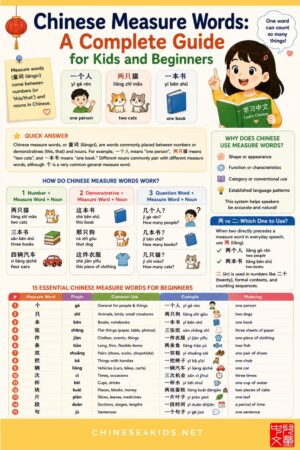
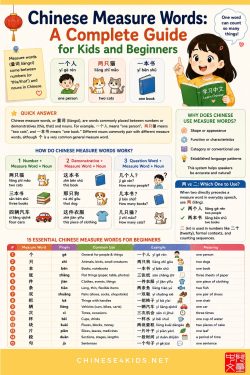
Chinese measure words, or 量词 (liàngcí), are words commonly placed between numbers or demonstratives (this, that) and nouns. For example, 一个人 means “one person,” 两只猫 means “two cats,” and 一本书 means “one book.” Different nouns commonly pair with different measure words, although 个 is a very common general measure word. When you count or identify a noun with a number or demonstrative, a measure word typically appears between them.
Chinese Measure Words at a Glance
| Pattern | Example | Meaning |
|---|---|---|
| Number + measure word + noun | 三本书 (sān běn shū) | three books |
| Demonstrative + measure word + noun | 这只猫 (zhè zhī māo) | this cat |
| Question word + measure word + noun | 几个人? (jǐ gè rén?) |
What Are Chinese Measure Words?
Chinese measure words, or 量词 (liàngcí)—also called classifiers in many English-language learning materials—are small words that sit between a number (or demonstrative like “this” or “that”) and a noun when you’re counting or identifying something.
In English, you say:
three books
In Mandarin Chinese, you say:
三本书 (sān běn shū) three [measure word] books
The measure word 本 (běn) marks books as a particular category.
Other examples:
一个人 (yī gè rén) one person
两只狗 (liǎng zhī gǒu) two dogs
五张纸 (wǔ zhāng zhǐ) five sheets of paper
这本书 (zhè běn shū) this book
Why Does Chinese Use Measure Words?
English also uses quantity expressions such as “a piece of paper,” “a pair of shoes,” and “a cup of water.” Chinese uses measure words much more systematically when a noun is counted or paired with a demonstrative like 这 (this) or 那 (that).
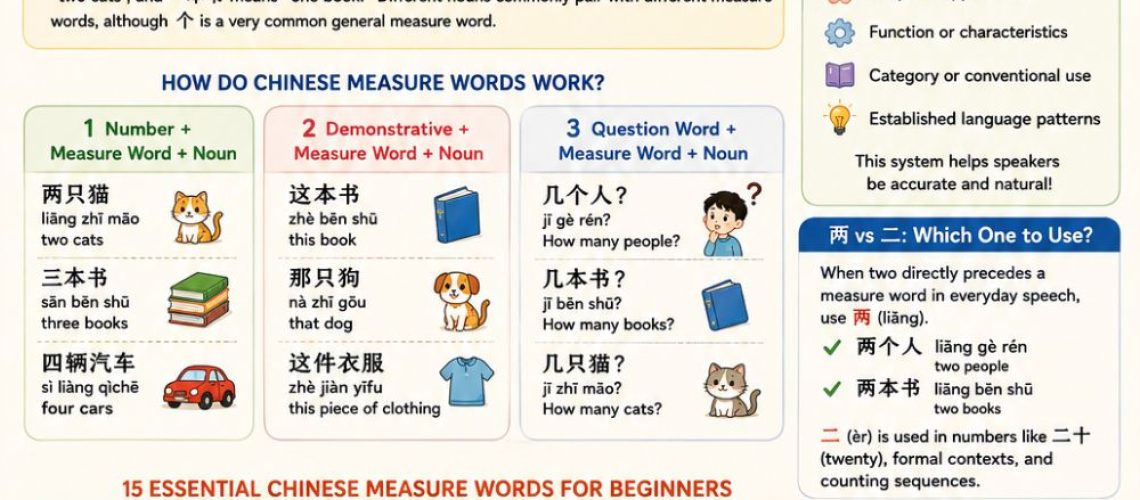
Measure words organize nouns into meaningful categories based on:
- Shape or appearance — 张 is used with many flat objects; 条 with many long, narrow, or flexible things.
- Function or characteristics — 把 is used with many handled objects; 辆 with wheeled vehicles.
- Category or conventional usage — 本 is used with books; 只 with many animals.
- Established language patterns — some measure words simply need to be learned with the nouns they commonly accompany.
This system helps speakers be accurate and natural. Using the appropriate measure word makes a phrase sound genuine and specific.
For children learning Mandarin, this system becomes logical once they see the patterns. Instead of memorizing 50 random words, they learn how Chinese groups and describes things.
How Do Chinese Measure Words Work?Pattern 1: Number + Measure Word + Noun
This is one of the most basic patterns. A common pattern is:
数字 + 量词 + 名词
Examples:
两只猫 (liǎng zhī māo) two [measure word: for animals] cats
三本书 (sān běn shū) three [measure word: for books] books
四辆汽车 (sì liàng qìchē) four [measure word: for vehicles] cars
Pattern 2: Demonstrative + Measure Word + Noun
You also use measure words with demonstratives like 这 (this) and 那 (that):
这本书 (zhè běn shū) this book
那只狗 (nà zhī gǒu) that dog
这件衣服 (zhè jiàn yīfu) this piece of clothing
Pattern 3: Question Word + Measure Word + Noun
To ask “how many,” use the question word 几 with a measure word:
几个人? (jǐ gè rén?) How many people?
几本书? (jǐ běn shū?) How many books?
几只猫? (jǐ zhī māo?) How many cats?
About 两 vs 二: Which One to Use?
In Mandarin, the number two has two forms. When it directly precedes a measure word in everyday speech, speakers use 两 (liǎng):
两个人 (liǎng gè rén) two people
两本书 (liǎng běn shū) two books
The form 二 (èr) appears in numbers like 二十 (twenty), in formal/mathematical contexts, and in counting sequences. For children beginning to count with measure words, teaching 两 + measure word first is practical advice. Both forms are grammatically correct in different contexts, so we emphasize the everyday pattern.
15 Essential Chinese Measure Words for Beginners
Not every learner needs to memorize 100+ measure words. Starting with a practical group helps children communicate in many common situations.
These 15 are chosen for frequency and usefulness in everyday child-focused vocabulary.
| Measure Word | Pinyin | Common Use | Example |
|---|---|---|---|
| 个 | gè | people, many common nouns, some events | 一个人 (yī gè rén) — one person |
| 只 | zhī | animals, some objects | 一只猫 (yī zhī māo) — one cat |
| 本 | běn | books, periodicals | 一本书 (yī běn shū) — one book |
| 张 | zhāng | flat, relatively thin objects and surfaces | 一张纸 (yī zhāng zhǐ) — one sheet of paper |
| 条 | tiáo | long, narrow or flexible things; certain animals and other nouns | 一条鱼 (yī tiáo yú) — one fish |
| 件 | jiàn | many items of clothing, especially upper-body garments; other matters | 一件衣服 (yī jiàn yīfu) — one piece of clothing |
| 辆 | liàng | vehicles | 一辆汽车 (yī liàng qìchē) — one car |
| 双 | shuāng | things that naturally occur or are used as pairs | 一双鞋 (yī shuāng xié) — one pair of shoes |
| 把 | bǎ | many handled objects and some objects with a grasping function | 一把伞 (yī bǎ sǎn) — one umbrella |
| 杯 | bēi | cups, glasses (of drinks) | 一杯水 (yī bēi shuǐ) — one cup of water |
| 块 | kuài | pieces, chunks (food, soap, money) | 一块巧克力 (yī kuài qiǎokèkèlì) — one piece of chocolate |
| 间 | jiān | rooms, classrooms, shops | 一间房 (yī jiān fáng) — one room |
| 位 | wèi | people (formal, showing respect) | 一位老师 (yī wèi lǎoshī) — one teacher |
| 群 | qún | groups, herds, crowds | 一群孩子 (yī qún háizi) — a group of children |
| 家 | jiā | families, companies, stores | 一家餐厅 (yī jiā cāntīng) — one restaurant |
These 15 give beginners a practical starting point for many common everyday situations. As vocabulary grows, children naturally encounter additional measure words.
Common Mistakes with Chinese Measure Words
Even with just these 15 words, children (and beginners) sometimes pair the wrong measure word with a noun. Here are some of the most common mistakes:
❌ Incorrect → ✅ Correct
三个书 → 三本书 (three books) Use 本, not 个, with books.
二个人 → 两个人 (two people) Use 两, not 二, before a measure word.
两只书 → 两本书 (two books) Use 本 for books, not 只.
一个双鞋 → 一双鞋 (one pair of shoes) Use 双 directly; don’t add 个 before it.
一辆自行车子 → 一辆自行车 (one bicycle) Don’t add 子 (diminutive) after nouns with measure words.
Common misconception:
❌ “只 = all animals”
✅ “只 is commonly used for many animals, but measure-word usage depends on the specific noun.”
For example:
一只猫 (one cat) — correct
一只马 — wrong (horses use 一匹马)
一只牛 — wrong (cattle use 一头牛)
Learning the right pairing for each noun matters more than knowing which words are “for animals.”
Learn Chinese Measure Words by Category
Your child will encounter measure words throughout vocabulary learning. We’ve organized them by category so you can explore deeper when you need to.
People
Learn measure words such as 个, 位, 群 and 家 for talking about people, groups, and families. For example: 一个人 (one person), 一位老师 (one teacher), 一群孩子 (a group of children).
→ Read the complete guide to Chinese measure words for people
Animals
Learn measure words such as 只, 匹, 头 and 群 for different kinds of animals. For example: 一只猫 (one cat), 一匹马 (one horse), 一群羊 (a flock of sheep).
→ Read the complete guide to Chinese measure words for animals
Food
Learn measure words such as 个, 块, 碗 and 杯 for different types of food and drinks. For example: 一个苹果 (one apple), 一块巧克力 (one piece of chocolate), 一杯牛奶 (one glass of milk).
→ Read the complete guide to Chinese measure words for food
Clothing
Learn measure words such as 件, 条 and 双 for clothes and accessories. For example: 一件衣服 (one piece of clothing), 一条裤子 (one pair of pants), 一双鞋 (one pair of shoes).
→ Read the complete guide to Chinese measure words for clothing
Transportation & Vehicles
Learn measure words such as 辆, 架, 艘 and 列 for cars, bikes, boats, trains, and other transportation. For example: 一辆汽车 (one car), 一架飞机 (one airplane), 一艘船 (one boat).
→ Read the complete guide to Chinese measure words for transportation
Household Items
Learn measure words such as 把, 张, 台 and 盏 for furniture, kitchenware, and objects around the home. For example: 一把椅子 (one chair), 一张桌子 (one table), 一盏灯 (one lamp).
→ Read the complete guide to Chinese measure words for household items
Body Parts
Learn measure words such as 个, 只, 双 and 颗 for parts of the body. For example: 一条腿 (one leg), 两只眼睛 (two eyes), 一颗牙齿 (one tooth).
→ Read the complete guide to Chinese measure words for body parts
School Supplies
Learn measure words such as 支,个, 本,把,and 块 for school supply items. For example: 一支铅笔(one pencil)、一个书包(a schoolbag)、一把尺子(a ruler)、一块橡皮(an eraser).
→ Read the complete guide to Chinese measure words for school supplies
Tableware
Learn measure words such as 个, 对, 套 and 副 for dishes, cups, bowls, and eating utensils. For example: 一个碗 (one bowl), 一对筷子 (one pair of chopsticks), 一套餐具 (one set of tableware).
→ Read the complete guide to Chinese measure words for tableware
Buildings & Structures
Learn measure words such as 座, 栋, 间 and 所 for houses, buildings, shops, and architectural structures. For example: 一座房子 (one house), 一栋楼 (one building), 一间房间 (one room).
→ Read the complete guide to Chinese measure words for buildings
Weather
Learn measure words such as 场,阵,朵,道,声, for different types of weather. For example: 场 (chǎng) for rain, snow, and storms; 阵 (zhèn) for short spells of wind or rain; 朵 (duǒ) for individual clouds; 道 (dào) for rainbows and lightning; and 声 (shēng) for sounds such as thunder.
→ Read the complete guide to Chinese measure words for weather
Plants
Learn measure words such as 朵, 束, 棵, 片 and 根 for flowers, trees, and plants. For example: 一朵花 (one flower), 一束花 (a bouquet of flowers), 一棵树 (one tree), 一片叶子 (one leaf), 一根树枝 (one branch).
→ Read the complete guide to Chinese measure words for plants
Festivals and Gifts
Some of the first Chinese words children love are the ones tied to celebrations. During Chinese New Year, children receive red envelopes with lucky money inside, and the measure word is easy: 个.
| Chinese | Pinyin | English |
|---|---|---|
| 一个红包 | yī gè hóngbāo | one red envelope |
| 两个红包 | liǎng gè hóngbāo | two red envelopes |
| 我有一个红包。 | wǒ yǒu yī gè hóngbāo | I have a red envelope. |
Don’t overthink it. 个 is the most common measure word, and it works for 红包. You may also hear 一封红包 (yī fēng hóngbāo). 封 is used for envelope-shaped things like letters, and some families use it for red envelopes too. Both are fine. Start with 个, and let 封 come naturally when children hear it.
Try it: Next time your child gets or gives a red envelope, say “一个红包!” together and count them: 一个红包, 两个红包, 三个红包.
Are Measure Words Only Used for Objects?
No. Chinese measure words can also occur with people, animals, events, actions, abstract concepts, and natural phenomena. For example:
一件事 (yī jiàn shì) one matter
一次机会 (yī cì jīhuì) one opportunity
一场比赛 (yī chǎng bǐsài) one match/game
一阵风 (yī zhèn fēng) a gust of wind
Measure words are a grammatical system that applies far beyond physical objects alone.
Note: Verbal Measure Words
Chinese also has measure words used with verbs, such as 次 (cì) for “times” and 遍 (biàn) for “times through”:
看一次 (kàn yī cì) watch/read once
去两次 (qù liǎng cì) go twice
看一遍 (kàn yī biàn) read/watch through completely
This guide focuses on measure words used with nouns. Verbal measure words work differently and are a separate grammatical category. We’ll explore them in a future guide.
How Should Kids Learn Chinese Measure Words?
The most important principle is: children shouldn’t memorize measure words in isolation.
Start with a Small Group
Your child doesn’t need to learn 50 measure words at once. Focus on these eight first:
个 — person, general objects
只 — animals
本 — books
张 — flat objects
条 — long, thin things
件 — clothing
辆 — vehicles
杯 — cups of drinks
Once these feel natural through repeated exposure, introduce more as vocabulary grows.
Learn Measure Words Together with Nouns
This is the key difference between memorization and real language learning.
Don’t teach:
只 = measure word for animals
Instead, teach:
一只猫 (one cat) 两只狗 (two dogs) 三只鸟 (three birds)
The child remembers a complete, meaningful language pattern. When they hear or see “cat,” they naturally include 只. The connection becomes automatic.
Learn in Semantic Groups
Organize measure words by the categories that make sense to your child:
Animals → 只、匹、头、群
Food → 个、块、片、碗、杯
Clothing → 件、条、双、顶
Vehicles → 辆、架、艘
Some measure words follow helpful patterns based on shape or function. Others are conventional and simply need to be learned with the nouns they commonly accompany. Recognizing both patterns helps children learn more effectively.
Measure Words in Poetry: A Classic Example
The Song Dynasty poem “山村咏怀” (Shān Cūn Yǒng Huái) by 邵雍 (Shao Yong) beautifully demonstrates measure words in authentic Chinese:
山村咏怀
一去二三里,
In the hills, a journey of two or three miles,
烟村四五家。
Amidst the mist, four or five houses beguile.
亭台六七座,
Pavilions and towers, six or seven rise,
八九十枝花。
With flowers aplenty, eight, nine, ten comprise.
Measure Words in Action
烟村四五家 (four or five homes)
The measure word 家 (jiā) classifies homes and households. In everyday speech, you’d also say 一家餐厅 (one restaurant) with the same word.
亭台六七座 (six or seven pavilions)
The measure word 座 (zuò) quantifies large structures, the same word we use today for buildings and monuments.
八九十枝花 (eight, nine, ten flowers)
The measure word 枝 (zhī) counts flowers and blossoms on their stems—a natural way to express botanical abundance.
Why This Matters
This poem shows that measure words aren’t arbitrary grammar rules. They’re woven into how Chinese naturally expresses meaning. Learning measure words isn’t memorizing isolated words—it’s understanding how Chinese organizes language itself.
Frequently Asked Questions
Understanding Measure Words
What are Chinese measure words?
Measure words (量词, liàngcí) are words commonly placed between numbers or demonstratives and nouns. For example, 个, 只, 本, and 张 are measure words. They classify the noun and help express quantity.
Why does Chinese use measure words?
Measure words organize nouns into categories based on shape, function, and convention. This creates precision and helps speakers and learners group related words together in meaningful ways.
What is a measure word called in Chinese?
The Chinese term for measure word is 量词 (liàngcí).
Are measure words the same as classifiers?
The terms are often used interchangeably. In linguistic discussions, classifiers might refer to a broader grammatical category, while measure words often refers specifically to the words used with numbers and demonstratives. For learners, the practical difference is minimal.
Are measure words only used for objects?
No. Measure words can be used with people, animals, events, actions, abstract concepts, and natural phenomena—not just physical objects.
Using Measure Words
How do you use Chinese measure words?
Place a measure word between a number (or demonstrative) and a noun: 两本书 (two books), 这只猫 (this cat), 几个人? (how many people?).
What is the most common Chinese measure word?
个 (gè) is the most common. It naturally occurs with people, many everyday objects, and some events.
When do you use 个?
Use 个 with people and many everyday nouns. It also appears in certain expressions involving events or abstract concepts. It’s frequently the appropriate choice, and in casual speech, you’ll often hear it with many nouns.
What’s the difference between 个 and 只?
个 is a general measure word for people and many objects. 只 is specific to animals (and sometimes one item from a pair). Use 只 when counting animals such as cats, dogs, or birds. Use 个 for people and general objects.
Why use 两 instead of 二?
两 (liǎng) is the typical form for “two” when it directly precedes a measure word in everyday Mandarin: 两个人 (two people), 两本书 (two books). 二 (èr) is used in numbers like 二十 (twenty), in counting sequences, and in many formal or technical expressions. For children learning to count with measure words, the 两 + measure word pattern is the natural starting point.
Do I always need a measure word?
When you count a noun or use a demonstrative, a measure word typically appears. However, nouns can occur without measure words in other sentence structures. For example, 我喜欢猫 (I like cats) doesn’t require a measure word because you’re not counting or identifying a specific number.
Learning Measure Words
How many Chinese measure words should beginners learn?
Beginners don’t need to memorize dozens of measure words at once. Start with a small group of high-frequency words and expand naturally as their vocabulary grows. Eight to twelve essential measure words give learners a practical foundation.
How should children learn Chinese measure words?
Children learn best when measure words are introduced alongside vocabulary. Rather than memorizing the word in isolation, teach it as part of a complete phrase: 一只猫 (one cat) rather than just “只 = animal classifier.” Use flashcards that show the complete phrase, and reinforce through repeated use in meaningful contexts.
Are Chinese measure words difficult for English-speaking children?
They can feel unfamiliar at first because English doesn’t use measure words in the same systematic way. Children often find them easier when they encounter them repeatedly with familiar vocabulary and meaningful phrases. Once they see patterns—flat things use 张, long things use 条, animals use 只—the system becomes more logical.
Explore → Practice → Teach
Learning doesn’t stop with understanding. Here’s how to move from understanding to practice:
Explore
Read the category-specific guides above to learn measure words for the vocabulary your child is studying. Each guide provides detailed examples and usage patterns organized by category.
Say each measure word with its tone: 只 (zhī), 条 (tiáo), 本 (běn) and 个 (gè) all sound different. If your child mixes tones up, play the games in Chinese tones for kids first. They make the measure words much easier to say clearly.
Practice
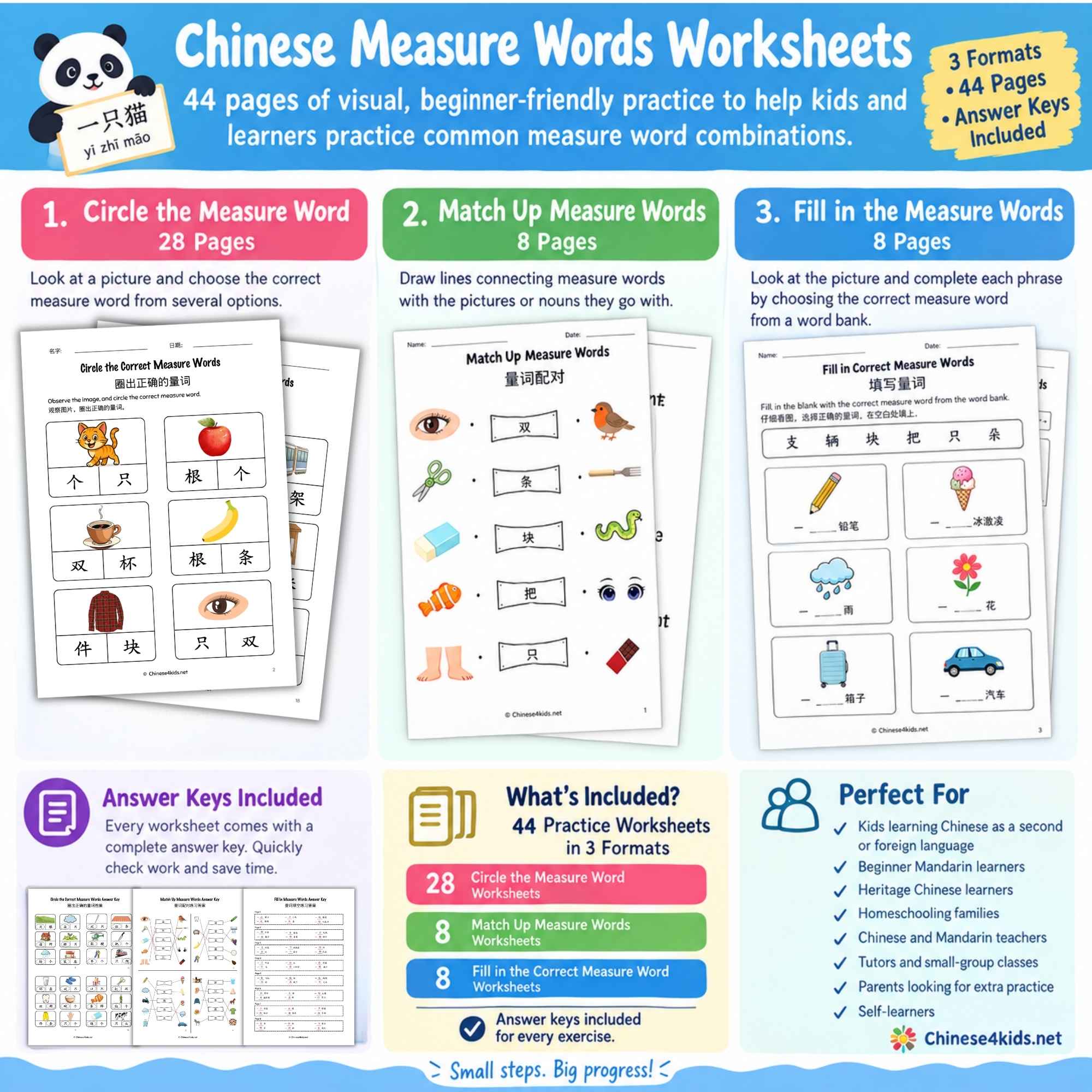
Use worksheets, activities, and printable resources to reinforce measure word patterns. Interactive practice helps children internalize the pairings between measure words and nouns, making them automatic over time.
Learn Visually
Learn these combinations with flashcards: Our Chinese Measure Words Flashcards organize measure words by category (people, animals, food, etc.) with color-coded patterns, pictures, and two learning versions. Print and practice at home, in class, or anywhere.
Teach with Ready-Made Resources
For teachers: The Chinese Teaching Made Easy Membership includes lesson plans and classroom-ready materials for teaching measure words in context.
For parents: The same membership provides ready-made activities and guidance for supporting measure word learning at home.
Chinese measure words might seem complex at first, but they follow logical patterns. Once your child understands the system—and learns measure words together with familiar vocabulary—they become natural. Start small, be consistent, and watch as your child naturally masters this essential part of Mandarin Chinese.
If you like this article, share it with other teachers and parents