Quick answer:
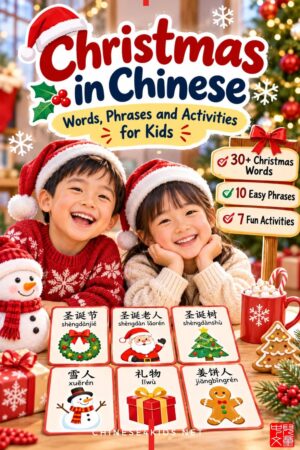
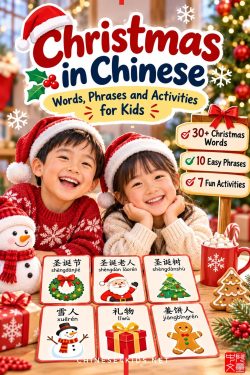
Christmas in Chinese is 圣诞节 (shèngdànjié). “Merry Christmas” is 圣诞快乐 (shèngdàn kuàilè). This guide gives you 30+ Christmas words with pinyin, ten simple phrases kids can say, and seven easy activities for parents and teachers. And you don’t need to speak Chinese to use it.
Christmas in Chinese is 圣诞节 (shèngdànjié). “Merry Christmas” is 圣诞快乐 (shèngdàn kuàilè). This guide gives you 30+ Christmas words with pinyin, ten simple phrases kids can say, and seven easy activities for parents and teachers. And you don’t need to speak Chinese to use it.
Some families celebrate Christmas. Others simply enjoy the lights and the songs, and some don’t celebrate at all. Either way, that’s fine. Christmas words are useful in every case, because children meet them in shops, at school and in books.
So start small. First, pick four or five words your child can see or touch and say them every day for a week. Then add a few more. That is enough.
How Do You Say Christmas in Chinese?
The holiday is called 圣诞节 (shèngdànjié). Here, 圣诞 means “holy birth,” and 节 means “festival.” The greeting is shorter, though: just add 快乐 (kuàilè), “happy.”
| Chinese | Pinyin | English |
|---|---|---|
| 圣诞节 | shèngdànjié | Christmas (the holiday) |
| 圣诞快乐 | shèngdàn kuàilè | Merry Christmas |
| 圣诞节快乐 | shèngdànjié kuàilè | Merry Christmas (a little fuller) |
| 平安夜快乐 | píng’ān yè kuàilè | Merry Christmas Eve |
| 新年快乐 | xīnnián kuàilè | Happy New Year |
Both 圣诞快乐 and 圣诞节快乐 are correct, but most people use the shorter one. Meanwhile, 平安夜 literally means “peaceful night.” People say 平安夜快乐 on Christmas Eve, although it is less common than 圣诞快乐. If you use traditional characters, Christmas is written 聖誕節 and Merry Christmas is 聖誕快樂.
Christmas Words for Kids, With Pinyin
Here are 33 words in five small groups. You don’t need all of them. Choose the group that matches what your child sees at home or in class.
Key holiday words
| Chinese | Pinyin | English |
|---|---|---|
| 圣诞节 | shèngdànjié | Christmas |
| 平安夜 | píng’ān yè | Christmas Eve |
| 新年 | xīnnián | New Year |
| 圣诞快乐 | shèngdàn kuàilè | Merry Christmas |
Christmas characters
| Chinese | Pinyin | English |
|---|---|---|
| 圣诞老人 | shèngdàn lǎorén | Santa Claus |
| 驯鹿 | xùnlù | reindeer |
| 雪人 | xuěrén | snowman |
| 圣诞精灵 | shèngdàn jīnglíng | elf |
| 天使 | tiānshǐ | angel |
| 姜饼人 | jiāngbǐngrén | gingerbread man |
Decorations and gifts
| Chinese | Pinyin | English |
|---|---|---|
| 圣诞树 | shèngdànshù | Christmas tree |
| 礼物 | lǐwù | gift, present |
| 星星 | xīngxing | star |
| 铃铛 | língdang | bell |
| 圣诞袜 | shèngdànwà | Christmas stocking |
| 圣诞花环 | shèngdàn huāhuán | Christmas wreath |
| 彩灯 | cǎidēng | colorful lights |
| 蜡烛 | làzhú | candle |
| 卡片 | kǎpiàn | card |
| 蝴蝶结 | húdiéjié | bow, ribbon bow |
Winter and snow
| Chinese | Pinyin | English |
|---|---|---|
| 冬天 | dōngtiān | winter |
| 雪 | xuě | snow |
| 雪花 | xuěhuā | snowflake |
| 冷 | lěng | cold |
| 雪橇 | xuěqiāo | sleigh |
| 手套 | shǒutào | gloves, mittens |
Christmas treats
| Chinese | Pinyin | English |
|---|---|---|
| 饼干 | bǐnggān | cookie |
| 糖果 | tángguǒ | candy |
| 拐杖糖 | guǎizhàng táng | candy cane |
| 姜饼 | jiāngbǐng | gingerbread |
| 热巧克力 | rè qiǎokèlì | hot chocolate |
| 蛋糕 | dàngāo | cake |
| 苹果 | píngguǒ | apple |
Notice the small word pieces that repeat. For example, 雪 is in 雪人, 雪花 and 雪橇, and 圣诞 is in 圣诞树, 圣诞袜 and 圣诞老人. Older children enjoy spotting these, while younger children just enjoy the pictures.
Want a hands-on way to practice these words? The Christmas Chinese Vocabulary Montessori 3-Part Flashcards turn 48 Christmas words into three printable sets: vocabulary, animals and numbers. Each word comes as a picture card, a word card and a control card with pinyin and English, so a parent who doesn’t read Chinese can still check the answers.
10 Easy Christmas Phrases for Kids
Single words are a good start. Next, short sentences help children use them. Say each phrase out loud with a real gift, a real cookie or a real tree nearby. That way, meani
| Chinese | Pinyin | English |
|---|---|---|
| 圣诞快乐! | Shèngdàn kuàilè! | Merry Christmas! |
| 圣诞老人来了! | Shèngdàn lǎorén lái le! | Santa is here! |
| 下雪了! | Xià xuě le! | It’s snowing! |
| 我喜欢圣诞树。 | Wǒ xǐhuan shèngdànshù. | I like the Christmas tree. |
| 这是给你的礼物。 | Zhè shì gěi nǐ de lǐwù. | This gift is for you. |
| 谢谢你的礼物。 | Xièxie nǐ de lǐwù. | Thank you for the gift. |
| 我们一起装饰圣诞树吧。 | Wǒmen yìqǐ zhuāngshì shèngdànshù ba. | Let’s decorate the Christmas tree together. |
| 你想吃饼干吗? | Nǐ xiǎng chī bǐnggān ma? | Do you want a cookie? |
| 我想喝热巧克力。 | Wǒ xiǎng hē rè qiǎokèlì. | I want hot chocolate. |
| 祝你新年快乐! | Zhù nǐ xīnnián kuàilè! | Happy New Year to you! |
Two patterns are worth repeating. The first is 我们一起…吧 (wǒmen yìqǐ … ba), which means “Let’s … together.” For example, you can swap in other actions, such as 我们一起唱歌吧 (wǒmen yìqǐ chànggē ba), “Let’s sing together.” The second is 祝你… (zhù nǐ …), “I wish you ….” You can find it in our We Wish You a Merry Christmas in Chinese guide.
And if you’re writing a card, our 12 Merry Christmas wishes in Chinese are ready to copy.
Christmas words and measure words
Christmas is also a gentle time to meet measure words. However, don’t explain a rule. Instead, just say these small phrases together a few times.
- 一棵圣诞树 (yì kē shèngdànshù): one Christmas tree
- 一份礼物 (yí fèn lǐwù): one gift
- 一颗星星 (yì kē xīngxing): one star
- 一个雪人 (yí ge xuěrén): one snowman
- 一块饼干 (yí kuài bǐnggān): one cookie
Over time, the patterns build with repetition. For the bigger picture, see our guide to Chinese measure words.
7 Christmas Activities in Chinese for Kids
Each activity takes 5 to 15 minutes and needs very little preparation. So choose one or two, because you don’t need to do them all.
1. Christmas I Spy
Ages 3–6. Materials: a few Christmas objects or picture cards.
First, put a few objects or pictures in view, such as a star, a bell, a gift and a tree. Say 我看见… (wǒ kànjiàn …), “I see …,” and name one item. Your child points to it. Then swap: your child names an item and you point. Start with three items, and then add more over several days.
2. Santa Says
Ages 4–9. No materials needed.
This is like “Simon Says.” Children only move when you begin with 圣诞老人说 (shèngdàn lǎorén shuō), “Santa says.”
- 跳 (tiào): jump
- 拍手 (pāishǒu): clap
- 坐下 (zuòxià): sit down
- 站起来 (zhàn qǐlái): stand up
- 摇铃铛 (yáo língdang): shake the bell
Once children know the game, let one of them be Santa and give the commands.
3. Mystery Gift Bag
Ages 4–10. Materials: a bag and four to six small Christmas items.
First, hide the items in the bag. Next, a child reaches in and feels one item without looking. Then ask 这是什么?(Zhè shì shénme?), “What is this?” The child guesses: 这是…(Zhè shì …), “This is ….” Finally, reveal the item and say the Chinese word together. A real surprise also makes the word easier to remember.
4. Decorate the Tree With Words
Ages 5–12. Materials: a paper tree, word cards or paper ornaments, tape.
First, draw or tape up a big paper tree. Then children make ornaments, write or copy one Chinese word on each, and add a small picture. As they hang each one, they say a full sentence: 圣诞树上有星星 (Shèngdànshù shàng yǒu xīngxing), “There is a star on the Christmas tree.” Next time, swap in other words: 铃铛, 礼物, 蜡烛.
5. Christmas Countdown
Ages 5–12. Materials: 24 paper strips or a simple calendar.
Each day, count down together in Chinese. Say 圣诞节还有十天 (Shèngdànjié hái yǒu shí tiān), “There are ten days until Christmas,” and learn one new word that day. In this way, children practice numbers, and the countdown gives them a reason to speak every day. Need a number refresher? See Chinese Numbers for Kids.
6. Cards for Faraway Family
Ages 6–14. Materials: folded paper, crayons or markers.
Children draw a Christmas picture and copy one short message, such as 圣诞快乐 or 祝你新年快乐. Send it to a grandparent or a friend, or film a short video of your child saying the greeting. A real reader gives children a real reason to write and speak. In the Christmas Chinese Learning Pack, you can find 3 designs to choose from.
7. Build a Christmas Figure
Ages 4–10. Materials: paper, scissors, glue.
Cut out simple paper pieces for a snowman, Santa, an elf, a reindeer and a tree. Children put each figure together, then label it in Chinese: 雪人, 圣诞老人, 圣诞精灵, 驯鹿, 圣诞树. When they’re done, the finished figures make cheerful wall decorations.
A Simple Christmas Chinese Plan for December
If you like a loose plan, spread the learning over four weeks. Ten minutes a few times a week is plenty.
| Week | Focus | What to do |
|---|---|---|
| Week 1 | Listen and learn words | Choose five words. Say them daily. Play Christmas I Spy. |
| Week 2 | Songs and phrases | Learn two phrases. Sing Jingle Bells in Chinese or the We Wish You chorus. |
| Week 3 | Play and make | Try Santa Says, the Mystery Gift Bag and the tree of words. |
| Week 4 | Share | Write cards and send a greeting to someone far away. |
If you miss a day, just pick up where you left off. Consistency matters more than finishing everything.
Christmas in Chinese-Speaking Places
Christmas is not a traditional Chinese festival, and people mark it in different ways. In mainland China it is not a public holiday, but many people enjoy decorations, music, shopping and meals with friends, and schools often hold small parties. Meanwhile, in Hong Kong, Christmas Day is a public holiday, and many families put up trees and exchange gifts. Chinese families living abroad, in turn, do all kinds of things: some celebrate fully, some mix Christmas with Chinese traditions, and some don’t celebrate.
Here is one fun custom. In some communities, especially in mainland China in recent years, people give apples on Christmas Eve. 苹果 (píngguǒ) sounds a little like 平安 (píng’ān), which means “peace and safety,” so the apple becomes a wish for peace. Not everyone does this, but children love hearing this kind of wordplay.
Frequently Asked Questions
How do you say Merry Christmas in Chinese?
Say 圣诞快乐 (shèngdàn kuàilè). You can also say 圣诞节快乐 (shèngdànjié kuàilè). Both are correct.
What is Santa Claus called in Chinese?
Santa Claus is 圣诞老人 (shèngdàn lǎorén). Literally, the name means “Christmas old person.” The word 老人 is a respectful way to say an elderly person.
How do you say Merry Christmas and Happy New Year in Chinese?
Say 圣诞快乐,新年快乐 (shèngdàn kuàilè, xīnnián kuàilè). The pattern is the same for any holiday: add 快乐 after the name.
Do people in China celebrate Christmas?
Some do, in their own way. Christmas is not a traditional Chinese festival, and it is not a public holiday in mainland China. It is a public holiday in Hong Kong. Many people in Chinese-speaking communities enjoy the decorations, songs and gift-giving whether or not they celebrate it religiously.
Can I teach Christmas Chinese if my family doesn’t celebrate Christmas?
Yes. The words and songs are useful for reading, shopping and school, and winter words such as snow, gloves and hot chocolate work for any family. You can also focus on greetings and use the 祝你… pattern for birthdays and New Year.
What age is Christmas Chinese suitable for?
Children from about age 3 can join in with words, actions and songs. Older children can read the pinyin, sort the words into groups, and write their own card messages.
More Christmas Learning
- Jingle Bells in Chinese: vocabulary, activities and lesson plans built around the song
- We Wish You a Merry Christmas in Chinese: a second song and the 祝你… wish pattern
- 12 Merry Christmas Wishes and Messages in Chinese: ideas for cards
- It’s Snowing: A Chinese Nursery Rhyme for Winter: a short rhyme for winter months
- Chinese Tones for Kids: easy tone games, since songs can blur the tones
Printable Christmas Chinese Learning Resources
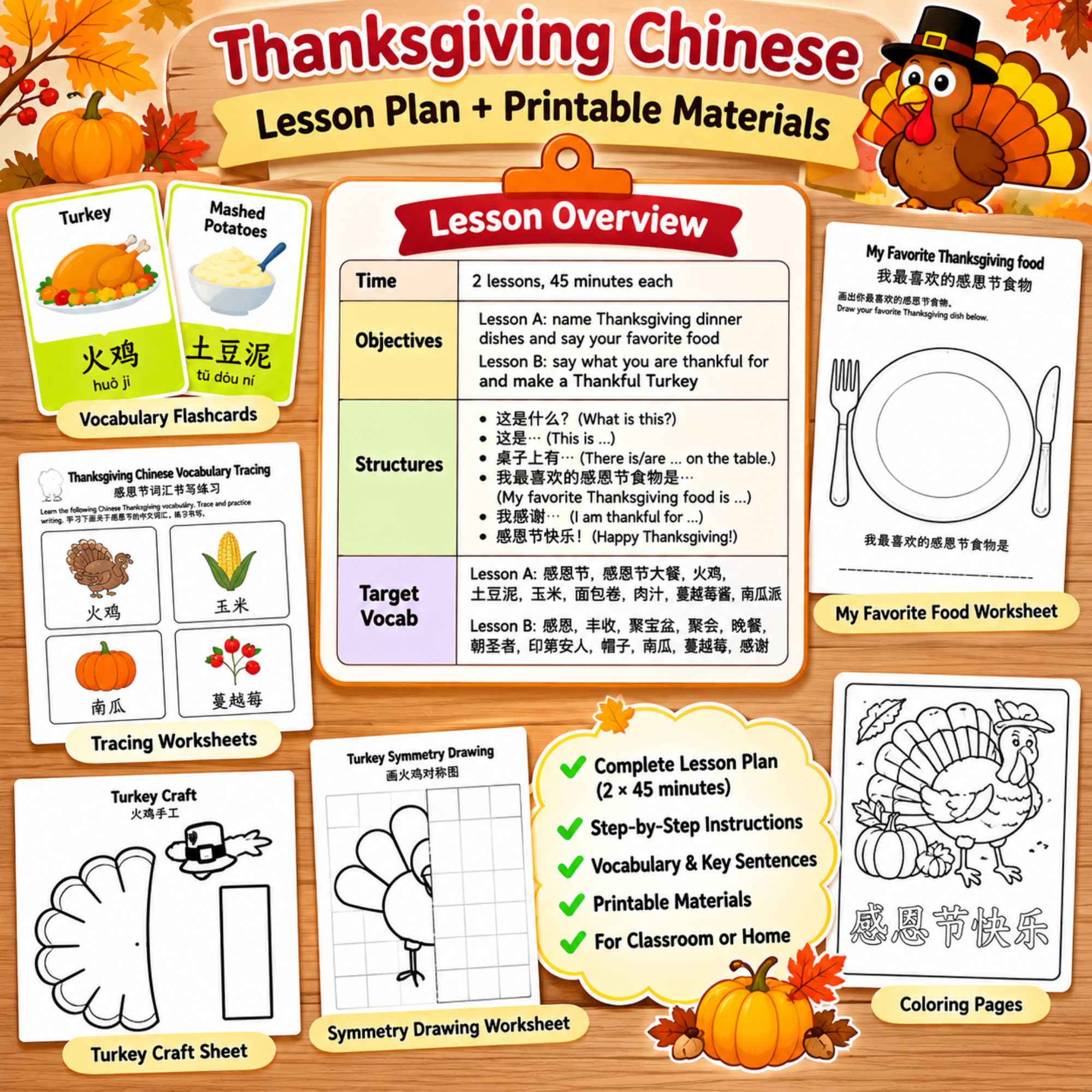
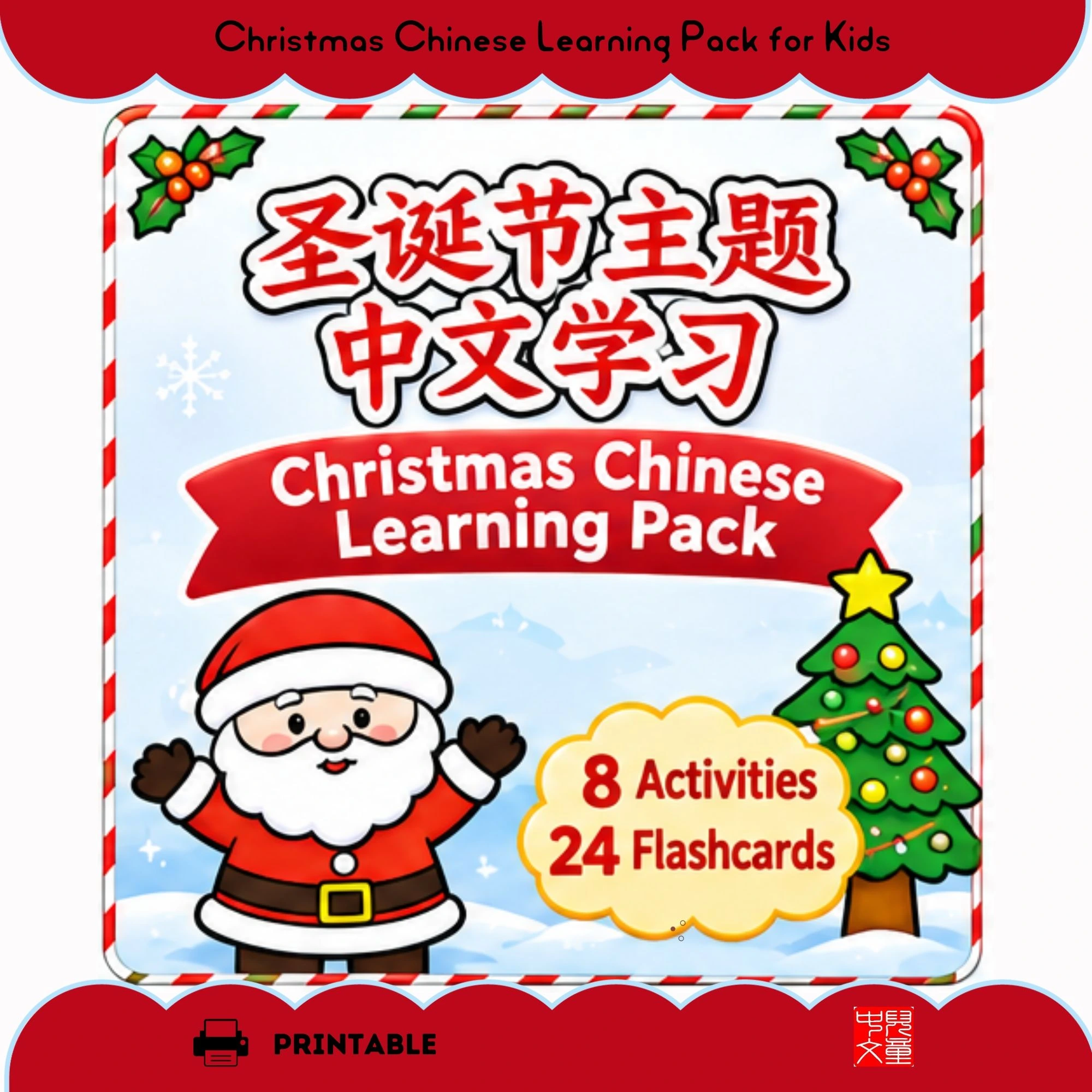
Would you like ready-to-use materials for Christmas Mandarin lessons? The Christmas Chinese Learning Pack brings together eight printable activities: 24 Christmas flashcards, color by number, symmetry drawing, a color-and-write word book, coloring pages, Christmas cards, a memory game and a Christmas figure craft. A short guide shows you how to use each part.
Choose the pack for a variety of Christmas activities. Choose the flashcards above when recognizing and matching words is your main goal.
圣诞快乐!(Shèngdàn kuàilè!)
If you find this article useful, share it