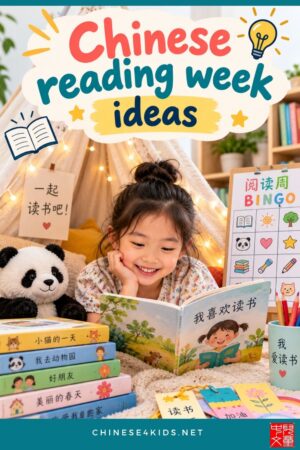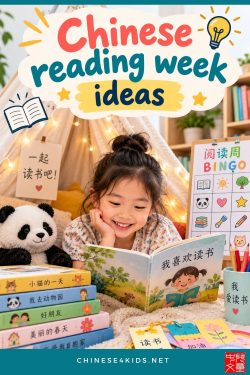
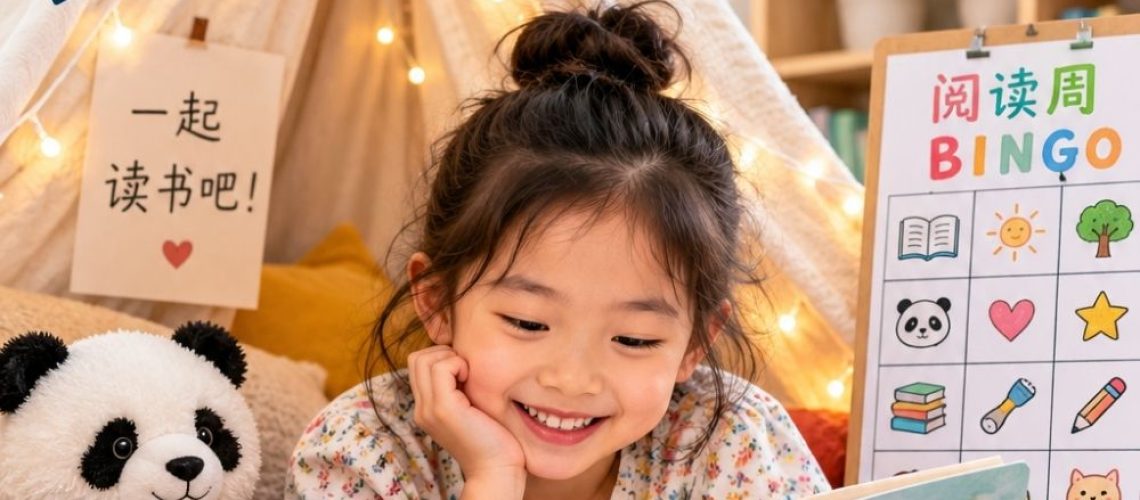
Most kids won’t pick up a Chinese book on their own. They have English books, screens, and a full week of school. A Chinese Reading Week gives them a reason to open one, and it turns reading into an event instead of homework.
You don’t need much. A handful of books, 10 to 15 minutes a day, and a few playful ideas are enough. This post gives you 10 activities, a simple five-day plan, and tips for choosing books at the right level.
Join Our Chinese Reading Week, October 26-30
We’re running a Chinese Reading Week right now, and you’re welcome to join. It’s free. Each day brings printable books at four levels and a short video, so you can read along with your child or class.
Arriving after October 30? No problem. The same form puts you on the waitlist, and we’ll email you when the next Reading Week opens.
What is Chinese Reading Week?
Quick Answer
A Chinese Reading Week (中文阅读周, zhōngwén yuèdú zhōu) is a week set aside for reading Chinese books together. Families or classrooms read a little every day, play simple reading games, and finish with a small celebration. Most weeks last five days, with about 10 to 15 minutes of reading each day. Kids don’t need to finish lots of books or understand every word to take part.
A Chinese Reading Week (中文阅读周, zhōngwén yuèdú zhōu) is a week set aside for reading Chinese books together. Families or classrooms read a little every day, play simple reading games, and finish with a small celebration. Most weeks last five days, with about 10 to 15 minutes of reading each day. Kids don’t need to finish lots of books or understand every word to take part.
Think of it as a small festival for stories. Kids read, share what they liked, and try a few games around the books. It also breaks up the usual routine of word lists and flashcards. Instead of drilling, children meet new words inside a story, and that feels very different.
You can run it at home with one child or in a classroom with a whole group. It works for beginners, and it works for kids who already read a little.
Why Does a Reading Week Work?
Children learning Mandarin as an additional language often get fewer chances to read Chinese than children who grow up surrounded by it. A dedicated week gives them extra time with books, without the pressure of a regular lesson. Here is what it can do:
- Vocabulary in context. Kids meet words in stories, next to pictures and meaningful sentences.
- Familiar characters. Seeing the same characters again and again helps children recognize them faster.
- Reading confidence. Short, easy books let kids experience success.
- Comprehension. Talking about characters and events helps children understand what they read.
- A reading habit. One focused week can be a good starting point for a longer routine.
These benefits depend on the books, your child’s level, and how often they read. The most important thing is to choose material your child can understand and enjoy. If you’d like to go deeper on this idea, read our guide to extensive Chinese reading.
10 Fun Activities for Chinese Reading Week
You don’t need to do all ten. Pick three or four that fit your child, your books, and your time. A simple plan that everyone enjoys beats a packed schedule.

D.E.A.R. Time (Drop Everything and Read)
Choose a time each day when everyone stops and reads. Parents and teachers read too. Kids love seeing the adults join in.
Start with 10 minutes. Let each child pick a book they can mostly read on their own, find a comfy spot, and read without interruption. Beginners can look at the pictures, listen to an adult, or reread a favorite.
Tip: Keep the books within easy reach. Starting is much easier when the book is already there.
Read-Aloud Sessions
Reading aloud lets children hear Mandarin while they follow the characters. You can read a story to the group, take turns with pages, or invite a child to read a favorite part.
Keep it relaxed. If you stop to correct every mistake, kids may get nervous and quit. Let the story flow, and fix only what gets in the way of meaning. For tone practice on the side, try our easy tone games.
Don’t speak Chinese? That’s okay. Let your child read to you. You can ask about the pictures, listen, and cheer for the effort. You don’t need to understand every word to share a story.
Reading Sprints
Set a timer for five or ten minutes and let children read as much as they comfortably can. This isn’t a race. The point is a steady habit.
When the timer rings, ask one easy question:
- Who was in the story?
- What happened?
- Which part did you like best?
- Did you notice a new Chinese word?
Kids who like tracking progress can write the book title or mark their reading time on a chart. Count minutes, not pages, because some books are harder than others.
Paired Reading
Pair each child with a reading buddy: a parent, sibling, classmate, or Chinese-speaking friend. They can take turns reading pages, read a sentence together, or let one person read while the other follows along.
In a mixed-level group, pair children with care. A confident reader can model pronunciation, while a newer reader can point out familiar characters or describe the pictures. Finish by asking each pair to share one moment they liked.
A Special Reading Corner
A new spot can make an ordinary book feel exciting. At home, try a blanket fort, a sunny corner, or the backyard. In a classroom, set up a corner with cushions and a basket of books sorted by theme.
You don’t need to buy anything. A few pillows and a basket are plenty. Let each child choose a favorite spot and read there for ten minutes.
Flashlight Reading
Dim the lights, hand out flashlights, and let everyone read a short Chinese book under a blanket. Ten minutes is plenty. Pick books with big text and clear pictures. It turns an ordinary story into a small adventure.
Read to a Stuffed Animal or Pet
Some kids feel shy reading aloud to people, and a teddy bear is a very patient listener. With no one to correct them, children relax and try harder words. Choose a book they already know well. If you read near a calm pet, keep an adult close, and never force an animal to take part.
Chinese Book Bingo
Make a simple bingo card with small reading challenges. Kids mark a square each time they finish one. Ideas to try:
- Read a Chinese book outside.
- Read a funny story.
- Find five characters you know.
- Read to a family member.
- Read a book about animals.
- Pick a favorite page and say why you like it.
- Reread a book you enjoyed.
- Learn one new Chinese word from a story.
Offer a small reward for each row, such as choosing the next book. For younger kids, add pictures next to the tasks. For older kids, add challenges like describing a character or retelling the ending.
Make Chinese Bookmarks
Hand out paper and colored pencils. Each child decorates a bookmark with a favorite character or a short word from this week’s reading, such as 读书 (dúshū, read books) or 加油 (jiāyóu, keep going). It marks the page now and reminds them to keep going after the week ends.
Retell a Story or Draw a Comic
After a story, children retell it aloud or draw it in three or four panels: first, next, and last. Ask them to label the pictures with a couple of Chinese words they learned. They show what they understood without writing a long summary.
Want more hands-on ideas to use all year? Explore our Chinese reading activities for kids.
Which Activities Fit Which Readers?
Choose by what your child can comfortably read, not by age alone.
| Reader | Activities to try |
|---|---|
| Beginners who know a few characters | Read-alouds, reading to a stuffed animal, picture books, paired reading |
| Growing readers who can read short sentences | D.E.A.R. Time, book bingo, paired reading, bookmark making |
| Confident readers who can follow longer stories | Reading sprints, retelling, comics, independent reading |
| Mixed-level classrooms | Reading buddies, book baskets by level, group comics, shared read-alouds |
A child can enjoy a story without reading every word alone. Listening, following along, spotting familiar characters, and talking about the pictures all count.
A Simple 5-Day Reading Week Plan
Here is an easy schedule for parents and teachers. Each day has one main activity, so it fits around your normal routine.
| Day | Focus | What to do |
|---|---|---|
| Day 1 | Kickoff | Choose books together, make bookmarks, and enjoy 10 minutes of quiet reading. |
| Day 2 | Read aloud | Read together, take turns, or let kids read to a stuffed animal. |
| Day 3 | Reading buddies | Try paired reading and start a Book Bingo card. |
| Day 4 | Reading adventure | Set up a cozy corner, try flashlight reading, or do a short reading sprint. |
| Day 5 | Celebrate | Share favorite stories, draw a comic, and hand out reading certificates. |
For younger kids, 10 to 15 minutes a day is a good start. Older or more experienced readers may enjoy longer sessions. If one activity becomes a favorite, repeat it. You don’t need to change things every day just for variety.
How Do You Choose the Right Books?
The right level matters more than the topic. A book that’s too hard leaves kids frustrated. One that’s too easy bores confident readers. Aim for books where your child can understand most of what they read.
Look for these features:
- Pictures that match the words. Illustrations help kids connect Chinese words with people, objects, and actions.
- Repeated words and patterns. Meeting the same words again and again makes the next page easier.
- Short, manageable text. Beginners do best with a few words or one short sentence per page. Later, they can move on to longer sentences and simple dialogue.
- Gradual steps up. Move from familiar words to short sentences, and then to connected stories.
- Topics kids like. Animals, family, food, and school are good starting points.
For a five-day week, five to ten short books are plenty. Rereading is fine, and it often helps. Kids recognize more characters the second time and notice details they missed before.
How to Organize Your Own Chinese Reading Week

You can run a reading week at home, in a weekend Chinese school, or in a regular classroom. Here are five steps.
- Choose your dates. Pick five days that work for your family or class. Tell the kids what to expect so they can look forward to it.
- Gather books. Collect a small set at different levels. Include a few easier books for confidence and a few harder ones for kids who want a challenge.
- Plan a little time each day. Ten minutes is enough to begin. Put it in the daily routine so kids know when it’s time to read.
- Invite others. Siblings, grandparents, teachers, and classmates can all join. People who don’t speak Chinese can listen, ask questions, and cheer.
- Celebrate at the end. Share favorite books, display bookmarks or comics, or hand out simple certificates. Celebrate taking part, not how many books got finished.
You can kick things off with a simple phrase: 我们一起读书吧! (wǒmen yìqǐ dúshū ba). It means “Let’s read together!”
Frequently Asked Questions
How long should a Chinese Reading Week last?
Five days is a good start. Try 10 to 15 minutes of reading a day for younger kids and a bit longer for older ones. Adjust to your child’s age, interest, and level.
Can I run a Reading Week if I don’t speak Chinese?
Yes. Your child can read to you, show you the pictures, or explain the story in their own words. You can also play a recorded read-aloud or invite a Chinese-speaking friend or relative to join.
What age is it best for?
It works for children from early primary school through the early teens. Choose books and activities by reading level and interests, not by age alone.
How many books do I need?
Five to ten short books are a good start for a family or small group. If kids reread favorites, you can use even fewer.
Can I use this in a mixed-level classroom?
Yes. Prepare books at several levels and let children choose from the right basket. Paired reading, shared stories, and group comics let kids with different skills join in together.
What if my child doesn’t want to read Chinese?
Start small. Offer a choice of books, read together, or try a playful idea like reading to a teddy bear. Pick stories that match your child’s interests, and avoid turning every session into a test. If reading feels frustrating, the book may be too hard, so try an easier one.
Does my child need to understand every character?
No. Children can enjoy the pictures, follow a familiar story, spot words they know, and pick up new ones bit by bit. Choose books where they can get the main idea without looking up every character.
Books for Your Reading Week
If you’d like books made for kids learning Mandarin outside China, take a look at our Chinese leveled readers. These are original printable picture books in four levels. They start with just a few words per page and grow into short stories with simple dialogue, so it’s easy to find a book at your child’s level.
The Chinese Reading Made Easy Book Vault brings all four levels together in one library. It includes a reading log, and you download, print, and assemble the books at home or in class.
Join Our Chinese Reading Week
Our Chinese Reading Week runs October 26-30, and you can still join. It’s free. If you’re reading this after October 30, the same form adds you to the waitlist for the next one.
Whether you teach Mandarin at home, support a heritage learner, or run a Chinese classroom, you’re welcome.
A Reading Week doesn’t have to be perfect or complicated. Start with a few books, set aside a few quiet minutes, and let your child discover how much fun a Chinese story can be. One happy reading session can be the start of a lasting habit.
If you find this article useful, share it