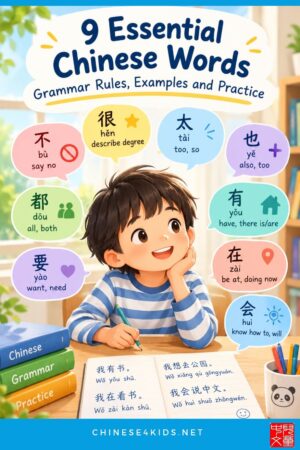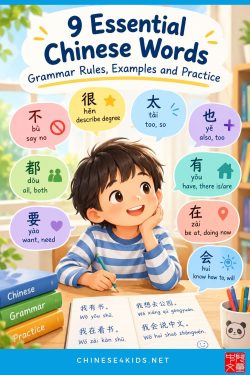
Nine small Chinese words do most of the work in a beginner’s first sentences: 不, 有, 很, 太, 也, 都, 在, 要 and 会. Once children learn how each one behaves, they can move from naming things to saying what they have, want, like and can do.
You’ll learn each word through simple sentence patterns you can say aloud, so there is no need for a lot of grammar terminology. You don’t need to learn all nine at once. Instead, choose one section at a time, read the examples aloud together, and try swapping in words from your child’s everyday life.
Quick answer:
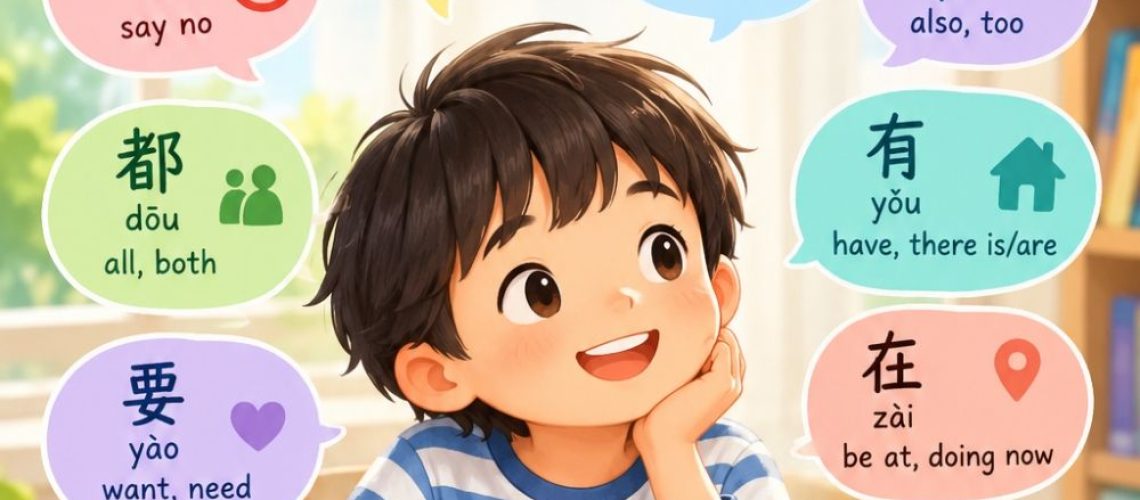
不 and 没(有) are two different ways to say no. 很 and 太 describe degree, 也 means “also”, and 都 means “all” or “both”. 有 says what you have or what is there, and 在 says where something is or what is happening now. 要 can mean want, plan or need, and 会 means know how to, or will probably. Here’s a quick look at what each word does.
不 and 没(有) are two different ways to say no. 很 and 太 describe degree, 也 means “also”, and 都 means “all” or “both”. 有 says what you have or what is there, and 在 says where something is or what is happening now. 要 can mean want, plan or need, and 会 means know how to, or will probably. Here’s a quick look at what each word does.
Contents
hide
The nine words at a glance
| Word | Main job | Example |
|---|---|---|
| 不 bù | Says no to a verb or adjective | 我不累。Wǒ bú lèi. I’m not tired. |
| 很 hěn | Links a person or thing to an adjective; can mean “very” | 天气很好。Tiānqì hěn hǎo. The weather is nice. |
| 太 tài | Too, or so (strong feeling) | 太好了!Tài hǎo le! That’s great! |
| 也 yě | Also, too | 我也喜欢。Wǒ yě xǐhuān. I like it too. |
| 都 dōu | All, both | 我们都来了。Wǒmen dōu lái le. We all came. |
| 有 yǒu | Have; there is / there are | 我家有四只猫。Wǒ jiā yǒu sì zhī māo. We have four cats. |
| 在 zài | Be at a place; doing something now | 我在看书。Wǒ zài kàn shū. I’m reading. |
| 要 yào | Want, going to, need to | 我要喝水。Wǒ yào hē shuǐ. I want to drink water. |
| 会 huì | Know how to; will (probably) | 我会游泳。Wǒ huì yóuyǒng. I can swim. |
1. 不 and 没(有): saying no
Use 不 for many habits, likes, plans and descriptions. In contrast, use 没有 to say you don’t have something. Also use 没 or 没有 for an action that did not happen or has not happened yet.
不 + verb or adjective
- 我不喝牛奶。Wǒ bù hē niúnǎi. I don’t drink milk.
- 她不高兴。Tā bù gāoxìng. She isn’t happy.
- 不要跑!Bú yào pǎo! Don’t run!
没有 for “don’t have”
- 我没有铅笔。Wǒ méiyǒu qiānbǐ. I don’t have a pencil.
- 我没有手机。Wǒ méiyǒu shǒujī. I don’t have a phone.
To say “don’t have” or “there isn’t / there aren’t”, use 没有, not 不有.
没 for things that didn’t happen
- 我昨天没去学校。Wǒ zuótiān méi qù xuéxiào. I didn’t go to school yesterday.
- 弟弟还没吃饭。Dìdi hái méi chī fàn. My little brother hasn’t eaten yet.
| 不 | 没(有) | |
|---|---|---|
| Use it for | Habits, likes, plans, adjectives | Not having something; past events; “not yet” |
| Example | 我不吃肉。Wǒ bù chī ròu. I don’t eat meat. | 我没吃早饭。Wǒ méi chī zǎofàn. I didn’t eat breakfast. |
These patterns will help you with many everyday sentences. For now, don’t worry about the exceptions, because you can learn them as you progress.
A tone change to listen for. 不 is usually bù, but it becomes bú before a fourth-tone syllable: 不是 bú shì, 不要 bú yào, 不累 bú lèi. Before other tones it usually stays bù, as in 不好 bù hǎo. Children usually pick this up by listening and copying, so say each pair aloud a few times.
2. 很 and 太: how much
很 is the everyday word before an adjective, and 太 means “too” or “so”.
很 before an adjective
Chinese does not normally use 是 before an adjective. In a plain statement, the adjective usually takes 很 in front of it.
- 他很高。Tā hěn gāo. He is tall.
- 这本书很重。Zhè běn shū hěn zhòng. This book is heavy.
- Wrong: 他是高。Right: 他很高。
A bare adjective, as in 他高, often needs a particular context and may sound contrastive. In a simple statement, 他很高 is usually more natural, and 很 doesn’t necessarily mean “very”. With stronger emphasis, 很高 can mean “very tall”. 很 also goes before feeling verbs: 我很喜欢猫。Wǒ hěn xǐhuān māo. I like cats a lot.
太…了: too, or so
- 太好了!Tài hǎo le! That’s great!
- 太冷了!Tài lěng le! It’s so cold! (or: too cold!)
- 这双鞋太贵了。Zhè shuāng xié tài guì le. These shoes are too expensive.
Depending on the situation and your tone of voice, this pattern can express delight or a complaint. In this pattern, 了 usually comes at the end.
不太: not very
- 我不太累。Wǒ bú tài lèi. I’m not very tired.
- 这个不太好吃。Zhège bú tài hǎochī. This isn’t very tasty.
To say “extremely”, use 非常 (fēicháng), as in 非常好, “extremely good”. You can study this word in more detail later. For now, it’s helpful to recognize it alongside 很 and 太.
3. 也 and 都: also and all
Both words go after the subject and before the verb or adjective. In fact, this word order works in many everyday sentences.
也: also, too
- 我也喜欢饺子。Wǒ yě xǐhuān jiǎozi. I like dumplings too.
- 他也很高。Tā yě hěn gāo. He is tall too.
- 你是学生,我也是。Nǐ shì xuéshēng, wǒ yě shì. You’re a student, and so am I.
In a complete sentence, 也 normally comes before the verb or adjective it modifies. English “too” can come at the end (“I like dumplings too”), but in Mandarin you say 我也喜欢饺子, not 我喜欢饺子也。For “me too”, say 我也是 or 我也喜欢. In everyday conversation, however, speakers sometimes drop words that are clear from context. For beginners, it is easiest to practise 也 in a complete sentence.
都: all, both
When you talk about two or more people or things, 都 can mean “both” or “all”.
- 我们都喜欢苹果。Wǒmen dōu xǐhuān píngguǒ. We all like apples.
- 爸爸妈妈都爱你。Bàba māma dōu ài nǐ. Mom and Dad both love you.
- 苹果和香蕉,我都喜欢。Píngguǒ hé xiāngjiāo, wǒ dōu xǐhuān. Apples and bananas, I like both.
也 + 都: also all
When you want to say “also all” or “also both”, 也 usually comes before 都.
- 你们也都是学生吗?Nǐmen yě dōu shì xuéshēng ma? Are you all students too?
都不 and 不都
These two patterns look similar, but their meanings are quite different. It’s helpful to learn them together.
| Pattern | Meaning | Example |
|---|---|---|
| 都不 | None, neither | 他们都不去。Tāmen dōu bú qù. None of them are going. |
| 不都 | Not all | 他们不都去。Tāmen bù dōu qù. Not all of them are going. |
In real conversation, context often makes the meaning clear. However, if this distinction feels tricky, practise the basic patterns first and return to it later.
4. 有 and 在: having, locating things, and actions in progress
While 有 tells what someone has or what is in a place, 在 tells where someone or something is, and what is happening right now.
有: have, there is, there are
- 我家有四只猫。Wǒ jiā yǒu sì zhī māo. We have four cats.
- 书包里有三本书。Shūbāo lǐ yǒu sān běn shū. There are three books in the bag.
- 你有没有铅笔?Nǐ yǒu méiyǒu qiānbǐ? Do you have a pencil?
Use 有没有… to ask whether someone has something. You can answer 有 (yes, I do) or 没有 (no, I don’t).
在: be at a place
- 妈妈在家。Māma zài jiā. Mom is at home.
- 书在桌子上。Shū zài zhuōzi shàng. The book is on the table.
Subject + 在 + place + verb: do something somewhere
- 我在学校吃午饭。Wǒ zài xuéxiào chī wǔfàn. I eat lunch at school.
在 + verb: doing it now
- 我在看书。Wǒ zài kàn shū. I’m reading.
- 弟弟正在睡觉。Dìdi zhèngzài shuìjiào. My little brother is sleeping right now.
正在 stresses “right now”, but plain 在 works in most sentences.
Same scene, two ways to say it
| You want to | Pattern | Example |
|---|---|---|
| Say where something is | thing + 在 + place | 书在书包里。Shū zài shūbāo lǐ. The book is in the bag. |
| Say what is in a place | place + 有 + thing | 书包里有书。Shūbāo lǐ yǒu shū. There is a book in the bag. |
Before you choose, ask yourself: “Am I saying where it is, or what is there?” This simple question can help you pick the right word.
5. 要 and 会: wanting, needing, knowing how
要 is for wanting, planning and needing. 会 is for skills you have learned and for things that will probably happen.
要: three jobs
- Want something: 我要一杯水。Wǒ yào yì bēi shuǐ. I want a glass of water.
- Want to, or going to, do something: 我要学中文。Wǒ yào xué Zhōngwén. I want to learn Chinese. 明天我们要去公园。Míngtiān wǒmen yào qù gōngyuán. Tomorrow we’re going to the park.
- Need to do something: 你要早点睡觉。Nǐ yào zǎodiǎn shuìjiào. You need to go to bed earlier.
The context helps you work out the meaning, so remember that 要 doesn’t always mean “want”.
To tell someone not to do something, use 不要 + verb: 不要跑!Bú yào pǎo! To say “I don’t want to”, 不想 is the safer choice: 我不想去。Wǒ bù xiǎng qù. I don’t want to go.
会: know how to, will
- A learned skill: 我会游泳。Wǒ huì yóuyǒng. I can swim.
- No skill yet: 她不会骑自行车。Tā bú huì qí zìxíngchē. She can’t ride a bike.
- Likely to happen: 明天会下雨。Míngtiān huì xià yǔ. It will probably rain tomorrow.
- Likely to happen: 爸爸今天会回来。Bàba jīntiān huì huílái. Dad will be back today.
想, 要, 会, 能 and 可以: five useful words to compare
These five words can have similar English translations, but each has its own job in Chinese. The examples below show how 想, 能 and 可以 differ from 要 and 会. You can study them in more depth later.
| Word | Idea | Example |
|---|---|---|
| 想 xiǎng | Would like to; feel like | 我想吃饺子。Wǒ xiǎng chī jiǎozi. I’d like to eat dumplings. |
| 要 yào | Want, going to, need to | 我要吃饺子。Wǒ yào chī jiǎozi. I want dumplings. |
| 会 huì | Know how to; will (probably) | 我会包饺子。Wǒ huì bāo jiǎozi. I know how to make dumplings. |
| 能 néng | Be able to, because of time, health or the situation | 我今天能来。Wǒ jīntiān néng lái. I can come today. |
| 可以 kěyǐ | Can; may; be permitted to | 我可以吃一个吗?Wǒ kěyǐ chī yí gè ma? Can I have one? |
Practice: pick the right word
Choose the correct word for each sentence, say the finished sentence aloud, then check the answer key. Ten minutes a few times a week works better than one long session.
- 我____累。(不 / 没)
- 我昨天____去学校。(不 / 没)
- 他____高。(是 / 很)
- 这个苹果____大了,我吃不完!(太 / 很)
- 你喜欢猫,我____喜欢猫。(也 / 都)
- 我和妹妹____喜欢画画。(也 / 都)
My sister and I both like drawing. - Which sentence means “None of us like it”? (A) 我们都不喜欢。(B) 我们不都喜欢。
- 书包里____三本书。(有 / 在)
- 我的书____桌子上。(有 / 在)
- “I know how to swim.” 我____游泳。(会 / 想)
Speak it: make three sentences about your family. Use 有 in the first, 也 in the second and 都 in the third.
Answer key
- 不 (我不累。Wǒ bú lèi.). 不 negates a description like 累, and it becomes bú before the fourth tone.
- 没 (我昨天没去学校。). 没 negates a past event.
- 很 (他很高。). Use 很, not 是, before an adjective.
- 太 (这个苹果太大了,我吃不完!). 太…了 means “too” or “so”.
- 也 (我也喜欢猫。). 也 means “too” and goes before the verb.
- 都 (我和妹妹都喜欢画画。). 都 means “both”.
- (A) 我们都不喜欢。都不 means none of us. (B) 不都 means not all of us.
- 有 (书包里有三本书。). Place + 有 + thing says what is there.
- 在 (我的书在桌子上。). Thing + 在 + place says where it is.
- 会 (我会游泳。). 会 is a learned skill. 想 would mean “I want to swim”.
Frequently Asked Questions
What is the difference between 不 and 没?
不 covers many habits, preferences and descriptions, and it goes before adjectives. 没 or 没有 covers things that didn’t happen or haven’t happened yet. For “don’t have”, use 没有 rather than 不有.
Do I always need 很 before an adjective?
No, but 很 is common in simple descriptive sentences, as in 他很高, “He is tall.” A bare adjective often sounds like a comparison. In an answer or a contrast, such as 他高,我矮, you can leave 很 out.
Does 很 always mean “very”?
No. In a plain statement it is usually light and just links the person to the adjective. If you stress it, however, it can mean “very”. Use 非常 when you want “extremely”.
How do I say “both” in Chinese?
Use 都. It can mean “both” or “all”, and it goes after the subject: 我们两个都喜欢。
What is the difference between 在 and 正在?
Both show that something is happening now. However, 正在 stresses the “right now”, while plain 在 is fine in most everyday sentences.
What is the difference between 要 and 想?
想 is softer: “would like to” or “feel like”. 要 is firmer: “want”, “going to” or “need to”. For “I don’t want to”, therefore, 不想 is the safer choice.
How should I practice these words with children?
Take one section a week. First, say the example sentences aloud, then swap in words from your child’s day, and finally try a few questions from the practice set. Short, frequent sessions beat long ones, because they are easier to keep up.
Want to explore Chinese grammar further?
If you’d like a reference book to explore Chinese grammar in more depth, the Chinese Grammar Wiki BOOK: Elementary and Basics is worth considering. Check the contents and sample pages to see whether it suits your needs.
As an Amazon Associate, I earn from qualifying purchases.
If you find this article useful, share it