Quick Answer
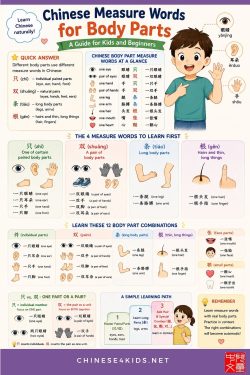
When talking about body parts in Chinese, different measure words are used for different types of body parts. 只 (zhī) is commonly used for individual eyes, ears, hands, and feet, while 双 (shuāng) is used for natural pairs such as eyes, hands, and feet. 条 (tiáo) is commonly used with long body parts such as legs and arms, and 根 (gēn) is used for individual hairs and other thin, long things.
When talking about body parts in Chinese, different measure words are used for different types of body parts. 只 (zhī) is commonly used for individual eyes, ears, hands, and feet, while 双 (shuāng) is used for natural pairs such as eyes, hands, and feet. 条 (tiáo) is commonly used with long body parts such as legs and arms, and 根 (gēn) is used for individual hairs and other thin, long things.
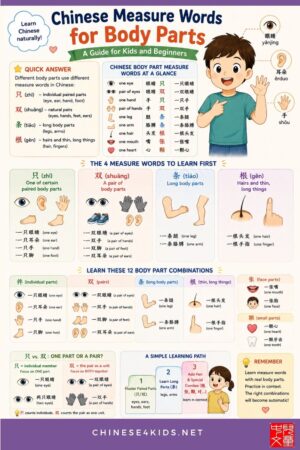
Chinese Body Part Measure Words at a Glance
| English | Chinese | Measure Word | Example |
|---|---|---|---|
| one eye | 眼睛 | 只 | 一只眼睛 |
| pair of eyes | 眼睛 | 双 | 一双眼睛 |
| one hand | 手 | 只 | 一只手 |
| pair of hands | 手 | 双 | 一双手 |
| one leg | 腿 | 条 | 一条腿 |
| one arm | 胳膊 | 条 | 一条胳膊 |
| one hair | 头发 | 根 | 一根头发 |
| one mouth | 嘴 | 张 | 一张嘴 |
| one heart | 心 | 颗 | 一颗心 |
What Are Measure Words for Body Parts?
In Chinese, when counting body parts, you normally put a measure word (量词, liàngcí) between the number and the body-part noun. Measure words help you count and describe your body naturally in Mandarin.
One eye: 一只眼睛 (yī zhī yǎn jīng)
A pair of eyes: 一双眼睛 (yī shuāng yǎn jīng)
One hand: 一只手 (yī zhī shǒu)
One leg: 一条腿 (yī tiáo tuǐ)
Chinese measure words are learned through common combinations, not rigid rules. Different body parts use different measure words based on how Chinese speakers naturally describe them. This article focuses on the most useful patterns.
New to measure words? Start with our complete guide to Chinese measure words, which explains how the system works across all categories. This article focuses on body parts specifically.
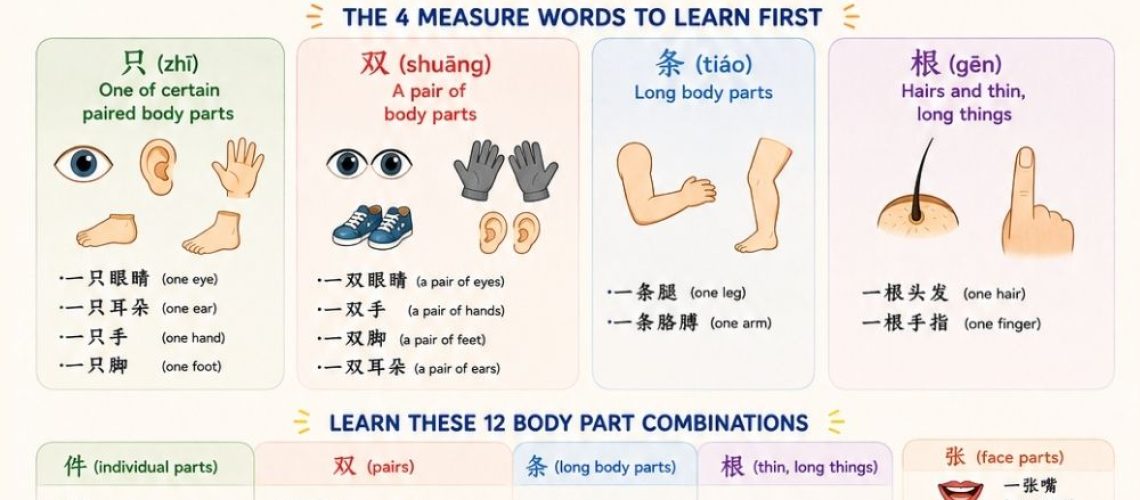
4 Measure Words to Learn First
These four measure words are the most useful to learn first when talking about body parts:
| Measure Word | Pinyin | Common Body-Part Use | Example |
|---|---|---|---|
| 只 | zhī | One of certain paired body parts | 一只眼睛 (one eye) |
| 双 | shuāng | A pair of body parts | 一双眼睛 (a pair of eyes) |
| 条 | tiáo | Long body parts | 一条腿 (one leg) |
| 根 | gēn | Individual hairs and thin, long things | 一根头发 (one hair) |
只 vs. 双: One Body Part or a Pair?
The distinction between 只 and 双 is essential. 只 counts an individual member of a paired body part, while 双 counts the two parts together as a unified pair.
How This Works with Eyes
Notice the three different ways to count:
- 一只眼睛 (yī zhī yǎn jīng) = one eye (focusing on one member)
- 两只眼睛 (liǎng zhī yǎn jīng) = two eyes (counting individuals)
- 一双眼睛 (yī shuāng yǎn jīng) = a pair of eyes (counting the pair as one unit)
This Pattern Works with Other Paired Body Parts
Hands:
- 一只手 → one hand
- 两只手 → two hands
- 一双手 → a pair of hands
Feet:
- 一只脚 → one foot
- 两只脚 → two feet
- 一双脚 → a pair of feet
Ears:
- 一只耳朵 → one ear
- 两只耳朵 → two ears
- 一双耳朵 → a pair of ears
Why This Matters Pedagogically
只 emphasizes counting individual members → 一只眼睛 = my left eye hurts
双 emphasizes the pair as a unit → 我有一双蓝眼睛 = I have blue eyes (as a pair)
This distinction makes the system more intuitive and memorable.
条: Long Body Parts (Legs and Arms)
For longer body parts like legs and arms, Chinese commonly uses 条 (the same measure word used for thin, long objects):
- 一条腿 (yī tiáo tuǐ) → one leg
- 两条腿 (liǎng tiáo tuǐ) → two legs
- 一条胳膊 (yī tiáo gē bo) → one arm
- 一条手臂 (yī tiáo shǒu bì) → one arm
胳膊 (gēbo) is a common everyday word for “arm.”
手臂 (shǒubì) is another word for “arm,” often used in more formal or written contexts.
Example sentences:
我有一条腿受伤了。(One of my legs is injured.)
他有很长的胳膊。(He has long arms.)
When talking about both legs together, you can say:
- 两条腿 → two legs (most common)
- 一双腿 → a pair of legs (emphasizing the pair)
根: Hair and Other Thin, Long Things
For individual hairs and other thin, long things, Chinese uses 根 (the same measure word used for strands, sticks, and thin objects):
- 一根头发 (yī gēn tóufa) → one hair
- 一根手指 (yī gēn shǒu zhǐ) → one finger
- 一根眉毛 (yī gēn méi máo) → one eyebrow hair
- 一根胡子 (yī gēn húzi) → one whisker
About Eyebrows: 眉毛
一根眉毛 specifically means one eyebrow hair, not the whole eyebrow.
When talking about the whole eyebrows as a pair, you can say:
- 一对眉毛 (yī duì méi máo) → a pair of eyebrows
- 一双眉毛 (yī shuāng méi máo) → a pair of eyebrows
Example sentences:
- 我掉了一根头发。(I lost one hair.)
- 她有漂亮的一双眉毛。(She has pretty eyebrows.)
Other Useful Body Part Measure Words
As your Chinese improves, you’ll encounter these additional measure words with body parts:
张 (zhāng) — Used with mouth and face:
一张嘴 (yī zhāng zuǐ) → one mouth
一张脸 (yī zhāng liǎn) → one face
颗 (kē) — Used with small, individual things:
- 一颗心 (yī kē xīn) → one heart
- 一颗牙齿 (yī kē yá chǐ) → one tooth
对 (duì) — Used for things that form a pair:
- 一对眼睛 → a pair of eyes
- 一对耳朵 → a pair of ears
- 一对眉毛 → a pair of eyebrows
个 (gè) — General-purpose measure word (used when no more specific measure word applies):
- 一个鼻子 → one nose
- 一个手指头 → one finger
Learn these additional measure words when you encounter them in context.
Common Body Parts + Measure Words
| Body Part | Useful Measure Words | Examples |
|---|---|---|
| 眼睛 Eye | 只 / 双 | 一只眼睛 / 一双眼睛 |
| 耳朵 Ear | 只 / 双 | 一只耳朵 / 一双耳朵 |
| 手 Hand | 只 / 双 | 一只手 / 一双手 |
| 脚 Foot | 只 / 双 | 一只脚 / 一双脚 |
| 腿 Leg | 条 / 双 | 一条腿 / 一双腿 |
| 胳膊 Arm | 条 | 一条胳膊 |
| 手臂 Arm (formal) | 条 | 一条手臂 |
| 头发 Hair | 根 | 一根头发 |
| 手指 Finger | 根 | 一根手指 |
| 眉毛 Eyebrow* | 根* / 对 / 双 | 一根眉毛* / 一对眉毛 |
| 嘴 Mouth | 张 | 一张嘴 |
| 脸 Face | 张 | 一张脸 |
| 心 Heart | 颗 | 一颗心 |
| 牙齿 Tooth | 颗 | 一颗牙齿 |
| 鼻子 Nose | 个 | 一个鼻子 |
Note: 一根眉毛 refers to an individual eyebrow hair. For the eyebrows themselves, use 一对眉毛 or 一双眉毛.
A Simple Learning Path
You don’t need to learn all measure words at once. Here’s how to build your knowledge:
Phase 1: Master Paired Body Parts (只/双)
Start with these combinations and notice the pattern:
- 一只眼睛 → 一双眼睛 (eye/eyes)
- 一只手 → 一双手 (hand/hands)
- 一只脚 → 一双脚 (foot/feet)
- 一只耳朵 → 一双耳朵 (ear/ears)
Get comfortable with understanding that 只 counts individual members and 双 counts the pair as a unit.
Phase 2: Learn Long Body Parts (条)
Introduce 条 for legs and arms:
- 一条腿 (one leg)
- 一条胳膊 (one arm)
- 两条腿 (two legs)
Phase 3: Encounter Hair, Fingers, and Special Combinations
As you read and listen more, you’ll naturally encounter:
- 一根头发 (one hair)
- 一根手指 (one finger)
- 一对眉毛 (a pair of eyebrows)
- 一张嘴 (one mouth)
- 一颗心 (one heart)
Learn these when you encounter them in context.
Try It Yourself: Quick Practice
Level 1: Choose the Correct Measure Word
1. 一___ 眼睛 (one eye)** a) 条 b) 只 c) 根
2. 一___ 眼睛 (a pair of eyes) a) 只 b) 双 c) 条
3. 一___ 手 (one hand) a) 条 b) 双 c) 只
4. 一___ 腿 (one leg) a) 只 b) 条 c) 双
5. 一___ 头发 (one hair) a) 根 b) 条 c) 颗
Answers
- 只 → 一只眼睛 (one eye)
- 双 → 一双眼睛 (a pair of eyes)
- 只 → 一只手 (one hand)
- 条 → 一条腿 (one leg)
- 根 → 一根头发 (one hair)
Level 2: Build the Sentence
Put the words in the correct order:
眼睛 / 一 / 只
Answer: 一只眼睛
手 / 一 / 双
Answer: 一双手
腿 / 一 / 条
Answer: 一条腿
头发 / 一 / 根
Answer: 一根头发
Level 3: Match
Match each body part with the correct singular measure word:
👁️ 眼睛 → 只
👐 手 → 只
🦶 脚 → 只
🦵 腿 → 条
💇 头发 → 根
👂 耳朵 → 只
Check your answers
All correct!
Notice:
只 is used for eyes, hands, feet, ears (individual paired body parts)
条 is used for legs (long body parts)
根 is used for hair (thin, long things)
只 is used for eyes, hands, feet, ears (individual paired body parts)
条 is used for legs (long body parts)
根 is used for hair (thin, long things)
When referring to pairs, use 双: 一双眼睛, 一双手, 一双脚.
Learn Measure Words with Real Vocabulary
The most important principle: Learn the most useful combinations first, then notice the patterns behind them.
Start with these combinations as complete chunks:
- 一只眼睛 (one eye)
- 一双眼睛 (a pair of eyes)
- 一条腿 (one leg)
- 一根头发 (one hair)
When measure words are connected to real body parts, children learn them naturally and remember them longer. Over time, the patterns behind 只, 双, 条, and 根 become much easier to recognize and use.
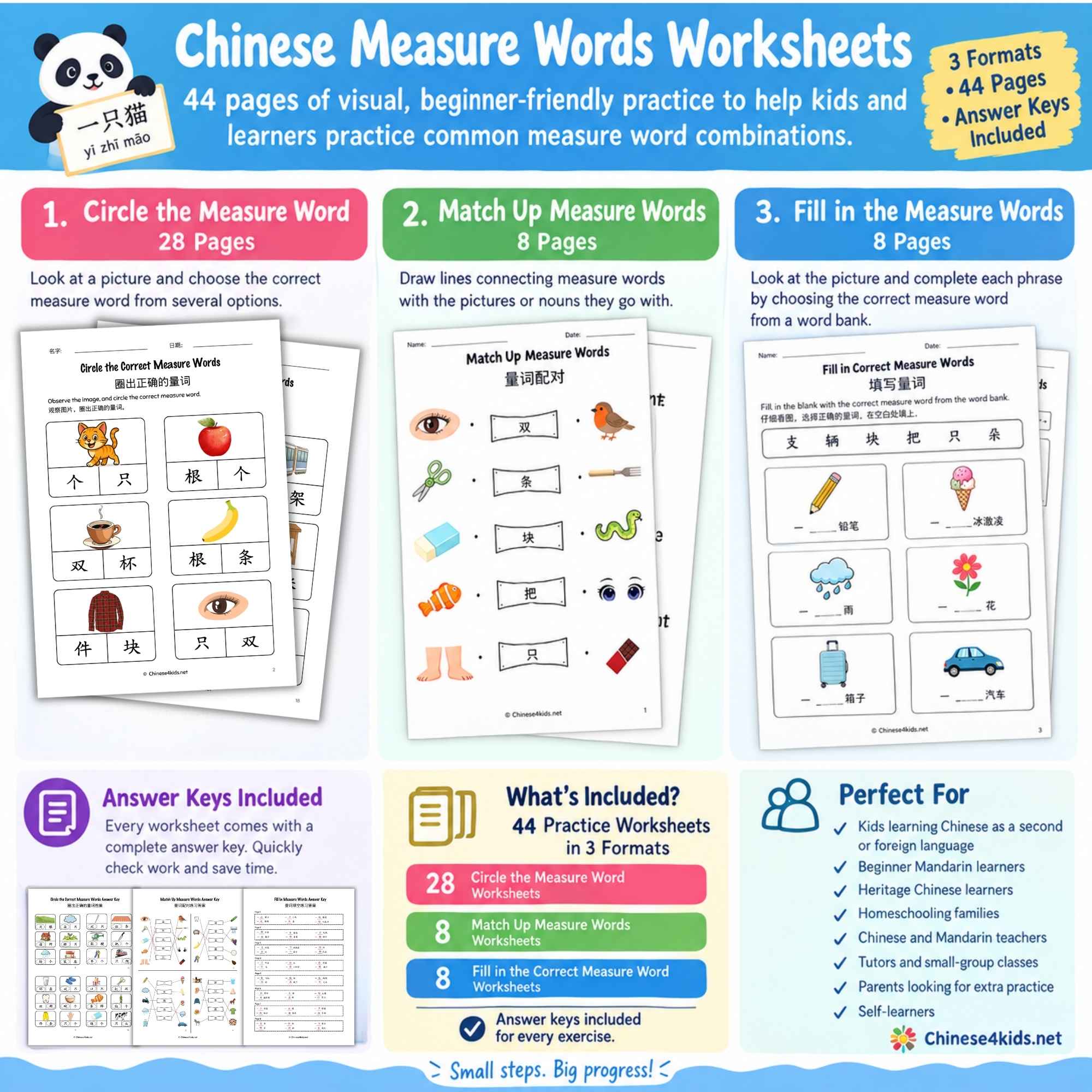
Practice at home Want printable practice for these measure words? Both resources use the same set of nouns, so your child can move from reading to writing without switching materials.
- Chinese Measure Words Flashcards — pair each noun with its measure word for quick review
- Chinese Measure Words Worksheets — written practice with answer keys
Related Measure Words
Once you’ve mastered body parts, explore related categories:
- Chinese Measure Words: A Complete Guide — See how all categories connect
- Measure Words for Clothing — Also uses 只 and 双 for similar concepts
- Measure Words for Animals — Learn 只, 头, 条, 匹
- Measure Words for People — Learn 个, 位, 群, 家, 口
- Measure Words for Food — Learn 个, 块, 片, 碗, 杯, 盘, 根
- Measure Words for Household Items — Common objects around the home
Frequently Asked Questions
What measure word is used for eyes in Chinese?
The most common measure word for one eye in Chinese is 只 (zhī): 一只眼睛. For a pair of eyes, use 双 (shuāng): 一双眼睛.
What is the difference between 一只眼睛 and 一双眼睛?
一只眼睛 (one eye) refers to a single eye — for example, when one eye is injured or you’re covering one eye. 一双眼睛 (a pair of eyes) refers to both eyes together as a unit — for example, describing someone’s eye color or when both eyes are involved together.
What measure word do you use for hands?
The most common measure word for one hand is 只 (zhī): 一只手. For a pair of hands together, use 双 (shuāng): 一双手.
What measure word do you use for feet?
The most common measure word for one foot is 只 (zhī): 一只脚. For a pair of feet together, use 双 (shuāng): 一双脚.
What measure word is used for legs in Chinese?
The most common measure word for a leg is 条 (tiáo): 一条腿. When referring to two individual legs, use 两条腿 (two legs). When emphasizing the pair, you can say 一双腿 (a pair of legs).
What measure word is used for eyebrows in Chinese?
For an individual eyebrow hair, use 根 (gēn): 一根眉毛. For the eyebrows as a pair, use 对 (duì): 一对眉毛 or 双 (shuāng): 一双眉毛.
What measure word is used for hair in Chinese?
The most common measure word for one hair is 根 (gēn): 一根头发. For example: 我掉了一根头发。 (I lost one hair.)
Can you use 双 and 只 with body parts?
Yes. 只 counts individual members of a paired body part (like one eye or one hand), while 双 counts the pair as a unified unit (like a pair of eyes or a pair of hands). Both are natural and commonly used, depending on whether you’re focusing on a single member or the pair together.
Final Takeaway
The easiest way to learn Chinese measure words for body parts is to learn them as vocabulary chunks, not isolated rules. Start with 一只眼睛, 一双眼睛, 一只手, 一双手, 一条腿 and 一根头发. Once these combinations become familiar, the patterns behind 只, 双, 条 and 根 become much easier to recognize and use in context.
Learning Pathway
Understand the System → Our complete guide to Chinese measure words explains how the system works across all categories.
Learn Body Parts → You’ve just read it! Now you understand the most useful patterns for talking about body parts with the correct measure words.
Ready to practice more? Our Chinese Measure Words Flashcards let children see measure words paired with each noun, and Chinese Measure Words Worksheets to practice.
If you like this article, share it