
Quick Answer
When talking about household items in Chinese, different measure words are used with different objects. 把 (bǎ) is used with objects like chairs, keys, and umbrellas. 张 (zhāng) is used with objects like tables, beds, and paper. 台 (tái) is used with machines and appliances like televisions and refrigerators. Learning which measure word goes with each household item helps you describe your home naturally in Mandarin.
When talking about household items in Chinese, different measure words are used with different objects. 把 (bǎ) is used with objects like chairs, keys, and umbrellas. 张 (zhāng) is used with objects like tables, beds, and paper. 台 (tái) is used with machines and appliances like televisions and refrigerators. Learning which measure word goes with each household item helps you describe your home naturally in Mandarin.
Chinese Household Item Measure Words at a Glance
| English | Chinese | Measure Word | Example |
|---|---|---|---|
| one chair | 椅子 | 把 | 一把椅子 |
| one table | 桌子 | 张 | 一张桌子 |
| one bed | 床 | 张 | 一张床 |
| one TV | 电视 | 台 | 一台电视 |
| one refrigerator | 冰箱 | 台 | 一台冰箱 |
| one umbrella | 伞 | 把 | 一把伞 |
| one key | 钥匙 | 把 | 一把钥匙 |
| a bunch of keys | 钥匙 | 串 | 一串钥匙 |
| one lamp/light | 灯 | 盏 | 一盏灯 |
| one towel | 毛巾 | 条 | 一条毛巾 |
| one quilt/duvet | 被子 | 床 | 一床被子 |
What Are Measure Words for Household Items?
In Chinese, when counting household items and things around the house, you normally put a measure word (量词, liàngcí) between the number and the object name. Measure words help you count and describe objects in your home naturally in Mandarin.
- One table: 一张桌子 (yī zhāng zhuōzi)
- One chair: 一把椅子 (yī bǎ yǐzi)
- One television: 一台电视 (yī tái diànshì)
Chinese measure words often show useful patterns, but many combinations are conventional. For beginners, the most reliable approach is to learn common measure word + noun combinations together. This article focuses on the most useful combinations for talking about things in your home.
New to measure words? Start with our complete guide to Chinese measure words, which explains how the system works across all categories. This article focuses on household items specifically.
A Helpful Pattern: Learn Combinations, Then Notice Patterns
Chinese measure words often have useful patterns, but the safest way to learn them is through common vocabulary combinations.
For example:
- 一把椅子 (one chair)
- 一张桌子 (one table)
- 一台冰箱 (one refrigerator)
The patterns can help you remember them, but the most important thing is to learn the whole measure word + object combination together. Over time, you’ll naturally notice which measure words go with similar types of objects.
3 Useful Measure Words to Learn First
These three measure words are useful starting points for learning common household vocabulary. Each has several common patterns, but remember that Chinese measure words are largely learned through conventional word combinations.
| Measure Word | Pinyin | Examples | Notes |
|---|---|---|---|
| 把 | bǎ | 椅子, 伞, 钥匙, 梳子 | Objects that can be held or have established conventional combinations |
| 张 | zhāng | 桌子, 床, 纸 | Flat, broad objects, or conventional combinations with broad surfaces |
| 台 | tái | 电视, 冰箱, 洗衣机, 空调 | Machines, appliances, equipment |
Learn These Core Combinations
Don’t memorize rules. Learn these combinations as complete units:
把 (Objects That Are Held or Have Established Combinations)
- 🪑 一把椅子 (yī bǎ yǐzi)
One chair - ☂️ 一把伞 (yī bǎ sǎn)
One umbrella - 🔑 一把钥匙 (yī bǎ yàoshi)
One key - 🧹 一把梳子 (yī bǎ shūzi)
One comb
张 (Flat, Broad, or Spread-Out Objects)
- 🏠 一张桌子 (yī zhāng zhuōzi)
One table - 🛏️ 一张床 (yī zhāng chuáng)
One bed - 📄 一张纸 (yī zhāng zhǐ)
One sheet of paper
台 (Machines and Equipment)
- 📺 一台电视 (yī tái diànshì)
One television - ❄️ 一台冰箱 (yī tái bīngxiāng)
One refrigerator - 🌀 一台洗衣机 (yī tái xǐyījī)
One washing machine - 🌬️ 一台空调 (yī tái kōngtiáo)
One air conditioner
Over time, these combinations become automatic and natural to use.
Common Household Items + Measure Words
| Household Item | Measure Word | Example |
|---|---|---|
| 椅子 Chair | 把 | 一把椅子 |
| 桌子 Table | 张 | 一张桌子 |
| 床 Bed | 张 | 一张床 |
| 纸 Paper | 张 | 一张纸 |
| 电视 Television | 台 | 一台电视 |
| 冰箱 Refrigerator | 台 | 一台冰箱 |
| 空调 Air conditioner | 台 | 一台空调 |
| 洗衣机 Washing machine | 台 | 一台洗衣机 |
| 钥匙 Key | 把 | 一把钥匙 |
| 伞 Umbrella | 把 | 一把伞 |
| 梳子 Comb | 把 | 一把梳子 |
| 灯 Lamp/light | 盏 | 一盏灯 |
| 台灯 Desk lamp | 盏 | 一盏台灯 |
| 灯泡 Lightbulb | 个 | 一个灯泡 |
| 枕头 Pillow | 个 | 一个枕头 |
| 毛巾 Towel | 条 | 一条毛巾 |
| 被子 Quilt/duvet | 床 | 一床被子 |
| 家具 Furniture | 套 | 一套家具 |
| 门 Door | 扇 | 一扇门 |
| 窗 Window | 扇 | 一扇窗 |
Understanding 把, 张, and 台
把 (bǎ): Objects That Are Held or Have Established Combinations
把 is used with many objects that can be held, grasped, or have a handle. It is also used in established combinations such as 一把椅子 and 一把钥匙. Because classifier usage is conventional, it is best to learn each common combination as a whole.
- 一把椅子 → one chair
- 一把伞 → one umbrella
- 一把钥匙 → one key
- 一把梳子 → one comb
Example sentences:
- 我需要一把新椅子。(I need one new chair.)
- 他有一把伞。(He has one umbrella.)
张 (zhāng): Flat or Broad Objects
张 is commonly used with flat, broad, or spread-out things. It is also used conventionally with objects such as tables and beds, which have a broad surface.
- 一张桌子 → one table
- 一张床 → one bed
- 一张纸 → one sheet of paper
Example sentences:
- 我有一张新床。(I have one new bed.)
- 请给我一张纸。(Please give me one sheet of paper.)
台 (tái): Machines and Equipment
台 is commonly used with machines, appliances, electronic equipment, and other substantial pieces of equipment.
- 一台电视 → one television
- 一台冰箱 → one refrigerator
- 一台洗衣机 → one washing machine
- 一台空调 → one air conditioner
Example sentences:
- 我家有一台新冰箱。(My home has one new refrigerator.)
- 她买了一台电视。(She bought one television.)
A Simple Learning Path
You don’t need to learn all measure words at once. Here’s how to build your knowledge:
Phase 1: Master the 3 Core Words (把, 张, 台)
Start with these three and their most common examples:
- 一把椅子 (one chair)
- 一把伞 (one umbrella)
- 一把钥匙 (one key)
- 一张桌子 (one table)
- 一张床 (one bed)
- 一台电视 (one television)
- 一台冰箱 (one refrigerator)
Get comfortable with learning these combinations together.
Phase 2: Add More Common Household Items
Expand to include:
- More items with 把: 梳子 (comb)
- More items with 张: 纸 (paper)
- More items with 台: 洗衣机 (washing machine), 空调 (air conditioner)
Phase 3: Encounter Other Measure Words
As you read and listen more, you’ll encounter these additional MWs with household items:
- 盏 (zhǎn) — for lamps: 一盏灯
- 条 (tiáo) — for towels: 一条毛巾
- 床 (chuáng) — for bedding: 一床被子
- 个 (gè) — for various items: 一个灯泡, 一个枕头, 一个垃圾桶
- 套 (tào) — for sets: 一套家具, 一套厨具
- 扇 (shàn) — for doors/windows: 一扇门, 一扇窗
- 根 (gēn) — for thin, long things: 一根电线, 一根绳子
- 块 (kuài) — for solid objects: 一块肥皂
- 串 (chuàn) — for bunches or strings: 一串钥匙
Learn these when you encounter them in context.
Keys: Understanding 把 vs 串
Chinese can use different measure words with the same noun depending on what you are counting. This distinction is important:
🔑 一把钥匙 (yī bǎ yàoshi)
= One key
(把 counts the individual key)
🔑🔑 一串钥匙 (yī chuàn yàoshi)
= A bunch or ring of keys
(串 counts a group of keys connected together)
Example:
- 我丢了一把钥匙。(I lost one key.)
- 我有一串钥匙。(I have a bunch/keyring of keys.)
This example shows why measure words matter: they describe what is being counted, not just the type of object.
Try It Yourself: Quick Practice
Level 1: Choose the Correct Measure Word
1. 一___ 椅子 (one chair) a) 张 b) 把 c) 台
2. 一___ 桌子 (one table) a) 把 b) 台 c) 张
3. 一___ 电视 (one television) a) 张 b) 把 c) 台
4. 一___ 伞 (one umbrella) a) 台 b) 把 c) 张
5. 一___ 床 (one bed) a) 把 b) 条 c) 张
Answers
- 把 → 一把椅子 (one chair)
- 张 → 一张桌子 (one table)
- 台 → 一台电视 (one television)
- 把 → 一把伞 (one umbrella)
- 张 → 一张床 (one bed)
Level 2: Match the Object to the Measure Word
Match each household item with the correct measure word:
- 🪑 椅子 → 把
- 🏠 桌子 → 张
- 📺 电视 → 台
- 📄 纸 → 张
- 🔑 one key → 把
- 🔑🔑 a bunch of keys → 串
- ☂️ 伞 → 把
- ❄️ 冰箱 → 台
- 🧹 梳子 → 把
Check your answers
All correct!
把 (certain objects): 椅子, 伞, 梳子, 一把钥匙 (one key)
张 (flat/extended): 桌子, 纸
台 (equipment): 电视, 冰箱
串 (bunches): 一串钥匙 (a bunch of keys)
Level 3: Fix the Mistake
Which sentence is correct?
1. A. 一台椅子 OR B. 一把椅子
Answer: B. 一把椅子 (one chair)
2. A. 一张冰箱 OR B. 一台冰箱
Answer: B. 一台冰箱 (one refrigerator)
3. A. 一把桌子 OR B. 一张桌子
Answer: B. 一张桌子 (one table)
4. A. 一把钥匙 = one key B. 一串钥匙 = a bunch of keys
Answer: Both are correct! They use different measure words to count different things.
This helps you understand that measure words are part of the vocabulary combination, not something separate from the object.
Learn Measure Words with Real Vocabulary
The most important principle: Learn the most useful combinations first, then notice the patterns behind them.
Start with these combinations as complete chunks:
- 一把椅子 (one chair)
- 一张桌子 (one table)
- 一张床 (one bed)
- 一台电视 (one television)
- 一台冰箱 (one refrigerator)
When measure words are connected to real household items, children learn them naturally and remember them longer. Over time, the patterns behind 把, 张, and 台 become much easier to recognize and use.
Our Chinese Measure Words for Household Items Montessori Flashcards use exactly this method. These flashcards are especially useful for parents and teachers who want children to learn measure words through pictures, vocabulary and matching rather than memorizing isolated grammar rules. Children see the object, read the vocabulary and match it with the correct measure-word combination.
For comprehensive practice across all measure word categories, explore our Complete Chinese Measure Words Bundle.
Other Useful Household Measure Words
盏 (zhǎn) — Lamps
- 一盏灯 — one lamp/light
- 一盏台灯 — one desk lamp
- 一盏吊灯 — one pendant/chandelier light
盏 is a traditional and standard measure word for lamps and lanterns. In everyday speech, 个 may also occur with some types of modern lights, but 一盏灯 is a useful standard combination for learners.
条 (tiáo) — Long, Narrow, or Flexible Things
- 一条毛巾 — one towel
床 (chuáng) — Bedding
- 一床被子 — one quilt/duvet/comforter
床 itself is also a measure word used specifically for bedding. This is one of the clearest examples of how measure words describe the way something is grouped or counted.
个 (gè) — General Measure Word
- 一个灯泡 — one lightbulb
- 一个枕头 — one pillow
- 一个垃圾桶 — one rubbish bin
个 is the most general measure word and is used with many household objects, especially when there is no more specific classifier that learners need to use. However, 个 is not interchangeable with every other classifier.
套 (tào) — Sets
- 一套家具 — a set of furniture
- 一套厨具 — a set of kitchen utensils
套 counts a set or coordinated group. This is different from counting individual items:
- 一件家具 = one piece of furniture
- 一套家具 = a set/suite of furniture
扇 (shàn) — Doors and Windows
- 一扇门 — one door
- 一扇窗 — one window
扇 is used for doors and windows, especially when counting the individual door or window panel/unit.
根 (gēn) — Thin, Slender Objects
- 一根电线 — one wire/electrical cord
- 一根绳子 — one rope/string
块 (kuài) — Solid, Chunk-Like Objects
- 一块肥皂 — one bar of soap
串 (chuàn) — Bunches, Strings, or Connected Groups
- 一串钥匙 — a bunch or ring of keys
- 一串珠子 — a string of beads
串 is used when objects are connected or grouped together. This is why we use 串 for a bunch of keys held together on a keyring, but 把 when counting individual keys.
Related Measure Words
Once you’ve mastered household items, explore related categories:
- Chinese Measure Words: A Complete Guide — See how all categories connect
- Measure Words for Body Parts — Learn 只, 双, 条, 根
- Measure Words for Clothing — Learn 件, 条, 双, 套
- Measure Words for Animals — Learn 只, 头, 条, 匹
- Measure Words for Food — Learn 个, 块, 片, 碗, 杯, 盘, 根
- Measure Words for People — Learn 个, 位, 群, 家, 口
- Measure Words for Buildings — Learn about architectural items
- Measure Words for Tableware — Learn 个, 套, 副
Practice at home Want printable practice for these measure words? Both resources use the same set of nouns, so your child can move from reading to writing without switching materials.
- Chinese Measure Words Flashcards — pair each noun with its measure word for quick review
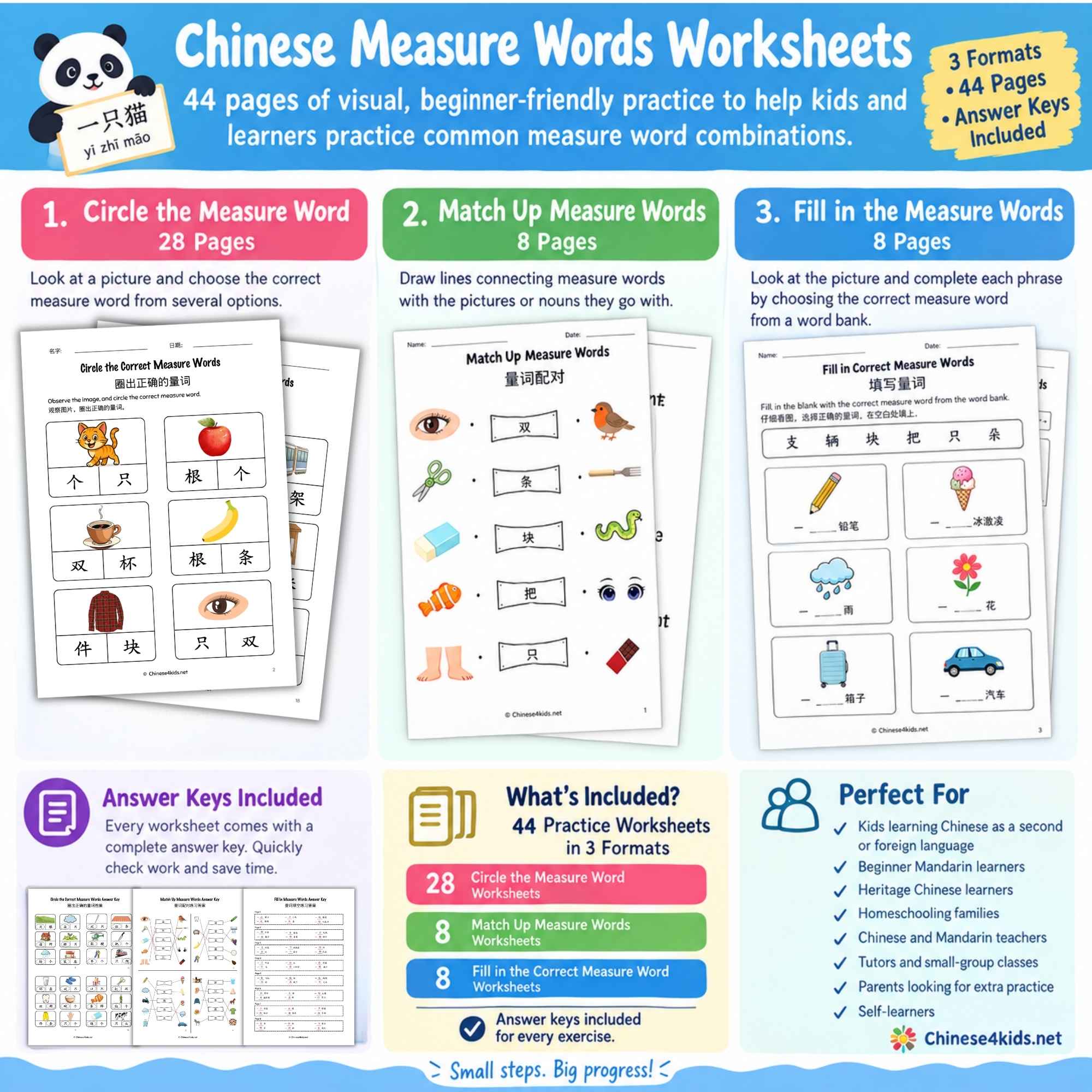
- Chinese Measure Words Worksheets — written practice with answer keys
Frequently Asked Questions
What measure word is used for a chair in Chinese?
The most common measure word for a chair is 把 (bǎ): 一把椅子. The 把 measure word is commonly used with certain objects that can be held or that have established conventional combinations.
What measure word do you use for a table?
The most common measure word for a table is 张 (zhāng): 一张桌子. The 张 measure word is commonly used with flat, broad objects or conventional broad-surface combinations such as tables, beds, and paper.
What measure word is used for a television?
The most common measure word for a television is 台 (tái): 一台电视. The 台 measure word is commonly used with machines, appliances, and equipment.
What measure word do you use for a refrigerator?
The most common measure word for a refrigerator is 台 (tái): 一台冰箱. Electronic appliances and kitchen equipment typically use the 台 measure word.
What measure word is used for a bed?
The most common measure word for a bed is 张 (zhāng): 一张床. When describing flat or broad-surface objects such as beds, tables, and paper, we often use the measure word of 张.
What measure word do you use for an umbrella?
The most common measure word for an umbrella is 把 (bǎ): 一把伞. The 把 measure word is commonly used with certain objects that can be held or that have established conventional combinations.
What measure word is used for a key?
The most common measure word for a single key is 把 (bǎ): 一把钥匙. For a bunch or ring of keys, use 串 (chuàn): 一串钥匙. The measure word you choose depends on what you are counting: an individual key or a group of keys connected together.
What is the difference between 把, 张, and 台?
把 is used with certain objects that can be held or that have established conventional combinations, such as chairs, umbrellas, keys, and combs.
张 is used with flat, broad, or spread-out objects, or conventional combinations with broad surfaces, such as tables, beds, and paper.
台 is used with machines, appliances, electronic equipment, and other substantial pieces of equipment, such as televisions, refrigerators, washing machines, and air conditioners.
These three measure words are useful starting points for learning common household vocabulary, but Chinese uses many other measure words for different objects.
What to Learn Next
Practice the core combinations with pictures and flashcards, then explore other measure-word categories.
Ready to practice more? Our Chinese Measure Words Flashcards let children see measure words paired with each noun, and Chinese Measure Words Worksheets to practice.
The key is learning what “feels right” through repeated use with actual household vocabulary.
If you like this article, share it