Quick Answer
When counting people in Chinese, you choose different measure words based on context. 个 (gè) is general and everyday. 位 (wèi) adds respect. 群 (qún) describes a group. For families, 家 and 口 are essential. Learning these small distinctions helps your Chinese sound natural and appropriate.
When counting people in Chinese, you choose different measure words based on context. 个 (gè) is general and everyday. 位 (wèi) adds respect. 群 (qún) describes a group. For families, 家 and 口 are essential. Learning these small distinctions helps your Chinese sound natural and appropriate.
What Are Measure Words for People?
In Chinese, you can’t just say “one person” or “three teachers.” You need to use a measure word (量词, liàngcí) between the number and the noun.
One person: 一个人 (yī gè rén)
Three teachers: 三位老师 (sān wèi lǎoshī)
A group of children: 一群孩子 (yī qún háizi)
Different measure words fit different situations. This article teaches you which ones to use.
New to the measure word system? Start with our complete guide to Chinese measure words, which explains how the system works. This article focuses on people specifically.
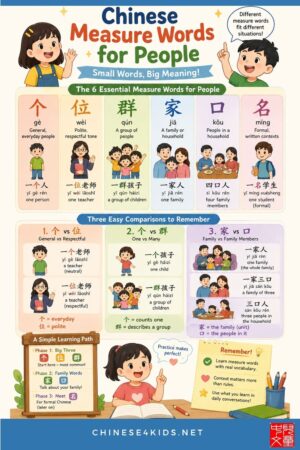
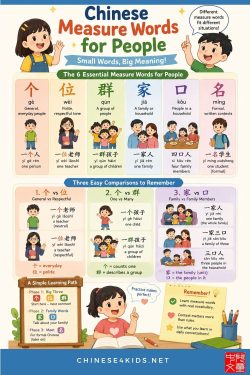
The 6 Essential Measure Words for People
These are the measure words every child should learn when studying Chinese:
| Measure Word | Pinyin | When to Use | Example |
|---|---|---|---|
| 个 | gè | General, everyday people | 一个人 (one person) |
| 位 | wèi | Polite, respectful tone | 一位老师 (one teacher) |
| 群 | qún | A group of people | 一群孩子 (a group of children) |
| 家 | jiā | A family or household | 一家人 (one family) |
| 口 | kǒu | People in a household | 四口人 (four family members) |
| 名 | míng | Formal, written contexts | 一名学生 (one student—formal) |
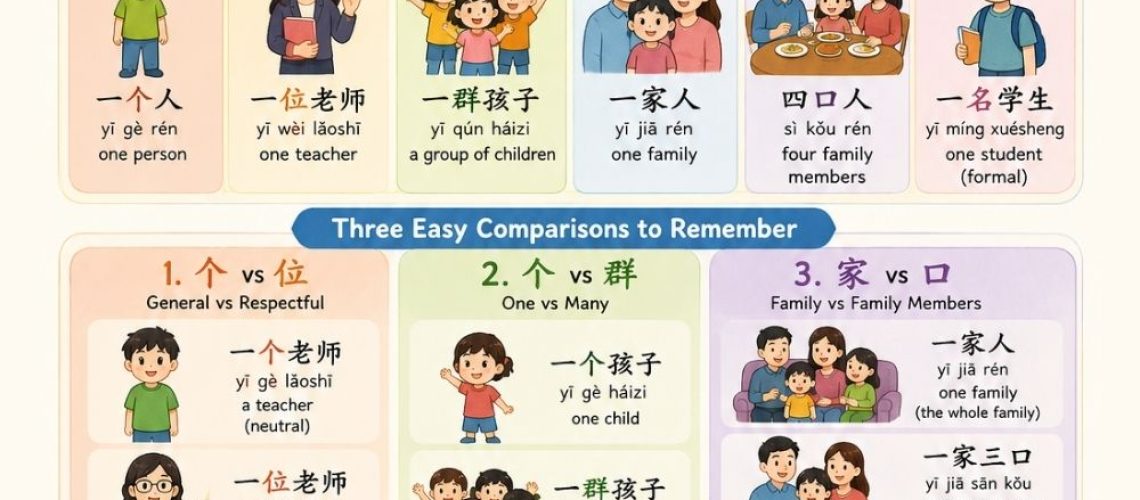
Think of Measure Words as “How Are We Counting?”
Measure words aren’t random—they describe how or why we’re grouping people. Here are visual examples:
👧 One child 一个孩子 (yī gè háizi) General, neutral
👩🏫 One teacher, respectfully 一位老师 (yī wèi lǎoshī) Showing respect or politeness
👧👦👧👦 A group of children 一群孩子 (yī qún háizi) People together as a collective
👨👩👧 A family 一家人 (yī jiā rén) Family as a unit
👨👩👧👦 Three family members 三口人 (sān kǒu rén) Counting individuals in a household
Three Easy Comparisons to Remember
1. 个 vs 位 — General vs Respectful
一个老师 = a teacher (neutral, everyday)
一位老师 = a teacher (respectful or polite)
Both are correct. Choose 个 in casual conversation, 位 when you want to be respectful.
Kid takeaway: 个 = everyday. 位 = polite.
2. 个 vs 群 — One vs Many
一个孩子 = one child
一群孩子 = a group of children
Use 个 to count individual people. Use 群 when people are together as a group.
Kid takeaway: 个 counts one. 群 describes a group.
3. 家 vs 口 — The Whole Family vs Family Members
一家人 = one family / the whole family
一家三口 = a family of three
三口人 = three people in the household
All three can describe families, but they emphasize different things:
- 家 = the family as a unit
- 口 = counting the people in the family
This is something you can use when talking about your own family!
Kid takeaway: 家 = the family. 口 = the people in it.
Common Misconceptions (Not Mistakes!)
Is 一个老师 wrong?
No. 一个老师 is perfectly correct—it’s just neutral.
- 一个老师 = a teacher (neutral)
- 一位老师 = a teacher (more respectful)
Choose based on context, not because one is “wrong.”
Is 一群人在这里 a mistake?
No, it’s completely grammatical. Both of these are correct:
- 一群人在这里。 = A group of people is here.
- 这群人在这里。 = This group of people is here.
They’re different, not wrong.
This is a real mistake to avoid
❌ 五个口人 ✅ 五口人
Don’t add 个 before 口. The word 口 already is the measure word, so you just use it alone.
A Simple Learning Path
You don’t need to memorize all six at once. Here’s how to learn them:
Phase 1: Start with the Big Three
Master these first:
- 个 (general)
- 位 (respectful)
- 群 (groups)
They’re the most common and most useful.
Phase 2: Add Family Words
Once you’re comfortable with the first three, add:
- 家 (the family)
- 口 (family members)
These let you talk about your own family.
Phase 3: Meet 名 (Later)
When you encounter formal Chinese (news, reports, written materials), you’ll see:
- 名 (formal contexts)
This is a more advanced distinction, so learn it when you start reading formal materials.
Other Measure Words You May Encounter
You might see these in Chinese stories or conversations. You don’t need to memorize them now—just know they exist.
户 (hù) — counts households
三户人家 — three households
队 (duì) — an organized group or team
一队游客 — a group of tourists
帮 (bāng) — an informal “bunch”
一帮朋友 — a bunch of friends
伙 (huǒ) — a group (informal)
一伙人 — a group of people
Tip: Children don’t need to memorize these at the beginning. Learn them when they appear in stories, conversations, or other Chinese materials.
Try It Yourself: Quick Practice
Can you choose the right measure word? (Numbers can be different from the example.)
1. ___ 孩子 (child/children) a) 个 b) 位 c) 群
2. ___ 老师 (teacher, when being respectful) a) 个 b) 位 c) 群
3. ___ 学生 (group of students) a) 个 b) 群 c) 口
4. ___ 人 (people in your family) a) 个 b) 群 c) 口
5. ___ 人 (family as a unit) a) 个 b) 家 c) 位
Answers
- 个 or 群 (一个孩子 = one child; 一群孩子 = a group of children)
- 位 (一位老师 = one teacher, respectfully)
- 群 (一群学生 = a group of students)
- 口 (四口人 = four people in my family)
- 家 (一家人 = one family)
Learn Measure Words with Real Vocabulary
Here’s the most important principle: Learn measure words together with the nouns they describe.
Don’t memorize “个” in isolation. Memorize:
- 一个人 (one person)
- 一个孩子 (one child)
- 一个朋友 (one friend)
Don’t memorize “位” alone. Learn:
- 一位老师 (one teacher)
- 一位客人 (one guest)
- 一位老人 (one elderly person)
When measure words are connected to real vocabulary, children learn them naturally.
Practice at home Want printable practice for these measure words? Both resources use the same set of nouns, so your child can move from reading to writing without switching materials.
- Chinese Measure Words Flashcards — pair each noun with its measure word for quick review
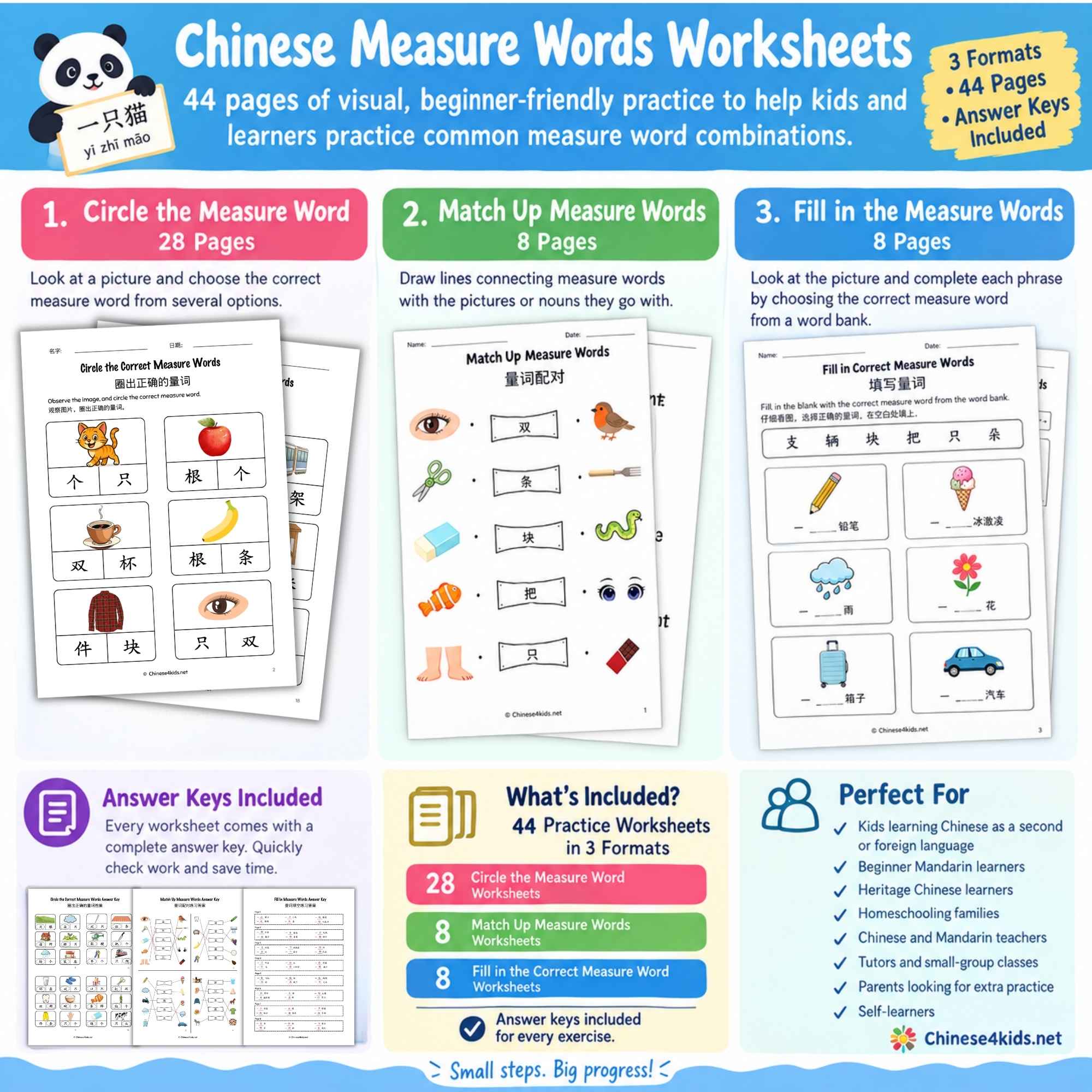
- Chinese Measure Words Worksheets — written practice with answer keys
Related Measure Words
Once you’ve mastered people measure words, explore other categories:
- Measure Words for Animals — Learn 只, 匹, 头, 群 in animal contexts
- Measure Words for Food — Different foods use different measure words
- Measure Words for Household Items — Common objects around the house
- Complete Guide to Chinese Measure Words — See how all categories connect
Frequently Asked Questions
What’s the difference between 个, 位, and 名?
Three different contexts:
个 = everyday, neutral (most common)
位 = respectful or polite (showing politeness)
名 = formal or written (different register, not about politeness)
Example: 一个学生 (everyday), 一位老师 (respectful), 一名学生 (formal written text).
Do children need to learn all six measure words immediately?
No. Start with 个, 位, and 群. Add family words (家, 口) when you talk about families. Learn 名 when you encounter formal Chinese (books, news, etc.).
Is 位 just a “nicer” way to say 个?
Not exactly. 位 shows respect or politeness, especially toward certain people (teachers, guests, elders). Use 个 in neutral, everyday situations. They’re not interchangeable—context determines which to use.
Why do we use 口 for family members?
Historically, 口 means “mouth.” Chinese used this measure word to count family members because families share meals together—they’re “mouths” that eat together. Today, it’s just the standard way to count people in a household.
What’s the difference between 一家人 and 四口人?
一家人 = referring to the family as a unit (“My whole family”)
四口人 = counting the individuals (“There are four people in my family”)
Both can describe the same family, but they focus on different things.
Is 名 hard to learn?
No, but it appears in more formal writing. You’ll mainly see it in news articles, official reports, and academic materials. Don’t worry about 名 until you encounter it naturally in formal Chinese.
Learning Pathway
Understand the System
Our complete guide to Chinese measure words explains how the system works across all categories.
Learn People First
You’ve just read it! Now you know which measure words to use when talking about people.
Practice with Flashcards
Use Measure Words Flashcards (for people and other 11 more categories) to see measure words paired with real vocabulary.
Explore Other Categories
Learn measure words for animals, food, objects, and more. Use our Chinese Measure Words Flashcards for all categories, and use Chinese Measure Words Worksheets to practice with answer keys.
Use What You’ve Learned
Start using these measure words in conversations, reading, and teaching. Your Mandarin will sound more natural.
Final Thoughts
Measure words might seem complicated at first, but they follow patterns. 个 is your safe choice for everyday people. 位 shows respect. 群 describes groups. 家 and 口 describe families. And 名 appears in formal writing.
Instead of memorizing isolated words, learn them together with real people: “一个孩子” (one child), “一位老师” (one teacher), “一群朋友” (a group of friends). This way, when you need to speak, the right measure word comes naturally.
Start with the big three (个, 位, 群), add family words when you talk about families, and you’ll be using measure words correctly within weeks.
If you like this article, share it