Quick answer:
Mandarin has four main tones and a light neutral tone. The four main tones are pitch patterns, and they can change the meaning of a word. Kids can start by listening to and copying one set of sounds: mā, má, mǎ, mà. Play for five minutes a day, use your hands to show the pitch, and keep it fun. You do not need to speak Chinese fluently to help your child practice.
Mandarin has four main tones and a light neutral tone. The four main tones are pitch patterns, and they can change the meaning of a word. Kids can start by listening to and copying one set of sounds: mā, má, mǎ, mà. Play for five minutes a day, use your hands to show the pitch, and keep it fun. You do not need to speak Chinese fluently to help your child practice.
Tones are the part of Mandarin that worries many parents. Maybe you speak Chinese at home. Maybe you are learning alongside your child. Either way, tone practice can be part of everyday play.
You do not need long explanations. Start with one simple pattern and these four games.
Contents
hide
The one pattern to start with: mā, má, mǎ, mà
Say the same syllable four times. The pitch changes, and so does the meaning.
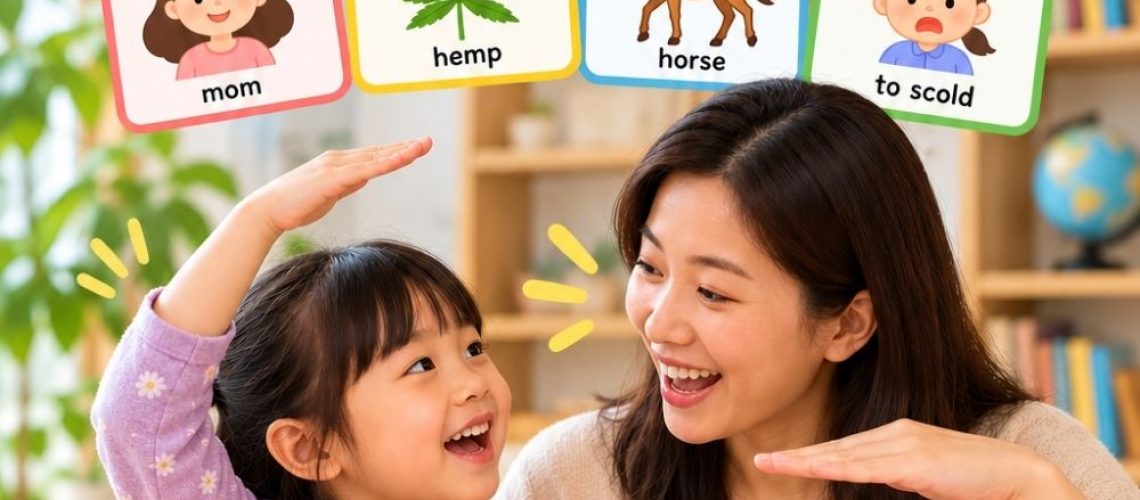
- mā (妈) means mom. Keep your voice high and level, like holding a musical note.
- má (麻) means hemp. Your voice rises, a little like asking “Huh?”
- mǎ (马) means horse. Your voice goes low and dips, then rises a little, like drawing a small curve in the air.
- mà (骂) means to scold. Your voice falls quickly from high to low.
Words like “Huh?” are only memory aids. Children should copy the pitch, not the English word.
Here is a tip for the third tone. When a word is said on its own, the third tone is often taught as a falling-rising pitch. In everyday speech, it is frequently pronounced as a low tone without the full rise. Both patterns are normal in their own contexts. Start by helping your child hear and copy the low pitch.
Mandarin also has a neutral tone. It is usually short and light, and it has no tone mark. You will meet it in the family words below, and children can pick it up later without a special lesson.
Game 1: Tone hands
Goal: connect the sound your child hears with a shape they can see and feel.
You need: just your hands.
Your hand draws the sound in the air.
- Hold your hand flat and steady for mā.
- Move your hand upward for má.
- Dip your hand down and then up for mǎ.
- Sweep your hand downward for mà.
Say each sound as you move. Then mix up the order and let your child lead. Kids love being the teacher. You can even make a mistake on purpose and let them correct you.
Teaching tip: Keep your voice and hand together. The movement reminds your child of the pitch, but listening comes first.
Game 2: Four corners
Goal: practice matching a sound to its tone through movement.
You need: four cards (mā, má, mǎ, mà) with simple pictures.
Put one card in each corner of the room, or in four spots on the floor. Use a picture of a mother for mā, a hemp plant or leaves for má, a horse for mǎ, and someone scolding for mà.
Say one syllable aloud. Your child moves to the matching card. Start slowly, and repeat a sound when needed. When your child gets the hang of it, take turns calling out the sounds.
You can whisper or use a playful voice, as long as the pitch pattern stays clear. If the voice gets too silly, the tone becomes hard to hear.
This one is great for active kids who learn best on the move.
Game 3: Same or different?
Goal: train the ear before asking for speaking.
You need: nothing, or a recording of a Mandarin speaker.
Say two syllables aloud, like these:
- má … má
- má … mǎ
- mā … mà
- mǎ … mǎ
Your child gives a thumbs-up if the tones sound the same and a thumbs-down if they sound different. Then swap roles. Your child says two sounds, and you guess.
Keep the syllable the same and change only the tone. For beginners, two very different tones, like mā and mà, are easiest to hear.
Not sure of your own pronunciation? Play a recording from a proficient Mandarin speaker and listen together. Then pause, copy the sound, and compare. Listening alone is not always enough, so mix in some copying and some familiar words.
Teaching tip: Hearing the difference comes before saying it correctly. Many children can tell tones apart before they can say them well, and that is a normal step.
Game 4: Family word echo
Goal: move from single sounds to real words your child cares about.
You need: nothing, or a family photo. You can also use My Family Members flashcards.
- māma (妈妈): mom
- bàba (爸爸): dad
- yéye (爷爷): grandpa on dad’s side
- nǎinai (奶奶): grandma on dad’s side
Say a word and let your child echo it. Add the hand movements if they help. Then swap, and let your child choose a word for you to copy.
Listen to the whole word, not just one syllable. In these family words, the second syllable is usually pronounced with the neutral tone, which makes it lighter and less stressed. Your child does not need to learn the technical rule yet. Just let them listen and copy.
When these feel easy, try a greeting: nǐhǎo (你好), meaning hello. In natural speech, it often sounds like “níhǎo,” because the first syllable rises when two third-tone syllables come together. The pinyin is still written nǐhǎo. Children can copy the natural sound without learning the rule.
How often should kids practice Chinese tones?
Five minutes is a good start. Choose one game, repeat a few sounds, and stop while your child is still enjoying it. You do not need to play all four games every day.
If your child mixes up the tones, stay relaxed. Say the word clearly again and give them another chance to listen. Try not to turn every chat into a pronunciation lesson.
How do Chinese tones fit with pinyin?
Pinyin writes Mandarin sounds with the Latin alphabet. Tone marks show the pitch pattern of each syllable:
- ā: a flat line for the first tone
- á: a rising line for the second tone
- ǎ: a dipping mark for the third tone
- à: a falling line for the fourth tone
When children can hear the shapes, the marks start to make sense. The marks then become a handy visual reminder when they read pinyin.
For the full picture, read our Hanyu Pinyin guide for kids. For more on sounds, songs and tongue-twisters, see our Chinese pronunciation practice guide.
Frequently Asked Questions: Chinese tones for kids
What age can kids start learning Mandarin tones?
Children can start listening to tones from a young age.
Preschoolers often enjoy copying sounds and moving to games. Older kids can add listening challenges and learn how the tone marks work in pinyin. Choose activities that fit your child’s attention span and Chinese level.
How long does it take for kids to learn the four tones?
There is no fixed timeline. With regular short practice, children may start to notice the differences between tones. Hearing tones and saying them accurately develop at different speeds, and that depends on age, exposure and the voices they hear. Steady listening beats trying to master everything at once.
Do I need to speak Chinese to teach my child tones?
No. You can learn alongside your child. Use clear audio from a proficient Mandarin speaker, listen closely, and play the games together. You do not have to be the expert in the room.
Why are tones important in Mandarin?
Tones help tell words apart when the syllable is the same. Mā (妈) means mom, and mǎ (马) means horse. Context often helps people understand you, even when a tone is off. Still, learning tones makes speech clearer and helps kids recognize spoken Chinese more easily.
What if my child keeps mixing up the second and third tones?
This is very common. Go back to Game 3 and compare má and mǎ only. Slow down, use clear audio, and let your child listen before repeating. Hearing the difference comes first, and saying it follows with practice.
Want an easier way to practice Mandarin at home?
If you would like help with listening and speaking, Speak Chinese with Kids gives you everyday Chinese phrases with audio, so you and your child can practice together. For more words to use in daily play, Chinese Vocabulary Made Easy introduces the 300 most common Chinese words.
Start with five minutes, pick a game your child enjoys, and come back to it tomorrow. Small, happy moments of practice add up.
If you find this article useful, share it