春夏秋冬 (chūn xià qiū dōng) literally means spring, summer, autumn, and winter. The phrase is used in Chinese to refer to all four seasons together, or to the passing of a full year.
Quick Answer: How to Say Autumn in Chinese
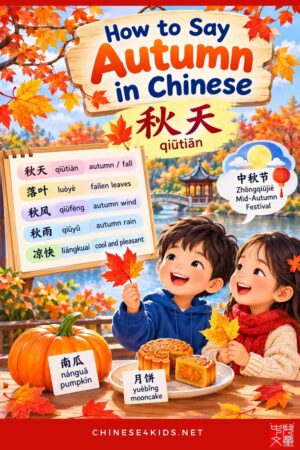
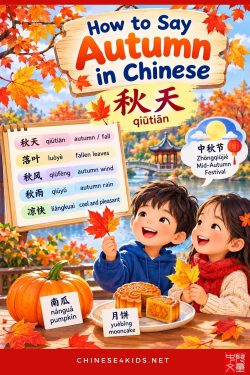
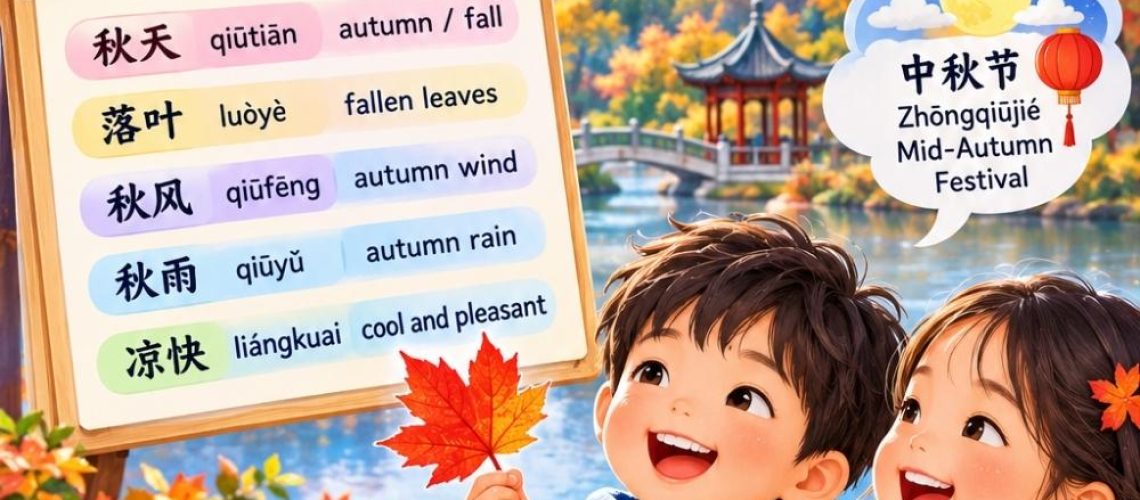
Autumn in Chinese is 秋天 (qiūtiān). “Fall” is also 秋天. Mandarin has one everyday word for the season, so children learn it once and use it for both English names.
Autumn in Chinese is 秋天 (qiūtiān). “Fall” is also 秋天. Mandarin has one everyday word for the season, so children learn it once and use it for both English names.
| English | Chinese | Pinyin |
|---|---|---|
| Autumn / fall | 秋天 | qiūtiān |
| Autumn (often formal or written) | 秋季 | qiūjì |
| Autumn wind | 秋风 | qiūfēng |
| Autumn rain | 秋雨 | qiūyǔ |
| Fallen leaves | 落叶 | luòyè |
| Mid-Autumn Festival | 中秋节 | Zhōngqiūjié |
Contents
hide
Where to Start
Parents with a beginner
Learn the five starter words below. Then read the short autumn story together.
Teachers planning a unit
Use the weather, clothes and food lists. Add the Mid-Autumn Festival words in the same week. Use ready made lesson plans on these topics.
Families celebrating abroad
Jump to the Halloween and Thanksgiving words. Both fit naturally into the season.
What Does 秋天 Mean?
秋天 (qiūtiān) means autumn. It is the third season, between summer (夏天, xiàtiān) and winter (冬天, dōngtiān). Both syllables are first tone, so say them long and steady.
In 春天 (chūntiān, spring), 夏天 (xiàtiān, summer), 秋天 (qiūtiān, autumn) and 冬天 (dōngtiān, winter), 天 is part of the word for each season. In other contexts, 天 can also mean “sky” or “day”. The four seasons together are 春夏秋冬 (chūn xià qiū dōng).
→ Learn all four seasons together: What Are the Four Seasons in Chinese? 春夏秋冬
When Does Autumn Start in China?
In many parts of China, September to November counts as autumn in the meteorological calendar. China is a large country, so the weather changes at different times in different regions.
In the traditional Chinese calendar, 立秋 (lìqiū) is one of the 24 solar terms. It marks the traditional beginning of autumn and usually falls around 7 or 8 August.
The date of 立秋 does not mean every part of China turns cool at once. Hot weather can continue for weeks afterwards.
A Memory Hook for the Character 秋
Look at 秋 and you will see two parts. On the left is 禾 (hé), a grain plant. On the right is 火 (huǒ), meaning fire. Children often remember the character through this picture: golden grain, and leaves as red as fire.
Treat this as a memory aid, not as the history of the character. The way 秋 developed over time is more complicated than its modern shape suggests.
Try this: Ask your child to say 秋天 three times. Then let them draw an autumn picture and write 秋天 beside it.
Start with These 5 Autumn Words
Learn these five words first. Say each one aloud with your child, and repeat the list once a day for a week.
| Chinese | Pinyin | English |
|---|---|---|
| 秋天 |
qiūtiān | autumn |
| 落叶 |
luòyè | fallen leaves |
| 南瓜 |
nánguā | pumpkin |
| 月饼 |
yuèbǐng | mooncake |
| 凉快 |
liángkuai | cool and pleasant |
月饼 is closely linked to the Mid-Autumn Festival, so many families eat it around that time rather than all through autumn. Add 中秋节 (Zhōngqiūjié, Mid-Autumn Festival) when your child is ready for the cultural topic.
More Autumn Weather Words
Autumn weather varies by region. In many places, the air becomes cooler. These words help children describe what they feel outside.
| Chinese | Pinyin | English |
|---|---|---|
| 天气 | tiānqì | weather |
| 凉爽 | liángshuǎng | refreshingly cool |
| 干燥 | gānzào | dry |
| 刮风 | guā fēng | windy |
| 秋风 | qiūfēng | autumn wind |
| 下雨 | xià yǔ | raining |
| 秋雨 | qiūyǔ | autumn rain |
| 阴天 | yīntiān | overcast |
A bonus phrase for older children:
秋高气爽 (qiū gāo qì shuǎng) describes clear, crisp autumn weather.
A well-known saying about autumn rain:
一场秋雨一场寒。
Yì cháng qiūyǔ yì cháng hán.
Each autumn rain brings colder weather.
This is a traditional saying, not a rule. Real weather depends on where you live.
A daily question:
今天天气怎么样?(Jīntiān tiānqì zěnmeyàng?) means “What is the weather like today?” Let your child answer with a short phrase, such as 很凉快 (hěn liángkuai).
→ More weather words: Weather in Chinese — Talk About the Weather with Kids
Autumn Clothes in Chinese
As the air cools, children layer up. Getting dressed becomes a daily vocabulary lesson.
| Chinese | Pinyin | English |
|---|---|---|
| 毛衣 | máoyī | sweater |
| 外套 | wàitào | jacket, coat |
| 长裤 | chángkù | long trousers |
| 牛仔裤 | niúzǎikù | jeans |
| 靴子 | xuēzi | boots |
| 围巾 | wéijīn | scarf |
| 帽子 | màozi | hat |
| 手套 | shǒutào | gloves |
| 雨衣 | yǔyī | raincoat |
| 运动鞋 | yùndòngxié | sneakers, trainers |
On some autumn days, mornings start cold and afternoons warm up. That makes a good moment to practise opposites: 早上冷,下午暖和 (Zǎoshang lěng, xiàwǔ nuǎnhuo) means “It is cold in the morning and warm in the afternoon.”
Easy Sentences About Autumn in Chinese
These are useful sentences, not single words. Short sentences help children use new words in real life. Say them during real autumn moments: a walk, a rainy day or getting dressed.
| Chinese | Pinyin | English |
|---|---|---|
| 秋天来了。 | Qiūtiān lái le. | Autumn is here. |
| 我喜欢秋天。 | Wǒ xǐhuan qiūtiān. | I like autumn. |
| 秋天很凉快。 | Qiūtiān hěn liángkuai. | Autumn is cool. |
| 秋天天气很凉快。 | Qiūtiān tiānqì hěn liángkuai. | The weather is cool in autumn. |
| 天气凉快了。 | Tiānqì liángkuai le. | The weather has turned cooler. |
| 树叶变黄了。 | Shùyè biàn huáng le. | The leaves have turned yellow. |
| 我穿毛衣。 | Wǒ chuān máoyī. | I am wearing a sweater. |
| 今天要带外套。 | Jīntiān yào dài wàitào. | Bring a jacket today. |
| 我们去捡落叶吧! | Wǒmen qù jiǎn luòyè ba! | Let’s go collect fallen leaves! |
Ask and Answer
Try this short chat with your child. Swap roles after the first round.
你喜欢秋天吗?
Nǐ xǐhuan qiūtiān ma?
Do you like autumn?喜欢!我喜欢秋天。
Xǐhuan! Wǒ xǐhuan qiūtiān.
Yes! I like autumn.秋天有什么?
Qiūtiān yǒu shénme?
What do we find in autumn?秋天有落叶和南瓜。
Qiūtiān yǒu luòyè hé nánguā.
There are fallen leaves and pumpkins in autumn.
Read a Short Story About Autumn
Now put the words together. Read the five lines aloud, then answer the questions.
秋天来了。
Qiūtiān lái le.
Autumn is here.天气凉快了。
Tiānqì liángkuai le.
The weather has become cooler.树叶变黄了。
Shùyè biàn huáng le.
The leaves have turned yellow.我穿上毛衣。
Wǒ chuān shàng máoyī.
I put on a sweater.我喜欢秋天!
Wǒ xǐhuan qiūtiān!
I like autumn!
Check your understanding
- What season is it? (秋天)
- What happens to the leaves? (They turn yellow.)
- What does the child put on? (A sweater.)
Ready to Read More Chinese?
If your child enjoyed this short story, try our Level aa reader Autumn 秋天. It introduces seasonal words through simple, picture-supported reading. Level aa has just a few words per page.
Watch the book video first, then read along and practise spotting words such as 落叶, 南瓜 and 月饼. When your child is ready, the series continues through Levels A, B and C.
→ See the whole series: Chinese leveled readers for kids, Level aa to C
Autumn Activities in Chinese
Autumn pulls families outdoors. These useful phrases let children name what they are doing.
| Chinese | Pinyin | English |
|---|---|---|
| 捡落叶 | jiǎn luòyè | collect fallen leaves |
| 赏红叶 | shǎng hóngyè | admire the red leaves |
| 赏月 | shǎng yuè | admire the moon |
| 爬山 | pá shān | go hiking |
| 摘苹果 | zhāi píngguǒ | pick apples |
| 摘南瓜 | zhāi nánguā | pick pumpkins |
| 野餐 | yěcān | have a picnic |
Next time you see red and gold leaves, name the change in Chinese together: 秋天的树叶变红了!(Qiūtiān de shùyè biàn hóng le!) means “The leaves on the trees have turned red!” Try 变黄了 (biàn huáng le, have turned yellow) next.
Mid-Autumn Festival: 中秋节
中秋节 (Zhōngqiūjié) falls on the 15th day of the eighth month of the lunar calendar. It is traditionally associated with the full moon. In the Gregorian calendar, the date usually lands in September or early October. The name includes 中秋, which means “mid-autumn”.
Common traditions include:
- Sharing a reunion meal (团圆饭, tuányuán fàn)
- Admiring the moon (赏月, shǎng yuè)
- Sharing mooncakes (吃月饼, chī yuèbǐng)
Families celebrate in different ways across Chinese communities, so your own traditions may look different. That is perfectly fine.
In the best-known legend, 嫦娥 (Cháng’é), a figure in Chinese mythology, drinks an immortality elixir and floats to the moon. Her companion there is 玉兔 (Yùtù), the jade rabbit. Other versions of the story exist.
→ Chinese Mid-Autumn Festival Celebration — traditions, stories and books
| Chinese | Pinyin | English |
|---|---|---|
| 中秋节 | Zhōngqiūjié | Mid-Autumn Festival |
| 中秋节快乐 | Zhōngqiūjié kuàilè | Happy Mid-Autumn Festival |
| 月亮 | yuèliang | moon |
| 月饼 | yuèbǐng | mooncake |
| 灯笼 | dēnglong | lantern |
| 团圆 | tuányuán | family reunion |
| 嫦娥 | Cháng’é | Chang’e (a figure in the moon legend) |
| 玉兔 | Yùtù | the jade rabbit |
| 桂花 | guìhuā | osmanthus flower (blooms in autumn) |
| 柚子 | yòuzi | pomelo (a popular festival fruit) |
Try these sentences on festival night: 今晚我们赏月。(Jīnwǎn wǒmen shǎng yuè.) means “Tonight we are admiring the moon.” 我想吃月饼!(Wǒ xiǎng chī yuèbǐng!) means “I want to eat a mooncake!”
For parents: People celebrate Mid-Autumn in mainland China, Taiwan, Hong Kong and Chinese communities around the world. Everyone looks up at the same moon. Stepping outside together is a simple way to make the festival real for children.
→ Celebrations, Festivals, and Special Occasions in Chinese Culture
Autumn Food in Chinese
Autumn is harvest season, so the table is full of new words. Name the food together before a meal. Thirty seconds a day is enough.
| Chinese | Pinyin | English |
|---|---|---|
| 苹果 | píngguǒ | apple |
| 葡萄 | pútao | grapes |
| 柚子 | yòuzi | pomelo |
| 柿子 | shìzi | persimmon |
| 栗子 | lìzi | chestnut |
| 红薯 | hóngshǔ | sweet potato |
| 玉米 | yùmǐ | corn |
| 螃蟹 | pángxiè | crab |
| 热汤 | rè tāng | hot soup |
You already know 南瓜 (pumpkin) and 月饼 (mooncake) from the starter list. Crab is a famous autumn treat in parts of China, especially hairy crab (大闸蟹, dàzháxiè) in the Yangtze Delta.
Halloween and Thanksgiving in Chinese
These are extra seasonal topics. They help most for families and classrooms that celebrate the two holidays. Skip them if they do not apply to you.
万圣节: Halloween
万圣节 (Wànshèngjié) is the everyday Chinese name for Halloween. People also say 万圣节前夜 (Wànshèngjié qiányè) for Halloween Eve.
| Chinese | Pinyin | English |
|---|---|---|
| 万圣节 | Wànshèngjié | Halloween |
| 南瓜灯 | nánguā dēng | jack-o’-lantern |
| 鬼 | guǐ | ghost |
| 怪物 | guàiwù | monster |
| 蜘蛛 | zhīzhū | spider |
| 女巫 | nǚwū | witch |
| 糖果 | tángguǒ | candy |
| 不给糖就捣蛋 | bù gěi táng jiù dǎodàn | trick or treat |
→ Activities for Learning Chinese at Halloween — more words and activities. Use Halloween Decoration files to decorate your classroom or home to create the environment, and Halloween Chinese Learning Pack for more practice.
感恩节: Thanksgiving
感恩节 (Gǎn’ēnjié) means “gratitude festival”. In the US it falls on the fourth Thursday of November. In Canada it falls on the second Monday of October.
| Chinese | Pinyin | English |
|---|---|---|
| 感恩节 | Gǎn’ēnjié | Thanksgiving |
| 感恩 | gǎn’ēn | gratitude, to be thankful |
| 感谢 | gǎnxiè | to thank |
| 火鸡 | huǒjī | turkey |
| 南瓜派 | nánguā pài | pumpkin pie |
| 团聚 | tuánjù | to gather, to reunite |
| 丰收 | fēngshōu | abundant harvest |
→ Thanksgiving in Chinese — vocabulary and activities. Use Thanksgiving Chinese Learning Pack for more practice.
Three Easy Ways to Practise Autumn Words
Start with three to five words. Repeat them for a few days before you add more.
1. Go on a leaf hunt. Collect fallen leaves together. At home, describe them in Chinese: 红色 (hóngsè, red), 黄色 (huángsè, yellow), 大 (dà, big) and 小 (xiǎo, small).
2. Make an autumn picture book. Your child draws a pumpkin, an apple, a tree and the moon. They write one Chinese word beside each picture and read it aloud.
3. Chat about the weather. Ask 今天冷吗?(Jīntiān lěng ma?) or 今天的天气怎么样? Encourage a short answer, such as 很凉快 or 有点冷 (yǒudiǎn lěng, a bit cold).
Common Mistakes with Autumn Words
- Looking for two words. “Autumn” and “fall” are both 秋天.
- Choosing 秋季 for everyday chat. 秋天 is the common word in conversation.
- Stressing 快 in 凉快. In liángkuai, the second syllable is usually light.
- Teaching too many words at once. Five words repeated all week beat fifty words seen once.
Frequently Asked Questions
How do you say autumn in Chinese?
Autumn in Chinese is 秋天 (qiūtiān). “Fall” is also 秋天, because Mandarin uses one everyday word for both English names.
What is the difference between 秋天 and 秋季?
Both mean autumn. 秋天 is very common in everyday conversation. 秋季 (qiūjì) is often used in written or formal contexts, such as schedules and announcements.
When does autumn start in China?
Many sources count September to November as autumn. The traditional Chinese calendar marks the start of autumn at 立秋 (lìqiū), usually around 7 or 8 August. Actual weather varies a lot across China.
What is the Mid-Autumn Festival in Chinese?
It is 中秋节 (Zhōngqiūjié). It falls on the 15th day of the eighth lunar month and is traditionally associated with the full moon. Common traditions include a family meal, mooncakes (月饼) and admiring the moon.
Practise Autumn Words Offline
Want your child to practise without a screen? Our Autumn Chinese Montessori 3-Part Flashcards give children a hands-on way to match pictures with Chinese words.
Use a few cards at a time. Say each word aloud, match the cards, and come back to the same words over several days.
Planning a pumpkin unit at home or in class? The Pumpkin Chinese Learning Pack for Kids includes pumpkin anatomy and life cycle posters, Montessori 3-part flashcards, number cards, a colour-and-learn vocabulary book, worksheets and coloring pages.
Keep Exploring
- What Are the Four Seasons in Chinese? 春夏秋冬
- Weather in Chinese — Talk About the Weather with Kids
- Chinese Mid-Autumn Festival Celebration
- Activities for Learning Chinese at Halloween
- Thanksgiving in Chinese
If you find this article useful, share it