Quick answer:
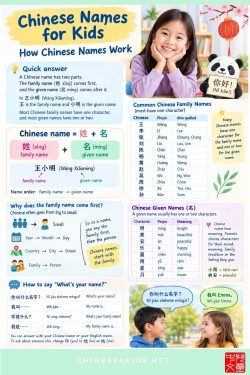
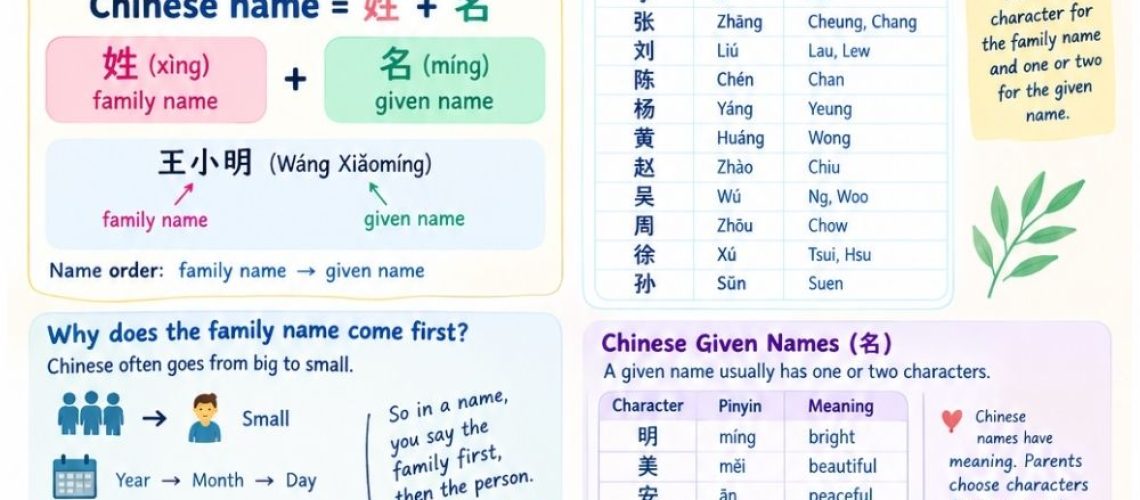
A Chinese name has two parts. The family name (姓 xìng) comes first, and the given name (名 míng) comes after it. In 王小明 (Wáng Xiǎomíng), 王 is the family name and 小明 is the given name. Most Chinese family names have one character, and most given names have one or two.
A Chinese name has two parts. The family name (姓 xìng) comes first, and the given name (名 míng) comes after it. In 王小明 (Wáng Xiǎomíng), 王 is the family name and 小明 is the given name. Most Chinese family names have one character, and most given names have one or two.
Chinese names are easy to understand once you know the pattern: the family comes first, then the person.
Chinese name = 姓 + 名
姓 (xìng) = family name
名 (míng) = given name
王小明: 王 = family name, 小明 = given name
Name order: family name → given name
Names are also a perfect first Chinese lesson. Every child can talk about themselves, and the sentences are short and useful from day one. This guide is written for parents and teachers, with simple sentences you can practise with your child along the way.
How Do Chinese Names Work?
A Chinese name has two parts: 姓 + 名 (xìng + míng).
- 姓 (xìng) = family name, or surname
- 名 (míng) = given name, or first name
For example, in 李小雨 (Lǐ Xiǎoyǔ), 李 is the family name and 小雨 is the given name.
The order is family name → given name. English usually does the opposite: given name → family name.
A traditional Chinese name usually has a family name and a given name. Chinese names generally don’t use middle names the way English names do.
Why Does the Family Name Come First?
Chinese often goes from big to small. You start with the bigger group, then get more specific.
| Big | → | Small | |
|---|---|---|---|
| Dates | month | city | day |
| Addresses | country | city | street |
| Names | family | person |
So in a name, you say the family first, then the person. A simple way to remember it: Chinese names start with the family.
Common Chinese Family Names (姓)
Most Chinese family names have one character. A small group of surnames is shared by a very large number of people. 王, 李 and 张 are the three most common.
Here are 12 of the most common Chinese surnames:
| Chinese | Pinyin | Also spelled |
|---|---|---|
| 王 | Wáng | Wong |
| 李 | Lǐ | Lee |
| 张 | Zhāng | Cheung, Chang |
| 刘 | Liú | Lau, Lew |
| 陈 | Chén | Chan |
| 杨 | Yáng | Yeung |
| 黄 | Huáng | Wong |
| 赵 | Zhào | Chiu |
| 吴 | Wú | Ng, Woo |
| 周 | Zhōu | Chow |
| 徐 | Xú | Tsui, Hsu |
| 孙 | Sūn | Suen |
Try spotting the family name in these names: 王伟 Wáng Wěi, 张明 Zhāng Míng, 陈小雨 Chén Xiǎoyǔ. In each one, the first character is the family name.
Why is the same surname spelled differently?
Pinyin is the spelling system used in mainland China. Families from Hong Kong, Taiwan, Singapore or Malaysia often use older spellings, or spellings based on Cantonese, Hokkien or other Chinese languages. So 陈 can be Chen or Chan, and 李 can be Li or Lee.
If your family name is spelled differently from the pinyin, that’s completely normal. The Chinese character is the same.
Can a Chinese family name have two characters?
Yes. Most surnames have one character, but a few have two:
- 欧阳 Ōuyáng
- 司马 Sīmǎ
- 诸葛 Zhūgě
- 司徒 Sītú
In 欧阳小雨 (Ōuyáng Xiǎoyǔ), 欧阳 is the family name and 小雨 is the given name. It’s still one family name. It just has two characters.
Chinese Given Names (名)
A Chinese given name usually has one or two characters.
- 王伟 Wáng Wěi: 王 is the family name, 伟 is the given name.
- 李小雨 Lǐ Xiǎoyǔ: 李 is the family name, 小雨 is the given name.
Chinese names have meaning
Chinese names are made from Chinese characters, and the characters usually have their own meanings. Parents may choose characters for their sound, meaning, family tradition, or the feeling they give.
Here are some characters you will often see in names:
| Character | Pinyin | Meaning |
|---|---|---|
| 明 | míng | bright |
| 美 | měi | beautiful |
| 安 | ān | peaceful |
| 乐 | lè | happy |
| 晨 | chén | morning |
| 雨 | yǔ | rain |
| 星 | xīng | star |
| 月 | yuè | moon |
| 海 | hǎi | sea |
| 心 | xīn | heart |
So 小雨 means “little rain”, and 林安 (Lín Ān) has a given name that means “peaceful”.
Do Chinese names have gender?
Some characters are more common in girls’ names or boys’ names. But many Chinese names work for anyone. Characters like 安 (peaceful), 乐 (happy), 晨 (morning), 星 (star) and 宁 (calm) are used for both. It’s usually more helpful to think about a name’s meaning and sound than to guess its gender.
What is a 小名 (xiǎomíng)?
Many Chinese children have a 小名, a pet name used at home. It’s often a repeated character, like 安安 (Ān’ān) or 明明 (Míngmíng), or a cute word like 豆豆 (Dòudou, “little bean”).
The 小名 is for family and close friends. At school, children use their full name.
How Do You Say “What’s Your Name?” in Chinese?
These four sentences are all a beginner needs to talk about names.
| Chinese | Pinyin | English |
|---|---|---|
| 你叫什么名字? | Nǐ jiào shénme míngzi? | What’s your name? |
| 我叫…… | Wǒ jiào… | My name is… |
| 你姓什么? | Nǐ xìng shénme? | What’s your family name? |
| 我姓…… | Wǒ xìng… | My family name is… |
You can answer with your Chinese name or your English name. Both are fine:
- 我叫王小明。 Wǒ jiào Wáng Xiǎomíng. My name is Wang Xiaoming.
- 我叫 Sophia。 Wǒ jiào Sophia. My name is Sophia.
To ask about someone else, just change 你 (you) to 他 (he) or 她 (she): 他叫什么名字? 他 and 她 sound exactly the same (tā). Only the written character is different.
The polite way to ask an adult
When talking to a grown-up you don’t know, ask 您贵姓? (Nín guìxìng?). It’s a polite way to say “What’s your family name?”
The answer is still simply 我姓王。 Don’t say 我贵姓王. The polite word 贵 is only for asking, never for talking about yourself.
How names are used every day
In China, names are used a little differently from English:
- Teachers: students say family name + 老师, like 王老师 (Wáng lǎoshī, Teacher Wang). They don’t use a teacher’s given name.
- Friends and colleagues: people often say 小 + family name for someone younger, like 小王, or 老 + family name for someone older, like 老王.
- Family: children are often called by their 小名 at home.
A Simple Chinese Name Conversation
Practise this short dialogue together. One person can be A, and the other can be B.
A: 你好!你叫什么名字? Nǐ hǎo! Nǐ jiào shénme míngzi? Hello! What’s your name?
B: 我叫 Emma。你呢? Wǒ jiào Emma. Nǐ ne? My name is Emma. And you?
A: 我姓王,叫王明。 Wǒ xìng Wáng, jiào Wáng Míng. My family name is Wang. My name is Wang Ming.
B: 很高兴认识你! Hěn gāoxìng rènshi nǐ! Nice to meet you!
Once your child is comfortable, swap roles and use your own names.
How Do You Write an English Name in Chinese?
If your name is English or another non-Chinese name, you can write it with Chinese characters that sound like it:
- Emma → 艾玛 (Àimǎ)
- Sophia → 索菲亚 (Suǒfēiyà)
- Michael → 迈克尔 (Màikè’ěr)
This is a sound-alike name. The characters are chosen for their sound, so their meanings matter less.
A full foreign name usually keeps its English order, with a dot in the middle: Emma Watson → 艾玛·沃森.
To find your own name in Chinese, see our guide: English Names in Chinese: 100+ Names with Chinese Characters and Pinyin.
Sound-Alike Name or a New Chinese Name?
There are two ways to have a name in Chinese:
| Sound-alike name | New Chinese name | |
|---|---|---|
| What it is | Your own name, written in Chinese sounds | A new name with a family name + a given name, like Chinese names |
| Example | Emma → 艾玛 | 林安 Lín Ān |
| Meaning | Sound matters most | Characters are chosen for their meaning |
| Good for | Saying your own name in Chinese | Chinese class, or a name of your own |
Want your existing name written in Chinese? Look it up in our English names in Chinese list. Want a Chinese name of your own? Read on.
How to Choose a Chinese Name
Choosing a Chinese name is a fun way to practise. Work through these steps:
- Pick a family name that sounds like yours. Many learners do this: Smith → 史 (Shǐ), Miller → 米 (Mǐ), Lee → 李 (Lǐ).
- Choose a meaning you like. Maybe peace, happiness, kindness, courage or nature.
- Make sure it’s easy to say. A name can look lovely on paper but be hard for a beginner to pronounce.
- Check the whole name. The characters must sound natural together, not just look good on their own.
- Ask a native speaker. Don’t pick characters only from a dictionary or an app. A Chinese teacher or a Chinese-speaking friend can spot names that sound odd or old-fashioned.
Does Your Child Have Two Names?
Many children in Chinese families abroad have an English name at school and a Chinese name at home. Some also have a 小名. That’s very common, and there’s no need to choose one.
In Chinese class, your child can use either name: 我叫 Lily。 or 我叫陈晨。 Learning to write their own Chinese name is often a proud first step.
Practice: Spot the Family Name
Cover the answers and ask your child to find the family name in each name.
- 张美美 (Zhāng Měiměi)
- 刘星 (Liú Xīng)
- 陈晨 (Chén Chén)
- 欧阳安 (Ōuyáng Ān)
- 王老师 (Wáng lǎoshī)
Answers: 1. 张 2. 刘 3. 陈 (the given name 晨 sounds the same, but it’s a different character) 4. 欧阳 (a two-character family name) 5. 王 (老师 means teacher)
Classroom Activity: My Chinese Name Card
This works well as a first lesson at home or in class. Each child makes a small card about themselves.
我的名字 (Wǒ de míngzi) My name
我叫 ______。 (Wǒ jiào ______.)
我姓 ______。 (Wǒ xìng ______.)
For example, Lily Smith would write: 我叫 Lily。我姓 Smith。
Children can draw a picture of themselves next to the sentences. Those who have a Chinese name can write the characters too. Then take turns: each child shows their card and asks a classmate 你叫什么名字?
Quick Summary
You don’t need to learn everything at once. Remember these four points:
- The family name comes first. In 王明, 王 is the family name.
- The given name comes after. 王 + 明 = Wáng + Míng.
- 姓 means family name. 我姓王。 My family name is Wang.
- 你叫什么名字? means “What’s your name?” Answer with 我叫……
| Chinese | Pinyin | Meaning |
|---|---|---|
| 姓 | xìng | family name |
| 名 / 名字 | míng / míngzi | given name / name |
| 叫 | jiào | to be called |
| 什么 | shénme | what |
| 我 / 你 | wǒ / nǐ | I / you |
| 他 / 她 | tā | he / she |
| 老师 | lǎoshī | teacher |
Frequently Asked Questions
Why does the family name come first in Chinese?
Chinese usually goes from big to small. Dates go year, month, day, and addresses go country, city, street. Names follow the same idea: family first, then the person.
How many characters does a Chinese name have?
Most Chinese names have two or three characters. The family name usually has one character, and the given name has one or two.
What is the most common Chinese surname?
王 (Wáng), 李 (Lǐ) and 张 (Zhāng) are the three most common Chinese surnames. Each is shared by many millions of people.
How do you say “What’s your name?” in Chinese?
Say 你叫什么名字? (Nǐ jiào shénme míngzi?). To answer, say 我叫…… (Wǒ jiào…) followed by your name.
Do Chinese people have middle names?
Usually not. A Chinese name normally has a family name and a given name. Chinese names don’t use middle names the way English names do.
Do Chinese women change their surname when they marry?
In mainland China, women traditionally keep their own family name after marriage. Children usually take their father’s family name.
Can I have a Chinese name if I’m not Chinese?
Yes. You can use a sound-alike version of your own name, like Emma → 艾玛 (find yours in our English names in Chinese list), or choose a new Chinese name. Ask a native speaker to check it.
What is a 小名?
A 小名 (xiǎomíng) is a pet name used at home, like 安安 or 豆豆. Family and close friends use it, but not teachers or strangers.
Keep Going
Once your child can say 我叫……, they can build on the same pattern:
| Chinese | English |
|---|---|
| 我叫…… | My name is… |
| 我喜欢…… | I like… |
| 我有…… | I have… |
| 我是…… | I am… |
For more first words and phrases, explore our Chinese vocabulary, lesson plans and printable learning resources.
Ready to practise? Ask your child 你叫什么名字? and let them answer 我叫……
Let’s listen to a song “你叫什么名字?”
If you like the post, PIN IT!
You May Also Be Interested:
- Chinese4kids Membership – a portal for busy Chinese teachers and parents
- Chinese learning flashcards Hive – a flashcards library that with regular additions of new quality Chinese learning flashcards
- Chinese learning worksheets collection – Also a part of Chinese4kids membership, this collection is for teachers and parents who want to have access to engaging worksheets and activity sheets created for kids learning Mandarin Chinese as an additional language
- Speak Chinese with Kids Course