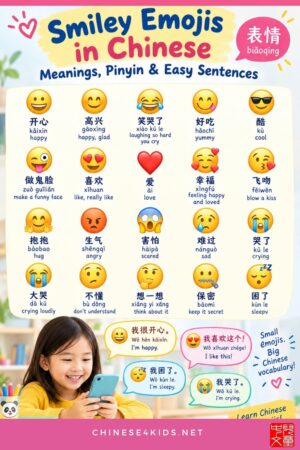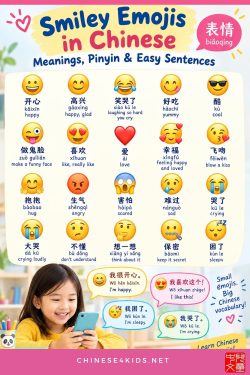
Many common emojis can be matched with a simple Chinese word. 😀 can show 开心 (kāixīn, happy). 😢 can show 哭了 (kū le, crying). 😠 can show 生气 (shēngqì, angry). 😴 can show 困了 (kùn le, sleepy). In everyday Chinese, the word for emoji is 表情 (biǎoqíng).
Kids already know what emojis mean. That makes emojis a great way to learn Chinese feeling words. In this guide, you will find 20 common emojis and their meanings in Chinese. Each one comes with pinyin, an English meaning and a short sentence.
Contents
hide
20 Common Emojis in Chinese: Quick List
| Emoji | Chinese | Pinyin | Meaning |
|---|---|---|---|
| 😀 | 开心 | kāixīn | happy |
| 😄 | 高兴 | gāoxìng | happy, glad |
| 😂 | 笑哭了 | xiào kū le | laughing so hard you cry |
| 😋 | 好吃 | hǎochī | yummy, delicious |
| 😎 | 酷 | kù | cool |
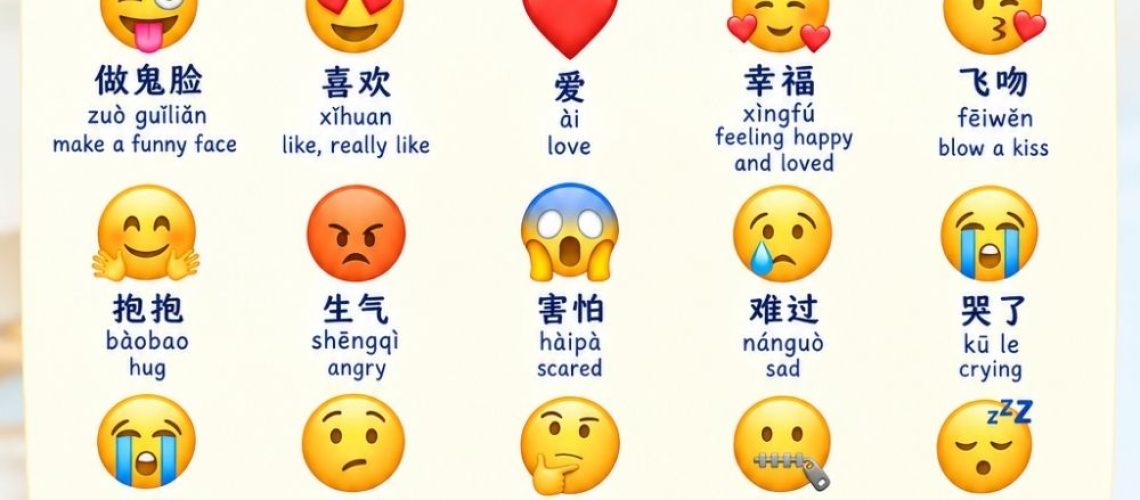
| 😜 | 做鬼脸 | zuò guǐliǎn | make a funny face |
| 😍 | 喜欢 | xǐhuan | like, really like |
| ❤️ | 爱 | ài | love |
| 🥰 | 幸福 | xìngfú | feeling happy and loved |
| 😘 | 飞吻 | fēiwěn | blow a kiss |
| 🤗 | 抱抱 | bàobao | hug |
| 😠 | 生气 | shēngqì | angry |
| 😱 | 害怕 | hàipà | scared |
| ☹️ | 难过 | nánguò | sad |
| 😢 | 哭了 | kū le | crying |
| 😭 | 大哭 | dà kū | crying loudly |
| 😕 | 不懂 | bù dǒng | don’t understand |
| 🤔 | 想一想 | xiǎng yi xiǎng | think about it |
| 🤐 | 保密 | bǎomì | keep it secret |
| 😴 | 困了 | kùn le | sleepy |
These are useful words to learn with each emoji. They are not official emoji names. The same emoji can mean slightly different things in different messages, and emojis look a little different on each phone.
Happy and Funny Emojis in Chinese
😀 开心 (kāixīn): happy
我很开心。
Wǒ hěn kāixīn.
I’m happy.
😄 高兴 (gāoxìng): happy, glad
我今天很高兴。
Wǒ jīntiān hěn gāoxìng.
I’m happy today.
😂 笑哭了 (xiào kū le): laughing so hard you cry
People use this emoji when something is so funny that tears come out.
太好笑了!
Tài hǎoxiào le!
That’s so funny!我笑哭了!
Wǒ xiào kū le!
I laughed so hard I cried!
😋 好吃 (hǎochī): yummy, delicious
People often use this emoji when they talk about food. Kids can use 好吃 at every meal.
真好吃!
Zhēn hǎochī!
So yummy!
😎 酷 (kù): cool
你真酷!
Nǐ zhēn kù!
You’re so cool!
😜 做鬼脸 (zuò guǐliǎn): make a funny face
鬼脸 means a funny face. 做 means to make.
他在做鬼脸。
Tā zài zuò guǐliǎn.
He’s making a funny face.
开心 or 高兴?
Both words mean happy, and kids can use either one. 开心 is a little more casual. 高兴 also shows up in set phrases, like 很高兴认识你 (Hěn gāoxìng rènshi nǐ, nice to meet you). Don’t overthink it: pick one and use it often.
Love and Friendly Emojis in Chinese
😍 喜欢 (xǐhuan): like, really like
我喜欢这个!
Wǒ xǐhuan zhège!
I like this!
❤️ 爱 (ài): love
我爱你!
Wǒ ài nǐ!
I love you!
🥰 幸福 (xìngfú): feeling happy and loved
幸福 is a deep, warm kind of happiness. People often use it when they talk about family, love or a good life.
我很幸福。
Wǒ hěn xìngfú.
I feel really happy.
😘 飞吻 (fēiwěn): blow a kiss
给你一个飞吻!
Gěi nǐ yí ge fēiwěn!
Here’s a kiss for you!
🤗 抱抱 (bàobao): hug
抱抱 is a cute, friendly way to say “a hug” or “give me a hug.” Adults say it to children, and friends often use it in messages too.
给你一个抱抱!
Gěi nǐ yí ge bàobao!
Here’s a hug for you!
Sad, Angry and Scared Emojis in Chinese
😠 生气 (shēngqì): angry
我生气了!
Wǒ shēngqì le!
I’m angry!
😱 害怕 (hàipà): scared
我有点害怕。
Wǒ yǒudiǎn hàipà.
I’m a little scared.
☹️ 难过 (nánguò): sad
我很难过。
Wǒ hěn nánguò.
I’m sad.
😢 哭了 (kū le): crying
妹妹哭了。
Mèimei kū le.
My little sister is crying.
😭 大哭 (dà kū): crying loudly
宝宝在大哭。
Bǎobao zài dà kū.
The baby is crying loudly.
Thinking and Everyday Emojis in Chinese
😕 不懂 (bù dǒng): don’t understand
This emoji is handy when you feel confused or don’t get something. 我不懂 is one of the most useful sentences in any Chinese class.
我不懂。
Wǒ bù dǒng.
I don’t understand.
🤔 想一想 (xiǎng yi xiǎng): think about it
让我想一想。
Ràng wǒ xiǎng yi xiǎng.
Let me think.
🤐 保密 (bǎomì): keep it secret
嘘!保密!
Xū! Bǎomì!
Shh! It’s a secret!
😴 困了 (kùn le): sleepy
我困了。
Wǒ kùn le.
I’m sleepy.
How Do You Say “Emoji” in Chinese?
The formal Chinese term for emoji is 表情符号 (biǎoqíng fúhào). In everyday talk, people usually just say 表情 (biǎoqíng), which also means facial expression.
这个表情是什么意思?
Zhège biǎoqíng shì shénme yìsi?
What does this emoji mean?
What is 表情包 (biǎoqíngbāo)?
In Chinese chat apps such as WeChat, people often send 表情包 (biǎoqíngbāo). These are stickers, GIFs and funny pictures that show a feeling or a reaction. Many have words on them. If your family chats in Chinese, you will see a lot of them.
Two Easy Sentence Patterns
You don’t need complicated grammar to start talking about feelings. These two simple patterns are enough to get started.
Pattern 1: 我很 + feeling
- 我很开心。 I’m happy.
- 我很难过。 I’m sad.
- 我很幸福。 I feel really happy.
Tip: 很 often means “very.” But in sentences like 我很开心, it also makes the sentence sound natural. You don’t need to translate it as “very” every time.
Pattern 2: 我 + feeling + 了
- 我困了。 I’m sleepy (now).
- 我生气了! I’m angry!
- 我笑哭了! I laughed so hard I cried!
Here 了 shows a change. I wasn’t sleepy before, but now I am.
Kids pick up these patterns by hearing them again and again. Short, daily practice works better than long lessons.
Does 🙂 Mean the Same Thing in Chinese?
🙂 is called 微笑 (wēixiào), which means smile. But in some Chinese online chats, especially among younger people, 🙂 can feel less warm than you might expect. It may come across as a bit cold or not very friendly.
Older relatives may simply use it as a friendly smile. So the context matters: look at who sent it and read the words around it. If you want your message to feel clearly cheerful, 😀 or 😄 usually works better.
How Do Chinese People Laugh in Messages?
Chinese messages often use characters to laugh instead of emojis.
- 哈哈 (hāhā): haha. Add more 哈 for a bigger laugh: 哈哈哈哈!
- 嘻嘻 (xīxī): hehe, a playful giggle.
- 嘿嘿 (hēihēi): hehe, often playful or a little cheeky.
- 笑死我了 (xiào sǐ wǒ le): “I’m dying laughing!” This one is very casual.
Be careful with 呵呵 (hēhē)
呵呵 looks like “hehe,” but online it can feel cold or even rude. If you are just starting to learn Chinese, use 哈哈 instead.
Try It at Home or in Class
- Feelings check-in: Ask 你今天开心吗? (Nǐ jīntiān kāixīn ma? Are you happy today?) Your child points to an emoji and answers with a short sentence.
- Emoji memory game: Put 6 emoji cards on the table. Say a Chinese word, and your child points to the right emoji. Then swap: you point to an emoji, and your child says the word.
- Emoji guessing game: One person makes an emoji face. Everyone else shouts the Chinese word.
- Send an emoji message: Help your child send a family member one emoji and one Chinese sentence, like 😴 我困了。
Frequently Asked Questions
What is “emoji” in Chinese?
The formal term is 表情符号 (biǎoqíng fúhào). In everyday talk, people usually just say 表情 (biǎoqíng).
What does 😂 mean in Chinese?
😂 can show 笑哭了 (xiào kū le), laughing so hard you cry. In messages, people may also write 哈哈哈 or 太好笑了 (that’s so funny).
What does 🙂 mean in Chinese?
🙂 is 微笑 (wēixiào), smile. In some online chats, especially among younger people, it can feel a bit cold. Older relatives may use it as a friendly smile. The context matters.
How do you say “haha” in Chinese?
哈哈 (hāhā). Write 哈哈哈 for a bigger laugh.
How do you say “LOL” in Chinese?
There is no exact match. People often write 哈哈哈 or 笑死我了 (xiào sǐ wǒ le), “I’m dying laughing.”
How do you say “I’m happy” in Chinese?
我很开心 (Wǒ hěn kāixīn) or 我很高兴 (Wǒ hěn gāoxìng). Both are correct.
Can children learn Chinese with emojis?
Yes. Kids already know what each emoji means, so they only need to learn the Chinese word. Then they can use it in a short sentence, like 我很开心.
Want to practise these 20 words?
The Theme Vocabulary Flashcards – Smiley Emoji in Chinese for Kids has all 20 emoji words from this article, are in Montessori 3-part format. Perfect for kids and Chinese beginning learners to study with various learning activities.
Start with a few emojis your child already loves. Learn one Chinese word for each, and use it in a short sentence every day.
😀 开心学中文!
Kāixīn xué Zhōngwén!
Have fun learning Chinese!
If you find this article useful, share it!