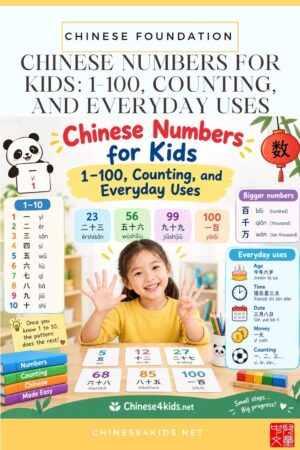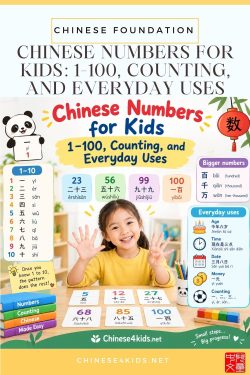
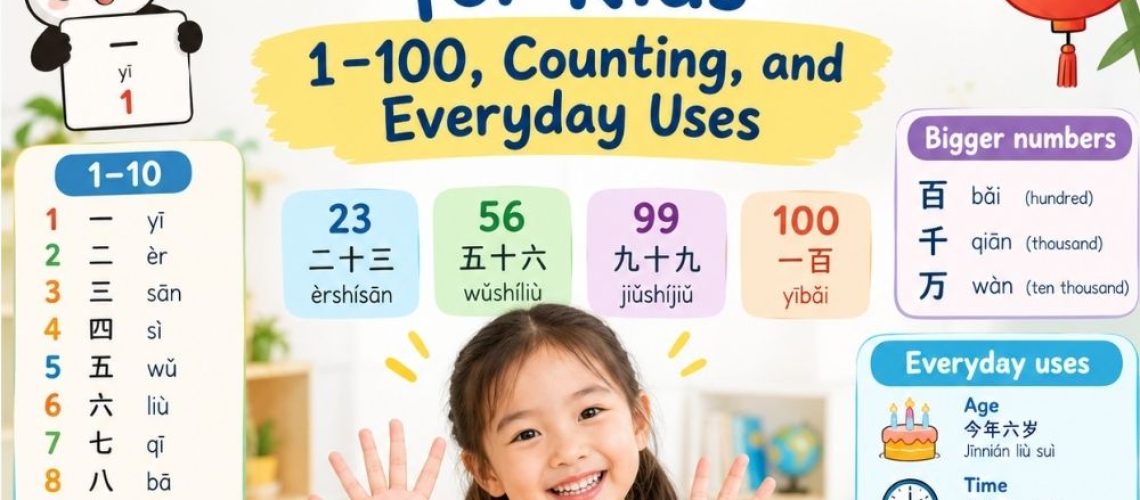
Chinese numbers are built from a small set of characters: 零 and 一 to 十, plus 百 (hundred), 千 (thousand) and 万 (ten thousand). Once a child knows 1 to 10, the pattern does the rest: 23 is 二十三, literally “two ten three.”
Chinese numbers: the quick guide
- 1–10 are the foundation for everything else.
- 11–99 follow one simple pattern: tens first, then units.
- 百, 千 and 万 build larger numbers.
- 两 replaces 二 before a measure word: 两个, 两点, 两岁.
- 零 fills an empty place inside a number, for example, 101 is 一百零一.
- Children use numbers for age, time, dates, money, and much more.
Numbers are one of the first things children learn in any language. In Mandarin, they are also one of the foundational knowledge that is not only useful, but also easy to learn. Once your child knows 1 to 10, they can start to say their age, count toys, tell the time, say today’s date, talk about money, line up for a race, and do simple sums.
This guide shows how the number system works, how to teach it, and how children use numbers every day.
Chinese numbers 0–10
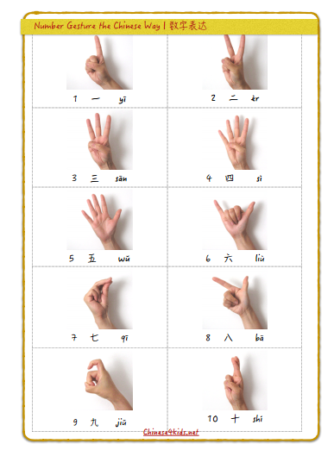
Start here. These eleven characters are the building blocks for almost every other number. The table also shows the one-hand gesture Chinese speakers use for each number.
| Number | Character | Pinyin | One-hand gesture |
|---|---|---|---|
| 0 | 零 | líng | A closed fist (or a circle with the fingers) |
| 1 | 一 | yī | Index finger up |
| 2 | 二 | èr | Index and middle finger |
| 3 | 三 | sān | Middle, ring and little finger |
| 4 | 四 | sì | Four fingers, thumb tucked in |
| 5 | 五 | wǔ | Open hand |
| 6 | 六 | liù | Thumb and little finger out |
| 7 | 七 | qī | Thumb, index and middle fingertips pinched together |
| 8 | 八 | bā | Thumb and index finger in an “L” |
| 9 | 九 | jiǔ | Index finger bent into a hook |
| 10 | 十 | shí | Crossed index fingers, or a fist |
Gestures work well for young learners. They add movement to the lesson, and they give a shy child a way to answer without speaking. You’ll also see them at markets and when grandparents ask how old a child is. The shapes for 7, 9, and 10 vary a little between regions and families. If a relative shows a different version, that’s normal.
Two pairs need extra listening practice: 四 (sì) and 十 (shí), and 一 (yī) and 七 (qī). A classic tongue twister helps with the first pair:
四是四,十是十,十四是十四,四十是四十
sì shì sì, shí shì shí, shísì shì shísì, sìshí shì sìshí
Kids love saying it faster and faster.
Count Real Things: Numbers + Measure Words
Once your child can count to ten, put a number to work. In Chinese, a small word sits between the number and the thing you count.
- 一个苹果 (yī gè píngguǒ), one apple. See measure words for food.
- 两只猫 (liǎng zhī māo), two cats. See measure words for animals.
- 三本书 (sān běn shū), three books.
- 五支铅笔 (wǔ zhī qiānbǐ), five pencils. See measure words for school supplies.
Notice 两 in 两只猫: it replaces 二 before a measure word. Start with 个, then add one new measure word each week. The full measure words guide shows how. Pair counting with the Measure Words Flashcards.
How Chinese numbers work
The pattern from 11 to 99
Numbers above ten are built like simple sums. You say the tens first, then the units.
11 to 19 start with 十: 十一 (11), 十五 (15), 十九 (19).
Whole tens put the number before 十: 二十 (20), 五十 (50), 九十 (90).
Everything else combines the two: 二十三 (23) is “two ten three,” and 九十九 (99) is “nine ten nine.”
Many children find this easier than English. There are no special words like “eleven” or “twenty.” If a child can count to ten, they can already count to ninety-nine.
Hundreds, thousands, and 万
Bigger numbers add three place words: 百 (bǎi, hundred), 千 (qiān, thousand), and 万 (wàn, ten thousand).
| Number | Chinese | Pinyin | How it’s built |
|---|---|---|---|
| 11 | 十一 | shíyī | ten + one |
| 23 | 二十三 | èrshísān | two tens + three |
| 99 | 九十九 | jiǔshíjiǔ | nine tens + nine |
| 100 | 一百 | yìbǎi | one hundred (the 一 is never dropped) |
| 101 | 一百零一 | yìbǎi líng yī | 零 fills the empty tens place |
| 365 | 三百六十五 | sānbǎi liùshíwǔ | 3 hundreds + 6 tens + 5 |
| 1,000 | 一千 | yìqiān | one thousand |
| 10,000 | 一万 | yíwàn | one “ten-thousand” — not 十千 |
The one surprise is 万. English groups big numbers in thousands, while Chinese groups them in ten-thousands. Younger children don’t need this yet. Older ones usually enjoy it as a puzzle.
Three things that confuse beginners
1. 二 or 两? Two words for “two”
Use 两 (liǎng) before a measure word when you talk about two of something: 两个苹果, 两只猫, 两本书. Use 二 (èr) when counting, reading numbers, saying ordinals, and inside numbers such as 十二 and 二十.
两个苹果 · 两点 · 我两岁
liǎng gè píngguǒ (two apples) · liǎng diǎn (two o’clock) · wǒ liǎng suì (I’m two)
liǎng gè píngguǒ (two apples) · liǎng diǎn (two o’clock) · wǒ liǎng suì (I’m two)
一、二、三 · 十二 · 第二 · 二月
yī, èr, sān (counting) · shí’èr (12) · dì-èr (second) · èryuè (February)
yī, èr, sān (counting) · shí’èr (12) · dì-èr (second) · èryuè (February)
Inside numbers, 二 is standard in 12, 20, and 22. For 200 you’ll hear both 二百 and 两百. Don’t overthink it. Kids pick this up through repetition far more than through rules.
2. 零 holds the empty place
When a place in the middle of a number is empty, Chinese says 零. So 101 is 一百零一. This matters, because 一百一 is a short way of saying 110, not 101.
3. What about the changing tone of 一?
You may hear 一 pronounced differently in phrases such as 一个 (yí gè) and 一天 (yì tiān). Young learners don’t need to memorise the tone rule at first. Hearing common phrases often is enough.
How children use Chinese numbers every day
Children remember numbers best when they use them for something real. These are the everyday uses worth practising first.
Age
你几岁? — 我七岁。
Nǐ jǐ suì? — Wǒ qī suì.
How old are you? — I’m seven.
Nǐ jǐ suì? — Wǒ qī suì.
How old are you? — I’m seven.
No verb is needed between 我 and the age. 几 (jǐ) is the question word for small numbers, so it suits young children well.
Time
现在三点。 · 两点半 · 下午四点
Xiànzài sān diǎn. (It’s three o’clock.) · liǎng diǎn bàn (half past two) · xiàwǔ sì diǎn (4 p.m.)
Xiànzài sān diǎn. (It’s three o’clock.) · liǎng diǎn bàn (half past two) · xiàwǔ sì diǎn (4 p.m.)
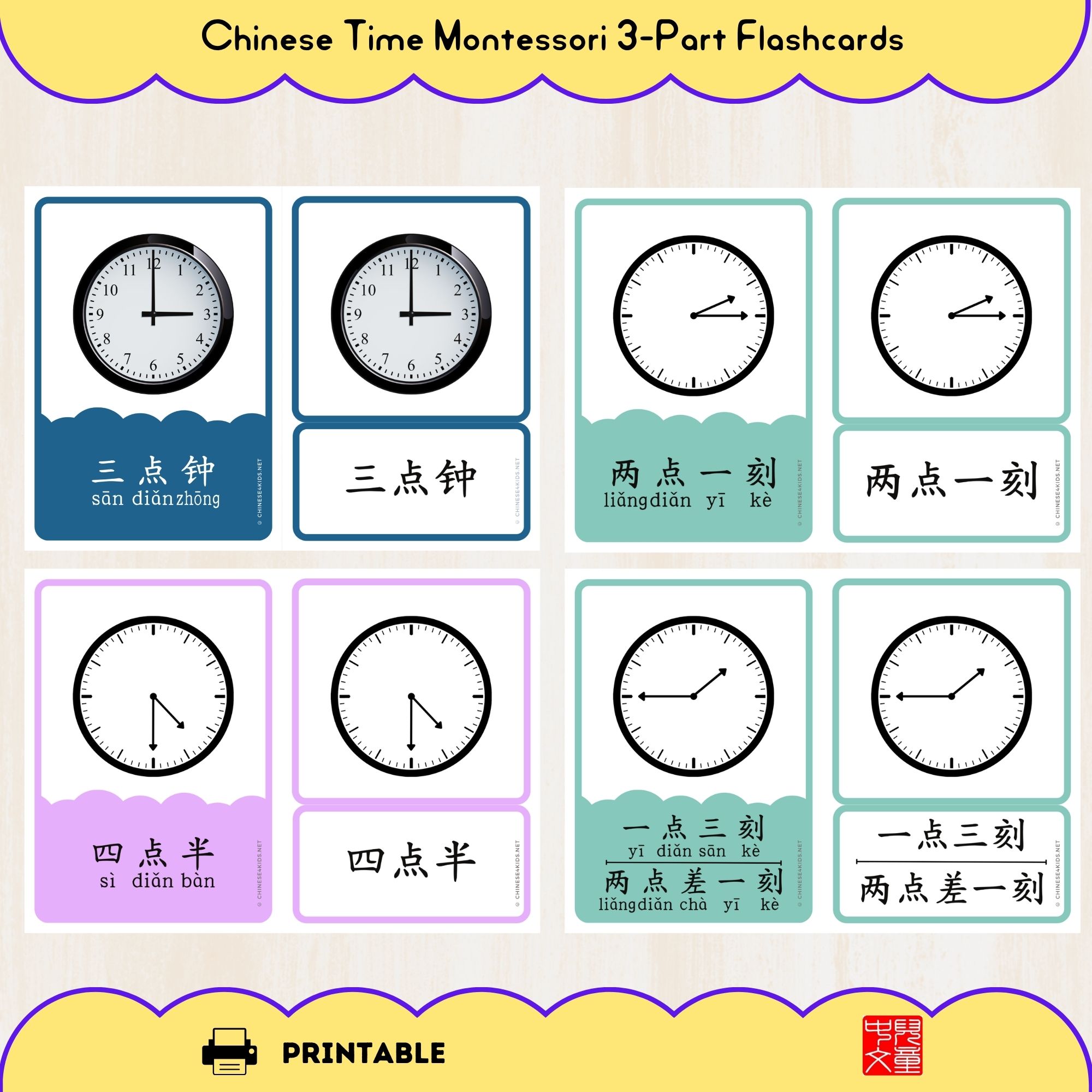
The hour comes first, then 点 (diǎn). Add 半 (bàn) for half past, and put 上午 (morning) or 下午 (afternoon) in front to show a.m. or p.m. Our guide on how to tell time in Chinese covers minutes, quarter hours, and asking the time.
Dates and weekdays
十月三号 · 星期一 · 星期天 / 星期日
shíyuè sān hào (October 3rd) · xīngqīyī (Monday) · xīngqītiān / xīngqīrì (Sunday)
shíyuè sān hào (October 3rd) · xīngqīyī (Monday) · xīngqītiān / xīngqīrì (Sunday)
Months and weekdays are simply numbered. Monday is “week one,” and October is “month ten.” Sunday is the exception: it’s 星期天 or 星期日, with 星期天 more common in everyday speech. Our guide to saying the year, month, and date in Chinese covers months, weekdays, and full dates.
Years
Years are read digit by digit, like a phone number. 2026年 is 二零二六年 (èr líng èr liù nián). This is one of the few places where 二, not 两, comes first.
Money
五块 · 十块五 · 十块五毛六分
wǔ kuài (5 yuan) · shí kuài wǔ (10.50) · shí kuài wǔ máo liù fēn (10.56)
wǔ kuài (5 yuan) · shí kuài wǔ (10.50) · shí kuài wǔ máo liù fēn (10.56)
In everyday speech people say 块 and 毛. On price tags and in writing you’ll see 元 and 角.
Order and ranking
Put 第 (dì) before any number to make it “first,” “second,” and so on: 第一 (first), 第二 (second), 第十 (tenth). Kids love this one for races and games.
Want to take Chinese numbers beyond counting?
The Chinese Numbers Booklet brings the everyday uses above into one printable reference. It covers hand gestures, numbers 1–100, ordinal numbers, months, weekdays, dates, and time, so children can see how numbers work in real life.
The Chinese Numbers Booklet brings the everyday uses above into one printable reference. It covers hand gestures, numbers 1–100, ordinal numbers, months, weekdays, dates, and time, so children can see how numbers work in real life.
Chinese numbers and measure words
In English you say “three apples.”, but in Chinese ,you need a small word between the number and the noun: 三个苹果 (sān gè píngguǒ). That word is a measure word. 个 works for many nouns, but animals, books, cars, and many other things use their own.
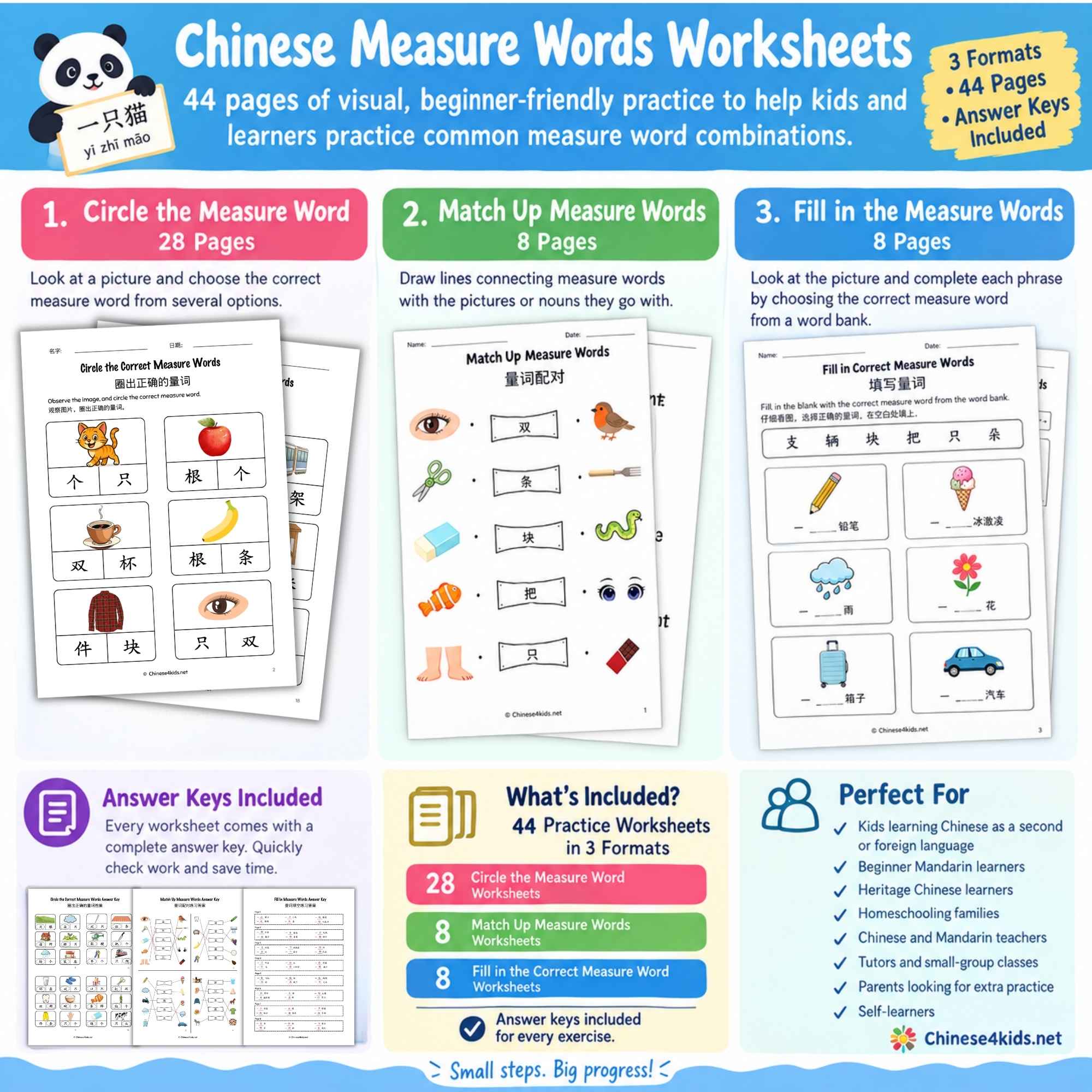
This is also where 两 appears most often: 两只猫 (liǎng zhī māo, two cats), 两本书 (liǎng běn shū, two books). Once your child can count, measure words are the natural next step. Our complete guide to Chinese measure words shows the most useful ones, grouped by category.
Counting people, pets or snacks? Jump straight to people, animals or food for ready-made examples.
Chinese numbers and Chinese culture
Some numbers carry extra meaning because of how they sound. 八 (bā) sounds similar to 发 (fā), as in 发财 (to prosper), so many people see 8 as lucky. 四 (sì) sounds similar to 死 (sǐ, death), so some people avoid 4 in phone numbers and floor numbers. Children usually find this fascinating, and it gives them extra practice with tones. Around Chinese New Year, numbers also turn up in many greetings. Our list of lucky Chinese New Year phrases that start with numbers is a fun way to practise them.
How to teach Chinese numbers to kids
Step 1 — Say and show. Count 1–10 aloud every day, with fingers and gestures. Short and frequent beats long and rare.
Step 2 — Count real things. Stairs, grapes, socks, toy cars. Linking the word to a real quantity is what makes numbers stick.
Step 3 — Connect sound to character. Match spoken numbers to 一 to 十, then to Arabic numerals. Children need to see that 3 and 三 mean the same thing. When they’re ready to write, have them count the objects first, then trace the character following the stroke order. Laminated cards and a dry-erase marker let them practise again and again.
Step 4 — Ask, don’t tell. Swap “this is five” for “how many?” Getting your child to recall the number does more than repeating it for them.
Step 5 — Use numbers in daily life. Ask the time, count change at the shop, say today’s date at breakfast. Each small use is a free review.
Teaching a class? Lesson 04, Numbers 1–10 (数字 1–10), in our Chinese lesson plans for teachers turns these steps into a ready-to-use lesson. Lessons 21 and 22 cover days of the week and months of the year, if your class is ready to use numbers in dates.
A simple learning path
Children learning Chinese move at very different speeds, depending on how much Chinese they hear. Follow the stages in order, at whatever pace suits your child.
Start with 1–10
Count real objects, use fingers and gestures, and practise saying the numbers out loud.
Resource: Count to 10 in Mandarin Flashcard Set, with native audio
Count real objects, use fingers and gestures, and practise saying the numbers out loud.
Resource: Count to 10 in Mandarin Flashcard Set, with native audio
Practice to 1–100
Recognise the characters 一 to 十, understand the pattern, and start writing the numbers.Resources: Numbers 1–10 in Chinese Workbook for first writing practice, then 1–100 Count & Trace Flashcards
Recognise the characters 一 to 十, understand the pattern, and start writing the numbers.Resources: Numbers 1–10 in Chinese Workbook for first writing practice, then 1–100 Count & Trace Flashcards
Start using numbers
Practise age, dates, weekdays, and time in short daily moments.
Resource: Chinese Numbers Booklet
Practise age, dates, weekdays, and time in short daily moments.
Resource: Chinese Numbers Booklet
Go further
Add money, measure words, larger numbers, and simple maths.
Read next: Chinese measure words and simple math in Chinese
Add money, measure words, larger numbers, and simple maths.
Read next: Chinese measure words and simple math in Chinese
If you don’t speak Mandarin yourself, numbers are one of the easiest places to start. Numbers also pair naturally with colours and action verbs, the other Mandarin building blocks young learners need early.
Simple math in Chinese
Once children can count, they can start doing sums in Chinese. Three words get you started: 加 (jiā, plus), 减 (jiǎn, minus), and 等于 (děngyú, equals).
三加四等于七。
Sān jiā sì děngyú qī.
Three plus four equals seven.
Sān jiā sì děngyú qī.
Three plus four equals seven.
Our guide to simple math vocabulary in Chinese adds multiplication, division, odd and even numbers, fractions, and more.
Common mistakes
Mistake 1: Saying 二个 instead of 两个. It’s the most common number mistake for every learner. Gently model the right form rather than correcting every time.
Mistake 2: Dropping 零. Saying 一百一 for 101 actually means 110. Practise a few “zero numbers” like 105 and 1,008 out loud.
Mistake 3: Mixing up 四 and 十. These are hard to tell apart at first. The tongue twister above is the most fun fix.
Mistake 4: Stopping at counting. A child who can recite 1–100 but can’t say their age or read a clock hasn’t finished learning numbers. Move to teach them numbers in real use such as saying dates, time, money, etc.
Related Chinese number topics
- How to tell time in Chinese — hours, minutes, half and quarter past
- How to say the year, month, and date in Chinese — months, weekdays, and full dates
- Chinese measure words — the words that come after a number
- Simple math in Chinese — sums, fractions, and comparing numbers
- Color by numbers in Chinese — a hands-on number activity
Frequently Asked Questions
How do you count from 1 to 10 in Chinese?
一 yī, 二 èr, 三 sān, 四 sì, 五 wǔ, 六 liù, 七 qī, 八 bā, 九 jiǔ, 十 shí. Zero is 零 (líng).
How do you say numbers 1–100 in Chinese?
11–19 are 十 plus the unit (十一, 十二), and whole tens are the number plus 十 (二十, 三十). Others combine both: 45 is 四十五. 100 is 一百 (yìbǎi).
How do Chinese numbers work?
Chinese numbers work like simple sums. When combined with 十, 百, 千 and 万, the digits 一 to 九 becomes tens, hundreds, thousands, and tens of thousands. You say the largest place first: 365 is 三百六十五, “three hundred six ten five.”
What is the difference between 二 and 两?
Both mean “two.” Use 两 before a measure word: 两个, 两点, 两岁, and Use 二 for counting, digits, ordinals, and inside numbers like 12 and 20.
Why is 10,000 called 万 in Chinese?
Chinese groups large numbers in units of ten thousand, not one thousand, and 万 is the word for that unit. So 10,000 is 一万, and 100,000 is 十万, “ten ten-thousands.”<
How do Chinese people show numbers with one hand?
1 to 5 use the usual fingers. 6 is thumb and little finger, 7 is three fingertips pinched, 8 is an “L” shape, 9 is a hooked index finger, and 10 is crossed index fingers or a fist. Shapes vary slightly by region.
Are Chinese numbers hard for kids to learn?
No. They are among the easiest parts of Mandarin. Ten characters, 一 to 十, and one simple pattern take a child all the way to 99.
I don’t speak Mandarin. Can I still teach my child numbers?
Yes. Numbers are short and regular, so they are one of the best places for a parent to start helping their kids to learn. Use audio to model pronunciation and learn alongside your child.
Do I need a measure word every time I count in Chinese?
Yes, when you count a noun, put a measure word between the number and the noun. Say 三个苹果, not 三苹果. 个 works for many everyday nouns, and you can add more measure words as your child grows.
If you like this article, share it