The short answer
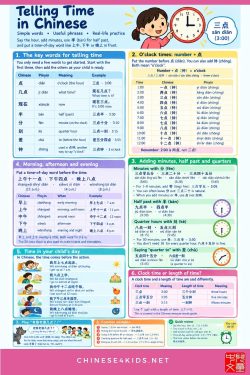
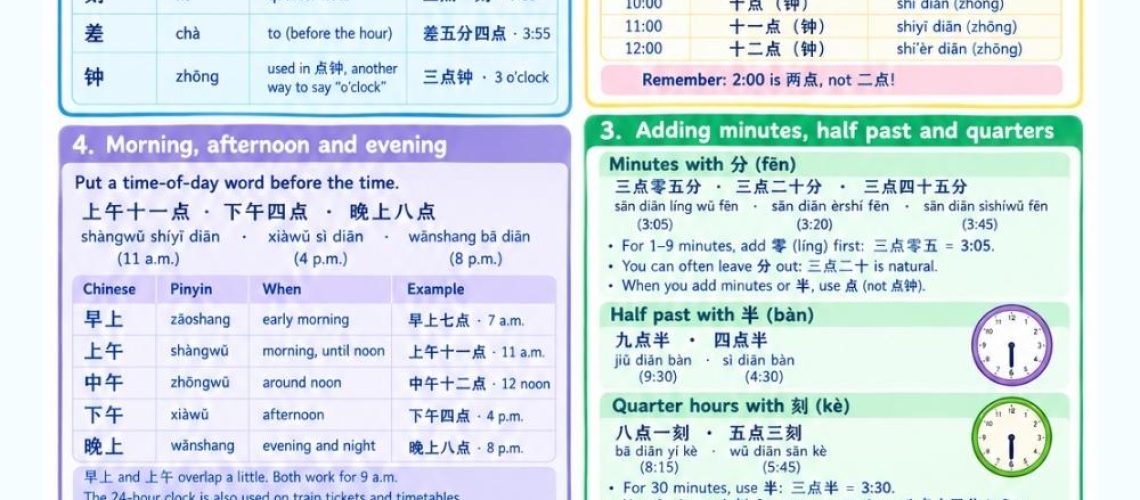
To tell time in Chinese, say the hour followed by 点 (diǎn): 三点 is three o’clock. Add minutes with 分 (fēn), use 半 (bàn) for half past, and put a time-of-day word such as 上午, 下午 or 晚上 in front to show roughly when it happens.
To tell time in Chinese, say the hour followed by 点 (diǎn): 三点 is three o’clock. Add minutes with 分 (fēn), use 半 (bàn) for half past, and put a time-of-day word such as 上午, 下午 or 晚上 in front to show roughly when it happens.
Telling time is useful for everyday Chinese. Children can use it to talk about their daily routines, from getting up in the morning to going to bed at night. It also gives them useful number practice.
The good news is that if your child can count to twelve, they already know most of the numbers they need. This guide starts with o’clock times and builds up step by step to minutes, half past, quarters, and times of day. It ends with daily routine phrases, a classic clock game, and the most common mistakes.
Contents
hide
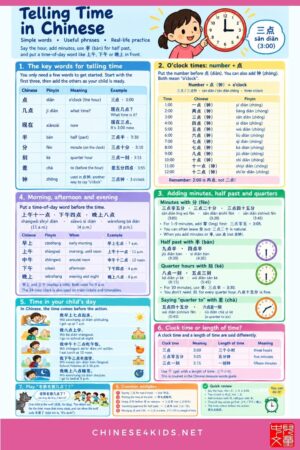
The key words for telling time
You only need a few words to get started. Start with the first three, then add the others as your child is ready.
| Chinese | Pinyin | Meaning | Example |
|---|---|---|---|
| 点 | diǎn | o’clock (the hour) | 三点 · 3:00 |
| 几点 | jǐ diǎn | what time? | 现在几点?· What time is it? |
| 现在 | xiànzài | now | 现在三点。· It’s 3:00 now. |
| 半 | bàn | half (past) | 三点半 · 3:30 |
| 分 | fēn | minute (on the clock) | 三点十分 · 3:10 |
| 刻 | kè | quarter hour | 三点一刻 · 3:15 |
| 差 | chà | to (before the hour) | 差五分四点 · 3:55 |
| 钟 | zhōng | used in 点钟, another way to say “o’clock” | 三点钟 · 3 o’clock |
O’clock times: number + 点
Saying the hour is simple. Put the number before 点 (diǎn). You can also add 钟 (zhōng): 点钟. Both mean “o’clock.” In everyday speech, 点 is often enough.
Number + 点(钟)= o’clock
三点 / 三点钟 · sān diǎn / sān diǎn zhōng · three o’clock
三点 / 三点钟 · sān diǎn / sān diǎn zhōng · three o’clock
| Time | Chinese | Pinyin |
|---|---|---|
| 1:00 | 一点(钟) | yī diǎn (zhōng) |
| 2:00 | 两点(钟) | liǎng diǎn (zhōng) |
| 3:00 | 三点(钟) | sān diǎn (zhōng) |
| 4:00 | 四点(钟) | sì diǎn (zhōng) |
| 5:00 | 五点(钟) | wǔ diǎn (zhōng) |
| 6:00 | 六点(钟) | liù diǎn (zhōng) |
| 7:00 | 七点(钟) | qī diǎn (zhōng) |
| 8:00 | 八点(钟) | bā diǎn (zhōng) |
| 9:00 | 九点(钟) | jiǔ diǎn (zhōng) |
| 10:00 | 十点(钟) | shí diǎn (zhōng) |
| 11:00 | 十一点(钟) | shíyī diǎn (zhōng) |
| 12:00 | 十二点(钟) | shí’èr diǎn (zhōng) |
One important thing to remember: 2:00 is 两点, not 二点. You will also see 两 before measure words such as 个 and 本. Our guide to Chinese numbers for kids explains when to use 两 and when to use 二.
Adding minutes with 分
For minutes, say the hour with 点, then the number of minutes, then 分 (fēn).
三点零五分 · 三点二十分 · 三点四十五分
sān diǎn líng wǔ fēn (3:05) · sān diǎn èrshí fēn (3:20) · sān diǎn sìshíwǔ fēn (3:45)
sān diǎn líng wǔ fēn (3:05) · sān diǎn èrshí fēn (3:20) · sān diǎn sìshíwǔ fēn (3:45)
For minutes from 1 to 9, add 零 (líng) first:
三点零五 = 3:05.
You can often leave 分 out in everyday speech:
三点二十 is perfectly natural.
When you say only the hour, you can use 点 or 点钟. When you add minutes or 半, use 点:
三点钟 = 3:00
三点半 = 3:30
三点二十分 = 3:20
三点半 = 3:30
三点二十分 = 3:20
Half past with 半
For half past, add 半 (bàn) after the hour. It’s one of the easiest patterns, so it’s a great second step after o’clock.
九点半 · 四点半
jiǔ diǎn bàn (9:30) · sì diǎn bàn (4:30)
jiǔ diǎn bàn (9:30) · sì diǎn bàn (4:30)
Quarter hours with 刻
刻 (kè) means a quarter of an hour, or 15 minutes.
八点一刻 = 8:15
bā diǎn yí kè ·五点三刻 = 5:45
wǔ diǎn sān kè
bā diǎn yí kè ·五点三刻 = 5:45
wǔ diǎn sān kè
For 30 minutes, use 半: 三点半 = 3:30.
You don’t need 刻 for every quarter hour. Saying 八点十五分 for 8:15 is also perfectly fine.
Saying “quarter to” with 差
差 (chà) means “short of” or “to.” You can use it for times just before the hour.
五点四十五分 = 5:45 · 六点差一刻 = a quarter to six
wǔ diǎn sìshíwǔ fēn · liù diǎn chà yí kè
wǔ diǎn sìshíwǔ fēn · liù diǎn chà yí kè
For beginners, 五点四十五分 is the easiest form to use. Quarters and 差 are a later step, and that’s fine.
A little more Chinese. You may also hear 差一刻六点 (chà yí kè liù diǎn), with 差 first. It means the same thing. For times just after the hour, you may hear 过 (guò, “past”), as in 两点过一刻 (2:15). Beginners don’t need either yet.
Morning, afternoon, and evening
Chinese commonly uses a time-of-day word before the time, such as 早上, 上午, 下午, or 晚上.
上午十一点 = 11 a.m.
下午四点 = 4 p.m.
晚上八点 = 8 p.m.
下午四点 = 4 p.m.
晚上八点 = 8 p.m.
| Chinese | Pinyin | When | Example |
|---|---|---|---|
| 早上 | zǎoshang | early morning | 早上七点 · 7 a.m. |
| 上午 | shàngwǔ | morning, until noon | 上午十一点 · 11 a.m. |
| 中午 | zhōngwǔ | around noon | 中午十二点 · 12 noon |
| 下午 | xiàwǔ | afternoon | 下午四点 · 4 p.m. |
| 晚上 | wǎnshang | evening and night | 晚上八点 · 8 p.m. |
早上 and 上午 overlap a little. Both work for 9 a.m., for example. Don’t overthink it. Children pick up the feel of each word from daily use.
You will also see the 24-hour clock on things like train tickets and timetables. In everyday conversation, people commonly use the 12-hour style together with words such as 上午, 下午, and 晚上.
Asking and answering “What time is it?”
现在几点?/ 现在几点了?
Xiànzài jǐ diǎn? / Xiànzài jǐ diǎn le?
What time is it now?
Xiànzài jǐ diǎn? / Xiànzài jǐ diǎn le?
What time is it now?
现在三点半。
Xiànzài sān diǎn bàn.
It’s half past three.
Xiànzài sān diǎn bàn.
It’s half past three.
You can also ask when something happens. Just put 几点 where the time goes.
你几点起床? — 我七点起床。
Nǐ jǐ diǎn qǐchuáng? — Wǒ qī diǎn qǐchuáng.
What time do you get up? — I get up at seven.
Nǐ jǐ diǎn qǐchuáng? — Wǒ qī diǎn qǐchuáng.
What time do you get up? — I get up at seven.
Time in your child’s day
Here’s the most useful pattern for children: in Chinese, the time normally comes before the action. Practise it with your child’s real routine.
我早上七点起床。
Wǒ zǎoshang qī diǎn qǐchuáng.
I get up at 7 a.m.<
Wǒ zǎoshang qī diǎn qǐchuáng.
I get up at 7 a.m.<
我八点上学。
Wǒ bā diǎn shàngxué.
I go to school at eight.
Wǒ bā diǎn shàngxué.
I go to school at eight.
我中午十二点吃午饭。
Wǒ zhōngwǔ shí’èr diǎn chī wǔfàn.
I eat lunch at 12 noon.)
Wǒ zhōngwǔ shí’èr diǎn chī wǔfàn.
I eat lunch at 12 noon.)
我下午三点半放学。
Wǒ xiàwǔ sān diǎn bàn fàngxué.
School finishes at 3:30 p.m.)
Wǒ xiàwǔ sān diǎn bàn fàngxué.
School finishes at 3:30 p.m.)
我晚上八点睡觉。
Wǒ wǎnshang bā diǎn shuìjiào.
I go to bed at 8 p.m.
Wǒ wǎnshang bā diǎn shuìjiào.
I go to bed at 8 p.m.
Clock time or length of time?
A clock time and a length of time are said differently in Chinese. The table shows the difference.
| Clock time | Meaning | Length of time | Meaning |
|---|---|---|---|
| 三点 | 3:00 | 三个小时 | three hours |
| 三点零五分 | 3:05 | 五分钟 | five minutes |
| 三点一刻 | 3:15 | 一刻钟 | fifteen minutes |
Notice 个 in 三个小时. You use a measure word when you say “three hours.” Our guide to Chinese measure words shows how these work.
Once your child can say the time, the natural next step is dates and days of the week. Our guide to saying the year, month, and date in Chinese covers both.
How to teach telling time in Chinese
Step 1 — Start with o’clock. Use a toy clock or a paper plate clock. Move the hour hand and say the time together: 三点, 四点, 五点.
Step 2 — Ask, don’t tell. Move the hand and ask 现在几点? Let your child answer. Asking your child to remember the time is more useful than simply repeating it.
Step 3 — Add half past. Once o’clock is easy, add 半. Then count minutes in fives around the clock face.
Step 4 — Use real routines. Ask 你几点起床? at breakfast and 几点了? before bedtime. Short, frequent practice beats long lessons.
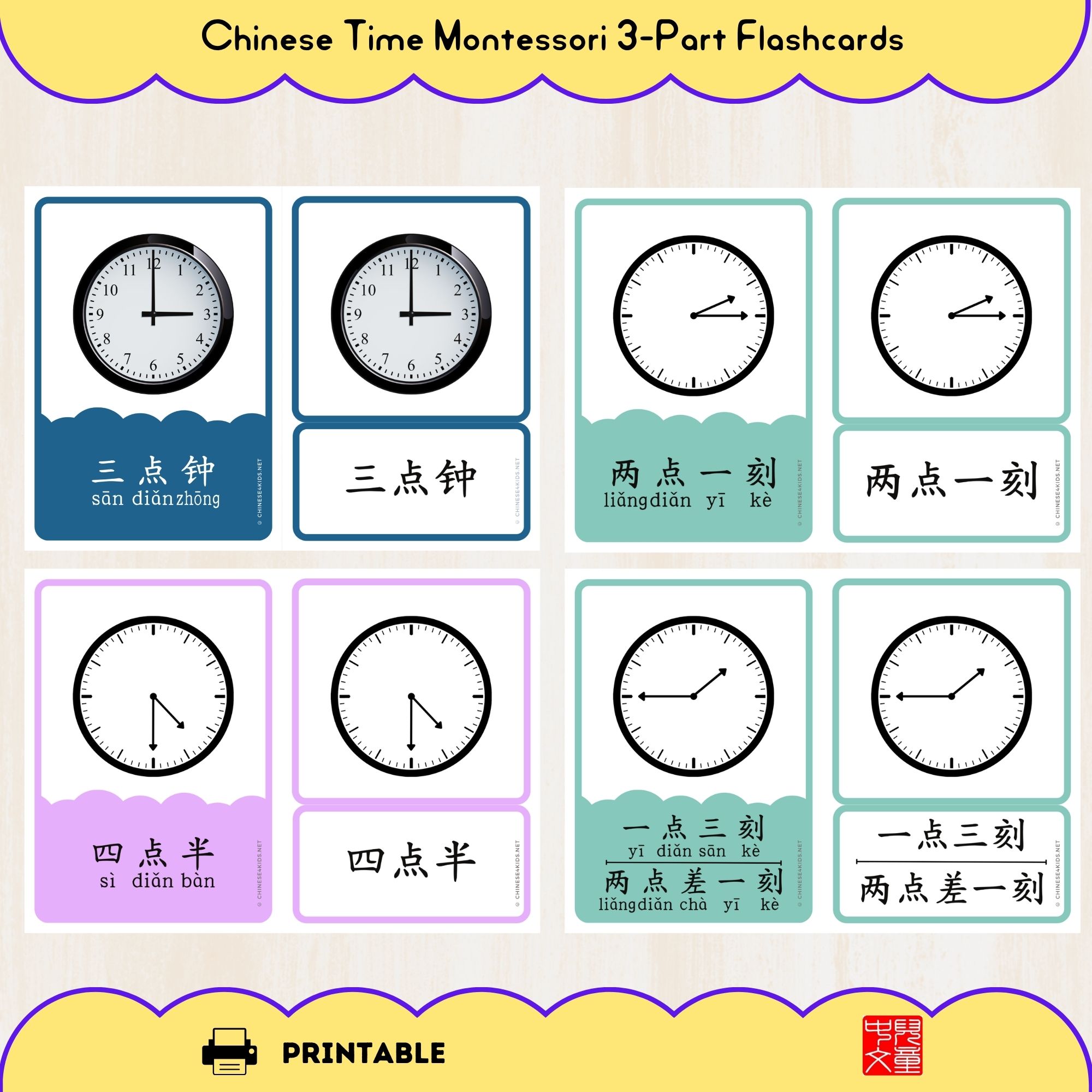
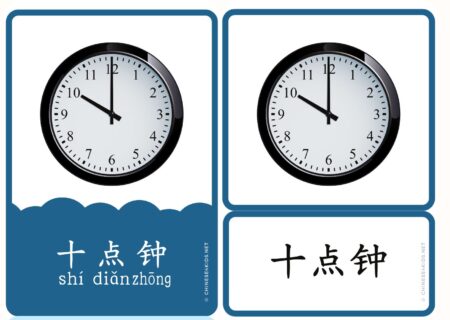
Step 5 — Match the clock and the words. Three-part cards make this easy: children match the clock picture with the Chinese time, then use the control card to check their answer.
Play “老狼老狼几点了?”
This classic Chinese children’s game is similar to “What’s the Time, Mr. Wolf?” One child is the wolf (老狼, lǎo láng). The other children call:
老狼老狼几点了?
Lǎo láng, lǎo láng, jǐ diǎn le?
“Old wolf, what time is it?”
Lǎo láng, lǎo láng, jǐ diǎn le?
“Old wolf, what time is it?”
The wolf answers with a time, such as 三点了, and the children take that many steps. When the wolf calls 天黑了 (tiān hēi le, “It’s dark!”), everyone runs. The rules can vary, so play it in whatever way works for your group. For younger children, the game turns time practice into listening and movement.
Common mistakes
Mistake 1: Saying 二点 for two o’clock. Use 两点. It’s the most common time mistake for beginners.
Mistake 2: Putting the time at the end. 我起床七点 sounds wrong. The time goes before the action: 我七点起床.
Mistake 3: Using 点钟 before 半 or minutes. 点钟 means “o’clock.” When you go on to say minutes or 半, use 点 on its own: not 三点钟半, but 三点半.
Mistake 4: Counting quarters for half past. For 30 minutes, use 半: 三点半. Save 刻 for 15 and 45.
Mistake 5: Mixing up 点 and 小时. 三点 is a time on the clock. 三个小时 is three hours long.
Frequently Asked Questions
How do you ask “What time is it?” in Chinese?
Say 现在几点? (Xiànzài jǐ diǎn?) or 现在几点了? Both are common and natural.
How do you say “o’clock” in Chinese?
Put 点 (diǎn) or 点钟 (diǎn zhōng) after the number: 八点 or 八点钟 means eight o’clock.
How do you say “half past” in Chinese?
Add 半 (bàn) after the hour. 九点半 (jiǔ diǎn bàn) is half past nine.
How do you say a.m. and p.m. in Chinese?
Use a time-of-day word before the time: 早上 / 上午 = morning, 下午 = afternoon, 晚上 = evening and night. For example, 下午四点 means 4 p.m.
Why is 2:00 两点 and not 二点?
2:00 is normally 两点 (liǎng diǎn), not 二点. 两 is commonly used before 点 and before measure words such as 个 and 本.
How do you say quarter past in Chinese?
Use 一刻 (yí kè): 八点一刻 is 8:15. Many people simply say 八点十五 or 八点十五分, which is also correct.
How do you say 2:05 in Chinese?
两点零五分 (liǎng diǎn líng wǔ fēn). In speech, 两点零五 is also natural.
How do you say 3:30 in Chinese?
三点半 (sān diǎn bàn).
How do you say 5:45 in Chinese?
五点四十五分 (wǔ diǎn sìshíwǔ fēn). You may also hear 六点差一刻, “a quarter to six.”
How do you say noon and midnight in Chinese?
十二点 can mean either, so context matters. For clarity, say 中午十二点 for noon and 半夜十二点 or 午夜十二点 for midnight.
Where does the time go in a Chinese sentence?
The time normally comes before the action: 我七点起床 (I get up at seven).
Do Chinese people use the 24-hour clock?
You’ll see it on things like timetables and train tickets. In conversation, people commonly use the 12-hour style with 上午, 下午 or 晚上.
Quick review
- Say the hour, then 点: 三点 is 3:00. 三点钟 also means three o’clock.
- Two o’clock is 两点, not 二点.
- Add minutes with 分 (两点二十分) and half past with 半 (九点半).
- 刻 means a quarter: 一刻 is :15, 三刻 is :45. Quarters and 差 can wait.
- Time-of-day words go first: 上午十一点, 下午四点, 晚上八点.
- The time comes before the action: 我七点起床.
Practice telling time
Ready to practise?
The Chinese Time Montessori 3-Part Flashcards cover o’clock, half past, and quarter hours in 48 card sets. Children match each clock picture with its Chinese time, then check their answer on the control card, which shows the Chinese, pinyin, and English. They come in two sizes for small hands.
For more number practice, the Chinese Numbers Booklet connects numbers with everyday topics such as dates and time.
If you find this article useful, share it