Quick answer:
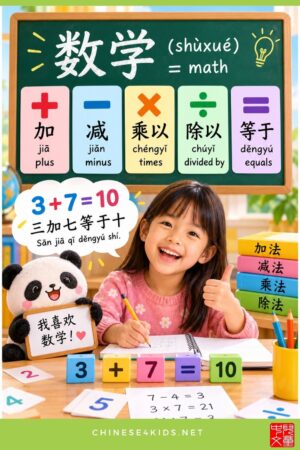
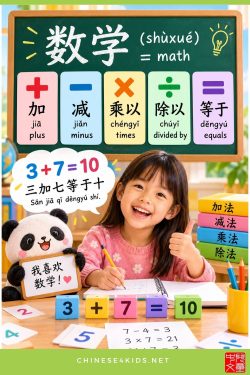
Math in Chinese is 数学 (shùxué). Plus is 加 (jiā), minus is 减 (jiǎn), times is 乘以 (chéngyǐ), divided by is 除以 (chúyǐ), and equals is 等于 (děngyú). Example: 3 + 7 = 10 is 三加七等于十 (Sān jiā qī děngyú shí).
Math in Chinese is 数学 (shùxué). Plus is 加 (jiā), minus is 减 (jiǎn), times is 乘以 (chéngyǐ), divided by is 除以 (chúyǐ), and equals is 等于 (děngyú). Example: 3 + 7 = 10 is 三加七等于十 (Sān jiā qī děngyú shí).
We use math every day. We count toys, share snacks, compare numbers and solve simple problems. Now you can do some of that in Chinese too!
Let’s have a look at the basic math words in Chinese, with pinyin and easy examples. You don’t need to learn everything at once. Start with 加, 减, 乘, 除 and 等于, then add more words as you need them.
First, four useful words:
| Chinese | Pinyin | English |
|---|---|---|
| 数学 | shùxué | math |
| 数字 | shùzì | number |
| 题目 | tímù | question / problem |
| 答案 | dá’àn | answer |
New to Chinese numbers? Learn 1–10 first with Chinese Numbers for Kids. Then come back here.
Plus, Minus, Times and Divide in Chinese
These five words are all you need to say a simple sum.
| Symbol | Chinese | Pinyin | English |
|---|---|---|---|
| + | 加 | jiā | plus |
| − | 减 | jiǎn | minus |
| × | 乘以 | chéngyǐ | times |
| ÷ | 除以 | chúyǐ | divided by |
| = | 等于 | děngyú | equals |
In a simple equation, say the first number, the math word, the second number, then 等于 and the answer. Don’t overthink it!
Tip: In math expressions, you may also see or hear 乘 (chéng) instead of 乘以 (chéngyǐ), and 除 (chú) instead of 除以 (chúyǐ). Beginners can start with 乘以 and 除以.
Let’s try some sums:
| Sum | Chinese | Pinyin |
|---|---|---|
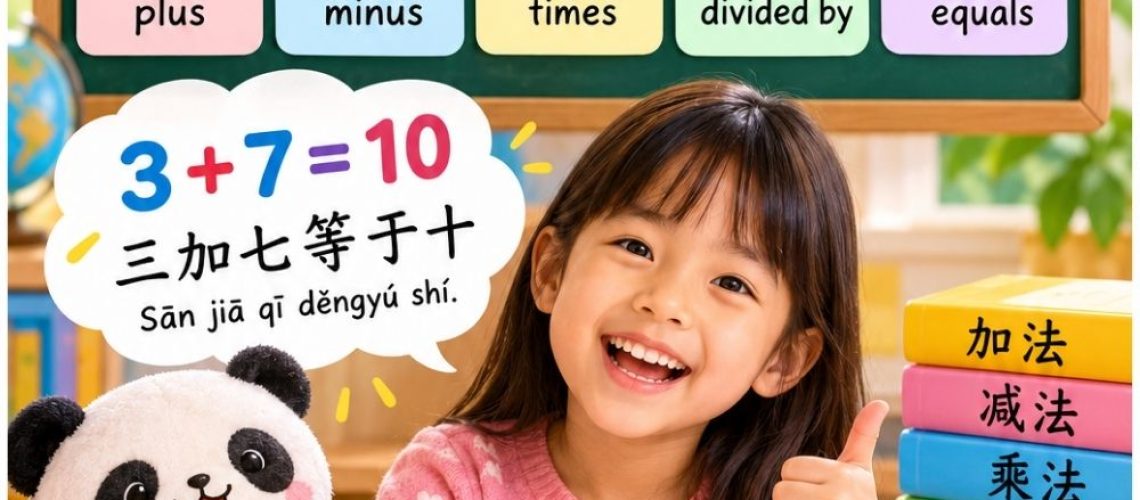
| 3 + 7 = 10 | 三加七等于十 | Sān jiā qī děngyú shí. |
| 7 − 4 = 3 | 七减四等于三 | Qī jiǎn sì děngyú sān. |
| 3 × 7 = 21 | 三乘以七等于二十一 | Sān chéngyǐ qī děngyú èrshíyī. |
| 21 ÷ 7 = 3 | 二十一除以七等于三 | Èrshíyī chúyǐ qī děngyú sān. |
How do you ask a math question in Chinese?
To ask for the answer, use 几 (jǐ). Here it means “how many” or “what number”. Put 几 where the answer should go.
| Chinese | Pinyin | English |
|---|---|---|
| 三加七等于几? | Sān jiā qī děngyú jǐ? | What is 3 + 7? |
| 三加七等于十。 | Sān jiā qī děngyú shí. | Three plus seven equals ten. |
Addition, Subtraction, Multiplication and Division
The words above help you say a sum. The four kinds of math have their own names in Chinese:
| Chinese | Pinyin | English |
|---|---|---|
| 加法 | jiāfǎ | addition |
| 减法 | jiǎnfǎ | subtraction |
| 乘法 | chéngfǎ | multiplication |
| 除法 | chúfǎ | division |
Greater Than, Less Than, Odd, Even and Half
Greater than and less than
大 means “big” and 小 means “small”. That makes 大于 and 小于 easy to remember.
| Symbol | Chinese | Pinyin | English | Example |
|---|---|---|---|---|
| > | 大于 | dàyú | greater than | 100 > 99: 一百大于九十九。Yībǎi dàyú jiǔshíjiǔ. |
| < | 小于 | xiǎoyú | less than | 98 < 99: 九十八小于九十九。Jiǔshíbā xiǎoyú jiǔshíjiǔ. |
Odd and even numbers
奇数 are numbers like 1, 3, 5, 7 and 9. 偶数 are numbers like 2, 4, 6, 8 and 10.
| Chinese | Pinyin | English | Example |
|---|---|---|---|
| 奇数 | jīshù | odd number | 三、五、七、九都是奇数。Sān, wǔ, qī, jiǔ dōu shì jīshù. |
| 偶数 | ǒushù | even number | 四、六、八、十都是偶数。Sì, liù, bā, shí dōu shì ǒushù. |
Half
一半 (yíbàn) means “half”. It is a word kids use a lot, for pizza, cookies and more.
| Chinese | Pinyin | English |
|---|---|---|
| 十的一半是五。 | Shí de yíbàn shì wǔ. | Half of 10 is 5. |
| 我吃了一半。 | Wǒ chī le yíbàn. | I ate half. |
Practice: Say It in Chinese
Read each one out loud. For questions 1–4, say the answer in Chinese. For number 5, choose 大于 or 小于. A few minutes a day works better than one long session. Mistakes are fine!
- 二加三等于几? Èr jiā sān děngyú jǐ?
- 九减四等于几? Jiǔ jiǎn sì děngyú jǐ?
- 二乘以五等于几? Èr chéngyǐ wǔ děngyú jǐ?
- 十二除以三等于几? Shí’èr chúyǐ sān děngyú jǐ?
- 八___六。Choose 大于 or 小于.
Answers
- 五 (wǔ). 二加三等于五。Èr jiā sān děngyú wǔ.
- 五 (wǔ). 九减四等于五。Jiǔ jiǎn sì děngyú wǔ.
- 十 (shí). 二乘以五等于十。Èr chéngyǐ wǔ děngyú shí.
- 四 (sì). 十二除以三等于四。Shí’èr chúyǐ sān děngyú sì.
- 大于 (dàyú). 八大于六。Bā dàyú liù.
Fun Ways to Practice with Kids
Short games help the words stick.
- Dice sums. Roll two dice. Add the numbers and say the answer in Chinese: 三加五等于八。Take turns and keep score.
- Math word cards. Make cards for 加, 减, 乘以, 除以 and 等于. Pick number cards and a math card, then make and say an equation.
- Odd and even clap. Count from 1 to 10 in Chinese. Clap when you say a 奇数 and stomp when you say an 偶数.
What to Learn Next
Good numbers make good math. If your child is still learning to count, these will help:
- Chinese Numbers for Kids: 1–100
- Chinese Number Booklet for everything about Chinese numbers in one place
- Numbers 1–10 in Chinese Workbook for Kids for writing and counting practice
Math is one of many school subjects you can learn in Chinese. See our guide to School Subjects in Chinese.
A Chinese Multiplication Chant for Kids
In Chinese, multiplication facts are often practiced with a short, rhythmic chant called 乘法口诀 (chéngfǎ kǒujué). It sounds like a song:
| Chinese | Pinyin |
|---|---|
| 一一得一, 二二得四, 三三得九。 |
Yī yī dé yī, èr èr dé sì, sān sān dé jiǔ. |
The word 得 (dé) connects the calculation to its answer. Try saying it aloud a few times. The rhythm can help you remember the multiplication facts.
Chinese Math Words: Quick Reference
| Chinese | Pinyin | English |
|---|---|---|
| 数学 | shùxué | math |
| 加 | jiā | plus |
| 减 | jiǎn | minus |
| 乘以 | chéngyǐ | times |
| 除以 | chúyǐ | divided by |
| 等于 | děngyú | equals |
| 加法 | jiāfǎ | addition |
| 减法 | jiǎnfǎ | subtraction |
| 乘法 | chéngfǎ | multiplication |
| 除法 | chúfǎ | division |
| 几 | jǐ | how many / what number |
| 大于 | dàyú | greater than |
| 小于 | xiǎoyú | less than |
| 奇数 | jīshù | odd number |
| 偶数 | ǒushù | even number |
| 一半 | yíbàn | half |
Frequently Asked Questions
How do you say math in Chinese?
Math in Chinese is 数学 (shùxué).
How do you say plus in Chinese?
Plus is 加 (jiā). It also means “to add”. For example, 二加三等于五 means “two plus three equals five”.
How do you say minus in Chinese?
Minus is 减 (jiǎn). It also means “to subtract”. For example, 九减四等于五 means “nine minus four equals five”.
How do you say times in Chinese?
Times is 乘以 (chéngyǐ). You may also hear 乘 (chéng). For example, 二乘以五等于十 means “two times five equals ten”.
How do you say divided by in Chinese?
Divided by is 除以 (chúyǐ). For example, 十二除以三等于四 means “twelve divided by three equals four”.
How do you say “equals” in Chinese?
Equals is 等于 (děngyú). For example, 3 + 7 = 10 is 三加七等于十 (Sān jiā qī děngyú shí).
How do you say multiplication in Chinese?
Multiplication is 乘法 (chéngfǎ). In a simple equation, use 乘以 (chéngyǐ) for “times”. For example, 三乘以四等于十二 means “three times four equals twelve”.
How do you say division in Chinese?
Division is 除法 (chúfǎ). In an equation, 除以 (chúyǐ) means “divided by”. For example, 十二除以三等于四 means “twelve divided by three equals four”.
How do you ask “What is 3 + 7?” in Chinese?
Say 三加七等于几? (Sān jiā qī děngyú jǐ?). The word 几 (jǐ) means “how many”.
Do kids need to know Chinese numbers before learning math words?
Yes, it helps a lot. Start with the numbers 1–10, then add the math words. See Chinese Numbers for Kids.
If you find this article useful, share it