Quick Answer
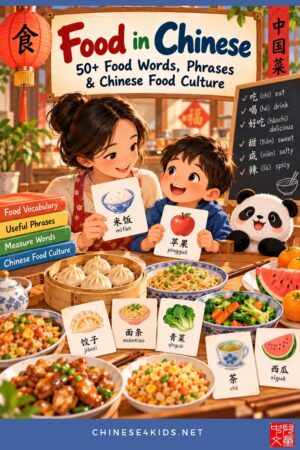
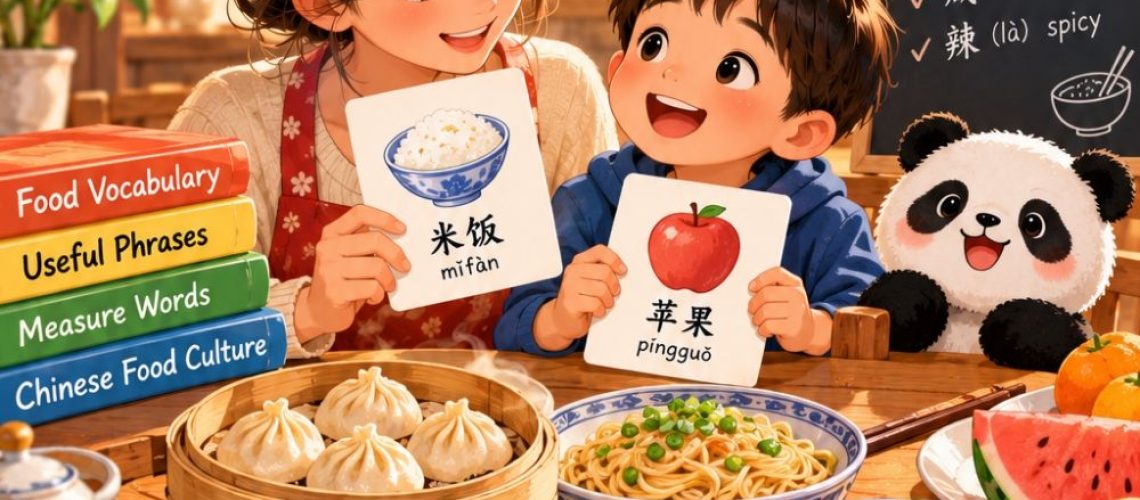
Food in Chinese is 食物 (shíwù).Useful beginner words include 吃 (chī, eat), 喝 (hē, drink), 米饭 (mǐfàn, cooked rice), 面条 (miàntiáo, noodles) and 水 (shuǐ, water). Children can practise these words at mealtimes, while shopping or when cooking with family.
Food in Chinese is 食物 (shíwù).Useful beginner words include 吃 (chī, eat), 喝 (hē, drink), 米饭 (mǐfàn, cooked rice), 面条 (miàntiáo, noodles) and 水 (shuǐ, water). Children can practise these words at mealtimes, while shopping or when cooking with family.
Food is an easy place to start learning Chinese because it is part of everyday life. Children already know many food words in their first language, and they encounter food every day. Mealtimes are a natural chance to practise a few Chinese words without making it feel like a lesson.
For many Chinese-speaking families, food is also a way to connect, celebrate and show care. Friends invite each other with 一起去吃饭吧! (Yìqǐ qù chīfàn ba! Let’s go and eat together!), and family reunion dinners are a highlight of major festivals.
This guide covers food words by category, measure words, mealtime phrases, festival foods, five activities and ready-made resources.
Essential Food Vocabulary
Start with these core words for food, eating, drinking and taste.
| Chinese | Pinyin | English |
|---|---|---|
| 食物 | shíwù | food |
| 吃 | chī | eat |
| 喝 | hē | drink |
| 好吃 | hǎochī | delicious, tasty |
| 甜 | tián | sweet |
| 咸 | xián | salty |
| 辣 | là | spicy |
Useful Chinese Characters in Food Words. 吃, 喝, 水, 米, 肉 and 好 appear in many other Chinese words, so food words give children a start on common characters. Our free Top 100 Chinese Characters printable lists useful characters for beginners: download it here.
Food Words by Category
Staple Foods & Grains (主食)
| Chinese | Pinyin | English |
|---|---|---|
| 米饭 | mǐ fàn | cooked rice |
| 面条 | miàn tiáo | noodles |
| 馒头 | mán tou | steamed bun (plain) |
| 包子 | bāo zi | steamed filled bun |
| 饺子 | jiǎo zi | dumplings |
| 粥 | zhōu | rice porridge / congee |
| 面包 | miàn bāo | bread |
| 米 | mǐ | uncooked rice / rice (the grain) |
米 and 米饭: 米 (mǐ) is rice as a grain, and 米饭 (mǐfàn) is cooked rice.
Meat, Seafood and Protein (肉类)
| Chinese | Pinyin | English |
|---|---|---|
| 鸡肉 | jī ròu | chicken |
| 牛肉 | niú ròu | beef |
| 猪肉 | zhū ròu | pork |
| 羊肉 | yáng ròu | lamb / mutton |
| 鱼 | yú | fish |
| 虾 | xiā | shrimp / prawn |
| 鸡蛋 | jī dàn | egg |
| 豆腐 | dòu fu | tofu |
Vegetables (蔬菜)
| Chinese | Pinyin | English |
|---|---|---|
| 青菜 | qīng cài | green vegetables |
| 白菜 | bái cài | Chinese cabbage |
| 西红柿 | xī hóng shì | tomato |
| 黄瓜 | huáng guā | cucumber |
| 土豆 | tǔ dòu | potato |
| 萝卜 | luó bo | radish |
| 胡萝卜 | hú luó bo | carrot |
| 玉米 | yù mǐ | corn |
| 蘑菇 | mó gu | mushroom |
Fruits (水果)
| Chinese | Pinyin | English |
|---|---|---|
| 苹果 | píng guǒ | apple |
| 香蕉 | xiāng jiāo | banana |
| 葡萄 | pú táo | grapes |
| 西瓜 | xī guā | watermelon |
| 橙子 | chéng zi | orange |
| 梨 | lí | pear |
| 草莓 | cǎo méi | strawberry |
| 桃子 | táo zi | peach |
Drinks (饮料)
| Chinese | Pinyin | English |
|---|---|---|
| 水 | shuǐ | water |
| 牛奶 | niúnǎi | milk |
| 茶 | chá | tea |
| 果汁 | guǒzhī | fruit juice |
| 豆浆 | dòujiāng | soy milk |
| 汽水 | qìshuǐ | fizzy drink, soda |
| 咖啡 | kāfēi | coffee |
Snacks & Desserts (零食 / 甜点)
| Chinese | Pinyin | English |
|---|---|---|
| 糖 | táng | sugar; sweets or candy, depending on context |
| 巧克力 | qiǎokèlì | chocolate |
| 冰淇淋 | bīngqílín | ice cream |
| 饼干 | bǐnggān | biscuit, cookie |
| 月饼 | yuèbǐng | mooncake |
| 汤圆 | tāngyuán | sweet rice balls |
Meals of the Day (一日三餐)
| Chinese | Pinyin | English |
|---|---|---|
| 早饭 | zǎofàn | breakfast |
| 午饭 | wǔfàn | lunch |
| 晚饭 | wǎnfàn | dinner |
| 零食 | língshí | snack |
| 夜宵 | yèxiāo | late-night snack |
Popular Chinese Dishes & Food
When you talk about “Chinese food,” you’re talking about more than just ingredients. Here are the dishes and food names that define Chinese cuisine:
| Chinese | Pinyin | English |
|---|---|---|
| 炒饭 | chǎofàn | fried rice |
| 炒面 | chǎomiàn | fried noodles |
| 火锅 | huǒguō | hot pot |
| 春卷 | chūnjuǎn | spring rolls |
| 馄饨 | húntun | wontons |
| 北京烤鸭 | Běijīng kǎoyā | Peking duck |
| 宫保鸡丁 | gōngbǎo jīdīng | Kung Pao chicken |
| 麻婆豆腐 | mápó dòufu | mapo tofu |
| 小笼包 | xiǎolóngbāo | soup dumplings |
| 粽子 | zòngzi | zongzi (sticky rice dumplings) |
| 中国菜 | Zhōngguó cài | Chinese cuisine, Chinese food |
Measure Words for Food
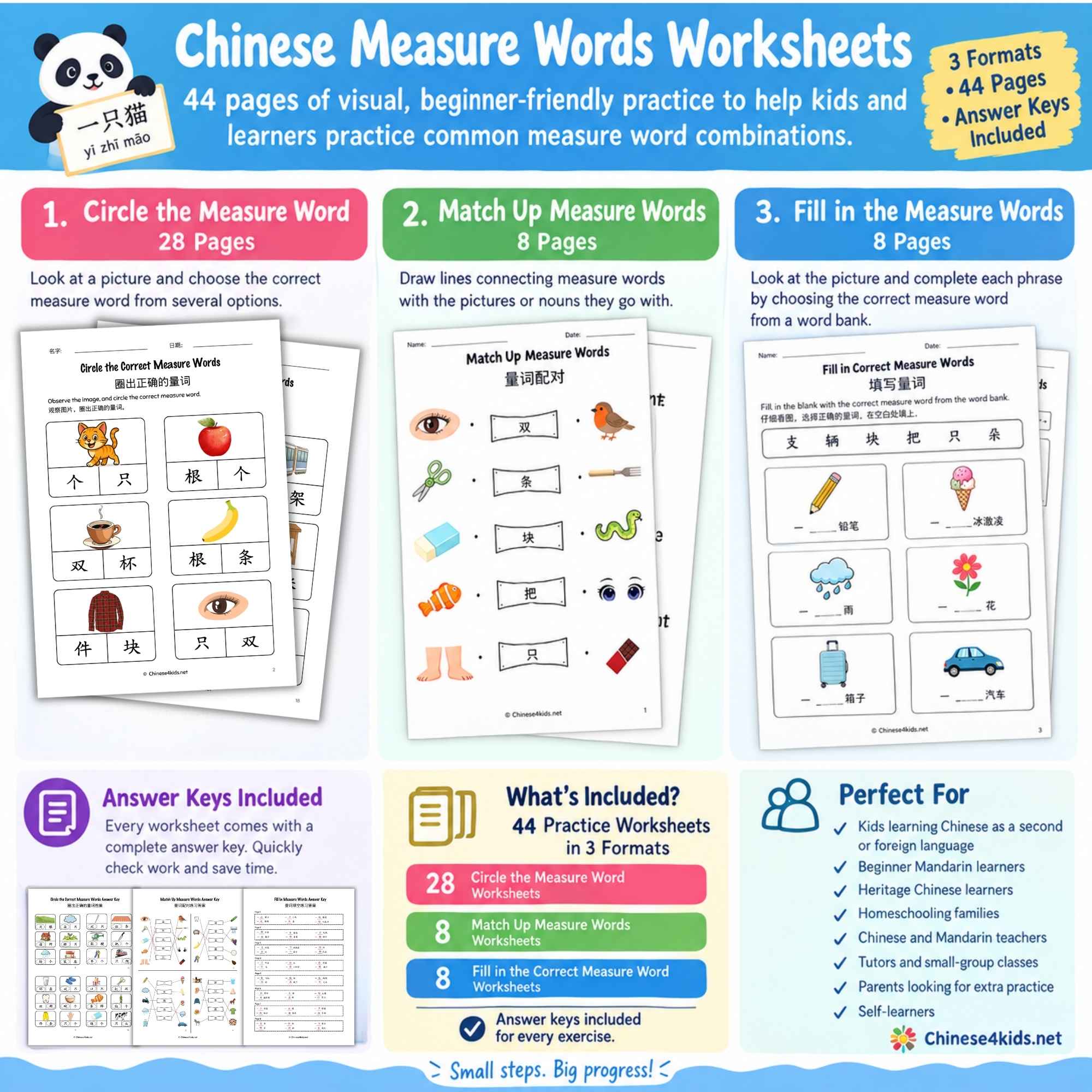
Chinese puts a measure word between a number and a noun, and food gives children natural practice. Start with useful combinations such as 一个苹果, 一碗米饭 and 一杯水, and add more measure words as children meet them in everyday conversation. It is easier to learn each word in a familiar phrase than to memorise a long list of rules.
| Phrase | Pinyin | Meaning | Measure word |
|---|---|---|---|
| 一碗米饭 | yì wǎn mǐfàn | a bowl of rice | 碗 (wǎn), bowl |
| 一碗面条 | yì wǎn miàntiáo | a bowl of noodles | 碗 (wǎn), bowl |
| 一杯水 | yì bēi shuǐ | a glass of water | 杯 (bēi), cup, glass |
| 一杯牛奶 | yì bēi niúnǎi | a glass of milk | 杯 (bēi), cup, glass |
| 一块蛋糕 | yí kuài dàngāo | a piece of cake | 块 (kuài), piece, lump |
| 一个苹果 | yí gè píngguǒ | an apple | 个 (gè), general measure word |
| 一条鱼 | yì tiáo yú | a fish | 条 (tiáo), often used for long, narrow things, such as fish |
For more examples, see our guide to Chinese measure words for food.
Useful Chinese Phrases for Mealtimes
Knowing food words is a good start. These phrases help children use them in conversation. Notice how often 吃 (eat), 喝 (drink), 喜欢 (like) and 要 (want) come up. They are useful beginner words, and food makes them easy to use naturally.
Asking What Someone Wants
| Chinese | Pinyin | English |
|---|---|---|
| 你饿吗? | Nǐ è ma? | Are you hungry? |
| 你想吃什么? | Nǐ xiǎng chī shénme? | What do you want to eat? |
| 你喜欢吃什么? | Nǐ xǐhuan chī shénme? | What do you like to eat? |
| 你不喜欢吃什么? | Nǐ bù xǐhuan chī shénme? | What don’t you like to eat? |
| 你要不要…? | Nǐ yào bu yào…? | Do you want…? |
Mini-dialogue:
A: 你想吃什么?
B: 我想吃面条。A: 你喜欢吃面条吗?
B: 喜欢!
Offering & Accepting
| Chinese | Pinyin | English |
|---|---|---|
| 再来一碗。 | Zài lái yì wǎn. | Another bowl, please. |
| 够了,谢谢。 | Gòu le, xièxie. | That’s enough, thank you. |
| 我还要。 | Wǒ hái yào. | I want more. |
| 不要了。 | Bú yào le. | No more, thank you. |
Talking About Taste
| Chinese | Pinyin | English |
|---|---|---|
| 好吃! | Hǎochī! | Delicious! |
| 不好吃。 | Bù hǎochī. | It doesn’t taste good. |
| 太甜了。 | Tài tián le. | Too sweet. |
| 太辣了。 | Tài là le. | Too spicy. |
| 太咸了。 | Tài xián le. | Too salty. |
| 我喜欢… | Wǒ xǐhuan… | I like… |
| 我不喜欢… | Wǒ bù xǐhuan… | I don’t like… |
At the Table
| Chinese | Pinyin | English |
|---|---|---|
| 开饭了! | Kāifàn le! | Dinner’s ready! |
| 吃饭了! | Chīfàn le! | Time to eat! |
| 慢慢吃。 | Mànmàn chī. | Take your time and enjoy your meal. |
| 我吃饱了。 | Wǒ chībǎo le. | I’m full. |
| 我饿了。 | Wǒ è le. | I’m hungry. |
| 好吃吗? | Hǎochī ma? | Is it good? |
Restaurant Phrases
| Chinese | Pinyin | English |
|---|---|---|
| 您要什么? | Nín yào shénme? | What would you like? (polite) |
| 我要一碗面条。 | Wǒ yào yì wǎn miàntiáo. | I’d like a bowl of noodles. |
| 我要一杯果汁。 | Wǒ yào yì bēi guǒzhī. | I’d like a glass of juice. |
| 还要别的吗? | Hái yào bié de ma? | Anything else? |
| 不要了,谢谢。 | Bú yào le, xièxie. | Nothing else, thank you. |
| 多少钱? | Duōshao qián? | How much is it? |
| 一共多少钱? | Yígòng duōshao qián? | How much is it altogether? |
Full mini-dialogue (restaurant):
Waiter: 您要什么?
Customer: 我要一碗面条。
Waiter: 还要别的吗?
Customer: 我还要一杯果汁。
Waiter: 一共多少钱?
Customer: 一共十块钱。
Food and Chinese Culture
Shared meals, hospitality, festivals and family gatherings often revolve around food. Festival foods are a natural way to teach culture and vocabulary together. The meanings below are common associations and traditions, and families and regions celebrate in different ways.
Festival Foods
Each major festival has its own symbolic food—and learning these is one of the most natural ways to teach culture and vocabulary together.
饺子 (jiǎozi) — Dumplings
Eaten at the Spring Festival (春节, Chinese New Year), especially in northern China. Their shape is often said to resemble old gold ingots, so they are associated with wealth and good fortune. Many families wrap them together.
Eaten at the Spring Festival (春节, Chinese New Year), especially in northern China. Their shape is often said to resemble old gold ingots, so they are associated with wealth and good fortune. Many families wrap them together.
月饼 (yuè bǐng) — Mooncakes
Eaten at the Mid-Autumn Festival (中秋节). Their round shape is associated with the full moon and family reunion, and they are shared with family and friends.
Eaten at the Mid-Autumn Festival (中秋节). Their round shape is associated with the full moon and family reunion, and they are shared with family and friends.
汤圆 (tāng yuán) — Sweet Rice Balls
Eaten at the Lantern Festival (元宵节) and on family reunion days. 汤圆 (tāngyuán) are sweet rice balls, while 团圆 (tuányuán) means family reunion. Both contain the character 圆 (yuán), meaning “round”, which helps explain the association with togetherness and completeness.
Eaten at the Lantern Festival (元宵节) and on family reunion days. 汤圆 (tāngyuán) are sweet rice balls, while 团圆 (tuányuán) means family reunion. Both contain the character 圆 (yuán), meaning “round”, which helps explain the association with togetherness and completeness.
粽子 (zòng zi) — Sticky Rice Dumplings
WEaten at the Dragon Boat Festival (端午节). A traditional legend connects them with the poet Qu Yuan, who is said to have drowned in the Miluo River. According to the legend, people threw rice into the water so the fish would leave his body alone. Families often wrap and eat them together.
WEaten at the Dragon Boat Festival (端午节). A traditional legend connects them with the poet Qu Yuan, who is said to have drowned in the Miluo River. According to the legend, people threw rice into the water so the fish would leave his body alone. Families often wrap and eat them together.
年糕 (nián gāo) — Year Cake
Eaten at the Spring Festival. 糕 (gāo, cake) sounds like 高 (gāo, high), so 年糕 is associated with wishes to rise higher in the new year.
Eaten at the Spring Festival. 糕 (gāo, cake) sounds like 高 (gāo, high), so 年糕 is associated with wishes to rise higher in the new year.
长寿面 (chángshòumiàn): longevity noodles.
Often eaten on birthdays as a wish for a long life.
Often eaten on birthdays as a wish for a long life.
For more festivals and traditions, see our guide to celebrations and festivals in Chinese culture.
The Greeting 吃了吗?
In some Chinese-speaking communities, people use 吃了吗? (Chī le ma?, “Have you eaten?”) as a casual greeting. Depending on the context, it may be a genuine question about a meal or simply a friendly way to start a conversation. It is not the only, or necessarily the most common, greeting today.
It shows children that the meaning of a phrase depends on the situation, not only on its words.
5 Fun Teaching Activities for Food in Chinese
You don’t need a textbook to teach food in Chinese. Here are five activities that work straight away, at home or in the classroom.
1. Name Everything on the Plate
At every meal, point to one food and name it in Chinese. Just one. Ask your child to repeat. Over a week, you will cover most of the vocabulary on this page — without anyone sitting down for a formal “lesson.”
Example: Breakfast tomorrow → point to the toast → “面包” → your child repeats.
Why this works: Food is concrete and visible, which gives children a meaningful chance to use new words.
2. The Supermarket Scavenger Hunt
2. The Supermarket Scavenger Hunt
Next time you shop for food, give your child a short list of foods to find, written in pinyin or Chinese characters. For example: 香蕉, 牛奶, 西红柿, 鸡蛋. The first three items earn a sticker. If you’re playing with younger children or beginners, work together to find the items instead of racing against each other.
Your child gets to look for familiar words on real food packages.
Why this works: Children tend to remember what they search for and find themselves.
3. Cook Together in Chinese
Pick a simple recipe — fried rice, dumplings, scrambled eggs with tomato. As you cook, name each ingredient:
- 这是鸡蛋。(This is an egg.)
- 这是西红柿。(This is a tomato.)
Give simple instructions:
- 把鸡蛋打到碗里。(Crack the egg into the bowl.)
- 加一点盐。(Add a little salt.)
The kitchen is one of the most powerful language classrooms there is.
Why this works: Children learn through action, and cooking creates real context for every word.
4. “I Like / I Don’t Like” Sorting Game
Print or draw pictures of 10 foods. Make two columns: 我喜欢 (I like) and 我不喜欢 (I don’t like). Let your child sort the foods and tell you which they like and which they don’t.
This practises food vocabulary and one of the most useful sentence patterns in beginner Chinese.
A: 你喜欢吃苹果吗?
B: 喜欢!
A: 你喜欢吃西红柿吗?
B: 不喜欢。
5. Restaurant Role-Play
Take turns being the customer and the waiter:
Waiter: 您要什么?(What would you like?)
Customer: 我要一碗面条。(I’d like a bowl of noodles.)Waiter: 还要别的吗?(Anything else?)
Customer: 我还要一杯果汁。(I’d also like a glass of juice.)
Role-play turns passive vocabulary into active conversation — and children love it.
Frequently Asked Questions (FAQ)
How do you say “food” in Chinese?
食物 (shíwù) means “food.” In everyday conversation, people often simply talk about what they want to 吃 (chī, eat) or 喝 (hē, drink).
How do you say “I like Chinese food” in Chinese?
我喜欢中国菜。 Wǒ xǐhuān Zhōngguó cài. I like Chinese food.
Or more simply: 我喜欢吃中国菜。 I like to eat Chinese food.
How do you say “What do you want to eat?” in Chinese?
你想吃什么? Nǐ xiǎng chī shénme?
This is one of the most useful phrases for mealtimes.
How do you say “I’m hungry” and “I’m full” in Chinese?
我饿了。 Wǒ è le. 我吃饱了。 Wǒ chī bǎo le.
What is the Chinese word for rice?
米饭 (mǐ fàn) means cooked rice. 米 (mǐ) alone means uncooked rice or rice as a grain. 饭 (fàn) means cooked rice/meal.
What is Chinese food called in Chinese?
中国菜 (Zhōngguó cài) means Chinese cuisine or Chinese food.
菜 (cài) specifically means dishes/cuisine, so 四川菜 (Sìchuān cài) is Sichuan cuisine, 广东菜 (Guǎngdōng cài) is Cantonese cuisine, etc.
How do you say “delicious” in Chinese?
好吃 (hǎo chī) means delicious or tasty, specifically for food.
The word 好 (hǎo) means “good,” and 吃 (chī) means “eat,” so 好吃 literally means “good to eat.”
Why do Chinese people use measure words for food?
Measure words (or “counters”) are a unique feature of Chinese grammar. Chinese doesn’t say “three rice,” it says “three bowls of rice” (三碗饭). Each type of object uses a different measure word based on its shape or nature.
How do I teach measure words to a beginner?
Start with useful combinations such as 一个苹果, 一碗米饭 and 一杯水. Add more measure words as your child meets them in everyday conversation. It is easier to learn each word in a familiar phrase than to memorise a long list of rules. Our guide to Chinese measure words for food has more examples.
Are 汤圆 and 团圆 the same thing?
No. 团圆 (tuányuán) means “reunion,” and 汤圆 (tāngyuán) is a food, sweet rice balls. They are connected through the character 圆 (yuán, round, whole), which suggests completeness in both the idea of reunion and the round shape of the food.
Ready-to-Use Food Learning Resources
For Parents & Homeschoolers
Food Theme Chinese Learning Posters All the food words in Chinese per category in one ready-to-use printable resource.
Instant download. Use at home or in a community-school setting.
For Teachers & Montessori Families
Food Chinese Vocabulary Montessori Flashcards Bundle feature 139 food words across seven themed sets:
278 cards total (3-part Montessori format), two sizes, perfect for hands-on learning.
Where to Go Next
Articles, most relevant first:
- Chinese Measure Words for Food: the next step in food grammar
- Chinese Food Vocabulary for Kids and Beginners: a shorter introduction to food vocabulary
- Chinese Dishes by Course: popular foods and cuisine names
- Chinese Fruit Vocabulary and Chinese Drinks Vocabulary
- Celebrations and Festivals in Chinese Culture: the festival background to many foods
- How to Teach Chinese Vocabulary and Building a Chinese Immersion Environment at Home
Courses and practice:
- Chinese Vocabulary Made Easy course: takes children from zero to the 300 most common Chinese words in twelve themed weeks, with food as one theme. It introduces vocabulary useful for beginner-level study, including words found in HSK 1 and HSK 2.
- Speak Chinese with Kids course: real dialogue, so children can have simple conversations with you every day.
- Chinese Teaching Made Easy Membership: lesson plans, worksheets, flashcards and activities organised by theme and level, for teachers and homeschoolers who want structure. You can also try the Worksheets Collection and the Flashcards Hive.
Final Thought
Pick one word tonight and use it at dinner. Tomorrow, pick another. Small, regular moments like these can help Chinese become part of daily life.
If you like the post, share it