
Why Chinese Riddles Are One of the Best Learning Tools
Chinese riddles are short. They are funny. They make kids think. For overseas children learning Mandarin, riddles are one of the most effective ways to practise vocabulary without it feeling like work.
Called 谜语 (míyǔ) in Chinese, riddles have been part of Chinese life for over 2,000 years. They train listening, reinforce vocabulary, and spark cultural curiosity. And kids genuinely enjoy them — which is the real secret to language learning that lasts.
In this updated guide, you’ll find:
- video of 72 Chinese riddles for kids
- 7 example Chinese riddles with pinyin and English
- A short history of Chinese riddles (with fun facts kids love)
- The difference between word riddles and character riddles (字谜)
- How to play riddles with your child or class
- A free printable to help you get started
Let’s begin.
A Brief History of Chinese Riddles (Fun Facts Kids Love)
Chinese riddles are not new. They are ancient. Here are a few facts you can share with your child or students:
- 🏮 Riddles are over 2,000 years old. The earliest Chinese riddles appear in poetry from the Zhou Dynasty (1046–256 BCE).
- 🏮 Riddles have a special name. They are called 谜语 (míyǔ). The riddle question is the miànr (面) and the answer is the mídǐ (谜底).
- 🏮 They became a national pastime during the Song Dynasty. People wrote riddles on paper and stuck them on lanterns. Anyone who guessed the answer won a small prize.
- 🏮 They are central to the Lantern Festival. Every year on the 15th day of the first lunar month, families gather to 猜灯谜 (cāi dēngmí) — “guess lantern riddles.” This is still celebrated all over China today.
- 🏮 Some riddles use only Chinese characters. These are called 字谜 (zìmí). You break a character into parts and the parts give you a clue. Brilliant for older kids learning character structure.
These short facts give riddles a story. They make children feel they are joining a tradition — not just doing an exercise.
7 Easy Chinese Riddles for Kids (with Pinyin and Answers)
Chinese riddles come in different forms. Most of them describe an object, person, or concept using clever clues. Here are a few popular types:
Riddle 1 — the Moon
圆圆脸儿亮光光,晚晚出来照四方,不怕风吹和雨打,只怕云儿把它藏。
Yuán yuán liǎn ér liàng guāng guāng, wǎn wǎn chūlái zhào sìfāng, bù pà fēng chuī hé yǔ dǎ, zhǐ pà yún ér bǎ tā cáng.
A round, bright face appears every night, shining in all directions. It isn’t afraid of wind or rain, only clouds that hide it.
Answer: 月亮 (yuèliàng) – The moon.
Riddle 2 — A Cat
白天睡大觉,捉鼠本领高。洗脸不用水,走路静悄悄。
Báitiān shuì dàjiào, zhuō shǔ běnlǐng gāo. Xǐ liǎn bù yòng shuǐ, zǒulù jìngqiāoqiāo.
It sleeps during the day and is great at catching mice. It washes its face without water and walks very quietly.
Answer: 猫 (māo) – A cat.
Riddle 3 — An Ant
身小力不小,团结又勤劳。有时搬粮食,有时挖地道。
Shēn xiǎo lì bù xiǎo, tuánjié yòu qínláo. Yǒu shí bān liángshí, yǒu shí wā dìdào
Small body, but great strength. Hardworking and united. Sometimes carrying food, sometimes digging tunnels.
Answer: 蚂蚁 (mǎyǐ) – An ant.
Riddle 4 — A Box
小小一个屋,装满好东西,要用先打开,用完再关上。
Xiǎo xiǎo yí gè wū, zhuāng mǎn hǎo dōngxi, yào yòng xiān dǎkāi, yòng wán zài guān shàng.
A small house filled with good things. To use it, open it first. After using, close it again.
Answer: 盒子 (hézi) – A box
Riddle 4 — Eyes
上边毛,下边毛,中间夹着黑葡萄,假如你要猜不到,请你和我瞧一瞧。
Shàng biān máo, xià biān máo, zhōngjiān jiāzhe hēi pútao, jiǎrú nǐ yào cāi bù dào, qǐng nǐ hé wǒ qiáo yī qiáo.
Hair on top, hair on the bottom, black grapes in the middle. If you can’t guess, take a look with me.
Answer: 眼睛 (yǎnjīng) – Eyes.
Riddle 5 — Salt
白白一片似雪花,落下水里不见。
Bái bái yí piàn sì xuěhuā, luò xià shuǐ lǐ bùjiàn.
A white flake like a snowflake, disappears when it falls into water.
Answer: 盐 (yán) – Salt.
Riddle 6 — A Watermelon
身穿绿衣裳,肚里水汪汪,生的孩子多,个个黑脸膛。
Shēn chuān lǜ yīshang, dù lǐ shuǐ wāngwāng, shēng de háizi duō, gègè hēi liǎntáng.
Dressed in green, full of water inside. It has many children, all with black faces.
Answer: 西瓜 (xīguā) – Watermelon.
Riddle 7 — the Sun
早上起得早,晚上睡得早。 不怕风和雨,每天都来到。Zǎoshang qǐ de zǎo, wǎnshang shuì de zǎo. Bú pà fēng hé yǔ, měitiān dōu láidào.
Wakes up early, sleeps early. Not afraid of wind or rain. Comes every day.
Answer: 太阳 (tàiyáng) — the sun
Character Riddles (字谜): A Clever Twist for Older Kids
Once your child knows 50 or more Chinese characters, they’re ready for character riddles (字谜). These are special. They break a character into smaller parts and turn the parts into clues. The answer is always one single character.
Here are two simple ones to try:
Character Riddle 1
一加一,不是二。
Yī jiā yī, bú shì èr. One plus one, but not two.
Answer: 王 (wáng) — the character “king.” Stack one (一) on top of another (一), then add a vertical line, and you get 王.
Character Riddle 2
一个人,背着一根木头。
Yí gè rén, bēizhe yì gēn mùtou. A person carrying a piece of wood.
Answer: 休 (xiū) — the character for “rest.” The radical 亻 (person) + 木 (tree/wood) = 休 (resting under a tree).
Character riddles are brilliant for older learners. They turn writing practice into a puzzle. They also teach radicals — the building blocks of Chinese characters. If your child has worked through the Top 100 Chinese characters, they are ready for character riddles.
Why Chinese Riddles Work So Well for Language Learning
Riddles aren’t just fun. They train skills that are difficult to teach any other way:
1. They train listening for tones. Chinese has many homophones. Words sound similar but mean different things. Riddles often play with this. Your child has to listen carefully — to both sounds and tones — to find the answer.
2. They build vocabulary in context. A flashcard shows one word, alone. A riddle shows the same word inside a sentence, with clues around it. The brain remembers words better when they appear in a story.
3. They reward thinking, not memorising. Children who solve a riddle feel clever. That feeling makes them want to try another. This is exactly the motivation language learning needs.
4. They open a door to Chinese culture. Riddles connect to the Lantern Festival, to old poetry, to family games. They are not separate from culture — they are the culture. Your child meets the language and the tradition at the same time.
For more brain-teasing fun in Chinese, see our guide to Chinese tongue twisters for children. And for festival-based games, take a look at our 8 fun Chinese New Year games for kids.
How to Play Chinese Riddles with Kids (5 Easy Ways)
You don’t need any special setup. Here are five ways to use riddles starting today.
1. Riddle of the day. Read one riddle at breakfast or before bed. That’s it. One riddle a day, every day, adds up to 365 riddles a year.
2. Riddle race. Read a riddle out loud. The first child to guess the answer in Chinese wins a small prize. Great for siblings or classrooms.
3. Draw the answer. Read the riddle. Let the child draw what they think the answer is. Drawing helps younger kids who don’t yet have the vocabulary to say the answer.
4. Lantern Festival riddles.Hang printed riddles on paper lanterns at home or in the classroom. Make a real Lantern Festival moment any time of year. (You can find festival-themed materials in our Special Events Chinese learning collection.)
5. Riddle of the week — let the child write one. Once kids know how riddles work, let them try writing their own. It’s the highest level of language practice. It tells you exactly what vocabulary they own.
For more daily-life ways to keep Chinese fun, see our guide on building a Chinese immersion environment at home.
The Foundation That Makes Riddles Work
Here’s the honest truth: a child cannot solve Chinese riddles if they don’t know the words yet.
Most beginner riddles use about 50–80 common characters. Words like 白 (white), 水 (water), 眼睛 (eyes), 走 (walk), 吃 (eat) show up again and again. Once your child knows these high-frequency words, riddles open up. Without them, every riddle feels like a wall.
This is exactly why we built our Chinese Vocabulary Made Easy course. It takes children from zero to the 300 most common Chinese words in twelve themed weeks. By the time they finish, your child can solve most of the riddles in this article — and many more besides. The vocabulary also overlaps heavily with HSK 1–2, so it doubles as exam preparation if needed.
Free Download: Top 100 Chinese Characters
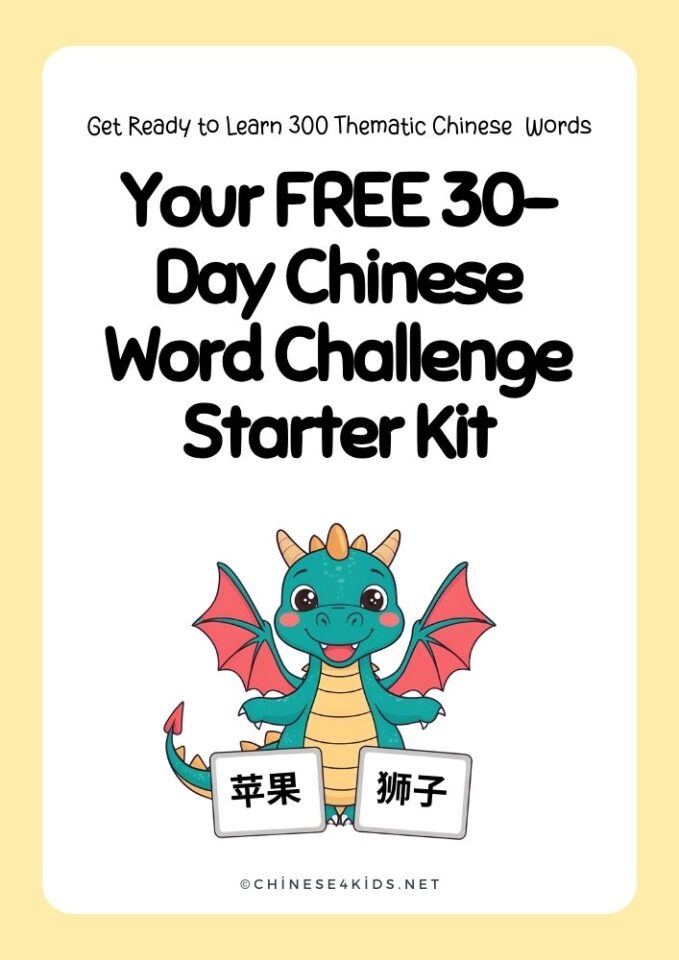
If you’d like a head start on the vocabulary that makes riddles solvable, our most popular free printable is the Top 100 Chinese Characters sheet. These are the 100 highest-frequency characters in everyday Chinese. They appear in almost every riddle, every children’s book, and every beginner conversation.
👉 Download the free Top 100 Chinese Characters here
Print it. Stick it on the fridge. Tick off one character a day. By the time you’ve finished the sheet, your child will recognise the building blocks of almost every riddle in this post.
The Easiest Way to Bring 70 Riddles into Your Home or Classroom
If you love the riddles in this article and want more, we’ve put together a ready-to-use resource: our Fun & Educational Chinese Riddle Cards — a set of 70 carefully selected Chinese riddles across four categories:
- 🐱 Animals
- 🍉 Food
- 👀 Body parts
- 🪞 Everyday objects
Each riddle comes in two formats:
- ✅Chinese with answer key — for authentic Chinese practice/li>
- ✅ Chinese with pinyin and English translation — for all levels of learners
They are beautifully designed, printable, and instant download. Use them at home, in classrooms, on car journeys, or as part of a Lantern Festival celebration. They are also perfect for Membership and worksheet activities if you’re a Chinese teacher.
👉 See the Chinese Riddle Cards here
Final Thought
Children remember what makes them laugh. They remember what makes them feel clever. Chinese riddles do both — every single time.
Start with one riddle. Read it tonight at dinner. Watch your child’s face when they figure it out. That moment — the small joy of solving a puzzle in Chinese — is what builds a lifelong love of the language.
Then come back tomorrow and try another.
Further Reading on Chinese4kids
- 📖 Chinese Tongue Twisters for Children — another playful way to practise tones and pronunciation
- 📖 8 Fun Chinese New Year Games for Kids — includes lantern riddle games and more
- 📖 Celebrations and Festivals in Chinese Culture — the cultural backdrop for many traditional riddles
- 📖 Building a Chinese Immersion Environment at Home — daily-life strategies that go beyond riddles
if you like this, share it.