Quick Summary
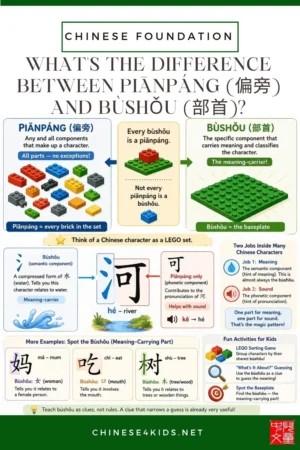
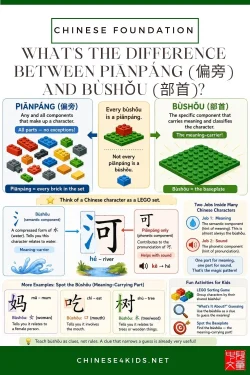
- Piānpáng (偏旁) means any component inside a Chinese character — the term covers all parts.
- Bùshǒu (部首) is the specific component that carries meaning and classifies the character in a dictionary.
- Every bùshǒu is a piānpáng. Not every piānpáng is a bùshǒu.
- Children don’t need to memorise these terms. What matters is learning to notice meaningful patterns inside characters.
“Why do you sometimes call a component a piānpáng and other times a bùshǒu? What’s the real difference?”
This is one of the most common points of confusion for overseas Chinese learners — especially those who didn’t grow up using a physical Chinese dictionary. Here is a clear answer, with examples.
Explanation in One Sentence
Piānpáng (偏旁)
Any and all components that make up a Chinese character. The term is broad — it covers every part, without exception.
Bùshǒu (部首)
The specific component used to classify a character — and usually the part that hints at its meaning. Only some piānpáng qualify as bùshǒu.
The key rule:
Every bùshǒu is a piānpáng. Not every piānpáng is a bùshǒu.
The LEGO Analogy
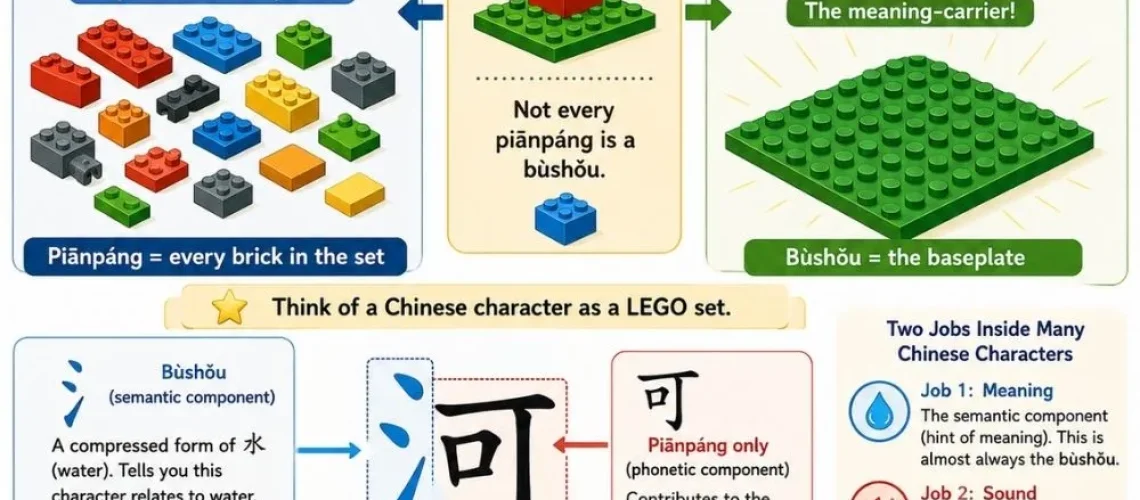
Think of a Chinese character as a LEGO set.
Piānpáng = every brick in the set
The red ones, the flat ones, the tiny connectors. All of them, without exception. Every piece counts.
Bùshǒu = the baseplate
It’s one of the bricks — but it plays a special role. It anchors the whole structure and tells you which category the set belongs to.
Not every brick is a baseplate. But every baseplate is definitely a brick.
Why This Difference Matters
FOR PARENTS AND TEACHERS
For adults, the distinction between piānpáng and bùshǒu is mainly a language term. For children, it is a learning shortcut.When children recognise a bùshǒu, they can often guess what a new character is related to. A water radical suggests something connected with water. A mouth radical often points to speaking, eating, or sounds.Children do not need to memorise the terms piānpáng and bùshǒu. What matters is learning to notice meaningful patterns inside characters. That habit alone gives them a tool for decoding new characters independently — which is the real goal.
For adults, the distinction between piānpáng and bùshǒu is mainly a language term. For children, it is a learning shortcut.When children recognise a bùshǒu, they can often guess what a new character is related to. A water radical suggests something connected with water. A mouth radical often points to speaking, eating, or sounds.Children do not need to memorise the terms piānpáng and bùshǒu. What matters is learning to notice meaningful patterns inside characters. That habit alone gives them a tool for decoding new characters independently — which is the real goal.
A Closer Look: The Character 河
Let’s use 河 (hé, “river”) to see exactly how this works.
河 (hé) — river
Made of two components — both are piānpáng.
Only one is the bùshǒu.
氵
Bùshǒu · Semantic component
A compressed form of 水 (water). Tells you this character relates to water. This is the bùshǒu — the meaning-carrier.
可
Piānpáng only · Phonetic component
Contributes to the pronunciation of 河. It is a piānpáng — a component — but not the bùshǒu. It does not carry the core meaning.
💡 Both 氵and 可 are piānpáng. Only 氵is the bùshǒu. The bùshǒu is almost always the meaning-carrying component.
Two Jobs Inside Many Chinese Characters
Understanding 河 reveals something important about how Chinese characters are built. Many characters contain two types of components, each doing a different job.
Job 1
Semantic Component
Hints at the meaning of the character. This is almost always the bùshǒu. In 河, that’s 氵(water).
Job 2
Phonetic Component
Hints at the pronunciation of the character. In 河, that’s 可 (kě) — which is why 河 is pronounced hé, with a similar sound.
This pattern — one part for meaning, one part for sound — applies to the majority of Chinese characters. Once children understand it, new characters stop feeling arbitrary. There is a logic inside them, waiting to be noticed.
For the purposes of this article, the bùshǒu is almost always the semantic component — the meaning-carrying one. That is why it matters more than any other piānpáng.
More Examples: Spotting the Bùshǒu
Here are three more characters to practise with. In each case, identify the bùshǒu — the meaning-carrying component.
妈 |
吃 |
树 |
| mā — mum | chī — eat | shù — tree |
| Bùshǒu: 女 (woman). The woman radical tells you this character relates to a female person. The right side 马 (horse) contributes the pronunciation. | Bùshǒu: 口 (mouth). The mouth radical tells you this character involves the mouth. The right side hints at pronunciation. | Bùshǒu: 木 (tree/wood). The wood radical tells you this character relates to trees or wooden things. The rest of the character contributes pronunciation. |
Does the Bùshǒu Always Tell You the Meaning?
Usually — but not always. The connection is sometimes very clear. 氵in 河 obviously relates to water. But sometimes it is looser or historical.
好 (hǎo, good) contains 女 (woman) and 子 (son/child). The connection comes from an ancient cultural idea — that having both a daughter and a son makes a complete family — not from a direct semantic link obvious to a modern learner.
Teach bùshǒu as clues, not rules. A clue that narrows a guess is enormously useful, even when it is not exact.
Activities: Teaching This to Children
🧱 LEGO Sorting Game
Write 10 characters on cards. Include characters from three radical families — some from 氵, some from 口, some from 木. Ask children to sort them into groups by the shared component. They don’t need to know every meaning — they just look for the shared part. After sorting, point to the shared component in each group and say: “This is the bùshǒu — the baseplate that holds the family together.”
🔍 “What’s It About?” Guessing
Show a new, unfamiliar character. Ask: “Can you find a part you recognise? What do you think this character might be about?” Wrong guesses are completely fine. The goal is the habit of looking for clues inside characters — using the bùshǒu as a starting point. This is exactly what skilled readers do automatically.
🎯 Spot the Baseplate
Show a character and ask children to identify which component is the bùshǒu — the “baseplate” that carries meaning. Start with obvious ones (氵in water words, 口 in mouth/eating words). As children become more confident, introduce less obvious ones. This game builds the habit of looking inside characters rather than treating them as indivisible whole shapes.
Frequently Asked Questions
What is the difference between piānpáng (偏旁) and bùshǒu (部首)?
Piānpáng (偏旁) refers to any component inside a Chinese character. Bùshǒu (部首) is the specific component that carries the meaning and is used to classify the character — traditionally in a dictionary. Every bùshǒu is a piānpáng, but not every piānpáng is a bùshǒu.
Is every radical a piānpáng?
Yes. Every radical (bùshǒu) is a component (piānpáng), but not every component is a radical. The radical is the meaning-carrying component that classifies the character. Other components — such as phonetic components — are piānpáng but not bùshǒu.
Do children need to learn the terms piānpáng and bùshǒu?
No — at least not at first. Most children benefit far more from learning to recognise patterns inside characters than from memorising terminology. The terms become useful later, when children encounter them in more formal Chinese education. For young overseas learners, the habit of noticing the meaning-carrying component is what matters.
How many radicals should children learn?
Around 10–30 common radicals give children a strong foundation. A small set of high-frequency radicals covers the majority of characters young learners encounter. There is no need to work through all 214 traditional radicals — focus on the ones that appear most often in everyday vocabulary.
Are radicals the same in Simplified and Traditional Chinese?
Most common radicals are shared between both systems, but some have been simplified. For example, 言 (speech) becomes 讠in simplified Chinese. The concept and function are identical — only the visual form changes in some cases. Teach the form that matches the script your child is learning.
Does the bùshǒu always tell you the meaning of a character?
Usually, but not always. The connection is sometimes very clear — 氵in 河 (river) obviously relates to water. Other times the link is historical and not immediately obvious to modern learners, such as 女 (woman) inside 好 (good). Teach bùshǒu as clues rather than exact rules. A clue that narrows a guess is already very useful.
Learn More: Common Chinese Radicals
Now that you understand the difference between piānpáng and bùshǒu, the next step is learning the most useful radical families. Each of the articles below focuses on one bùshǒu and its character family — with examples, pinyin, and teaching activities.
- 30 Most Important Chinese Radicals for Kids →The complete guide — all 30 high-frequency radicals with examples and activities
- Chinese characters with the water radical 氵→河, 海, 湖, 泳, 洗 and more
- Chinese characters with the mouth radical 口 →吃, 喝, 叫, 唱, 吹 and more
- Chinese characters with the woman radical 女 →妈, 姐, 妹, 好, 她 and more
- Chinese characters with the hand radical 扌→打, 拿, 推, 拉, 抱 and more
- Chinese characters with the wood radical 木 →树, 桌, 椅, 桥, 林 and more
- Chinese characters with the person radical 亻→你, 他, 们, 住, 做 and more
- Chinese characters with the grass radical 艹→花, 草, 茶, 菜, 药 and more
- 30 Chinese Radical Family Poster Pack – 30 beautifully illustrated posters — one for every major Chinese radical.
If you like the article, share it!