Simplified or traditional Chinese? Here is one-sentence answer:
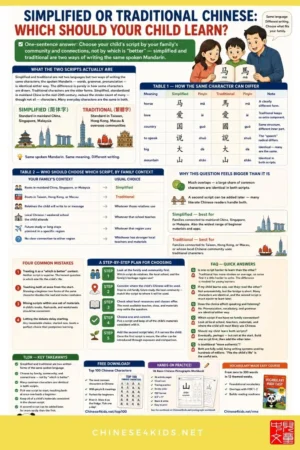
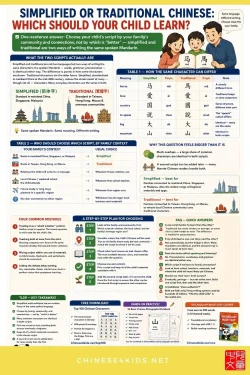
Choose your child’s script by your family’s community and connections, not by which is “better” — simplified and traditional are two ways of writing the same spoken Mandarin, so the decision is about fit, not language.
Contents
hide
What the two scripts actually are
Simplified and traditional are not two languages but two ways of writing the same characters; the spoken Mandarin — words, grammar, pronunciation — is identical either way. The difference is purely in how some characters are drawn. Traditional characters are the older forms. Simplified characters, standardized in mainland China in the mid-20th century, reduce the stroke count of many — though not all — characters. Many everyday characters are in fact the same in both; where they differ, the difference can be small or substantial.
Today, simplified is standard in mainland China, Singapore, and Malaysia. Traditional is standard in Taiwan, Hong Kong, and Macau, and is widely used in overseas communities with roots in those places.
Table 1 — How the same character can differ between scripts
| Meaning | Simplified | Traditional | Note |
|---|---|---|---|
| horse | 马 mǎ | 馬 mǎ | A clearly different form. |
| love | 爱 ài | 愛 ài | Traditional keeps an extra component. |
| country | 国 guó | 國 guó | Same structure, different inner part. |
| to speak | 说 shuō | 說 shuō | The “speech” radical differs in form. |
| big | 大 dà | 大 dà | Identical — many common characters are. |
| mountain | 山 shān | 山 shān | Identical in both scripts. |
Which script is best for your family
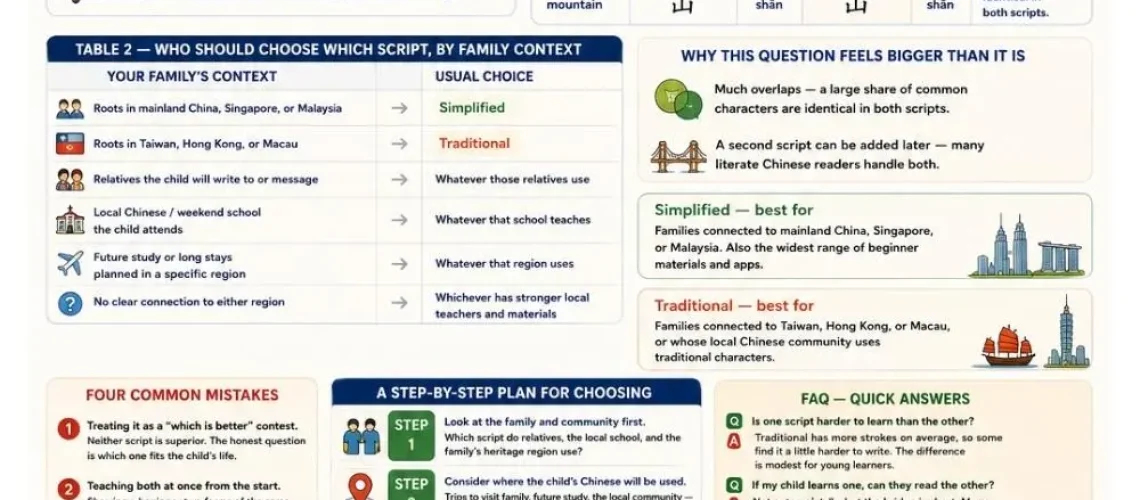
Because the choice is about fit, the clearest way to decide is to match the script to your family’s situation. The table below gives the typical fit; the short summary under it states each script in one line.
Table 2 — Who should choose which script, by family context
| Your family’s context | Usual choice |
|---|---|
| Roots in mainland China, Singapore, or Malaysia | Simplified |
| Roots in Taiwan, Hong Kong, or Macau | Traditional |
| Relatives the child will write to or message | Whatever those relatives use |
| Local Chinese / weekend school the child attends | Whatever that school teaches |
| Future study or long stays planned in a specific region | Whatever that region uses |
| No clear connection to either region | Whichever has stronger local teachers and materials |
Simplified — best for
Families connected to mainland China, Singapore, or Malaysia. Also the widest range of beginner materials and apps.
Traditional — best for
Families connected to Taiwan, Hong Kong, or Macau, or whose local Chinese community uses traditional characters.
Why this question feels bigger than it is
The simplified-versus-traditional debate carries real cultural and political weight for adults. For a young overseas learner the practical stakes are far smaller, for two reasons.
First, much overlaps — a large share of common characters are identical in both scripts, so a child learning one is not starting from zero in the other.
Second, a second script can be added later: many literate Chinese readers handle both, and a child who knows one script well picks up the other far more easily than a beginner learning their first.
Four common mistakes
Mistake 1: Treating it as a “which is better” contest. Neither script is superior. The honest question is which one fits the child’s life.
Mistake 2: Teaching both at once from the start. Showing a beginner two forms of the same character doubles the load and invites confusion. Pick one to begin.
Mistake 3: Mixing scripts within one set of materials. A child’s books, flashcards, and worksheets should be consistent. Switching scripts between resources undermines recognition.
Mistake 4: Letting the debate delay starting. Families stall for months over the choice. Any reasonable choice, started now, beats a perfect choice that postpones learning.
A step-by-step plan for choosing
Step 1 — Look at the family and community first.
Which script do relatives, the local Chinese school, and the family’s heritage region use? This is usually the strongest single factor.
Step 2 — Consider where the child’s Chinese will be used.
Trips to visit family, future study, the local community — match the script to the places Chinese will actually serve the child.
Step 3 — Check what local resources and classes offer.
The most available teacher, class, and set of materials may settle the question on practical grounds.
Step 4 — Choose one and commit.
Pick a script and keep all of the child’s materials consistent with it. Consistency matters more than the choice itself.
Step 5 — Add the second script later, if it serves the child.
Once the first script is secure, the other can be introduced through exposure and comparison — a far lighter task than the first.
Real scenarios: two common families
Among the overseas families we work with, two patterns recur.
The stalled family. They spend months researching which script is “right,” reading the debates, asking everyone. The child, meanwhile, learns no Chinese at all. The decision becomes the obstacle.
The grounded family. They look at their own situation — the grandparents’ region, the weekend school down the road — pick the script that matches, and start. The choice takes an afternoon. The child is learning by the following week, and the question never resurfaces as a problem.
Both families faced the same decision. One let it block the child; the other answered it from their own life and moved on.
FAQ
Q: Is one script harder to learn than the other?
A: Traditional characters have more strokes on average, so some find them a little harder to write. But for a child learning either as their first script, the difference is modest — far smaller than the debate implies.
Q:If my child learns one, can they read the other?
A: Not automatically, but the bridge is short. Many characters are identical, and a child who knows one script well can pick up the other far more easily than a beginner learning from scratch.
Q:Does the choice of script affect speaking and listening?
A: No. Simplified and traditional are written forms of the same spoken Mandarin. Pronunciation, vocabulary, and grammar are identical regardless of which script a child reads.
Q:Which script should we choose if we have no family connection to either region?
A: Look at practical factors: the local Chinese school, available teachers and materials, and where the child is most likely to use Chinese. Any well-supported choice is a sound one.
Q:Should my child learn both scripts?
A: Eventually, perhaps — but not at the start. Build one script securely first, then add the second later through exposure if it serves the child. Both at once overloads a beginner.
Q:Is traditional Chinese “more authentic”?
A: Traditional forms are older, but both scripts are fully valid, living writing systems used by hundreds of millions of people. “Authentic” is not the useful axis; “fits the child’s life” is.
Key takeaways
- Simplified and traditional are two written forms of the same spoken language.
- Choose by the family’s community, relatives, and connections — not by “which is better.”
- Many common characters are identical in both scripts.
- Pick one script to start; teaching both at once overloads a beginner.
- Keep all of a child’s materials consistent in the chosen script.
- A second script can be added later, far more easily than the first.
If you like this article, share it!