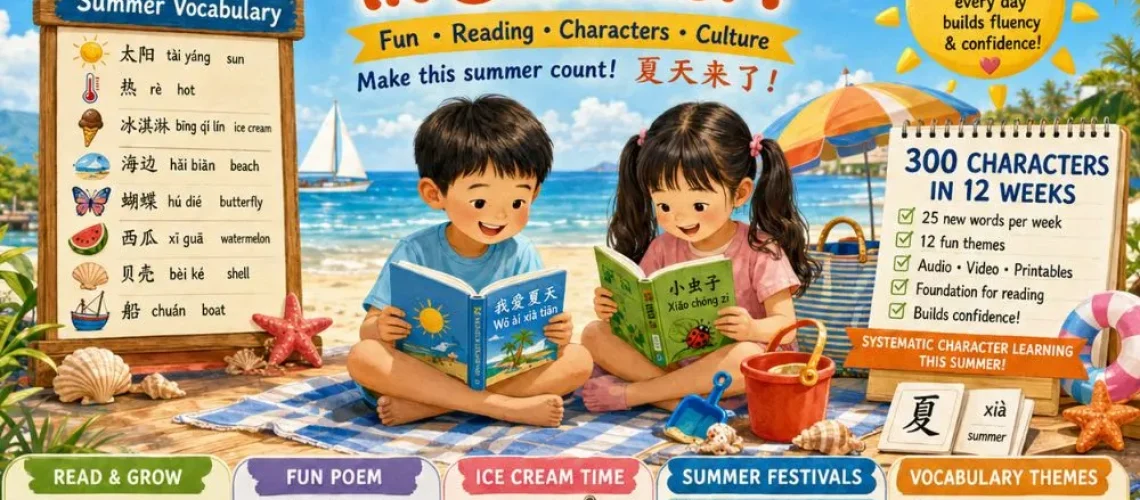
Sunny and hot — summer is officially here. If you ask a child which season they love most, the answer is almost always summer. It is the season of holidays, ice cream, beach days, and free time.
For Chinese-heritage families, summer is also a hidden gold mine. With school out and pressure off, children can finally learn Chinese in summer without feeling rushed. They can read for fun, sing rhymes, hunt for bugs, and build new vocabulary — all without the weight of a school timetable.
Summer is also the perfect time to learn Chinese characters systematically. School holidays give children a long, unbroken stretch — exactly what character learning needs. We’ll come back to this, with a clear method, further down.
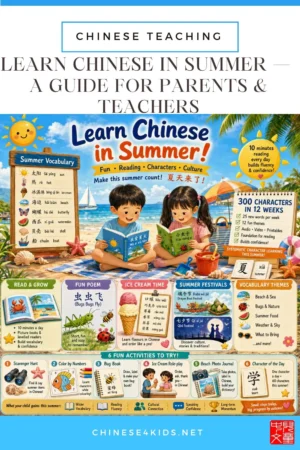
In this guide, you’ll find everything you need to learn Chinese in summer:
- 40+ summer words in Chinese with pinyin
- A children’s poem about summer bugs
- Summer reading ideas to keep Chinese going at home
- A systematic plan for character learning over the holidays
- Ice cream and beach vocabulary
- Summer festivals — Dragon Boat and Qixi
- 6 fun teaching activities
- Quick answers to common parent questions
- All our summer printable resources, in one place
💡 Looking for parent strategies? This guide focuses on what Chinese your child can learn this summer. For how to keep Chinese going day to day — beating the “summer slide,” labelling the house, screen-time tricks, kitchen Chinese — see our companion guide: Keep Mandarin Fun This Summer — A Practical Guide to No-Stress Learning.
Contents
hide
How to Say “Summer” in Chinese
Summer in Chinese is 夏天 (xià tiān).
- 夏 (xià) means summer
- 天 (tiān) means day or sky
- 夏天 (xià tiān) means summer time
You may also hear:
- 暑假 (shǔ jià) — summer holidays
- 炎热 (yán rè) — hot (a stronger word than 热)
- 夏日 (xià rì) — a summer’s day (a more poetic word)
Summer Is Perfect for Systematic Character Learning
Most families try to learn Chinese characters in small bits between school activities. It works — but slowly. The summer holiday breaks that pattern. Children have time. And character learning rewards time more than almost any other Chinese skill.
Why summer works for characters
- No school competition. Long stretches free for focused practice.
- Time for repetition. Characters need to be seen many times. Summer gives you that runway.
- Real reading practice. Once your child knows the first 100–300 characters, they can actually read short books — and that turns the summer into a Chinese reading summer.
A simple character-learning plan for the summer
The most useful first goal is 300 characters. That number is not random. The most common 300 Chinese characters cover roughly 60% of all everyday Chinese text. Once your child knows them, beginner books open up, daily conversation makes more sense, and confidence grows fast.
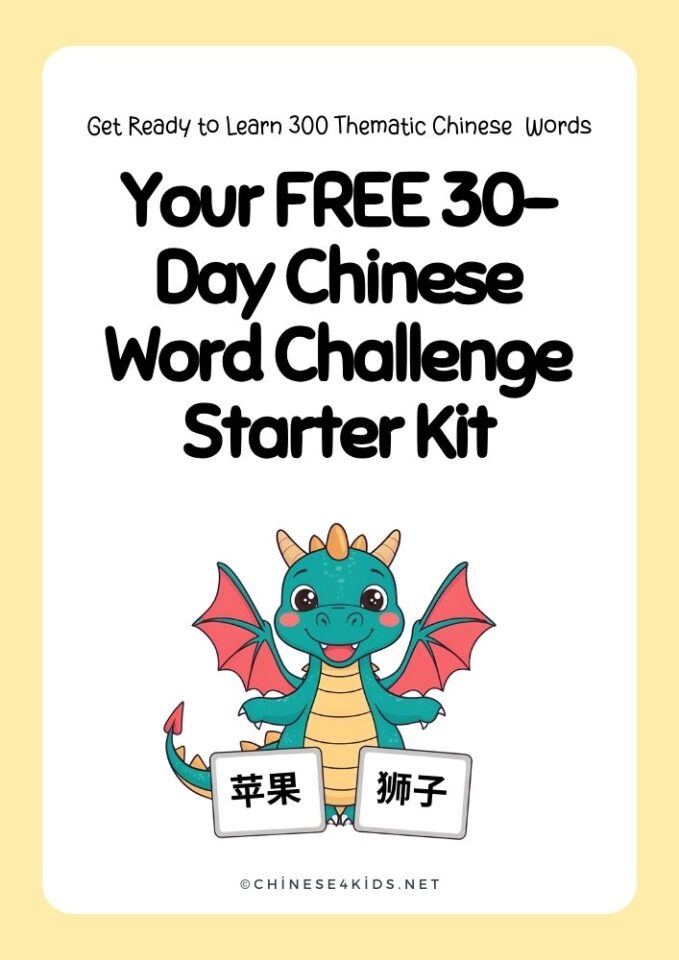
Our Chinese Vocabulary Made Easy course teaches exactly these 300 most common Chinese words across 12 themed weeks. Each week covers one theme — animals, colours, food, family, body parts, actions, and more. The 300 words overlap heavily with HSK 1–2, so it also serves as a foundation for formal exams later.
Why this fits summer perfectly:
- 12 weeks ≈ a full summer holiday
- 25 new words per week — manageable, not overwhelming
- Themed approach makes new words stick
- Comes with audio, video, and printables
- Children finish the summer with a real, named achievement: I know the
- 300 most common Chinese words
Pair the course with the free Top 100 Chinese Characters list as a daily check-off chart. By autumn, your child will have built something real — and it sticks.
👉 Start Chinese Vocabulary Made Easy here
Summer Reading — The Easiest Way to Keep Chinese Going at Home
Summer reading is the secret weapon of every Chinese-learning family.
Even 10 minutes of Chinese reading a day prevents the dreaded summer slide — the loss of language skills that happens when children stop practising over the long break. Reading is gentle. It feels like fun, not work. And it locks in everything your child has learned during the school year. (For the full story on beating the summer slide, see Keep Mandarin Fun This Summer.)
What to read in summer
- Beginner picture books — 1 to 3 words per page, lots of repetition
- Levelled readers — short stories with controlled vocabulary that build confidence
- Familiar stories in Chinese — Little Red Riding Hood, The Very Hungry Caterpillar — easier because your child already knows the plot
- Summer-themed books — about beach, bugs, fruit, animals, holidays
Our Chinese Reading Books for Kids page lists levelled readers from aa to C, all designed for overseas learners. For families who want unlimited access, the Chinese Reading Made Easy book vault gives you the whole library.
A simple summer reading habit
- 📖 10 minutes a day — every day, after breakfast or before bed
- ⭐ Sticker chart — one sticker per book finished
- 🎉 A small celebration at 10 books — a little treat, a video call to grandparents to “show off”
Ten minutes feels like nothing — but over 8 summer weeks, that’s nearly 10 hours of Chinese reading. Real, measurable progress.
Summer Vocabulary in Chinese — The Essentials
Below are the most useful summer words, grouped by where your child will meet them.
Sun, Weather, and Sky
- 太阳 (tài yáng) — sun
- 阳光 (yáng guāng) — sunshine
- 云 (yún) — cloud
- 热 (rè) — hot
- 水 (shuǐ) — water
Plants and Garden Life
- 植物 (zhí wù) — plant
- 花 (huā) — flower
- 树叶 (shù yè) — leaf
- 草 (cǎo) — grass
Summer Bugs and Small Creatures
- 瓢虫 (piáo chóng) — ladybug
- 蜜蜂 (mì fēng) — bee
- 蝴蝶 (hú dié) — butterfly
- 蚂蚁 (mǎ yǐ) — ant
- 蜗牛 (wō niú) — snail
- 蚯蚓 (qiū yǐn) — earthworm
- 鸟 (niǎo) — bird
Beach and Sea
- 海水 (hǎi shuǐ) — sea water
- 沙 (shā) — sand
- 贝壳 (bèi ké) — shell
- 海星 (hǎi xīng) — sea star
- 鱼 (yú) — fish
- 船 (chuán) — boat
What to Bring to the Beach
- 桶 (tǒng) — bucket
- 皮球 (pí qiú) — beach ball
- 拖鞋 (tuō xié) — flip flops
- 躺椅 (tǎng yǐ) — beach chair
- 阳伞 (yáng sǎn) — umbrella
- 太阳眼镜 (tài yáng yǎn jìng) — sunglasses
- 防晒霜 (fáng shài shuāng) — sun lotion
- 帽子 (mào zi) — hat
- 沙滩巾 (shā tān jīn) — beach towel
Summer Food
- 冰淇淋 (bīng qí lín) — ice cream
- 西瓜 (xī guā) — watermelon
- 水果 (shuǐ guǒ) — fruit
Useful Summer Phrases
- 今天好热。 (Jīn tiān hǎo rè.) — Today is so hot.
- 我们去海边。 (Wǒ men qù hǎi biān.) — Let’s go to the beach.
- 我想吃冰淇淋。 (Wǒ xiǎng chī bīng qí lín.) — I want to eat ice cream.
- 太阳出来了。 (Tài yáng chū lái le.) — The sun has come out.
A Chinese Children’s Poem for Summer — 虫虫飞 (Bugs Bugs Fly)
Summer evenings are full of bugs. As the family sits outside, breeze cool and crickets chirping, this is the perfect poem to read aloud.
虫虫虫虫飞飞飞
chóng chóng chóng chóng fēi fēi fēi
Bugs, bugs, fly, fly, fly
飞到草地喝露水
fēi dào cǎo dì hē lù shuǐ
Fly to the grass to drink the dew
虫虫虫虫飞飞飞
chóng chóng chóng chóng fēi fēi fēi
Bugs, bugs, fly, fly, fly
飞到花园踢踢腿
fēi dào huā yuán tī tī tuǐ
Fly to the garden to kick their legs
虫虫虫虫飞飞飞
chóng chóng chóng chóng fēi fēi fēi
Bugs, bugs, fly, fly, fly
飞到天空排排队
fēi dào tiān kōng pái pái duì
Fly to the sky to line up in rows
虫虫虫虫飞飞飞
chóng chóng chóng chóng fēi fēi fēi
Bugs, bugs, fly, fly, fly
飞到树杈睡一睡
fēi dào shù chā shuì yī shuì
Fly to the tree branch to sleep
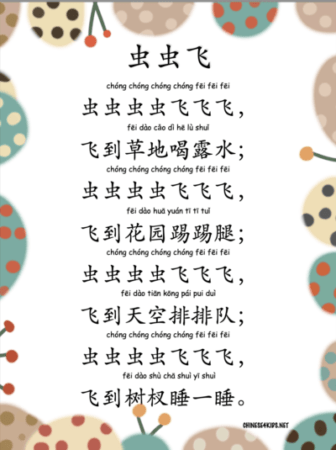
Read it slowly the first time. Sing it the second. By the third reading, your child will be chanting along.
For more, see our guide to 3 Cute and Easy Chinese Nursery Rhymes for Summer.
Learn Chinese Through Ice Cream
Visiting a gelato shop is a summer must. Why not turn it into a Chinese lesson?
While ordering, name the flavours in Chinese:
- 巧克力 (qiǎo kè lì) — chocolate
- 草莓 (cǎo méi) — strawberry
- 香草 (xiāng cǎo) — vanilla
- 抹茶 (mǒ chá) — matcha
- 芒果 (máng guǒ) — mango
Then ask: 你想吃什么口味? (Nǐ xiǎng chī shénme kǒu wèi? — What flavour do you want?)
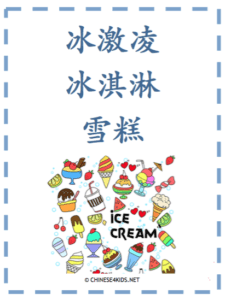
Our Ice Cream Theme Chinese Learning Pack has full vocabulary, a children’s poem “I Love Ice Cream”, and activity worksheets — ideal for hot afternoons indoors.
Summer Festivals — Dragon Boat and Qixi
Summer brings two important Chinese festivals. These give your child a chance to learn culture, not just vocabulary.
端午节 (Duān wǔ jié) — Dragon Boat Festival
Falls in late May or June. Families eat 粽子 (zòng zi — sticky rice wrapped in bamboo leaves) and watch dragon boat races. The festival remembers the poet Qu Yuan. For full activities and stories, see our guide to Duanwu Jie — Dragon Boat Festival.
七夕节 (Qī xī jié) — Qixi Festival
Often called “Chinese Valentine’s Day,” Qixi falls on the 7th day of the 7th lunar month — usually in August. It tells the story of the Cowherd and the Weaver Girl, separated by the Milky Way and reunited once a year. A beautiful summer story to share at bedtime.
6 Fun Teaching Activities for Summer Chinese
Summer Chinese should be playful. Here are six activities that work straight away.
1. The summer scavenger hunt
Make a list of summer items in Chinese — 贝壳, 沙, 蝴蝶, 太阳眼镜. At the beach or park, ask your child to find each one. As they find each item, they say the word aloud. The world becomes a Chinese textbook. For more, see our guide on using scavenger hunts to make Chinese fun.
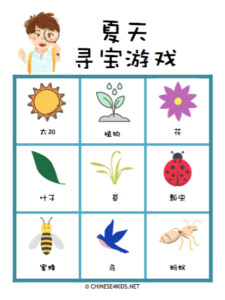
*Source: Summer Theme Chinese Learning Pack for Kids
2. Color by numbers in Chinese
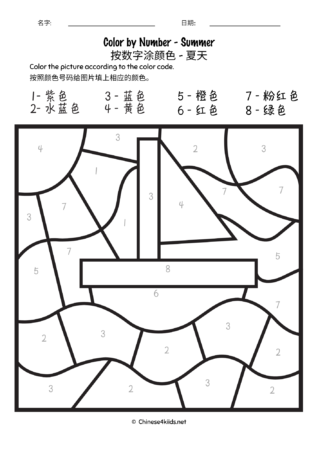
Hot afternoons are perfect for indoor activities. Color-by-numbers worksheets that use Chinese characters or words turn coloring into reading practice. See our Color by Numbers Activities for Summer Chinese for ideas.
3. Bug hunt with a Chinese label
Bring a small notebook on a walk. Each time your child spots a bug, draw it and label it in Chinese — 瓢虫, 蜜蜂, 蚂蚁, 蝴蝶. By the end of summer, they will have their own bug book in Chinese.
Set up a pretend ice cream shop at home. One child is the customer. One is the seller. Use Chinese for the whole exchange: ordering, asking the price, saying thank you. Role-play is one of the most powerful ways to turn vocabulary into real speech.
5. Beach vocabulary photo journal
Take photos of beach items — 贝壳, 沙, 海星, 桶 — and stick them in a small notebook. Label each one in Chinese. By summer’s end, your child has a personal photo dictionary they made themselves.
6. A summer character of the day
Pick one character a day. Write it big on a card. Stick it on the fridge. Say it together at meals. Over a 60-day summer holiday, that’s 60 characters — a real and measurable win. Pair this with the Top 100 Chinese Characters list for a ready-made plan.
For more activity ideas, see our guides to 5 Chinese Learning Activities for Summer Holidays and Keep Mandarin Fun This Summer.
What Your Child Is Really Learning
A summer of Chinese gives your child more than vocabulary. Here is what they really gain.
- A wider vocabulary base. Themed summer words — beach, bugs, food, weather — slot directly into daily life.
- Reading fluency. Daily summer reading turns recognised characters into automatic reading.
- Cultural connection. Festivals like Dragon Boat and Qixi link language to family stories.
- Confidence to speak. Holiday role-play and scavenger hunts build the habit of using Chinese, not just studying it.
- Long-term momentum. A child who keeps Chinese going through summer returns to school months ahead of one who didn’t.
For more on building Chinese into daily life, see our guide on building a Chinese immersion environment at home.
Quick Answers — Common Parent Questions About Summer Chinese
How do I keep my child learning Chinese over the summer?
The best summer Chinese routine is short, consistent, and fun. Aim for 15–20 minutes a day. Mix three things: a small amount of structured learning (a course or workbook), daily reading (even 10 minutes), and one playful activity (a song, a craft, a scavenger hunt).
How many Chinese characters should my child learn in a summer?
A realistic, motivating goal is 300 characters over 8–12 weeks — about 25 a week. The first 300 most common characters cover roughly 60% of everyday Chinese text, which makes beginner reading much easier afterwards.
What is the best Chinese course for kids over the summer?
For systematic vocabulary and character building, the Chinese Vocabulary Made Easy course teaches the 300 most common Chinese words across 12 themed weeks — exactly matching a summer holiday’s length.
What should my child read in Chinese over the summer?
Levelled readers designed for the child’s stage. For beginners, picture books with 1–3 words per page. For intermediate readers, short stories with controlled vocabulary. Our Chinese Reading Books for Kids library is built exactly for this.
Is summer too short to make a difference in Chinese?
No. An 8–12 week summer of consistent practice is one of the highest-return periods in a young learner’s year. School-free time, lower pressure, and longer focus stretches mean a summer of Chinese can move a child up a full level.
All Our Summer Chinese Resources in One Place
Here are all our summer learning resources, organised so you can pick what fits your family.
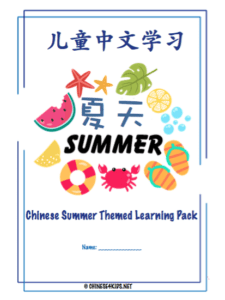
- ☀️ Summer Theme Chinese Learning and Activity Pack — summer vocabulary, the “Bugs Bugs Fly” poem, a reading book, scavenger hunt, and worksheets
- 🍦 Ice Cream Theme Chinese Learning Pack — flavours, the “I Love Ice Cream” poem, worksheets
- 🎨 Color and Learn Chinese Vocabulary Workbook — Summer — colouring and summer vocabulary in one
Flashcards for summer vocabulary
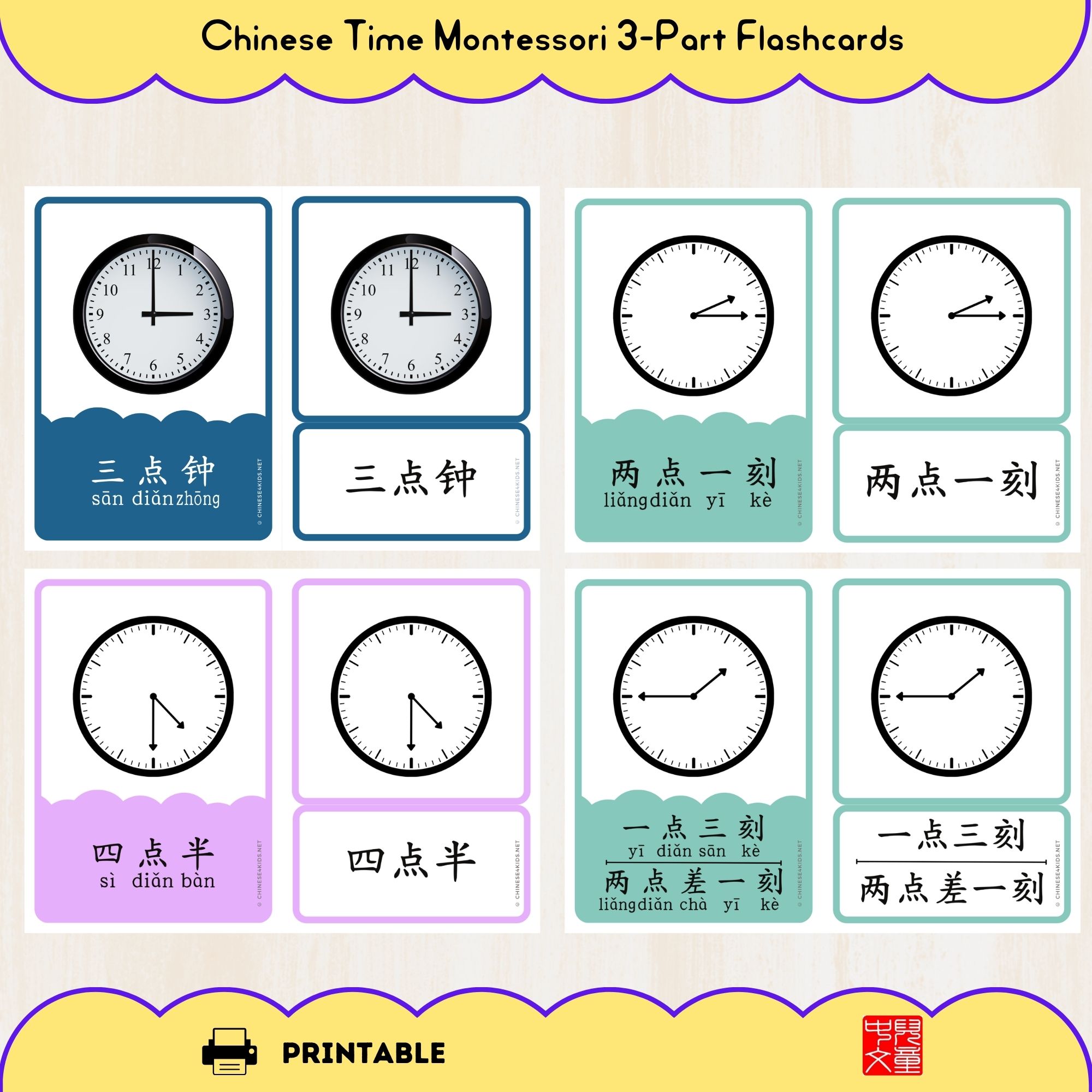
- 🌞 Summer Chinese Montessori 3-Part Flashcards — classic Montessori 3-part cards (control + image + word) for summer vocabulary. Brilliant for assessment, sorting games, and matching real-world objects on the go. See our guide to using 3-part Montessori flashcards for summer Chinese for ideas.
For systematic character and vocabulary learning
- 📚 Chinese Vocabulary Made Easy Course — the 300 most common Chinese words across 12 themed weeks
- 📋 Free Top 100 Chinese Characters — the daily-character starter list
For summer reading
- 📖 Chinese Reading Books for Kids — Levelled Readers — graded readers from aa to C
- 📖 Chinese Reading Made Easy — the full book vault, unlimited access
Everything is instant-download or instant-access. No waiting for the post.
Membership tip: if you’re a Chinese4kids member, the Summer Pack and Ice Cream Pack are already included in your member area.
Final Thought
Summer is more than a break. It is a window — long, warm, and free — to build real Chinese skills without the rush of the school year.
Pick one habit this week: 10 minutes of reading a day, or 5 new characters, or a daily summer rhyme. Just one. Stick with it for 8 weeks. By autumn, your child will be ahead.
That is what learning Chinese in summer is really about — slow, sunny, joyful momentum.
Make this summer count.
Further Reading on Chinese4kids
- 📖 Keep Mandarin Fun This Summer — A Practical Guide to No-Stress Learning — the companion parent-strategy guide: beating the summer slide, screen time, kitchen Chinese, outings
- 📖 5 Chinese Learning Activities for Kids During Summer Holidays — five hands-on summer ideas
- 📖 Fun Color by Numbers Activities for Summer — coloring meets Chinese
- 📖 Summer Chinese Learning with 3-Part Montessori Flashcards — how to use Montessori flashcards for summer vocabulary
- 📖 3 Chinese Nursery Rhymes for Summer Time — three lovely summer rhymes
- 📖 Ideas for Outdoor Chinese Learning — taking Chinese outside the classroom
- 📖 Duanwu Jie — Dragon Boat Festival — late-spring/early-summer cultural learning
If you like this post, PIN IT