If your child is learning Mandarin, shapes in Chinese are one of the best topics to teach early. Shapes are everywhere. A clock is a circle. A book is a rectangle. A slice of pizza is a triangle. Once your child knows the words, they can spot them all day long.
Like colours, shapes connect language to the real world. Your child doesn’t just memorise a word — they attach it to objects they already know. That makes the vocabulary stick fast.
There is one more bonus. Shape words follow a clear, simple pattern. Most of them end in the same character: 形 (xíng), which means “shape.” Once your child notices this, half the work is done.
Shapes in Chinese: The Essential Vocabulary List
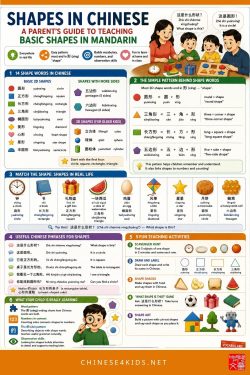
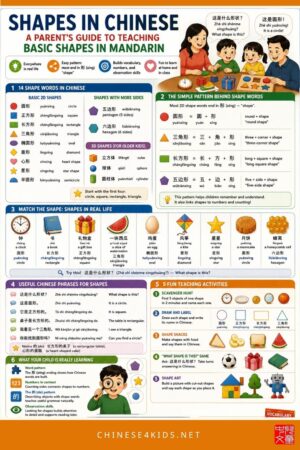
Below are the most useful shape words in Chinese. Each one includes the characters, pinyin, and English meaning. The word for “shape” itself is 形状 (xíngzhuàng).
Basic 2D Shapes
- 圆形 (yuánxíng) — circle
- 正方形 (zhèngfāngxíng) — square
- 长方形 (chángfāngxíng) — rectangle
- 三角形 (sānjiǎoxíng) — triangle
- 椭圆形 (tuǒyuánxíng) — oval
- 菱形 (língxíng) — diamond / rhombus
- 心形 (xīnxíng) — heart shape
- 星形 (xīngxíng) — star shape
- 半圆形 (bànyuánxíng) — semicircle
Shapes with More Sides
- 五边形 (wǔbiānxíng) — pentagon (five sides)
- 六边形 (liùbiānxíng) — hexagon (six sides)
3D Shapes (for older kids)
- 立方体 (lìfāngtǐ) — cube
- 球体 (qiútǐ) — sphere
- 圆柱体 (yuánzhùtǐ) — cylinder
Don’t feel you must teach all of these at once. Start with the first four — circle, square, rectangle, triangle. They cover most of daily life.
The Simple Pattern Behind Shape Words
Here’s a small secret that makes shapes in Chinese much easier.
Look at the 2D shapes again. Almost every one ends in 形 (xíng) — the character for “shape.”
- 圆形 = 圆 (round) + 形 (shape) → “round shape”
- 三角形 = 三 (three) + 角 (corner) + 形 (shape) → “three-corner shape”
- 长方形 = 长 (long) + 方 (square) + 形 (shape) → “long square shape”
- 五边形 = 五 (five) + 边 (side) + 形 (shape) → “five-side shape”
This is wonderful for young learners. The shape name often describes the shape. A triangle literally is a “three-corner shape.” A pentagon literally is a “five-side shape.”
Point this out to your child. Once they see the pattern, the words stop feeling random. They start to make sense — and words that make sense are words that stay.
This also gives your child early practice with numbers. Counting the corners or sides of a shape, then naming it, links two topics at once. For more on numbers, our themed materials cover them in the same simple style.
Match the Shape: Shapes in Real Life
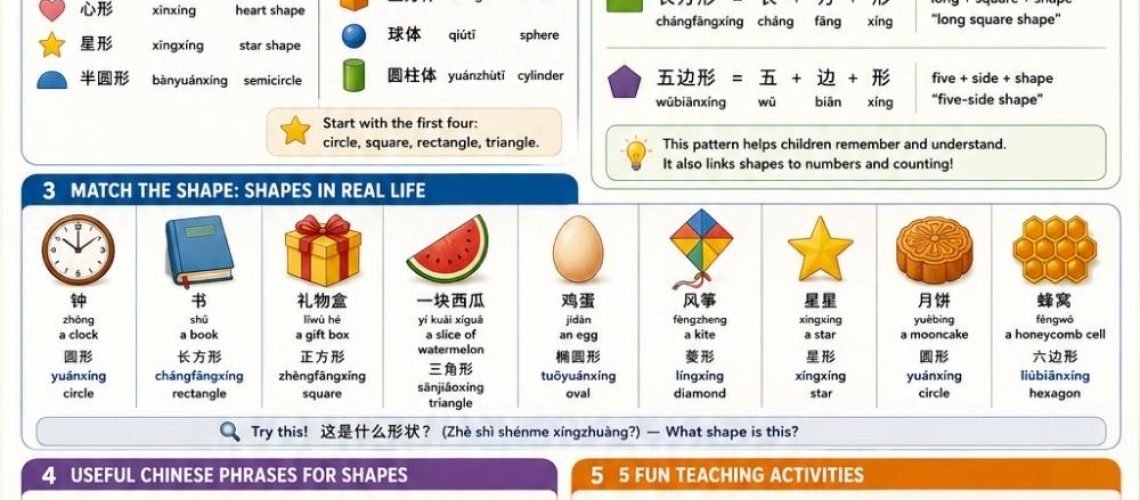
Children learn shapes best when they connect them to real objects. Here are everyday things matched to their shape in Chinese.
- 钟 (zhōng) — a clock — 圆形 circle
- 书 (shū) — a book — 长方形 rectangle
- 礼物盒 (lǐwù hé) — a gift box — 正方形 square
- 一块西瓜 (yí kuài xīguā) — a slice of watermelon — 三角形 triangle
- 鸡蛋 (jīdàn) — an egg — 椭圆形 oval
- 风筝 (fēngzheng) — a kite — 菱形 diamond
- 星星 (xīngxing) — a star — 星形 star
- 月饼 (yuèbing) — a mooncake — 圆形 circle
- 蜂窝 (fēngwō) — a honeycomb cell — 六边形 hexagon
Try this with your child: pick any object in the room and ask, “这是什么形状?” (Zhè shì shénme xíngzhuàng? — What shape is this?). Then answer together: “这是圆形。” (Zhè shì yuánxíng. — It is a circle.)
This one question turns the whole house into a shapes lesson.
Useful Chinese Phrases for Teaching Shapes
Vocabulary works best inside simple sentences. Here are the key phrases for shapes in Chinese.
- 这是什么形状?(Zhè shì shénme xíngzhuàng?) — What shape is this?
- 这是圆形。(Zhè shì yuánxíng.) — It is a circle.
- 它是正方形的。(Tā shì zhèngfāngxíng de.) — It is square.
- 桌子是长方形的。(Zhuōzi shì chángfāngxíng de.) — The table is rectangular.
- 我看见一个三角形。(Wǒ kànjiàn yí gè sānjiǎoxíng.) — I see a triangle.
- 你能找到圆形吗?(Nǐ néng zhǎodào yuánxíng ma?) — Can you find a circle?
Notice the small word 的 (de). When a shape describes an object, Chinese often adds 的 — 长方形的桌子 (a rectangular table), 心形的蛋糕 (a heart-shaped cake). This is a useful early grammar pattern, taught painlessly through shapes.
5 Fun Teaching Activities for Shapes in Chinese
You don’t need a textbook to teach shapes. Here are five activities that work straight away.
1. Shape scavenger hunt
Give your child one shape word — 圆形. Set a timer for two minutes. Ask them to find five round things in the house and name each one in Chinese. Real-world hunting locks vocabulary into memory far better than a flashcard ever could.
2. Draw and label
Let your child draw each shape on paper. Then write — or trace — the Chinese name underneath. Drawing the shape while saying the word connects hand, eye, and ear. This works well for children who are also starting to write characters.
3. Shape snacks
Food has shapes too. Cut toast into a triangle (三角形). Slice a banana into circles (圆形). Make a square sandwich (正方形). As you eat, name the shapes. Snack time becomes a quiet Chinese lesson.
4. “What shape is this?” game
Hold up an object — a ball, a box, a book. Ask “这是什么形状?”. Let your child answer in Chinese. Take turns. This builds the question-and-answer pattern that real conversation depends on.
5. Shape art
Give your child cut-out paper shapes — circles, squares, triangles, stars. Let them build a picture: a house, a face, a robot. As they place each piece, they say its name in Chinese. Creating something makes the words feel useful, not just memorised.
What Your Child Is Really Learning
A simple shapes lesson teaches much more than shape names. Here is what your child picks up along the way:
- A useful word pattern. The 形 (xíng) ending shows children that Chinese words are often built from smaller, logical parts. This is a powerful idea that helps with all future vocabulary.
- Numbers in context. Counting the sides of a pentagon or hexagon links shapes to numbers — two topics reinforcing each other.
- The 的 (de) pattern. Describing objects with shape words gives natural, painless practice with one of Chinese’s most common grammar structures.
- Observation skills. A child who looks for shapes is a child who looks at the world closely. That habit of noticing helps with character recognition later.
For more on building vocabulary the natural way, see our guide on building a Chinese immersion environment at home.
The Easiest Way to Teach Shapes in Chinese at Home
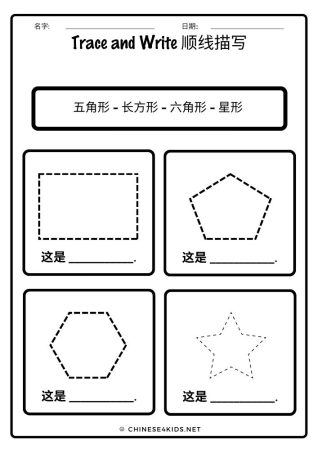
If you’d like everything in this article in one ready-to-use, printable resource, our Let’s Learn Shapes in Chinese Workbook is built for exactly this. It contains 13 worksheets and activity sheets, so your child can learn and practise shapes through play.
Inside the workbook, children can:
- ✏️ Trace and write the Chinese shape words
- 🔍 Match shapes to real-life objects
- 🎨 Colour, cut, and sort shapes
- ✅ Complete fun review activities
👉 See the Let’s Learn Shapes in Chinese Workbook here
Everything is instant-download. Just print and go — no preparation needed. It works at home, in homeschool, or in a community-school classroom. Here is an example below:
Going Further: Vocabulary Made Easy
If you want to build your child’s Chinese foundation in a more systematic way, our Chinese Vocabulary Made Easy course takes children from zero to the 300 most common Chinese words in twelve themed weeks. Shapes sit alongside colours, numbers, animals, food, and family — each theme building on the last.
The 300 words overlap heavily with HSK 1–2, so the course also gives a natural foundation if your child later sits formal exams. By the time they finish, they will recognise the building blocks of beginner reading.
Final Thought
Shapes are a generous topic. They are simple. They are everywhere. And the words follow a pattern, so they teach your child how Chinese works, not just a list of words.
Pick one shape today — 圆形. Find three round things together. Name them in Chinese. Tomorrow, pick another shape.
In a couple of weeks, your child will be naming half the room in Chinese without realising they’re “learning.” That is exactly what learning Chinese should feel like.
— updated in 2026
If you like this post, share it
Further Reading on Chinese4kids
- 📖 Building a Chinese Immersion Environment at Home — turn everyday moments into Chinese lessons
- 📖 Chinese Food and Food in Chinese — another easy themed-vocabulary starting point
- 📖 Chinese Riddles: A Fun Way to Learn the Chinese Language — many riddles describe objects by their shape
- 📖 36 Chinese Pictogram Characters — how many Chinese characters began as simple shapes