Quick Answer
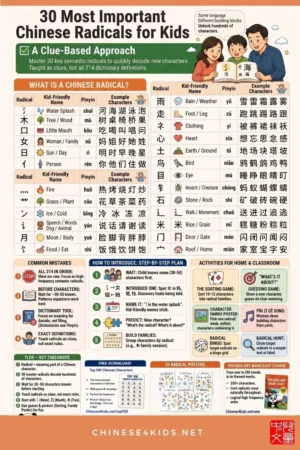
Chinese radicals for kids are the meaning-carrying building blocks inside Chinese characters. Learning 12 high-frequency radicals gives children a clue to the meaning of hundreds of characters — turning character learning from rote memorisation into an educated guessing game.
Chinese radicals for kids are the meaning-carrying building blocks inside Chinese characters. Learning 12 high-frequency radicals gives children a clue to the meaning of hundreds of characters — turning character learning from rote memorisation into an educated guessing game.
There are 214 Chinese radicals in total. You do not need to teach them all.
In fact, you shouldn’t. Most of the 214 radicals appear in only a handful of rare characters. Teaching them in order is a lot of effort for very little return — especially for children learning Chinese outside of China.
What works much better is a small, carefully chosen set of high-frequency radicals. The 12 in this article appear again and again in everyday Chinese. They are easy to spot, easy to picture, and each one unlocks a whole family of characters.
What Is a Chinese Radical?
Most Chinese characters are not single pictures. They are built from smaller parts.
A radical (部首, bùshǒu) is the meaning-carrying part inside a character. It is almost always the component that hints at what the character is about.
Take the character 河 (hé, “river”). It has two parts: 氵on the left and 可 on the right. The 氵is the radical. It is a compressed form of 水 (water), and it tells you this character has something to do with water. The 可 on the right hints at the pronunciation — but not the meaning.
This pattern repeats across most Chinese characters: one part for meaning, one part for sound. The radical is almost always the meaning part.
Once a child knows that 氵means water, they already have a clue about 河 (river), 海 (sea), 湖 (lake), 泳 (swim), 泡 (bubble) — before they have learned any of those characters.
That is the power of Chinese radicals for kids.
Before You Start: One Important Rule
Do not introduce radicals before your child knows any characters.
A radical only makes sense as a pattern across characters the child already recognises. Taught in isolation, it is just another abstract shape to memorise.
A good rule of thumb: wait until your child can recognise around 30–50 characters. Then start pointing out the shared parts. Let them notice the pattern themselves before you give it a name.
The 30 Most Important Chinese Radicals for Kids
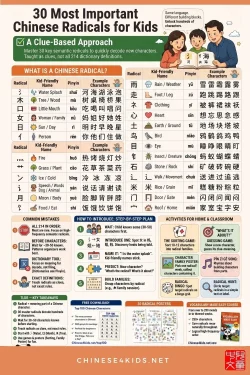
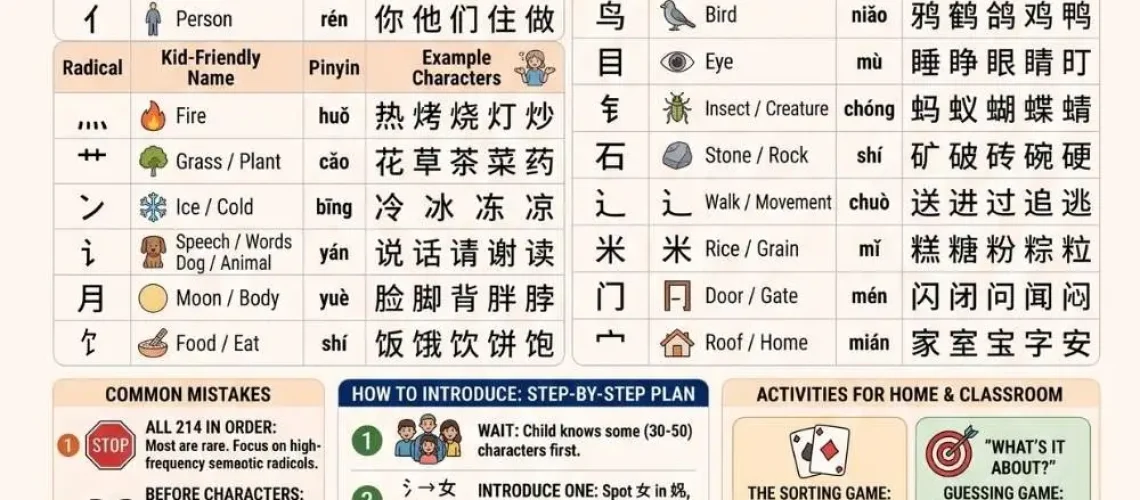
Here is a quick-reference table, followed by a detailed card for each radical.
| Radical | Meaning | Pinyin | Example characters |
|---|---|---|---|
| 氵 | water | shuǐ | 河 海 湖 泳 泡 |
| 木 | tree / wood | mù | 树 桌 椅 桥 果 |
| 口 | mouth | kǒu | 吃 喝 叫 唱 问 |
| 女 | woman | nǚ | 妈 姐 好 她 姓 |
| 日 | sun / day | rì | 明 时 早 晚 星 |
| 亻 | person | rén | 你 他 们 住 做 |
| 扌 | hand | shǒu | 打 拿 推 拉 找 |
| 忄 | heart / feeling | xīn | 想 怕 忙 快 忘 |
| 火/灬 | fire | huǒ | 热 烤 烧 灯 炒 |
| 艹 | grass / plant | cǎo | 花 草 茶 菜 药 |
| 冫 | ice / cold | bīng | 冷 冰 冻 凉 |
| 讠 | speech / words | yán | 说 话 请 谢 读 |
| 犭 | dog / animal | quǎn | 狗 猫 狐 狼 猪 |
| 月 | moon / body | yuè | 脸 脚 背 胖 脖 |
| 饣 | food / eat | shí | 饭 饿 饮 饼 饱 |
| 雨 | rain / weather | yǔ | 雪 雷 霜 露 雾 |
| ⻊ | foot / leg | zú | 跑 跳 踢 路 跟 |
| 衤 | clothing | yī | 被 裤 裙 袜 袄 |
| 忄 | feeling / mental | xīn | 怕 忙 忆 情 恨 悔 |
| 心 | heart | xīn | 想 忘 思 念 急 感 |
| 土 | earth / ground | tǔ | 地 场 块 塔 坡 城 |
| 鸟 | bird | niǎo | 鸦 鹤 鸽 鸡 鸭 鹅 |
| 目 | eye | mù | 睡 睁 眼 睛 盯 看 |
| 虫 | insect / creature | chóng | 蚂 蚁 蝴 蝶 蜻 蜓 |
| 钅 | metal | jīn | 钉 铁 钢 钟 钱 针 |
| 石 | stone / rock | shí | 矿 破 砖 碗 硬 碎 |
| 辶 | walk / movement | chuò | 送 进 过 追 逃 运 |
| 米 | rice / grain | mǐ | 糕 糖 粉 粽 粒 |
| 纟 | thread / silk | sī | 红 绿 线 绳 绵 绸 |
| 门 | door / gate | mén | 闪 闭 问 闻 闷 闲 |
| 宀 | roof / home | mián | 家 室 宝 字 安 富 |
1. 氵 Water (水 shuǐ)
Three drops on the left
This is one of the most common radicals in everyday Chinese. When you see three dots on the left of a character, the character almost always has something to do with water, liquid, or wetness.
河 river
海 sea
湖 lake
泳 swim
汽 steam
泡 bubble
💡 Say to kids: “Look for the three water drops on the left.”
2. 木 Tree / Wood (木 mù))
Looks like a tree with roots
木 looks like a tree: a vertical trunk, branches spreading out, roots going down. It appears in characters related to trees, wood, and wooden objects — including a lot of furniture.
树 tree
林 woods
桌 table
椅 chair
桥 bridge
果 fruit
根 root
💡 Say to kids: “木 looks like a tree. Wood characters often involve trees or furniture.”
3. 口. Mouth (口 kǒu)
A simple square — open mouth
口 is a simple square — the shape of an open mouth. It appears in characters about speaking, eating, drinking, and sounds. Children recognise it quickly because the shape makes immediate sense.
吃 eat
喝 drink
叫 call out
唱 sing
喊 shout
问 ask
💡 Say to kids: “The little square is a mouth. Mouth characters usually involve talking or eating.”
4.女 Woman (女 nǚ)
One of the oldest Chinese characters
女 is one of the oldest Chinese characters. It appears in characters related to family relationships and people. It is a great starting point because many of the words it unlocks are among the first a child learns.
妈 mum
姐 older sister
妹 younger sister
她 she
好 good
姓 surname
💡 Say to kids: “The 女 radical often appears in characters about family.”
5. 日 Sun / Day (日 rì)
Rectangle with a line through it
日 is a rectangle with a horizontal line through it — a stylised picture of the sun. It appears in characters related to time, light, and brightness. Many time words contain this radical.
明 bright
时 time
早 morning
晚 evening
星 star
昨 yesterday
💡 Say to kids: “The sun is a rectangle with a line in the middle. Time words often have the sun inside.”
6. 亻Person (人 rén)
Two strokes — a person walking
人 means person. As a radical on the left side of a character it becomes 亻— two slanted strokes. It appears in characters about people and actions that people do. Several of the most common pronouns contain it.
你 you
他 he
们 plural marker
住 live/stay
做 do/make
休 rest
💡 Say to kids: “The little person on the left means this character is about someone doing something.”
7. 扌 Hand (手 shǒu)
Three strokes on the left
手 means hand. As a radical it becomes 扌— three strokes on the left side. It appears in characters involving actions done with the hands. Once children know this one, they start spotting it everywhere.
打 hit/play
拿 hold/take
推 push
拉 pull
找 look for
抱 hug
💡 Say to kids: “Three strokes on the left usually means doing something with your hands.”
8. 忄 Feeling / Mental (忄xīn)
竖心旁 — emotions and mental states
忄is the left-side form of 心 (heart). It appears in characters about feelings, emotions, and mental states — fear, busyness, memory, regret. When you see 忄on the left, the character almost always describes how someone feels inside.
怕 afraid
忙 busy
忆 remember / recall
情 emotion / feeling
恨 hate / resent
悔 regret
💡 Say to kids: “忄on the left means a feeling — something happening inside your heart. Are you 怕 (scared) or 忙 (busy)?”
9. 灬 Fire (火 huǒ)
Four dots at the bottom = flames
火 means fire. It appears on the left of some characters, or at the bottom as 灬 — four dots representing flames underneath. It appears in characters related to heat, light, and cooking. Very useful for kitchen vocabulary.
热 hot
烤 roast/bake
烧 burn/cook
灯 lamp
炒 stir-fry
煮 boil/cook
💡 Say to kids: “Four dots at the bottom means fire underneath — something hot or cooked.”
10. 艹 Grass / Plants (草 cǎo)
Two sprouts on top
艹 sits at the top of characters like a little crown of leaves. It appears in characters related to plants, flowers, food, and nature. Children often remember it as “the plant hat.”
花 flower
草 grass
茶 tea
菜 vegetable
药 medicine
苹 apple (苹果)
💡 Say to kids: “Two little sprouts on top — this character is probably a plant or something that grows.”
11. 冫 Ice / Cold (冰 bīng)
Two strokes — icicles dripping
冫is two short strokes on the left — a stylised form of ice. It appears in characters related to cold temperatures. It is easy to mix up with the water radical 氵(three drops) — so make that distinction explicit with children.
冷 cold
冰 ice
冻 freeze
凉 cool/refreshing
💡 Say to kids: “Two little strokes on the left — like two icicles. Water has three drops; ice has two.”
12. 讠 Speech / Words (言 yán)
Simplified form: 讠· Traditional: 言
言 means speech or language. In simplified Chinese it becomes 讠— two strokes on the left. It appears in characters related to talking, language, and communication. Note: if your child is learning traditional Chinese, the full 言 form appears on the left instead.
说 speak
话 speech/words
请 please/invite
谢 thank
读 read
语 language
💡 Say to kids: “The speech radical means this character has something to do with words or talking.”
13. 犭 Dog / Animal (犬 quǎn)
反犬旁 — three strokes on the left
犬 (quǎn) means dog. As a radical it becomes 犭— three strokes on the left, nicknamed 反犬旁 (fǎn quǎn páng, “reverse dog side”) in Chinese. It appears in characters for animals — especially mammals. It is a favourite with children because the character family is full of creatures they already know.
狗 dog
猫 cat
狐 fox
狼 wolf
猪 pig
狮 lion
💡 Say to kids: “Three strokes on the left — the animal paw! This character is probably an animal.”
14. 月 Moon / Body (月 yuè)
月字旁 — moon or body parts
月 means moon. But as a radical, it often represents 肉 (ròu, flesh/body) — the two uses look identical after simplification. In practice this means 月 appears in many body part words. It is very useful for health and physical vocabulary.
脸 face
脚 foot
背 back
胖 chubby
脖 neck
肚 belly
💡 Say to kids: “When 月 is on the left, think body parts. When it stands alone, think moon and time.”
15. 饣 Food / Eat (食 shí)
食字旁 — simplified form of 食
食 (shí) means food or to eat. As a radical in simplified Chinese it becomes 饣— two strokes on the left. It appears in characters related to food, eating, and hunger. A very practical radical for mealtime vocabulary.
饭 rice / meal
饿 hungry
饮 drink
饼 flatbread / cake
饱 full (after eating)
馆 restaurant / hall
💡 Say to kids: “The food radical on the left means this character is about eating or food — are you 饿 (hungry) or 饱 (full)?”
16. 雨 Rain / Weather (雨 yǔ)
雨字旁 — sits on top like a rain cloud
雨 (yǔ) means rain. As a radical it sits at the top of characters like a rain cloud, with four dots underneath representing raindrops. It appears in characters for all kinds of weather — making it a wonderful radical for everyday conversations about what is happening outside.
雪 snow
雷 thunder
霜 frost
露 dew
雾 fog / mist
霞 rosy clouds / glow
💡 Say to kids: “The rain cloud on top! This character is probably a kind of weather.”
17. ⻊Foot / Leg (足 zú)
足字旁 — movement and leg actions
足 (zú) means foot or leg. As a radical it becomes ⻊on the left side of characters. It appears in characters for movements and actions done with the feet and legs — running, jumping, kicking, and walking. A very energetic radical family that children can act out as they learn.
跑 run
跳 jump
踢 kick
路 road / path
跟 follow / heel
踩 step on / stomp
💡 Say to kids: “The foot radical means this character is about moving with your legs — running, jumping, or kicking!”
18. 衤 Clothing (衣 yī)
衣字旁 — clothes and fabric
衣 (yī) means clothes or clothing. As a radical it becomes 衤— five strokes on the left side of a character. It appears in characters for all kinds of clothing and fabric items. Children learn these words early because they get dressed every day — making this a very practical radical family.
被 duvet / quilt
裤 trousers
裙 skirt
袜 socks
袄 padded jacket
衬 lining / shirt (衬衫)
衫 shirt / top
💡 Say to kids: “The clothing radical on the left — this character is probably something you wear! Look around the room and find something with 衤in it.”
19. 心 Heart (心 xīn)
心字底 — sits at the bottom of characters
心 (xīn) means heart. Unlike its sibling 忄(which sits on the left), 心 sits at the bottom of characters. It appears in characters about deep thinking, longing, and the workings of the mind and heart — slightly more reflective than the quick feelings expressed by 忄.
想 think / miss
忘 forget
思 think / ponder
念 miss / read aloud
急 anxious / urgent
感 feel / sense
💡 Say to kids: “心 sits at the bottom — like the heart carrying everything above it. 想 (think/miss) has a heart underneath because thinking comes from the heart.”
20. 土 Earth / Ground (土 tǔ)
土字旁 — ground and places
土 (tǔ) means earth or soil. It looks like a cross with a base — a plant pushing up through the ground. It appears in characters related to land, ground, places, and structures built on the earth.
地 ground / earth
场 field / place
块 chunk / piece
塔 tower / pagoda
坡 slope / hill
城 city / town wall
💡 Say to kids: “土 looks like a plant sprouting from the ground. Characters with 土 are often about land or places.”
21. 鸟 Bird (鸟 niǎo)
鸟字旁 — birds and poultry
鸟 (niǎo) means bird. As a radical it appears on the right side of characters — or sometimes forms the whole character. It covers wild birds, farm birds, and poultry. Children love this family because every character is a creature they can picture immediately.
鸦 crow
鹤 crane
鸽 pigeon / dove
鸡 chicken
鸭 duck
鹅 goose
💡 Say to kids: “Spot the bird! If you see 鸟 in a character, it’s almost certainly a bird
22. 目 Eye (目 mù)
目字旁 — sight and eye actions
目 (mù) means eye. It is a rectangle with two horizontal lines inside — a stylised eye with eyelids. It appears in characters related to seeing, looking, and eye actions. A useful companion to the body-part radical 月.
睡 sleep
睁 open eyes wide
眼 eye
睛 eyeball
盯 stare at
看 look / watch
💡 Say to kids: “目 looks like an eye — a rectangle with lines inside. Eye characters are all about seeing or looking.”
23. 虫 Insect / Creature (虫 chóng)
虫字旁 — insects and small creatures
虫 (chóng) means insect or small creature. As a radical it appears on the left of characters for insects, bugs, and small animals. This is one of the most exciting radical families for children — it contains the components of all their favourite garden creatures.
蚂 ant (蚂蚁)
蚁 ant
蝴 butterfly (蝴蝶)
蝶 butterfly
蜻 dragonfly (蜻蜓)
蜓 dragonfly
💡 Say to kids: “虫 means creepy-crawly! Spot the 虫 and you’ve found a bug. Both halves of 蚂蚁 (ant) and 蝴蝶 (butterfly) have 虫 — it really is a bug family!”
24. 钅 Metal (金 jīn)
金字旁 — metals and metal objects
金 (jīn) means gold or metal. As a radical in simplified Chinese it becomes 钅— five strokes on the left. It appears in characters for metals, metal tools, and everyday metal objects. Many common household and school items contain this radical.
钉 nail
铁 iron
钢 steel
钟 clock / bell
钱 money
针 needle / pin
💡 Say to kids: “The metal radical on the left — this character is probably made of metal. 钱 (money) is metal too — coins!”
25. 石 Stone / Rock (石 shí)
石字旁 — stone and hard materials
石 (shí) means stone or rock. As a radical it usually appears on the left side of characters. It appears in characters related to rocks, minerals, and hard solid materials — including everyday objects like bowls and bricks.
矿 mineral / ore
破 broken / smash
砖 brick
碗 bowl
硬 hard / firm
碎 shattered / crumbled
💡 Say to kids: “石 means rock — solid and heavy. Characters with 石 are often hard things. Even a 碗 (bowl) has stone in it — ceramic is baked earth!”
26. 辶 Movement / Walk (辶 chuò)
走之底 — movement and direction
辶 is a compressed form of 辵 (chuò), meaning walk or movement. It wraps around the bottom-left of characters. It appears in characters for moving, going, sending, and travelling — making it one of the most action-packed radicals in everyday Chinese.
送 send / deliver
进 enter / advance
过 pass / cross
追 chase
逃 escape / flee
运 transport / luck
💡 Say to kids: “The little swish at the bottom-left means going or moving. Characters with 辶 usually involve someone going somewhere or something being moved.”
27. 米 Rice / Grain (米 mǐ)
米字旁 — rice, grain and food
米 (mǐ) means rice or grain. As a radical it usually appears on the left side of characters. It appears in characters related to rice, grain, food, and things made from grain. Very culturally relevant — and children encounter these words at every meal.
糕 cake / pastry
糖 sugar / sweets
粉 powder / flour
粽 rice dumpling (zòngzi)
粒 grain / particle
滋 nourish / flavour
💡 Say to kids: “米 means rice — the grain that feeds so many people. Characters with 米 are often foods made from grain or rice.”
28. 纟 Thread / Silk (纟sī)
绞丝旁 — thread, fabric and colour
纟is a simplified form of 糸 (sī, silk thread). As a radical it appears on the left side of characters. It covers thread, fabric, and — interestingly — colours. Many colour words in Chinese contain this radical because silk was traditionally dyed in many colours.
红 red
绿 green
线 thread / line
绳 rope
绵 cotton / soft
绸 silk fabric
💡 Say to kids: “The thread radical — colours and fabric! 红 (red) and 绿 (green) both have thread inside them. That’s because silk was dyed to make colours.”
29. 门 Door / Gate (门 mén)
门字框 — doors, openings and states
门 (mén) means door or gate. As a radical it wraps around the inside component of a character like a door frame. It appears in characters about doors, openings, and states of being open or closed. The character family is small but full of very high-frequency words.
闪 flash / dodge
闭 close / shut
问 ask
闻 smell / hear
闷 stuffy / bored
闲 idle / leisurely
💡 Say to kids: “门 is a door frame — and the character inside is doing something with that door. 闭 closes the door; 闪 flashes through the gap!”
30. 宀 Roof / Home (宀 mián)
宝盖头 — shelter, home and safety
宀 (mián) means roof or shelter. It sits at the very top of characters like a little roof or hat. It appears in characters related to home, shelter, safety, and things that happen under a roof. Some of the most fundamental words in Chinese — including 家 (home) and 字 (character) — wear this roof.
家 home / family
室 room
宝 treasure
字 character / word
安 peaceful / safe
富 wealthy / abundant
💡 Say to kids: “宀 is a little roof on top. Characters under the roof are usually about home, safety, or things inside a house. 字 (Chinese character) is studied under a roof — at home or school!”
Do Radicals Always Tell You the Meaning?
Not always — but usually they give you a useful hint.
The connection is sometimes very clear. 氵in 河 obviously relates to water. But sometimes the connection is looser or historical. 好 (good) contains 女 (woman) for reasons rooted in ancient Chinese culture that are not immediately obvious today.
The key message for children: radicals are clues, not rules. A clue that narrows a guess is already enormously useful — even when it is not exact.
Common Mistakes to Avoid
Mistake 1: Teaching all 214 radicals in order.
Most of the 214 radicals appear in rare characters. Start with frequency, not the Kangxi system list.
Mistake 2: Introducing radicals before the child knows any characters.
A radical only makes sense as a pattern across characters a child already recognises. Taught first, it is just an abstract shape.
Mistake 3: Treating radicals mainly as a dictionary tool.
Children look characters up by pinyin today, not by radical index. The real value is meaning, not filing.
Mistake 4: Expecting exact meanings. Radicals hint — they do not define.
Teach children to use them as clues, not answers.
How to Introduce Radicals: A Step-by-Step Plan
1. Wait until the child knows some characters.
Start once the child can recognise around 30–50 characters. Radicals organise what is already known — they are not a starting point.
2. Introduce one radical through characters the child already knows.
Show 妈, 好, and 姐 together. Ask: “What part do these all share?” Let the child spot the 女 themselves. Discovery beats being told.
3. Give it a kid-friendly name.
“氵is the water splash.” “口 is the little mouth.” A vivid label is far easier to hold than “radical number 85.”
4. Use radicals to predict, not just to sort.
When a new character appears, ask: “What’s the radical? What do you think it’s about?” This turns every new character into a small puzzle.
5. Build character families.
Once 木 is known, gather 树, 桌, 椅, and 桥 into one “tree family” session. Characters learned in groups stick together far better than isolated ones.
6. Add one new radical every one to two weeks.
There is no need to rush. Depth with a few radicals beats shallow familiarity with many.
Fun Activities for Home and Classroom
🃏 The Sorting Game
Write 10–12 characters on individual cards. Include characters from three or four radical families — some from the 氵family, some from 口, some from 木. Ask children to sort them into groups. They do not need to know every character’s meaning. They just look for the shared part. This builds pattern recognition fast and works well at home or in a group class.
🎯 “What’s It About?” Guessing Game
Show a new, unfamiliar character. Ask: “Can you find a part you recognise? What do you think this character is about?” Wrong answers are completely fine. The goal is not accuracy — it is the habit of looking for clues inside characters. This game turns every new character into something interesting rather than something scary.
🖼️ Character Family Poster
Pick one radical per week. Write it large in the centre of a piece of paper. Each time you come across a character containing that radical — in a book, on a flashcard, on a food package — add it to the poster. By the end of the week you have a living character family that the child built themselves. Start with 口 — it appears constantly in everyday vocabulary and is very easy to spot.
See the full 口 character family for poster-building inspiration.
🎵 拼字歌 (Pīn Zì Gē) — Character Building Song
拼字歌 is a traditional Chinese character-building rhyme. Each verse describes how two parts combine to make a new character — then names the character at the end. It is a wonderful way to show children that characters are built from pieces, not memorised as whole pictures. Read the verses aloud together, clap along, and see if children can guess the final character before you say it.
左边木字右边几,我来造架大飞机 机机
Zuǒ biān mù zì yòu biān jǐ, wǒ lái zào jià dà fēi jī — jī jī
Wood on the left, 几 on the right — I’m going to build a big aeroplane! 机 机左边王字右边求,我最喜欢踢足球 球球
Zuǒ biān wáng zì yòu biān qiú, wǒ zuì xǐ huān tī zú qiú — qiú qiú
王 on the left, 求 on the right — my favourite thing is playing football! 球 球左边是片绿禾苗,右边是片红火苗 秋秋
Zuǒ biān shì piàn lǜ hé miáo, yòu biān shì piàn hóng huǒ miáo — qiū qiū
Green grain shoots on the left, red flames on the right — that’s autumn! 秋 秋一根木料,交给学校 校校
Yì gēn mù liào, jiāo gěi xué xiào — xiào xiào
A piece of wood, handed to the school — 校 校舌头添一添,甘草有点甜 甜甜
Shé tóu tiǎn yi tiǎn, gān cǎo yǒu diǎn tián — tián tián
Give it a lick with your tongue — liquorice root is a little sweet! 甜 甜一日是一天,一字站左边 旧旧
Yí rì shì yī tiān, yī zì zhàn zuǒ biān — jiù jiù
One day is one 日, with 一 standing on the left — that’s old! 旧 旧女儿有匹马,我有好妈妈 妈妈
Nǚ ér yǒu pí mǎ, wǒ yǒu hǎo mā mā — mā mā
A girl with a horse — I have a wonderful mum! 妈 妈又来一只鸟,变成小鸡跑 鸡鸡
Yòu lái yì zhī niǎo, biàn chéng xiǎo jī pǎo — jī jī
又 meets a bird and turns into a little chicken running away! 鸡 鸡你说奇怪不奇怪,两个月亮站一排 朋朋
Nǐ shuō qí guài bù qí guài, liǎng gè yuè liàng zhàn yì pái — péng péng
Isn’t it strange? Two moons standing side by side — that’s a friend! 朋 朋广字下面木料放,一放进去变成床 床床
Guǎng zì xià miàn mù liào fàng, yí fàng jìn qù biàn chéng chuáng — chuáng chuáng
Put a piece of wood under the 广 roof — and it becomes a bed! 床 床两个娃娃两张口,下面来了一只狗 哭哭
Liǎng gè wá wá liǎng zhāng kǒu, xià miàn lái le yì zhī gǒu — kū kū
Two babies, two mouths — and a dog appears underneath — crying! 哭 哭两个可字叠起来,一个哥哥站起来 哥哥
Liǎng gè kě zì dié qǐ lái, yí gè gē ge zhàn qǐ lái — gē gē
Stack two 可 on top of each other — and an older brother stands up! 哥 哥
💡 How to use it: Read each verse aloud and pause before the final character. Ask children: “Can you guess what character we’re building?” Then reveal the answer together. Older children can try drawing the character from the description before seeing it written.
🎲 Radical Bingo
Make a simple 3×3 or 4×4 bingo grid. Fill each square with a different radical. Call out characters one by one — or show flashcards. Children mark off a square if they can spot that radical inside the character. First to complete a row wins. This works especially well in a classroom setting and naturally reinforces the idea that each character has multiple parts but only one radical.
🔍 Radical Hunt
Give children a short piece of Chinese text — a simple book page, a flashcard set, or even a food label. Set a timer for two minutes. Their task: find and circle every character that contains a target radical. Works at all levels — easier radicals like 口 for beginners, trickier ones like 忄for more advanced learners.
Where to Start: The Best Three Radicals for Beginners
If you are just getting started, do not try to introduce all 30 at once. Begin with these three:
- 氵(water) — very easy to spot, appears in many everyday words
- 口 (mouth) — simple shape, immediately meaningful to children, great character family
- 木 (tree) — visually intuitive, appears in familiar words like 桌 (table) and 树 (tree)
Once those three are solid, add 女, 亻, and 日. Then expand gradually from there at a pace that suits the child.
Radicals work best when children are learning characters in a logical, high-frequency order — so the same radicals keep appearing and reinforcing each other. Vocabulary Made Easy covers the 300 most commonly used Chinese characters, which means the core radicals in this article recur naturally throughout the course. Children begin noticing the patterns on their own, without being formally drilled. (Add link to Vocabulary Made Easy)
30 Chinese Radical Family Posters — now available in the Shop
Each poster focuses on one radical and shows its character family with illustrations — perfect for displaying in a classroom or at home. Children absorb the patterns passively just by seeing them on the wall every day.
🌟Get the 30 Chinese Radical Family Poster Pack
Frequently Asked Questions
How many Chinese radicals should kids learn?
Far fewer than the full 214. A working set of 20–30 high-frequency semantic radicals covers most characters children meet in their early years. The 30 in this article are a strong, comprehensive starting point. Coverage matters more than completeness.
What age should children start learning Chinese radicals?
There is no fixed age — it depends on character knowledge, not birthday. A good rule: introduce radicals once a child can already recognise around 30–50 characters. At that point, patterns start to emerge naturally and radicals have something concrete to organise.
Are Chinese radicals the same in simplified and traditional Chinese?
Many are shared, but simplification changed some forms. For example, 言 (speech) appears as 讠in simplified Chinese, but keeps its full form 言 in traditional. Teach the form that matches the script your child is learning.
What is the difference between a radical and a character component?
The earlier the better, but it is never too late. Older children and teenagers can also strengthen their Chinese, especially when they feel a personal connection to family, culture, or identity.
Can a child become fluent if they mostly understand Chinese now?
Every radical is a component, but not every component is a radical. A radical (部首, bùshǒu) is the specific component that carries the meaning and is traditionally used to index the character in a dictionary. Other components are called piānpáng (偏旁). Read the full explanation here
Should I teach radical names and stroke counts?
For young children, no. A vivid, memorable meaning — “the water splash,” “the little mouth,” “the plant hat” — is far more useful than formal names and stroke counts. Save those for older learners preparing for exams.
Do radicals always tell you the meaning of a character?
Not always. Radicals hint at meaning — they do not define it. The connection is sometimes very clear (氵in 河, river) and sometimes loose or historical (好 “good” containing 女 “woman”). Teach children to use radicals as clues that narrow a guess, not as exact definitions.
Key Takeaways · Chinese Radicals for Kids
- A radical (部首, bùshǒu) is the meaning-carrying component inside a Chinese character.
- Learning 30 high-frequency radicals gives children a meaning clue for hundreds of characters.
- Do not start with radicals — wait until a child knows around 30–50 characters first.
- Teach radicals as clues, not rules. The meaning hint is not always exact.
- The three best radicals to start with are 氵(water), 口 (mouth), and 木 (tree).
- Activities like Sorting, Family Posters, and “What’s It About?” work for both home and classroom.
- There are 214 radicals in total, but a working set of 30 high-frequency ones covers most characters young learners meet.
Further Reading
- Chinese characters with the 氵(water) radical →Full character family with examples and usage
- Chinese characters with the 木 (tree) radical →Full character family — trees, wood, and furniture
- Chinese characters with the 口 (mouth) radical →Full character family with examples and usage
- Chinese characters with the 女 (woman) radical →Full character family with examples and usage
- Chinese characters with the 亻(person) radical →Pronouns and everyday action words
- Chinese characters with the 扌(hand) radical →Action verbs — push, pull, hug, throw, and more
- Chinese characters with the 艹(grass) radical →Plants, flowers, vegetables, and nature vocabulary
- What’s the Difference Between Piānpáng (偏旁) and Bùshǒu (部首)?
- Introduction to Chinese Characters
- Chinese Character Learning Strategies
If you like this post, PIN IT!