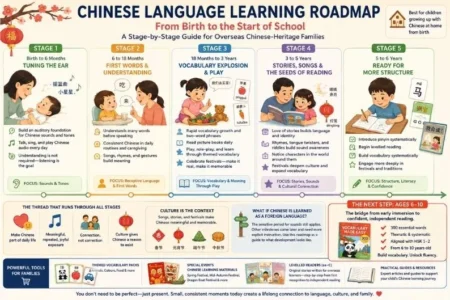
If you are raising a child overseas and hoping to pass on Chinese, the early years feel both urgent and overwhelming.
Urgent, because everyone tells you the window is short. Overwhelming, because no one tells you what to actually do — not in the vague, general sense of “expose them to the language,” but specifically: what does a three-month-old need? What about a two-year-old? What changes at four? What should be in place before school starts?
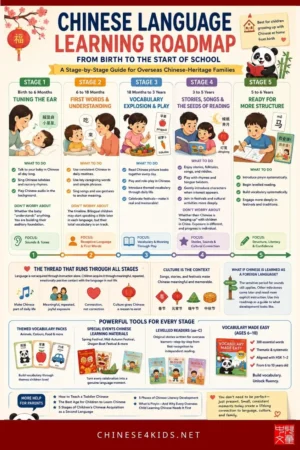
Let’s go through those questions, stage by stage, from birth to the start of formal schooling.
Contents
hide
An Important Note Before You Start: Who Is This Roadmap For?
The stages described in this article reflect the natural path of Chinese language development for children who grow up with Chinese as a heritage language — meaning Chinese is spoken in the home, by at least one parent or primary caregiver, from birth or very early childhood. Researchers often call these children simultaneous bilinguals or heritage language learners. They are acquiring Chinese alongside the local language (English, or whichever language dominates school and social life) from the very beginning.
If your child is learning Chinese as a foreign or additional language — with little or no Chinese at home, introduced instead through classes, tutors, or supplementary programmes — the picture looks different. The sensitive period for phonetics still applies, but the vocabulary explosion of Stage 3, the natural storytelling of Stage 4, and the reading readiness of Stage 5 will all occur later and typically require more deliberate scaffolding. In that context, treat this roadmap as a guide to what eventual development looks like, rather than a set of milestones to hit at specific ages.
With that clarification in place: if you are a Chinese-heritage family raising children overseas, this article is written for you.
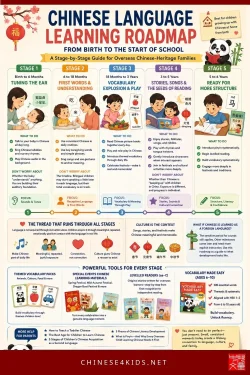
Stage 1: Birth to 6 Months — Tuning the Ear
What’s happening developmentally
In the first six months of life, an infant’s auditory system is performing a remarkable task. Babies are born capable of distinguishing every phoneme in every human language — that gradually fades as the brain begins to specialise in the sounds heard most often.
The research here is remarkably consistent. Studies by Kuhl et al. (2006) and Werker & Tees (1984) established that by the end of the first year, infants’ discrimination of native-language phoneme contrasts improves while sensitivity to non-native contrasts declines. In other words, the brain is already editing the world’s sounds down to the ones it uses.
For Mandarin specifically, this matters in a direct and striking way. RMattock & Burnham (2006) found that Mandarin’s four lexical tones — the pitch patterns that distinguish meaning — become significantly harder to discriminate by just 9 months of age for infants learning a non-tonal language such as English. A child who hears Mandarin’s tonal system regularly in the first months of life builds a phonetic foundation that becomes progressively harder to establish from scratch after this window closes.
This is not a reason to panic. Instead, it is a reason to understand what this stage is actually for: building an auditory baseline for Chinese sounds, especially tones.
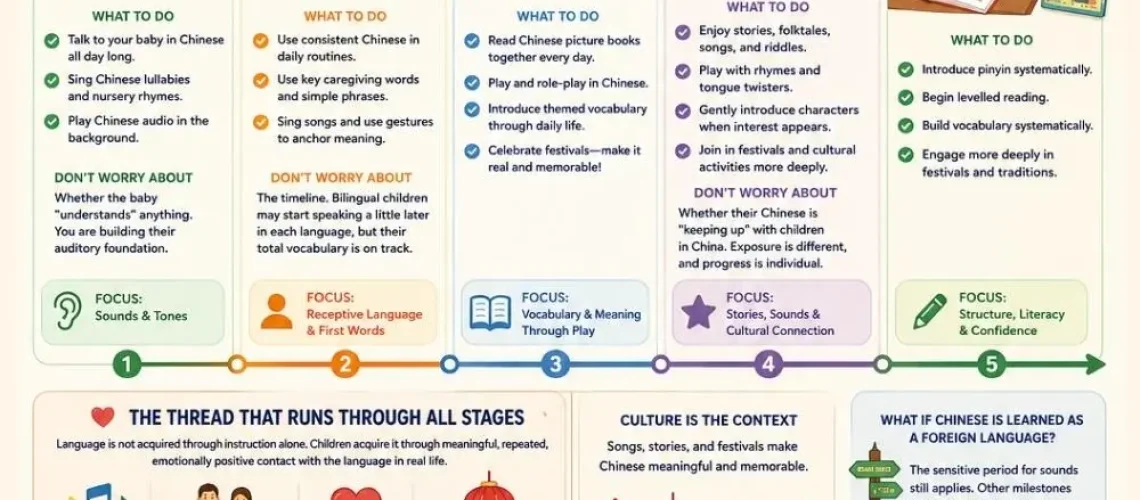
What to do:
- Talk to your baby in Chinese. It doesn’t matter what you say. Narrate what you’re doing — nappy changes, feeding, bathing. 宝宝,我们来洗澡了 (bǎobao, wǒmen lái xǐzǎo le). The content is irrelevant; the sounds are everything.
- Sing Chinese lullabies and nursery rhymes. Songs are ideal because they exaggerate the melodic qualities of the language, making tones easier to register. Classics like 小星星 (Twinkle Twinkle in Chinese), 小白兔, and 摇篮曲 are perfect starting points.
- Play Chinese audio in the background. Soft Chinese music or children’s songs playing during waking hours contributes to the ambient soundscape without requiring anything from you.
What not to worry about:
Whether the baby “understands” anything. In the conventional sense, they don’t. But the auditory system is being shaped, and that shaping is exactly what this stage is for.
Stage 2: 6 to 18 Months — First Words and First Understanding
What’s happening developmentally
This stage marks the beginning of receptive language — the child starts to understand words before producing them. By around 12 months, most children understand 50 or more words even if they can only say a handful.
For bilingual families, this stage introduces the first real question: will my child get confused by two languages?
What the research says about bilingual vocabulary
The evidence here is reassuring. Studies consistently show that comparing bilingual children to monolingual norms based on a single language underestimates what bilingual children actually know (Paradis, 2005; Thordardottir et al., 2006). When vocabulary is measured across both languages — what researchers call “total conceptual vocabulary” — bilingual and monolingual children know equal numbers of lexicalized meanings (Pearson, Fernández & Oller, 1993). The vocabulary is not smaller; rather, it distributes across two languages instead of concentrating in one.
Children raised bilingually do not get confused by hearing two languages. Occasionally they mix a word in Chinese with one in English, but this is normal bilingual behaviour — not evidence of confusion.
What to do
- Maintain consistent Chinese in specific, reliable contexts. Choose the moments when Chinese always happens (mealtimes, bathtime, bedtime) and use it reliably there. Children learn to associate the language with the context.
- Use Chinese for caregiving language. The words that appear most in a child’s daily life are the ones that stick first: 吃 (chī — eat), 睡觉 (shuìjiào — sleep), 洗澡 (xǐzǎo — bath), 来 (lái — come), 看 (kàn — look), 不 (bù — no), 很好 (hěn hǎo — good).
- Continue songs and rhymes — now with gestures and actions that anchor words to meaning. 拍手歌, 头肩膝脚趾 (Head, Shoulders, Knees and Toes in Chinese), and call-and-response songs work well.
What not to worry about
The timeline. Some children say their first words at 10 months; others at 16. Bilingual children sometimes take slightly longer to produce their first words in each language individually — but as the research above shows, this reflects distribution of vocabulary across two systems, not a deficit in either.
Stage 3: 18 Months to 3 Years — Vocabulary Explosion and Play
What’s happening developmentally
Around 18 months, most children hit the “vocabulary explosion” — words accumulate rapidly, and simple two-word combinations begin to appear (妈妈,吃 / 宝宝,书). By age three, many children in Chinese-speaking households produce sentences of three to five words.
The exposure challenge for overseas families
For overseas heritage children, however, this is also the stage where the dominant local language begins to exert real competitive pressure. A child who hears English 80% of their waking hours and Chinese 20% will develop English more quickly and Chinese more slowly. This is not failure — it is simply the mathematics of exposure.
Krashen’s comprehensible input hypothesis (1982) established that language acquisition requires meaningful, understood input just beyond the learner’s current level. In an overseas environment, therefore, the central challenge is ensuring enough of that input arrives in Chinese. The goal at this stage is to make the most of the Chinese time available — and to make it as rich, enjoyable, and memorable as possible.
What to do
- Read Chinese picture books together, every day. Even very simple books — a few words per page, clear illustrations, familiar topics — build vocabulary in context. The most important thing is not the book; it’s the daily ritual.
- Play in Chinese. Role-play in Chinese: 我们去买菜 (we’re going to the market), 你是医生 (you’re the doctor), 把娃娃放这里 (put the doll here). Short, playful, repeated exchanges are what this age needs.
- Introduce themed vocabulary through daily life. Colours, animals, body parts, food, family members — these are the topics that dominate a toddler’s world, and where Chinese vocabulary sticks most naturally.
This is a perfect age to build a small library of themed Chinese materials. The Chinese4kids Shop offers a range of illustrated vocabulary packs and themed learning materials covering animals, colours, food, and more. Simple flashcards that a child can handle and sort are particularly effective at this age — the physical interaction reinforces the word in a way that screen exposure alone cannot.
Bring the Chinese cultural calendar in early
By age two or three, children notice and remember recurring events. Making 饺子 before Spring Festival, hanging paper lanterns for 元宵节, talking about 月饼 and the moon story during Mid-Autumn Festival — these are the moments that make Chinese feel like it belongs to your child’s life, not just their lessons.
The Special Events Chinese Learning Materials in the shop are designed exactly for this. Festival-themed packs for Spring Festival, Mid-Autumn Festival, Dragon Boat Festival, and others include vocabulary, activities, and printables that turn each celebration into a genuine language moment. No classroom can replicate that.
What not to worry about:
Whether your child’s Chinese “sounds right.” Approximation is entirely normal at this stage. A child who mixes Chinese and English freely is doing exactly what developing bilingual children do.
Stage 4: 3 to 5 Years — Stories, Songs, and the Seeds of Reading
What’s happening developmentally:
Between three and five, children’s language capacity expands dramatically. They ask why, tell stories, narrate the past, imagine the future. They also become increasingly aware of social context — noticing which language is spoken where and with what response.
This is the age when identity starts to intersect with language. Research on heritage language maintenance consistently highlights this stage as critical: a child who associates Chinese with warmth, belonging, and pleasure is far more likely to sustain the language through the more socially pressured years of adolescence than one who associates it with obligation or correction (Cummins, 2001).
What to do: storytime and language play
Elevate storytime. Three-to-five-year-olds are ready for longer, more complex stories. Chinese folktales and traditional narratives — the Mid-Autumn Festival legend of 嫦娥 and 后羿, stories from the zodiac calendar, the tale of 孟姜女 — carry cultural weight that no English story can replicate. When a child knows a story their English-speaking friends don’t, Chinese becomes a source of something exclusive and meaningful.
Use language play: rhymes, tongue twisters, and riddles. Tongue twisters like 四是四,十是十,十四是十四 deliver intensive phonetic practice disguised as a game. Chinese riddles (谜语) are ideal for this age — accessible enough to engage, rich enough in vocabulary to do real work, and naturally connected to Chinese cultural tradition.
What to do: characters and the cultural calendar
Plant the seeds of character recognition — gently. Some children at this age spontaneously start noticing characters in their environment: on food packaging, on posters, in books. When that happens, nurture the interest — point to characters, name them, trace them together. However, avoid pushing formal character instruction. Research on early Chinese literacy development suggests that premature formal instruction often produces anxiety without producing lasting gains (Li & Rao, 2000). The goal at this stage is a love of language, not early reading performance.
Continue the cultural calendar with deeper participation. By four or five, children can engage meaningfully: making paper crafts, learning festival songs, hearing the stories behind each occasion. The vocabulary — 春节, 红包, 灯笼, 月饼, 龙舟 — is vivid and memorable precisely because experience attaches it to something real.
The Special Events Chinese Learning Materials work particularly well here. A child who makes a paper lantern while learning that it is called 灯笼 (dēnglong) and carried during 元宵节 (Yuánxiāojié) is not studying vocabulary. Living it is something else entirely.
What not to worry about
Whether your child’s Chinese is “keeping up” with children in China. It isn’t, and it cannot be expected to. An overseas heritage child who loves Chinese, uses it with family, and has age-appropriate vocabulary for their exposure level is doing extremely well. Comparing them to children in Chinese-speaking environments is comparing apples to something entirely different.
Stage 5: 5 to 6 Years — Ready for More Structure
What’s happening developmentally
At five and six, children enter formal schooling, develop stronger metacognitive awareness, and become genuinely ready for more structured engagement with language — including, for the first time, systematic character study and early reading.
The payoff of the early years
This is where the foundations laid in the previous five years begin to pay their most tangible dividends. Specifically, a heritage child who has been immersed in Chinese sounds, songs, stories, and conversation since infancy arrives at this stage with:
- A well-tuned ear for Chinese phonology, including tones — built during the sensitive period identified by Kuhl, Werker, and colleagues
- A conversational vocabulary of several hundred words
- A natural feel for the rhythm and structure of Chinese sentences
- Positive emotional associations with the language
- Cultural familiarity with Chinese festivals, stories, and traditions
That platform cannot be built quickly. It takes years of exactly the kind of consistent, enjoyable contact described in this article.
What to do
- Introduce pinyin systematically. At five or six, children have the cognitive readiness for systematic phonics instruction. Pinyin gives them a tool to decode new characters independently. For a detailed guide, see: What Is Pinyin — And Why Every Overseas Child Learning Chinese Needs It First.
- Begin levelled reading. A child with a conversational vocabulary in Chinese and basic pinyin knowledge is ready to start reading. Beginning with very simple, high-frequency texts — aa or A level graded readers — and progressing gradually builds fluency and confidence. The Chinese4kids original levelled readers are written specifically for the overseas learning context, with four levels (aa through C) that take a child from first recognition through to independent reading.
- Start building vocabulary systematically. Conversational vocabulary acquired through immersion is invaluable but uneven — a child might know 装扮 (costume) from a favourite story but not 椅子 (chair). Systematic vocabulary work, organised around the most frequently used words, fills these gaps. Vocabulary Made Easy is designed for exactly this transition — taking children aged 6–10 systematically through the 300 most essential Chinese words, aligned with HSK Levels 1–2, in a sequence that supports the move into independent reading.
- Continue the cultural calendar. A five-year-old can now engage meaningfully with the stories behind each festival. They can write a simple red envelope greeting in Chinese. They can help make rice dumplings for Dragon Boat Festival and describe what they are doing. Culture and language, at this age, reinforce each other powerfully.
A Note on Children Learning Chinese as a Foreign or Additional Language
If your child is beginning Chinese through classes, a tutor, or a supplementary programme rather than through home use, a few things are worth knowing.
What still applies
The phonetic sensitive period (birth to 12 months) remains relevant. Early exposure to Chinese songs, rhymes, and audio — even in small doses — is worthwhile for any young child with a connection to Chinese culture, regardless of whether the family speaks Chinese at home.
What differs
Beyond phonetics, however, the trajectory differs significantly. Children learning Chinese as a foreign or additional language will not follow the same vocabulary explosion timeline as heritage children. They will benefit from earlier and more explicit instruction — in pinyin, vocabulary, and basic grammar — because they cannot draw on the thousands of hours of conversational input that heritage children accumulate naturally.
For these children, the 0–6 roadmap described here is best understood as a long-term aspiration: a picture of what fluency in Chinese looks like as it develops, rather than a set of milestones tied to specific ages.
The resources recommended throughout this article — themed vocabulary packs, festival materials, levelled readers — are equally useful for foreign language learners. The timeline for introducing them may simply be compressed or shifted depending on when formal learning begins.
The Thread That Runs Through All of It
Reading back through these five stages, one principle recurs at every point: language is not acquired through instruction alone. Children acquire it through meaningful, repeated, emotionally positive contact with the language in real life.
For overseas Chinese-heritage families, this means making Chinese present in the textures of daily life — in songs, stories, the seasonal celebrations, the dinner table conversations, the bedtime routines. The festival calendar is one of the most powerful tools available, precisely because it gives Chinese a reason to exist outside the classroom.
The Special Events Chinese Learning Materials and themed vocabulary packs in the Chinese4kids shop support exactly this goal — providing families with the printables, flashcards, and activity materials to make each cultural occasion a genuine language moment, from a simple Spring Festival vocabulary pack to more detailed celebration activity books.
Further Reading on Chinese4kids
- 📖 The Best Age for Children to Learn Chinese — a deeper look at the research on early language acquisition and why the window matters
- 📖 5 Stages of Children’s Chinese Acquisition as a Second Language — understanding the predictable stages of acquisition helps set realistic expectations at every age
- 📖 5 Phases of Chinese Literacy Development — how reading ability develops from pre-reading through to fluency
- 📖 What Is Pinyin — And Why Every Overseas Child Learning Chinese Needs It First — the essential guide to introducing pinyin at the right time
References
- Kuhl, P.K., et al. (2006). Infants show a facilitation effect for native language phonetic perception between 6 and 12 months. Developmental Science.
- Mattock, K., & Burnham, D. (2006). Chinese and English infants’ tone perception: Evidence for language-specific listening. Developmental Science.
- Pearson, B.Z., Fernández, S.C., & Oller, D.K. (1993). Lexical development in bilingual infants and toddlers: Comparison to monolingual norms. Language Learning, 43(1), 93–120.
- Thordardottir, E., et al. (2006). Bilingual assessment: Can overall proficiency be estimated from separate measurement of two languages? Journal of Multilingual Communication Disorders.
- Werker, J.F., & Tees, R.C. (1984). Cross-language speech perception: Evidence for perceptual reorganization during the first year of life. Infant Behavior and Development.
- Krashen, S.D. (1982). Principles and Practice in Second Language Acquisition. Pergamon Press.
- Cummins, J. (2001). Language, Power and Pedagogy: Bilingual Children in the Crossfire. Multilingual Matters.
As your child moves into the 6–10 age range, systematic vocabulary building becomes the most important lever available. Vocabulary Made Easy takes children aged 6–10 through the 300 most essential Chinese words in a structured, thematic sequence — the bridge from early immersion into confident, independent reading.
If you like this article, share it