Quick Answer
Qingming Festival (清明节, Qīngmíng Jié) is a traditional Chinese holiday for honouring ancestors and celebrating the arrival of spring. Families visit graves, offer food, and fly kites. It falls around 4–6 April each year and is a public holiday in mainland China, Hong Kong, Taiwan, and Macau.
Qingming Festival (清明节, Qīngmíng Jié) is a traditional Chinese holiday for honouring ancestors and celebrating the arrival of spring. Families visit graves, offer food, and fly kites. It falls around 4–6 April each year and is a public holiday in mainland China, Hong Kong, Taiwan, and Macau.
Every spring, millions of Chinese families make a quiet journey — to hillside cemeteries, to ancestral villages, to a graveside where they lay fresh flowers and light incense.
This is Qingming. And unlike the loud, bright festivals of Chinese New Year or Mid-Autumn, it asks something different of children: stillness, remembrance, and an understanding that family stretches back through generations.
For overseas Chinese families, it also raises a question that doesn’t have an easy answer: how do you observe a festival rooted in place — in ancestral graves, in shared land — when you are far from home?
This article covers what Qingming is, what it means, the key traditions and phrases to share with children, and practical activities that make its values come alive even thousands of kilometres from China.
What Is Qingming Festival?
Qingming (清明, Qīngmíng) literally means “clear and bright.” It is one of the 24 solar terms in the traditional Chinese lunisolar calendar — a seasonal marker that originally signalled the best time of year for farming, when skies clear and temperatures rise.
Over time, Qingming absorbed an older tradition called Hanshi Festival (寒食节, Hánshí Jié) — a memorial day when people ate cold food and swept the graves of their ancestors. Today, the two have merged into a single important holiday.
Qingming falls on the 15th day after the spring equinox, which puts it between 4 and 6 April each year. In mainland China, it is a public holiday lasting three days. It is also observed in Hong Kong, Taiwan, Macau, and by Chinese communities across Southeast Asia.
Did You Know?
Qingming is one of only two traditional Chinese festivals that follow the solar calendar rather than the lunar calendar — the other being the Winter Solstice (冬至, Dōngzhì). This is why it falls on almost the same date every year.
Qingming is one of only two traditional Chinese festivals that follow the solar calendar rather than the lunar calendar — the other being the Winter Solstice (冬至, Dōngzhì). This is why it falls on almost the same date every year.
The Meaning Behind the Festival
At its heart, Qingming is about two things: honouring the dead and celebrating life.
This combination sounds unusual, but it reflects a deeply Chinese way of seeing the world. The Confucian idea of filial piety (孝, xiào) — deep respect for parents and ancestors — extends beyond death. Ancestors are not forgotten. They are thanked, remembered, and cared for.
At the same time, spring is at its most beautiful during Qingming. Willows are budding. Peaches are blossoming. The air is warm and clear. So after visiting the graves of those who are gone, families also go out to enjoy the world that remains — flying kites, walking in parks, eating seasonal foods.
For children, this balance is worth exploring. Qingming teaches that it is possible to hold sadness and joy at the same time — to remember someone who has died while also feeling glad to be alive in a world they helped shape.
Traditions and Customs
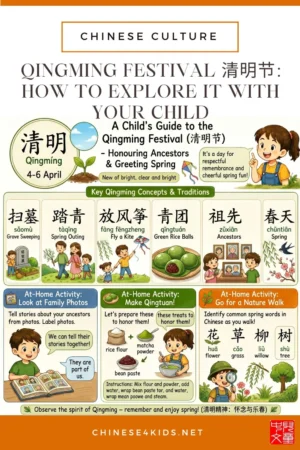
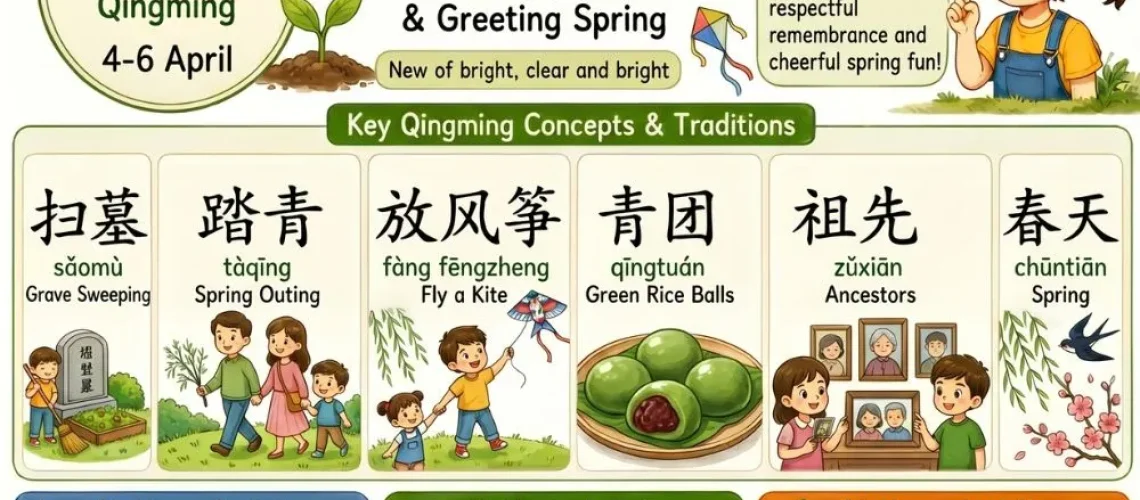
1. Grave Sweeping (扫墓, Sǎomù)
The most important Qingming tradition is visiting and cleaning the graves of ancestors. Families pull weeds, sweep away leaves, and tidy the gravestone. Then they bow, burn paper offerings, and place food and flowers at the grave.
The ritual sends a clear message to children: these people mattered. We have not forgotten them.
2. Burning Paper Offerings (烧纸, Shāo Zhǐ)
Families burn paper representations of money, houses, clothes, and everyday objects. The belief is that these will reach ancestors in the afterlife. Many families also burn joss sticks (香, xiāng) — incense that carries prayers upward with the smoke.
In recent years, some families have moved toward more environmentally friendly offerings: paper flowers, biodegradable wreaths, and written letters.
3. Offering Food (供食, Gòng Shí)
Favourite foods of the deceased — or traditional seasonal dishes — are placed at the grave. Common offerings include:
- Qingtuan (青团, qīngtuán) — green glutinous rice balls, coloured with mugwort juice. The most iconic Qingming food.
- Cold food — honouring the ancient Hanshi tradition of eating nothing hot.
- Eggs — symbolising new life and spring.
- Fruits — fresh seasonal offerings.
After the ceremony, families eat the food together — sharing the meal, in a sense, with those who have passed.
4. Kite Flying (放风筝, Fàng Fēngzheng)
Kite flying is one of the most joyful Qingming traditions. Children and adults fly kites in parks and open fields. Traditionally, at the end of the day, people cut the kite string and let the kite fly away — sending bad luck and illness up into the sky with it.
5. Spring Outing (踏青, Tàqīng)
Tàqīng means “stepping on the green” — going out to walk on fresh spring grass. After visiting graves, families picnic, walk in parks, and enjoy nature. Willows (柳, liǔ) are a symbol of Qingming; people often carry willow branches or weave them into circlets.
Key Phrases and Vocabulary for Kids
These are the words and phrases your child is most likely to encounter during Qingming. Teach them in conversation — during a walk, while looking at photos, or while making qingtuan together.
| Chinese | Pinyin | English |
|---|---|---|
| 清明节 | Qīngmíng Jié | Qingming Festival |
| 祖先 | zǔxiān | ancestors |
| 扫墓 | sǎomù | grave sweeping |
| 怀念 | huáiniàn | to miss / to remember with longing |
| 放风筝 | fàng fēngzheng | to fly a kite |
| 青团 | qīngtuán | green rice balls (Qingming food) |
| 踏青 | tàqīng | spring outing |
| 孝顺 | xiàoshùn | filial piety / being a good son or daughter |
| 柳树 | liǔshù | willow tree |
| 春天 | chūntiān | spring |
Phrases to Use at Home
These short sentences give children language to talk about Qingming — and to begin understanding feelings around death and memory in Chinese.
今天是清明节。
Jīntiān shì Qīngmíng Jié.
Today is Qingming Festival.我们去扫墓。
Wǒmen qù sǎomù.
We’re going to sweep the graves.我想念太爷爷 / 太奶奶。
Wǒ xiǎngniàn tài yéye / tài nǎinai.
I miss my great-grandfather / great-grandmother.我们放风筝吧!
Wǒmen fàng fēngzheng ba!
Let’s fly a kite!春天来了。
Chūntiān lái le.
Spring has come.
For Parents Who Want to Say More
Speak Chinese with Kids
These conversations — about seasons, feelings, family — become much easier when you have the language ready. Speak Chinese with Kids is a daily scene phrase course for parents. Each module gives you 30 ready-to-use sentences for real home situations, with audio to help your pronunciation. You don’t need to be fluent. You just need to start.Learn More →
Speak Chinese with Kids
These conversations — about seasons, feelings, family — become much easier when you have the language ready. Speak Chinese with Kids is a daily scene phrase course for parents. Each module gives you 30 ready-to-use sentences for real home situations, with audio to help your pronunciation. You don’t need to be fluent. You just need to start.Learn More →
Celebrating Qingming Overseas
Many overseas Chinese families feel a particular ache at Qingming. The graves of grandparents and great-grandparents are in Fujian, Guangdong, or Sichuan — not in Sydney, London, or Toronto.
But Qingming is not only a physical act. The values at its core — gratitude, memory, connection to those who came before — are portable. Here are ways to observe the spirit of Qingming even far from ancestral land:
Visit a local cemetery together. Even if your own ancestors are buried elsewhere, walking through a cemetery with your child opens the conversation about death, memory, and care.
Video call relatives in China. If family members are observing Qingming at the ancestral grave, a video call can bridge the distance. Children can bow virtually, say a greeting, or simply watch and listen.
Make qingtuan together. The bright green rice balls are a memorable sensory experience — kneading dough, mixing in matcha or mugwort powder, filling with sweet red bean paste. Children remember what they make.
Look at old family photos. Tell children the names of the people in the photos. Where they lived, what they were like, how they are connected to your child. This is oral history — and it is the real practice of Qingming.
Fly a kite in a park. Simple, joyful, and unmistakably Qingming.
Learning Activities for Children
The following activities are designed for children aged 4–12. They connect Qingming’s themes — remembrance, spring, family, gratitude — to hands-on learning.
1. Family Memory Book (Ages 5–12)
Help your child create a small “memory book” about a family member who has passed, or an older relative they know. Include a photo, the person’s name in Chinese, where they were from, and one thing your child knows or loves about them.
Language practice: Write the person’s name in Chinese characters. Label the photo with words like 奶奶 (nǎinai), 爷爷 (yéye), 太奶奶 (tài nǎinai). Teach the sentence: 她/他的名字是___。 (Her/His name is ___.).
2. Make Qingtuan (Green Rice Balls) (Ages 4–10)
Making qingtuan (青团) together is one of the most memorable ways to mark Qingming at home. A simple version uses glutinous rice flour (糯米粉, nuòmǐfěn) and matcha powder for the green colour, with sweet red bean paste (红豆沙, hóngdòu shā) as filling.
Language practice: Count the rice balls together in Chinese (一个、两个、三个 yī gè, liǎng gè, sān gè). Name the colours and ingredients. Describe the texture: 软软的 (ruǎn ruǎn de — soft and squishy).
3. Design and Fly a Kite (Ages 4–12)
Buy a simple kite from a toy shop, or make one from bamboo sticks and tissue paper. Let children decorate it with Chinese characters — their name, the word 春 (chūn, spring), or a simple drawing of a butterfly or fish.
Language practice: Practise the phrase 放风筝 (fàng fēngzheng — fly a kite). Describe the wind: 风大不大? (Fēng dà bù dà? — Is it windy?). Point out 柳树 (liǔshù — willow trees) if you see them.
4. Spring Nature Walk and Vocabulary Hunt (Ages 4–8)
Go for a walk in a park or garden and practise spring vocabulary in Chinese. Look for things to name in Chinese as you walk: flowers, birds, trees, the sky, the grass.
花 (huā) — flower
草 (cǎo) — grass
树 (shù) — tree
鸟 (niǎo) — bird
天空 (tiānkōng) — sky
太阳 (tàiyáng) — sun
Language practice: Take photos of what you see. When you get home, write or stamp the Chinese characters next to each photo to make a Qingming spring book.
5. Ancestor Story Time (Ages 6–12)
Set aside 15 minutes to look at old family photos with your child. Tell them the name and one story about each person. If you have photos of relatives back in China, even better — connect the faces to places.
Language practice: Use Chinese while you talk: 这是你的爷爷 (Zhè shì nǐ de yéye — This is your grandfather). 他以前住在___ (Tā yǐqián zhù zài ___ — He used to live in ___). This activity is especially powerful for children who are old enough to ask questions and hold longer conversations.
6. Write a Letter to an Ancestor (Ages 8–12)
Older children can write a short letter — in English or Chinese — to an ancestor they never met. Prompt them: What would you want them to know about your life today? What would you want to ask them?
This activity builds emotional literacy, cultural connection, and, if done in Chinese, genuine writing practice. It can be read aloud during a family Qingming observance, or folded and kept as a keepsake.
Build Vocabulary That Lasts
Vocabulary Made Easy
Many of the nature and family words in these Qingming activities — 花, 草, 树, 爷爷, 奶奶 — are among the 300 most common Chinese words children need to know. Vocabulary Made Easy is a structured course that helps children aged 6–10 learn all 300 words with audio, visuals, and repetition — building the foundation for confident reading.
Learn More →
Vocabulary Made Easy
Many of the nature and family words in these Qingming activities — 花, 草, 树, 爷爷, 奶奶 — are among the 300 most common Chinese words children need to know. Vocabulary Made Easy is a structured course that helps children aged 6–10 learn all 300 words with audio, visuals, and repetition — building the foundation for confident reading.
Learn More →
Frequently Asked Questions
When is Qingming Festival celebrated?
Qingming falls on the 15th day after the spring equinox — usually between 4 and 6 April each year. In 2025 it falls on 5 April. In mainland China it is a three-day public holiday.
What do people eat during Qingming Festival?
The most iconic Qingming food is qingtuan (青团) — green glutinous rice balls filled with sweet red bean paste. The green colour traditionally comes from mugwort juice; at home, matcha powder makes a good substitute. Traditional Qingming foods are often cold or plant-based, reflecting the ancient Hanshi Festival custom of eating cold food.
Why do people fly kites at Qingming?
Kite flying during Qingming combines the joy of spring with a traditional ritual. At the end of the day, people cut the kite string and let the kite fly free — the belief is that this releases bad luck and illness for the year ahead. For children, it is simply great fun, and a wonderful way to celebrate the clear, breezy weather of early April.
How do I explain Qingming to my young child?
Keep it simple and honest. Qingming is a day to remember people in our family who lived before us. We visit their graves, bring them flowers and food, and say thank you for being part of our family. Then we go out and enjoy the beautiful spring — because they would want us to be happy. Children under 6 usually accept this naturally; the concept of remembrance is accessible even to young children when it is tied to tangible actions like bringing flowers or making food.
Can we celebrate Qingming if we can’t visit any graves?
Yes. The values of Qingming — gratitude, remembrance, family connection — don’t require a grave. You can observe the spirit of the festival by looking at family photos, telling children stories about relatives, video-calling family in China during their Qingming observance, making qingtuan at home, and going out to enjoy spring. Many overseas Chinese families have developed their own adapted rituals that carry the meaning forward in a new context.
Is Qingming a sad festival?
Not exactly — and this is one of its most valuable lessons for children. Qingming holds both grief and joy. The grave-sweeping part is quiet and respectful. But the spring outing, the kite flying, and the seasonal food are genuinely celebratory. Chinese tradition does not ask people to choose between sadness and happiness — both are real, and both belong in a full life.
Further Reading
-
- Chinese Celebrations, Festivals & Special Occasions A complete guide to the major festivals in the Chinese cultural calendar — with traditions, vocabulary, and ideas for celebrating overseas.
- 8 Fun Chinese New Year Games for Kids to Learn Chinese Hands-on games and activities to celebrate Chinese New Year while building Mandarin vocabulary.
- Mid-Autumn Festival for Families Moon cakes, lanterns, and the stories behind the Mid-Autumn moon.
- Spring Vocabulary in Chinese Nature words, weather words, and seasonal phrases for early learners.
If you like this article, share it