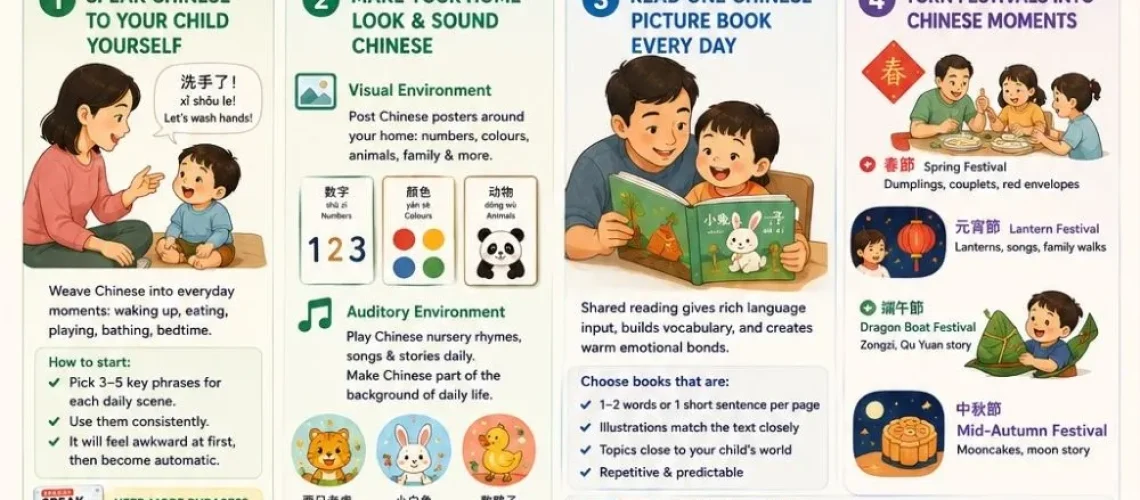
If you’re raising a one- or two-year-old overseas and hoping Chinese will become a real part of their life, you’ve probably heard one piece of advice a hundred times:
“Start early. The earlier the better.”
That advice is correct. It also doesn’t tell you what to actually do. What should you say? What should they watch? What should they listen to? They can’t really respond yet — how do you even know any of it is going in? The English-speaking world is so dominant — is the Chinese you can offer at home really enough?
This article aims to put those anxieties down and replace them with a concrete, doable plan. Not for “children” in some vague sense, but for one very specific window: ages 1 to 3. The most critical, and the most underestimated, stretch of language development your child will ever go through.
The Most Important Thing First: At This Age, You Don’t “Teach”
Many overseas parents start feeling anxious around their child’s first or second birthday — should we buy curriculum? Should we sign up for classes? Should we be doing something systematic? The anxiety is understandable, but it’s pointed in the wrong direction.
A 1–3 year old learns language in a fundamentally different way than a 5-, 7-, or 10-year-old does. They don’t acquire language through instruction — they acquire it through immersion. The reason a two-year-old can go from barely speaking to telling stories and cracking jokes within two years is not teaching. It’s that during the dozen or so waking hours every day, they are constantly surrounded by language.
What this means is that for this age group, the most effective approach is not “lessons” but weaving Chinese into every crack of daily life. Waking up, eating, playing, bathing, going to sleep. Put another way:
at this stage, “teaching Chinese” is roughly equivalent to “living life in Chinese.”
Once you understand that, the rest of the questions get a lot more concrete.
The Critical Two Years: What’s Happening Between 1 and 3
To know what to do, it helps to know what your child’s brain is actually working on.
Ages 1 to 2 is typically the vocabulary explosion phase. At one, most children can produce a countable handful of words. By two, the average child has 200–300 words and is starting to combine them into two-word phrases (“Mommy hug,” “want water”). This is a phase of massive linguistic intake — the speed at which children absorb language far outpaces their ability to produce it. The number of words they understand is always many times greater than the number they can say.
Ages 2 to 3 is when sentence structure and narrative ability begin to bud. Children start producing three- and four-word sentences, asking why, describing things that happened earlier. Researchers sometimes call this the “grammar bootstrapping” phase, because the child is no longer just repeating — they’re generating. They’re assembling sentences in their own mind.
For overseas Chinese-heritage families, these two years carry a particular significance: this is the last stretch before English (or whatever the local language is) takes the upper hand. Once a child enters preschool or kindergarten, 6–8 hours of every day will be spent immersed in English. The proportion of Chinese input drops sharply. Ages 1 to 3 are the period during which the family has the most control over the child’s overall language environment. The window doesn’t last.
That’s not meant to make you anxious. It’s meant to point out that you don’t need to be doing anything special right now. You only need to do one thing: make Chinese one of the dominant sounds of these two years.
Pillar One: Speak Chinese to Your Child Yourself
This sounds obvious, but in practice it’s where most overseas parents get stuck.
Many parents’ Chinese is actually adequate — it’s just not available fast enough. When the child cries, falls down, or wants something, the first response that surfaces is in English. English is the default of the surrounding environment and reaches the tongue faster. By the time you’ve remembered to use Chinese, the warm moment has passed.
There’s also another category of parents — the ones whose own Chinese isn’t fluent to begin with. You might be second-generation ABC. Or a non-Chinese spouse. Or someone whose Mandarin is limited but who wants to give their child a foundation regardless. For these parents, “speaking Chinese to my child” isn’t just about reaction time — it’s genuinely a question of not knowing what to say.
Whichever category you fall into, here’s a principle worth remembering:
The amount of Chinese you have matters far less than whether you can reach for it in the moment.
A fluent Chinese-speaking parent who habitually defaults to English in the warm moments builds a smaller Chinese world for their child than a parent with limited Chinese who consistently reaches for whatever they have. This isn’t motivational language — it’s just how children absorb language. They absorb what is actually present, not what their parents know.
Where to start: the most repeated daily scenes
How to put this into practice? Start with the most repeated daily scenes:
- Morning, getting dressed: “起床了 (qǐ chuáng le — time to get up),” “自己穿衣服 (zì jǐ chuān yī fu — get dressed yourself),” “快一点 (kuài yī diǎn — hurry up a bit)”
- Mealtimes: “想吃什么?(xiǎng chī shén me — what do you want to eat?),” “好吃吗?(hǎo chī ma — is it good?),” “再来一口 (zài lái yī kǒu — one more bite)”
- Playtime: “这是什么?(zhè shì shén me — what’s this?),” “我们一起玩 (wǒ men yī qǐ wán — let’s play together),” “你看,红色的车 (nǐ kàn — look, a red car)”
- Bath and bedtime: “洗头发 (xǐ tóu fa — wash your hair),” “水太热了 (shuǐ tài rè le — the water is too hot),” “晚安,做个好梦 (wǎn ān, zuò ge hǎo mèng — goodnight, sweet dreams),” “我爱你 (wǒ ài nǐ — I love you)”
Pick three to five most-used phrases per scene and lock them in. It feels awkward for the first few days; within a couple of weeks it becomes automatic. After a month or two, you’ll find these moments are simply in Chinese by default — no switching required.
When you don’t know what to say
If you don’t know what to say, or you keep using the same handful of phrases and feel stuck, Speak Chinese with Kids was built for exactly this problem. The course maps family life into 12 common scenes — mealtimes, bath time, playtime, going out, illness, bedtime, and others. Each scene gives you 30 natural everyday phrases, complete with characters, pinyin, English translation, and native-speaker audio. You don’t need to be fluent — you just follow the audio. The initial awkwardness is normal, but with 30 phrases per scene, you can rotate through them rather than burning out on the same five.
🎁 Free download: 30 Chinese phrases to encourage and praise your child
Want to try this before committing to anything? I’ve put together a free PDF of 30 ready-to-use Chinese phrases for encouraging and praising your child — phrases like “好棒!(hǎo bàng — well done!),” “我为你骄傲 (wǒ wèi nǐ jiāo ào — I’m proud of you),” and “再试一次 (zài shì yī cì — try again).” Each phrase comes with characters, pinyin, and English translation, so you can start using them today.
These are the same kinds of phrases you’ll find inside Speak Chinese with Kids — and a perfect first taste of the approach. Praise and encouragement happen dozens of times a day with a toddler, which makes them the easiest scenes to switch into Chinese first.
Pillar Two: Make Your Home Look and Sound Chinese
Children at this age don’t absorb language by being taught — they absorb it by being steeped in it. The physical environment of your home is, on its own, quietly speaking all day long.
The visual environment
Put simple Chinese pictures and characters on the walls, the fridge, beside the bookshelf. This isn’t to make a one- or two-year-old “learn to read” — children at this age aren’t actually decoding characters. The point is that Chinese becomes part of the daily visual landscape. A child who has seen Chinese in their environment from birth will not, later in life, perceive it as “a foreign language.” It will simply feel familiar.
Themed posters (numbers, colours, animals, family members) work especially well in the corners where your child spends time — by the dining table, in the play area, on the back of the bedroom door. The Chinese4kids 9 Chinese Learning Posters for Homeschool and Classroom pack covers exactly the foundational topics this age group benefits from — numbers, colours, days of the week, months, shapes — in both characters-only and pinyin versions.
The auditory environment
Background music and children’s songs are among the most easily absorbed forms of Chinese input for a 1–3 year old. Classic Chinese nursery rhymes — 两只老虎 (Two Tigers), 小白兔 (Little White Rabbit), 数鸭子 (Counting Ducks), 小燕子 (Little Swallow) — have repeating melodies, simple rhythms, and high-frequency vocabulary. After a few playthroughs, children start humming along.
The point isn’t whether your child “understands” the words. It’s whether these sounds are showing up in their environment regularly. The brain’s capacity to absorb phonology and prosody at this age is something an adult brain simply cannot match.
There are plenty of natural slots in the day: nursery rhymes during breakfast, Chinese audio stories in the car, soft Chinese lullabies before bed. The cumulative “Chinese listening time” this builds up is far more effective than a once-a-week class.
Pillar Three: Read One Chinese Picture Book a Day
If I had to pick one single “specifically-for-Chinese” thing to do at this age, it would be — without hesitation — read a Chinese picture book to your child every day.
Why daily picture-book reading works so well
Three reasons:
First, shared reading is the most efficient form of language input for this age group. The language in picture books is richer and more complete than everyday conversation, but it’s anchored to images and story, so the child can follow it. A sentence like “小兔子蹦蹦跳跳地走进了树林 (the little rabbit hopped and bounced into the woods)” is perfectly accessible inside a book — but it would almost never come up naturally in conversation.
Second, shared reading attaches Chinese to the warmest moments of the day — bedtime, cuddles, the few minutes of being completely attended to. This emotional association is the deepest source of motivation for a child to keep speaking Chinese in the years ahead. Heritage language research keeps surfacing the same finding: whether a child holds onto a language through adolescence depends largely on whether the language was attached, in childhood, to feelings of warmth, intimacy, and safety.
Third, when you start reading Chinese books from age one or two, your child treats “reading Chinese” as something that has always been part of life — not something they need to “start” one day. That naturalness is more valuable than it looks.
How to choose books for this age
The most suitable Chinese picture books for ages 1–3 satisfy a few conditions:
- One or two words, or one short sentence, per page
- Illustrations and text in tight correspondence (the child can “read” the meaning from the picture)
- Topics close to the child’s world (colours, animals, food, family)
- Repetition strong enough that language becomes predictable
The Chinese4kids original levelled readersaa level designed for exactly this stage. Each book has 1–3 words per page, tight image-text correspondence, and topics drawn from a young child’s familiar world. At this level, the books aren’t really “for the child to read.” They’re for the parent to read to the child. Gradually, your child starts pointing along, then saying along, then pretending to read on their own — which is itself the most natural beginning of literacy.
If you’re worried your pinyin or pronunciation isn’t strong enough, you can lean on the pinyin edition and learn alongside. Reading imperfectly is completely fine. The act of reading matters far more than the accuracy of the reading.
Pillar Four: Turn Festivals Into Chinese Moments
One resource that overseas Chinese families absolutely should not waste is the Chinese festival calendar.
Why festivals work so well at this age
Spring Festival, Mid-Autumn, Dragon Boat, Lantern Festival — these holidays offer the most natural answer all year to the question “why Chinese?” A two-year-old doesn’t grasp anything as abstract as “cultural heritage.” But they will remember making dumplings with Mom, carrying a paper lantern at dusk, biting into a mooncake, watching a dragon dance. The Chinese vocabulary attached to those memories — 红包 (red envelope), 灯笼 (lantern), 月饼 (mooncake), 龙 (dragon), 鞭炮 (firecracker) — sticks more firmly than any vocabulary list ever will, because it’s bonded to specific, joyful, distinctive experiences.
Festivals also do something important: they turn Chinese into something the child uniquely owns. When the kids at English school don’t know what Mid-Autumn Festival is, but your child knows, participates, and has a story to tell — Chinese shifts from being “an extra burden” to “a thing that’s mine.” That subtle shift in identity will keep working for the next decade and beyond.
What festival celebration looks like in practice
Nothing complicated:
- Spring Festival — put up couplets, make dumplings, hand the child a red envelope, narrating as you go: “这是春联 (this is the spring couplet),” “我们在包饺子 (we’re making dumplings),” “这是红包,里面有压岁钱 (this is a red envelope, with lucky money inside)”
- Lantern Festival — make or buy a simple paper lantern, walk outside with it as evening falls
- Dragon Boat Festival — eat zongzi, tell a child-friendly version of the Qu Yuan story
- Mid-Autumn — gaze at the moon together, share mooncakes, tell the Chang’e legend
Each festival has roughly a dozen related vocabulary words. Over a few years of repetition, a child knows them all without ever having “studied” them.
If you’d like to make these activities more structured and engaging, the Special Events Chinese Learning Materials in the Chinese4kids shop offer themed activity packs for each major festival — vocabulary cards, colouring pages, craft materials, festival stories, and interactive activities. A one- or two-year-old can already participate in the simplest pieces (colouring, stickers, picture-word matching). A three-year-old can do more hands-on work. Built up over a year, you end up with a genuine “Chinese festival tradition” that belongs to your family.
A Few Common Misconceptions
1. “My Chinese isn’t great — am I going to teach my child wrong?”
Short answer: no.
Long answer: the worry is that your child will pick up imperfect pronunciation or non-native expressions from you. The worry is understandable, but a few things are worth knowing.
First, the human brain is built to handle multiple language inputs simultaneously. Your child won’t permanently inherit your accent, because they’ll also be hearing Chinese from nursery rhymes, picture books, videos, and other relatives — different voices, different speech patterns.
Second, the gap between “imperfect Chinese input” and “no Chinese input” is enormous. The first becomes a foundation. The second becomes nothing.
Third — your child seeing you put effort into a language alongside them is, in itself, a form of education.
2. “My two-year-old doesn’t really talk yet. What’s the point of speaking Chinese to him?”
Substantial point. Children at this age have a receptive vocabulary far larger than their productive vocabulary. A two-year-old might only produce a few dozen words but understand a thousand. Every Chinese sentence you speak to them is feeding the input pool. When the day comes that they start speaking, they’ll be drawing from the linguistic stockpile you’ve spent two years building up.
3. “Does watching Chinese cartoons count as learning Chinese?”
Partly — but not as a substitute.
Curated, age-appropriate Chinese cartoons can be one part of language input. They provide complete linguistic context and authentic phonetic models. For families without a robust Chinese-speaking environment, this is genuinely valuable. But cartoons have one fundamental limitation: a screen does not respond to your child.< Language acquisition runs on interaction — the child says a word, gets a reaction; does an action, hears a description. A screen only outputs in one direction. The most effective Chinese input always comes from a real person.
A reasonable ratio: cap screen-based Chinese at 15–30 minutes a day, and reserve the rest of your Chinese time for human interaction.
4. “Should I start teaching them to write characters?”
No.
The fine motor control of a 1–3 year old is still developing. Asking them to write characters is almost guaranteed to produce frustration. The goal at this stage is exactly one thing: make your child love the language. Recognising characters, writing them, learning pinyin — each of these has its right entry point around ages 5 to 6. Pushing them in too early tends to backfire.
A Simple Daily Distribution
If the above is more than you can hold in your head, here’s the minimum viable version. The ideal Chinese distribution for a 1–3 year old’s day looks roughly like:
- Morning, 7–15 minutes: dressing and breakfast, Chinese nursery rhymes in the background
- Daytime play: Chinese woven in around specific activities (no need for full-time; natural is the rule)
- Mealtimes: keep these as Chinese-dominant as possible
- Bedtime, 15–30 minutes:< read a Chinese picture book, sing a Chinese lullaby, say “晚安” and “我爱你”
Simple as it looks, sustained over a year or two this leaves a child with a level of Chinese familiarity that’s in a completely different league from a child who attends a weekly Chinese class but goes home to all-English.
Don’t Aim for Perfect — Aim for “Often”
One last thing for any parent who’s reading this and still feeling anxious.
One of the great truths about parenting is that there is no “standard family.” No overseas family hits 100% Chinese environment, and there’s no need to. You don’t need to sing a certain number of songs, read a certain number of books, or speak a certain number of Chinese sentences per day to “qualify.”
What you need is for Chinese to be something that shows up often in this household. Often in the morning, often at meals, often at bedtime. Frequency matters more than intensity. A weekly intensive Chinese class produces nothing close to the cumulative effect of fifteen low-pressure Chinese minutes every day.
And whether you can manage “often” depends much less on how strong your Chinese is, than on whether — in the real moments when your child needs a response — you can reach for Chinese.
If your Chinese level is the bottleneck, Speak Chinese with Kids breaks the “reaching” process down into 12 daily-life scenes, with 30 of the most-used phrases per scene, paired with audio and pinyin. It isn’t trying to turn parents into Chinese teachers. It’s trying to make sure that when a parent should open their mouth in Chinese, they can.
The rest, your child will handle on their own.
–updated in April 2026
If you like the article, share it

Further Reading
- 📖 What’s the Best Age for Children to Learn Chinese? — a deeper look at early language acquisition research
- 📖 The 5 Stages of Children’s Chinese Acquisition as a Second Language — understanding the predictable stages of language development
- 📖 A Step-by-Step Guide for Kids to Chinese Reading — from shared reading to independent reading
- 📖 5 Pillars for Raising a Happy Chinese Learner — building a lasting, positive relationship with the language
Want Chinese to become the language that simply shows up in your home, without needing to be fluent yourself? Speak Chinese with Kids gives you 30 ready-to-use phrases for each of 12 everyday scenes, with native-speaker audio and pinyin, so that in every moment Chinese should be there, you won’t be stuck.