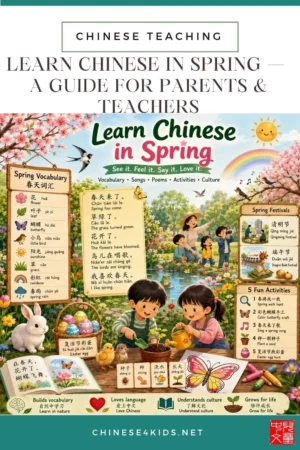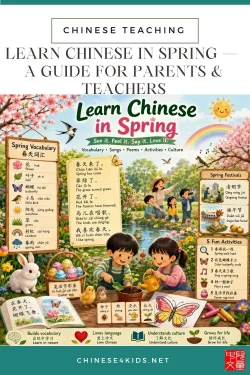
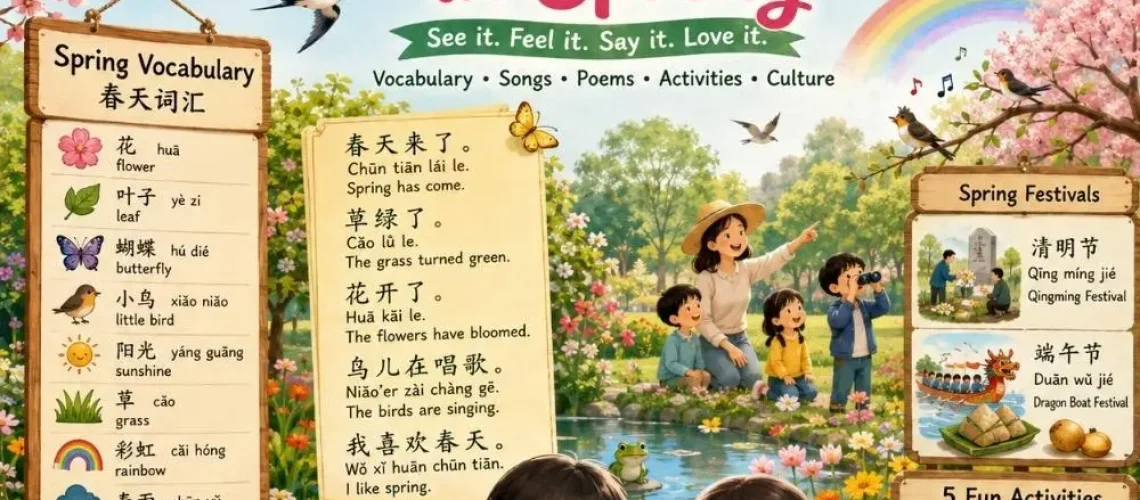
As winter fades, spring brings a burst of new life.
Grass turns green. Trees bud with new leaves. Flowers bloom. Birds sing. Small animals scurry about in the warm sunshine.
For young Mandarin learners, this is a gift. Learning Chinese in spring is easier than at any other time of year. Why? Because children can see, touch, hear, and smell what they are learning. A walk in the park becomes a vocabulary lesson. A blooming flower becomes a Chinese word. A rainy morning becomes a song.
In this guide, you’ll find everything your child needs to learn Chinese in spring:
- 40+ spring words in Chinese with pinyin
- Spring nursery rhymes and a butterfly tongue twister
- A short children’s poem about spring
- Easy spring Chinese reading
- Gardening and coloring activities
- Easter Chinese vocabulary
- All our spring printable resources, organised in one place
Spring Vocabulary in Chinese — The Essentials
Start with the words your child will see and hear every day in spring. Each word below has the characters, pinyin, and English.
The Season Itself
春天 (chūn tiān) — spring
春风 (chūn fēng) — spring breeze
春雨 (chūn yǔ) — spring rain
温暖 (wēn nuǎn) — warm
阳光 (yáng guāng) — sunshine
Plants Coming to Life
花 (huā) — flower
花朵 (huā duǒ) — flowers (a more poetic word)
草 (cǎo) — grass
树 (shù) — tree
叶子 (yè zi) — leaf
种子 (zhǒng zi) — seed
Spring Weather
太阳 (tài yáng) — sun
风 (fēng) — wind
雨 (yǔ) — rain
彩虹 (cǎi hóng) — rainbow
蓝天 (lán tiān) — blue sky
Spring Animals
蝴蝶 (hú dié) — butterfly
蜜蜂 (mì fēng) — bee
小鸟 (xiǎo niǎo) — little bird
燕子 (yàn zi) — swallow
青蛙 (qīng wā) — frog
小鸡 (xiǎo jī) — chick
兔子 (tù zi) — rabbit
Colours of Spring
红色 (hóng sè) — red
黄色 (huáng sè) — yellow
绿色 (lǜ sè) — green
粉色 (fěn sè) — pink
紫色 (zǐ sè) — purple
Useful Spring Phrases
春天来了。 (Chūn tiān lái le.) — Spring has come.
草绿了。 (Cǎo lǜ le.) — The grass turned green.
花开了。 (Huā kāi le.) — The flowers have bloomed.
鸟儿在唱歌。 (Niǎo’er zài chàng gē.) — The birds are singing.
我喜欢春天。 (Wǒ xǐ huān chūn tiān.) — I like spring.
Notice the small word 了 (le) at the end of 草绿了 and 花开了. It is a tiny but important grammar marker. It tells us something has changed — the grass became green, the flowers began to bloom. Spring is the perfect season to introduce this useful word.
For displaying these words at home or in class, the Spring Chinese Montessori 3-Part Flashcards are perfect. Print, cut, and stick on the wall — instant vocabulary reference.
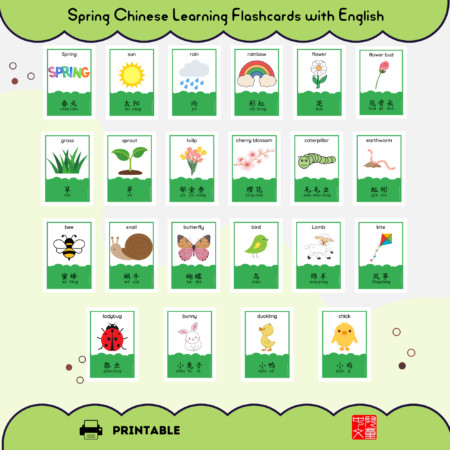
*Source: Spring Montessori 3-Part Chinese Learning Flashcards
Spring Animals and Farm Visits
Spring is when baby animals appear. Visits to farms, parks, and zoos become language lessons too.
Common farm animals in Chinese
牛 (niú) — cow
羊 (yáng) — sheep
猪 (zhū) — pig
鸡 (jī) — chicken
鸭子 (yā zi) — duck
马 (mǎ) — horse
If your child loves farm animals, our Farm Animals Chinese Learning Pack covers them in detail with flashcards, a word wall, and activity sheets.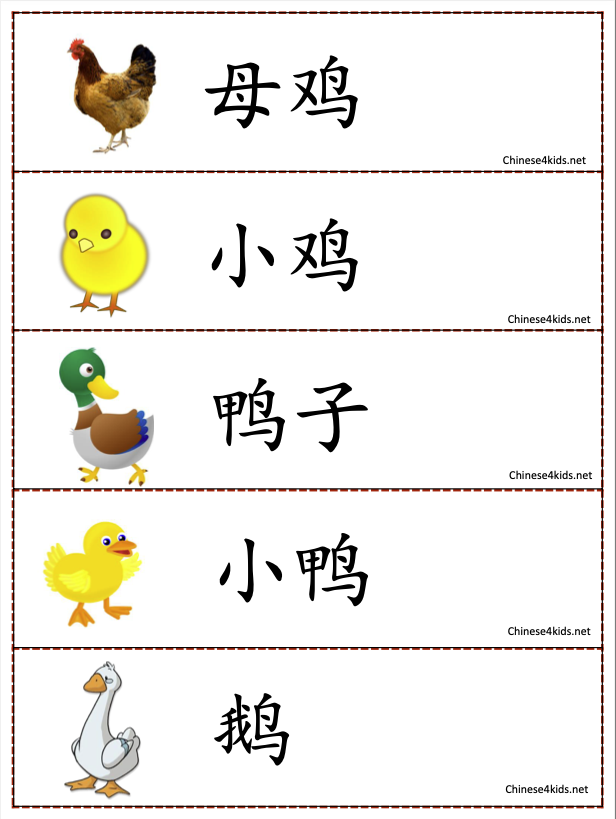
Mom and baby animals
Spring is the season of baby animals. Teaching your child the names of both the parent and the baby — 牛 and 小牛 (calf), 鸡 and 小鸡 (chick), 鸭 and 小鸭 (duckling) — opens up a whole new conversation. Our Mom and Baby Farm Animals Montessori Flashcards< make this easy.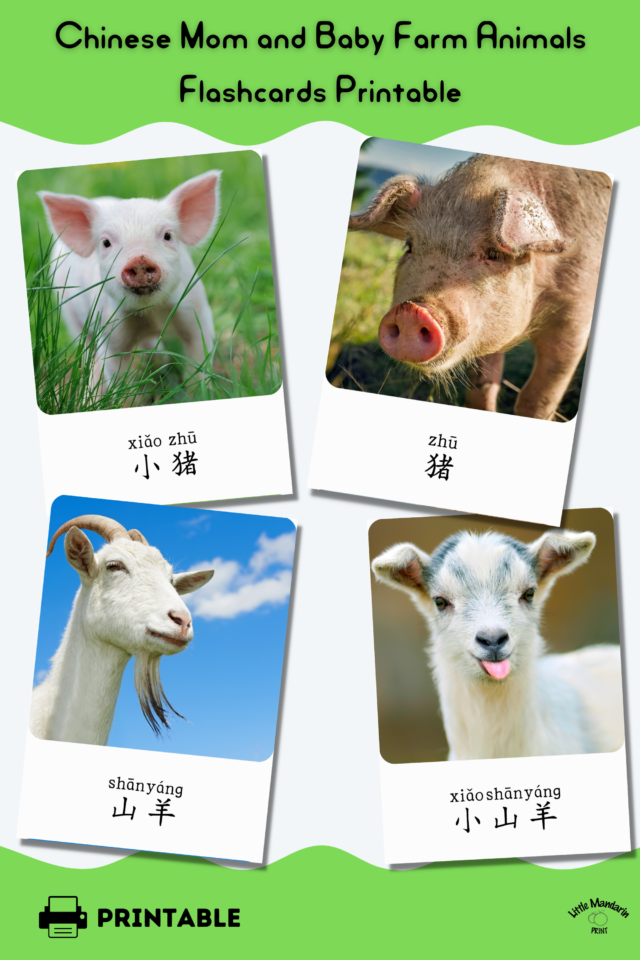
Animal sounds in Chinese
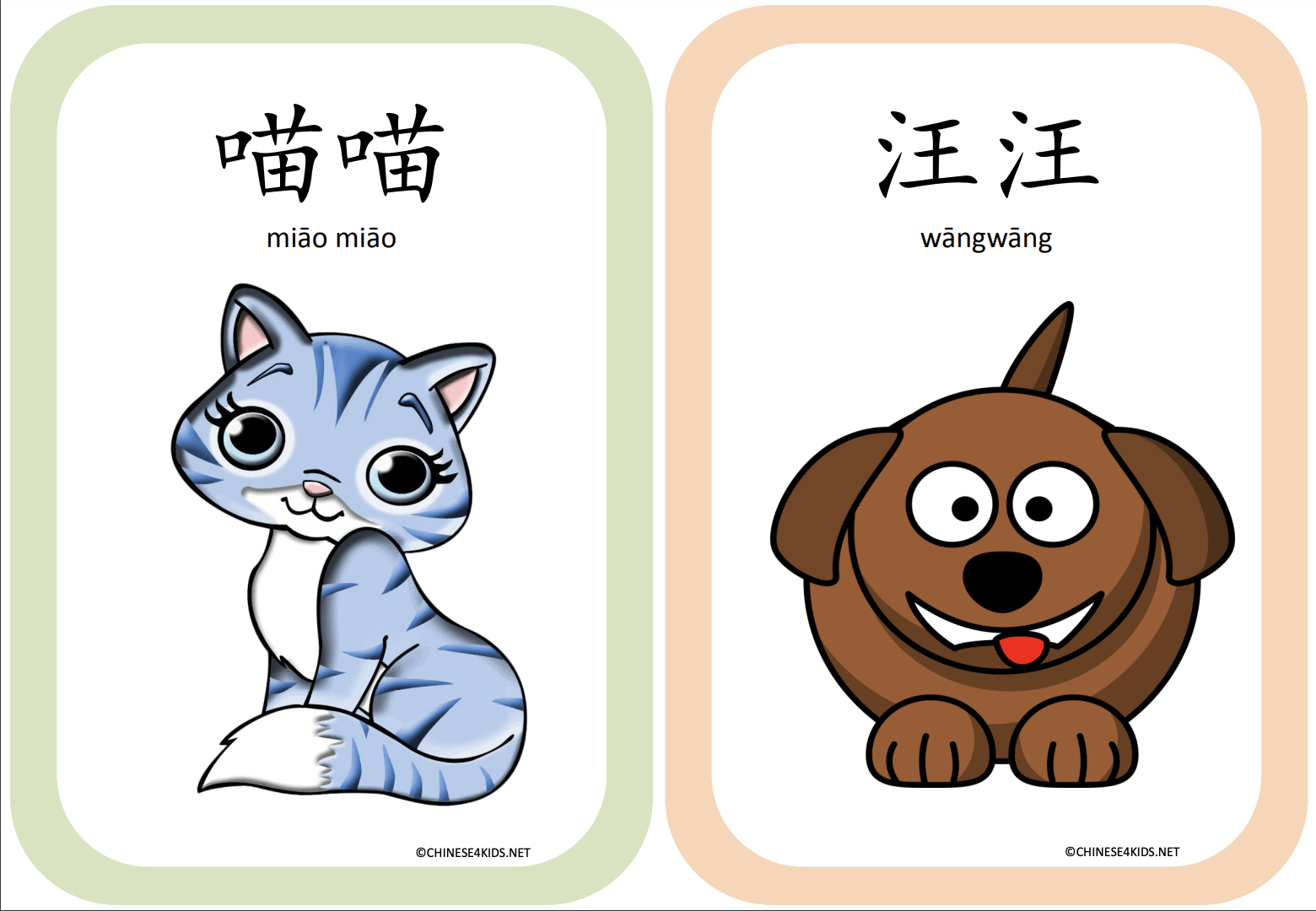
A small but delightful fact: animals “say” different things in Chinese. A dog says 汪汪 (wāng wāng). A cat says 喵喵 (miāo miāo). A cow says 哞哞 (mōu mōu). Children love this — it always brings laughter.
For a full list, see our Chinese Animal Sounds Theme Learning Pack with flashcards and worksheets.
Some other vocabulary like the clothes for Spring are also good for kids to learn
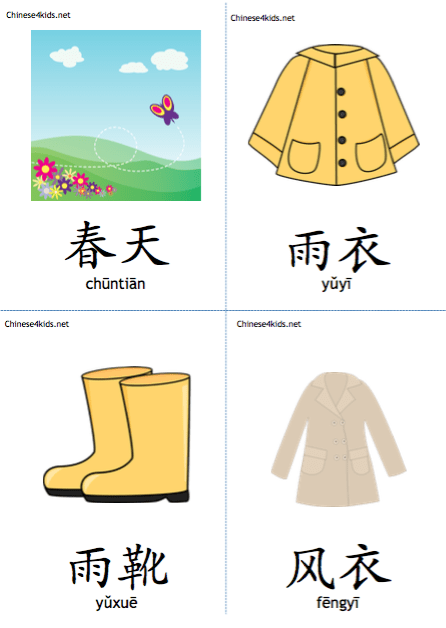 source: Theme Vocabulary Pack – Seasonal Clothes
Spring Nursery Rhymes in Chinese
Songs are one of the easiest ways for children to absorb Chinese. The melody carries the tones. Repetition feels like play. Spring rhymes are gentle, easy to learn, and full of seasonal vocabulary.
Here is one beloved spring rhyme:
春风春风,脚步轻轻 Chūn fēng chūn fēng, jiǎo bù qīng qīng Spring breeze, spring breeze, walking softly
走近小草,轻轻一亲 Zǒu jìn xiǎo cǎo, qīng qīng yì qīn Coming to the little grass, with a gentle kiss
小草醒了 Xiǎo cǎo xǐng le The grass wakes up
Simple. Beautiful. Easy to sing.
For five more spring rhymes, see our full guide to 6 Chinese Nursery Rhymes for Spring.
If you’d like the rhymes printed and ready to teach, our Chinese Nursery Rhymes for Spring eBook has all six in one printable pack.
For families who love animal songs, our Animals Rock: Chinese Animal Nursery Rhymes book brings animal vocabulary to life through rhyme.
A Butterfly Tongue Twister for Spring
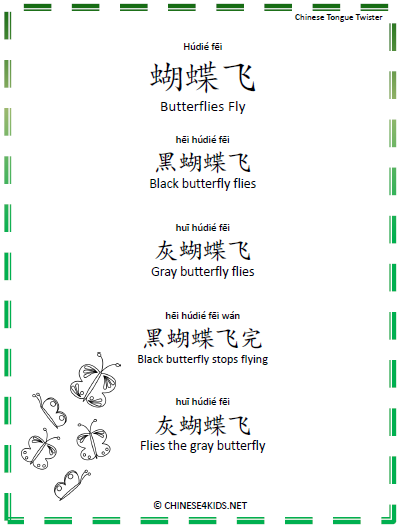
Spring brings butterflies — and butterflies bring a wonderful tongue twister. This one is short, silly, and brilliant for practising the tricky h and f sounds.
黑蝴蝶飞完,灰蝴蝶飞。
Hēi hú dié fēi wán, huī hú dié fēi.
When the black butterfly finishes flying, the grey butterfly flies.
The three key words to watch:
黑 (hēi) — black
灰 (huī) — grey
飞 (fēi) — to fly
*Source: Spring Theme Learning and Activity Worksheets
Try it slowly. Then faster. Then faster still. Both you and your child will giggle by the third try — which is exactly the point. Laughter and language go together.
For more pronunciation play, see our guide to Chinese tongue twisters for children.
A Children’s Poem: Spring Is Getting Near
Children’s poems work just like rhymes — short, rhythmic, easy to memorise. A spring poem teaches vocabulary, sentence rhythm, and a love of language all at once.
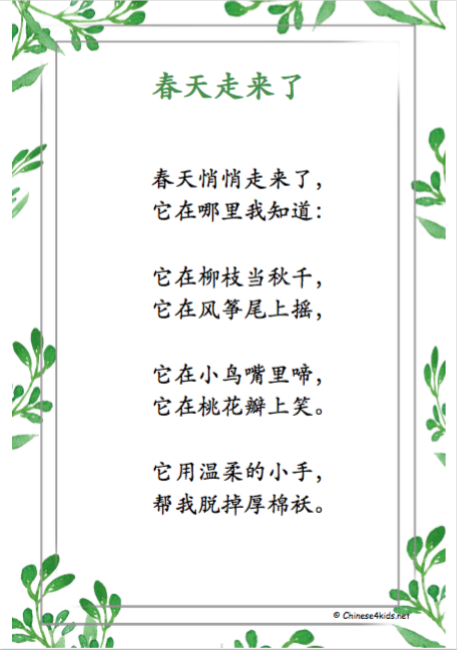
Our Spring Is Getting Near — Chinese Children’s Poem and Activity Worksheets gives you the full poem plus printable activities to use after reading. It is one of the most loved spring resources in our collection.
Spring Reading in Chinese
Reading even one small book in Chinese gives children huge confidence. Here is a short, beginner-friendly passage your child can practise.
在春天 Zài chūn tiān In Spring
在春天,草绿了。 Zài chūn tiān, cǎo lǜ le. In spring, the grass turns green.
在春天,花开了。 Zài chūn tiān, huā kāi le. In spring, the flowers bloom.
在春天,鸟儿唱歌。 Zài chūn tiān, niǎo’er chàng gē. In spring, the birds sing.
在春天,蝴蝶飞舞。 Zài chūn tiān, hú dié fēi wǔ. In spring, the butterflies dance.
我喜欢春天。 Wǒ xǐ huān chūn tiān. I love spring.
Six lines. Six wins. Read it aloud together, point to each character, and celebrate every line.
For more beginner reading material, our My Very First Chinese Reading and My First Chinese Reading series are designed for children just starting out — see them in the Chinese Reading Books for Kids section.
Learning Chinese in Gardening
Spring is the natural season for gardening — and the garden is one of the best classrooms a parent can have.
As your child plants a seed, name each step in Chinese: 这是种子 (this is a seed), 种子在土里 (the seed is in the soil), 我们浇水 (we water it). When the first green shoots appear, celebrate: 绿色! 春天! 长大了!
Gardening also teaches useful action verbs that don’t appear in flashcards — 种 (zhòng — to plant), 浇水 (jiāo shuǐ — to water), 长大 (zhǎng dà — to grow).
For a ready-made set of materials, our Gardening and Plants Chinese Learning Pack has printable worksheets, flashcards, coloring pages, and games — all built around plants and gardening vocabulary.
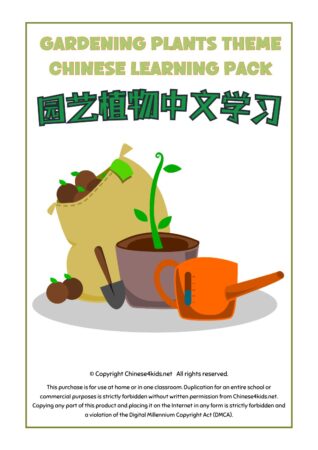
Source: Gardening- Plants Chinese Learning Pack for Kids
Spring Coloring Activities
Coloring is the easiest activity in the world — and one of the most effective for learning. A child colouring a butterfly while saying 红色蝴蝶 (red butterfly), 黄色蝴蝶 (yellow butterfly) is layering vocabulary, colour, and animal name in a single happy moment.
Two of our most loved spring coloring resources:
- 🎨 Color and Learn Chinese Vocabulary Workbook — Spring — colour and learn spring vocabulary at the same time
- 🐰 Spring Animal Chinese Coloring Pages — 20 cute spring animals to colour, trace, and name (also a lovely Easter activity)
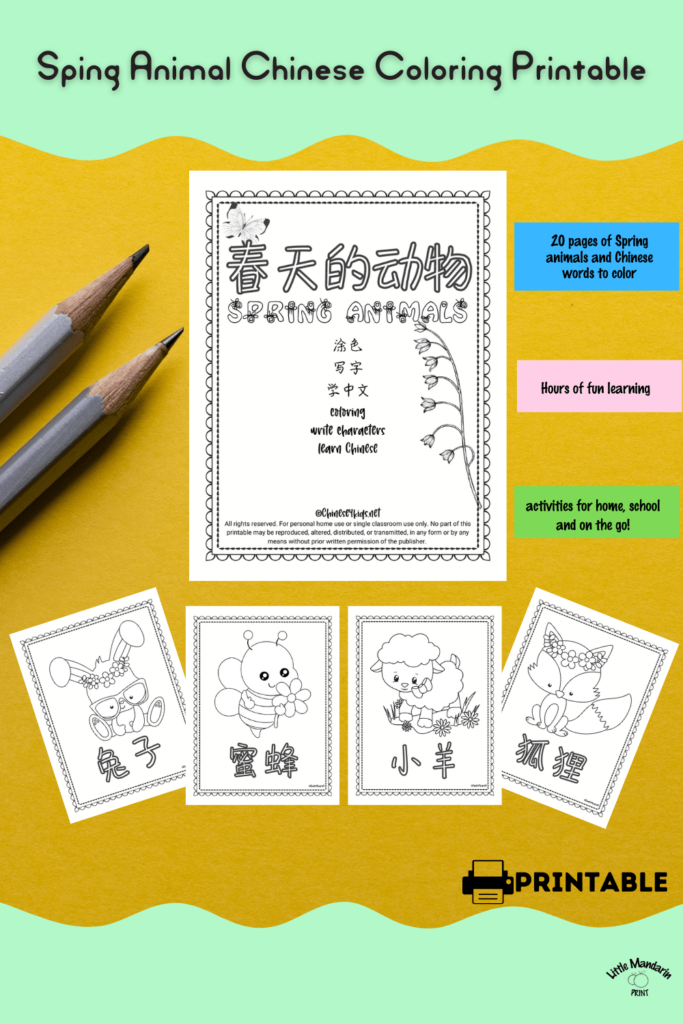
*source: Spring Easter Animal Chinese Coloring Pages for Kids
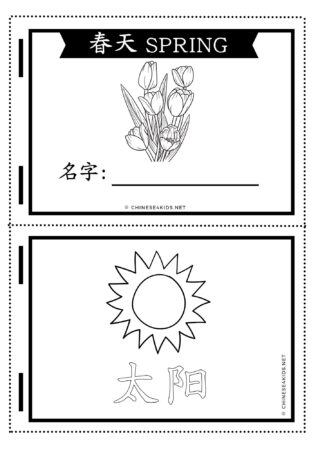
source: Color and Learn Chinese Vocabulary Workbook – Spring
Spring Clothes — A Practical Vocabulary
Spring brings warmer days, lighter clothes, and a new wardrobe — which means new vocabulary. Teach your child the spring clothes they actually wear: 外套 (jacket), 衬衫 (shirt), 裙子 (skirt), 鞋子 (shoes).
For a complete set, see our Seasonal Clothes Chinese Theme Pack — clothes vocabulary for all four seasons, with flashcards and worksheets.
Easter Chinese Learning
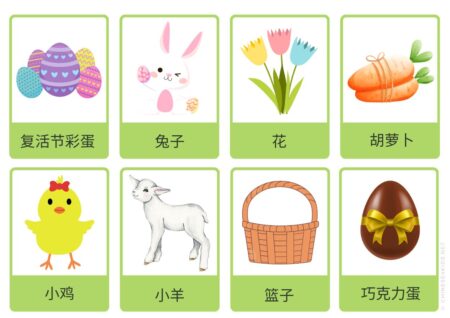
For many families, Easter (复活节 — fù huó jié) is the highlight of spring. Children love the decorations, the food, and most of all — the egg hunt!
Easter is also a wonderful time to introduce some new Chinese vocabulary:
- 复活节 (fù huó jié) — Easter
- 复活节彩蛋 (fù huó jié cǎi dàn) — Easter egg
- 兔子 (tù zi) — rabbit
- 找彩蛋 (zhǎo cǎi dàn) — to hunt for eggs
For full activities, see our guide to Learning Chinese during Easter — Fun Activities for Kids.
Other Spring Celebrations: Qingming and Dragon Boat
As spring moves on, two important Chinese festivals appear:
- 清明节 (Qīng míng jié) — the Qingming Festival, when families remember and honour their ancestors with tomb-sweeping and outings into nature
- 端午节 (Duān wǔ jié) — the Dragon Boat Festival, with sticky-rice 粽子 (zòng zi) and dragon boat races
For a deeper look, see our guide to Duanwu Jie — the Dragon Boat Festival.
These festivals turn spring into a season of culture, not just vocabulary.
5 Fun Teaching Activities for Spring Chinese
Spring vocabulary is best learned outdoors and through play. Here are five activities that work straight away.
1. The spring walk hunt
Take your child on a walk with a small list of spring words. Ask them to spot each one and name it in Chinese — a 花, a 蝴蝶, a 树, a 鸟. The world becomes a Chinese textbook.
2. The colour butterfly craft
Cut a butterfly shape from paper. Let your child colour it however they like. As they colour, name each colour in Chinese — 红色, 黄色, 绿色. When finished, ask: 你的蝴蝶是什么颜色? (What colour is your butterfly?)
3. “Spring has come” — a tiny song
Sing 春天来了, 春天来了 (Spring is here, spring is here) to a happy tune of your choice. Add lines as you go: 草绿了, 花开了, 蝴蝶飞了. Children remember songs faster than word lists.
4. Plant a seed together
Plant a real seed in a pot. Each day, check it and say 种子长大了吗? (Has the seed grown?) When green shoots appear, celebrate. Real learning sticks because it is real.
5. The Easter egg vocabulary hunt
Hide plastic eggs around the house. Inside each one, put a Chinese word card. When your child finds an egg, they have to say the word aloud. Egg hunt + Chinese practice — two activities, one happy child.
For more outdoor ideas, see our guide to Spring Into Chinese: Fun Outdoor Activities.
What Your Child Is Really Learning
A spring vocabulary lesson teaches far more than season words. Here is what your child gains.
- High-frequency characters. Words like 来 (come), 了 (a key grammar marker), 在 (at/in), 是 (is), 喜欢 (like) appear in spring sentences again and again — and in almost every Chinese conversation.
- The 了 (le) grammar pattern. Spring is perfect for teaching this little word — 草绿了, 花开了, 春天来了. It marks change, and children meet it naturally through the season.
- Sentence-building skills. 我看见一只蝴蝶。 (I see a butterfly.) — a complete, real sentence built from common words.
- Cultural awareness. Spring is deeply tied to Chinese culture — from Qingming to Dragon Boat to Spring Festival.
- A lifelong love of nature in Chinese. A child who learns 花, 草, 鸟, 蝶 in childhood will see those words in poems, songs, and stories for the rest of their life.
For more, see our guide to building a Chinese immersion environment at home.
All Our Spring Chinese Resources — One Place
Here are all our spring learning resources, organised so you can pick what fits your family or class.
Complete spring packs (best value)
- 🌸 Spring Theme Chinese Learning and Activity Worksheets — vocabulary flashcards, butterfly worksheets, the “In Springtime” reading book, the butterfly tongue twister, and more
- 🌷 Gardening and Plants Chinese Learning Pack — worksheets, flashcards, coloring pages, and games around gardening
- 🍎 Farm Animals Chinese Learning Pack — flashcards, word wall, and activities for farm animal vocabulary
Flashcards
- 🌸 Spring Chinese Montessori 3-Part Flashcards — classic 3-part Montessori cards
- 🐄 Mom and Baby Farm Animals Flashcards — parent and baby animal pairs
- 🔊 Chinese Animal Sounds Pack — flashcards and worksheets for animal sounds
Coloring and creative
- 🎨 Color and Learn Chinese Vocabulary Workbook — Spring
- 🐰 Spring Animal Chinese Coloring Pages — 20 spring animals to colour and trace
Songs and poems
- 🎵 Chinese Nursery Rhymes for Spring (printable)
- 🎶 Animals Rock — Chinese Animal Nursery Rhymes Book
- 📜 Spring Is Getting Near — Children’s Poem and Activity Worksheets
Practical and seasonal
- 👕 Seasonal Clothes Chinese Theme Pack — clothes vocabulary for all seasons
- 🌳 Chinese Word Wall for All Four Seasons — display the season vocabulary on the wall
Everything is instant-download. Print and use today.
Membership tip: if you’re a Chinese4kids member, many of these packs are already included in the member area.
Free Download: Top 100 Chinese Characters
Many of the most common characters in this guide — 春, 来, 了, 在, 是, 我, 花 — are part of the Top 100 most frequently used Chinese characters. Once your child knows the top 100, spring vocabulary and beginner reading both become much easier.
👉 Download the free Top 100 Chinese Characters here
Print it. Stick it on the fridge. Tick off one character a day.
Final Thought
Spring is a gift to Chinese learners. It gives children real things to see, real words to say, and real reasons to use their Chinese.
Take one spring word today — 花. Find a flower together. Say its name. Tomorrow, learn another — 蝴蝶. Sing a spring rhyme. Plant a seed. Colour a butterfly.
In just a few weeks, your child will be naming half the garden in Chinese. That is exactly what learning Chinese should feel like — gentle, joyful, and rooted in real life.
春天来了!
– updated in April 2026
Further Reading on Chinese4kids
- 📖 Spring Into Chinese: Fun Outdoor Activities — take Chinese outside this spring
- 📖 6 Chinese Nursery Rhymes for Spring — beloved spring songs with full lyrics
- 📖 Where Is Spring? 春天在哪里 — A Children’s Song Guide — a single-song deep dive
- 📖 Learning Chinese During Easter — fun Easter activities for kids
- 📖 Duanwu Jie — Dragon Boat Festival — late-spring cultural learning
If you like the post, share it