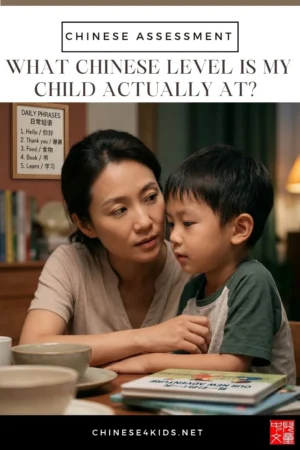
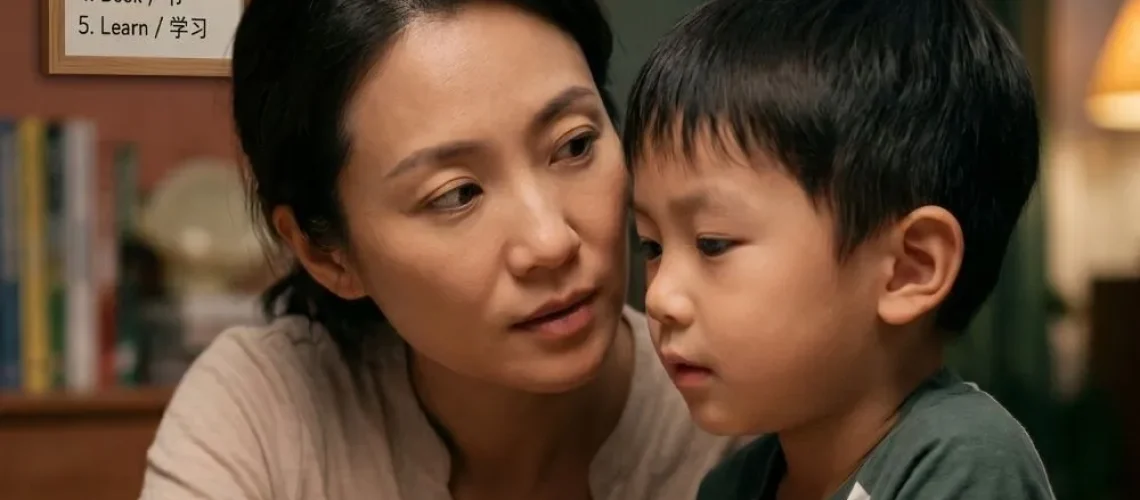
It’s dinner time. You casually ask your child in Chinese, “今天学校怎么样?”
They glance up and reply, “It was fine.
You pause for half a second, and that familiar question surfaces again —
What level is his Chinese, really?
Not for a test. Not to compare with someone else’s child. Just to know: is what we’re doing at home actually working? Is he making progress, or stuck in place? Should we push harder, or back off?
Almost every overseas Chinese parent has asked themselves this question. Overseas Chinese teachers get pulled aside by parents asking it too — “So what level would you say she’s at?” — and find that the honest answer is harder to give than it should be.
HSK was designed for learners living in China. School grade benchmarks even more so. And the “Mandarin as a foreign language” assessments used in most Western schools are often so loose that they give parents a false sense that everything is fine.
Overseas children are a distinct population: some Chinese at home, maybe two hours of weekend class, living in an English-speaking world, with perhaps ten or fifteen minutes of real Chinese input on a typical day. Measuring them against any single existing standard will distort the picture.
So this article doesn’t give you a test. It gives you a set of milestones you can actually observe in daily life — at the dinner table, in the car, during bedtime reading.
- These are standards for overseas children, not children in China.Every indicator below assumes Chinese as a second language, with limited daily exposure. Please don’t use it to compare your child to peers in China — that isn’t fair, and it isn’t useful.
- Age is a starting point, not a verdict.A child who began learning Chinese at age eight will look very different at ten from a child who has heard Chinese since birth. Direction of progress matters more than whether a specific box gets ticked.
- Everyday observation beats formal testing.You can spot every indicator below while cooking dinner, driving to school, or reading a bedtime story. You don’t need to sit your child down and quiz them — and I’d actually recommend against it, especially for younger children. The moment Chinese becomes “the thing being evaluated,” resistance climbs far faster than any data point can justify.
Ages 3–5: The Listening and Speaking Foundation
At this stage, the goal is not reading. Not writing. Not even “learning” Chinese in any formal sense.It’s about letting your child build a natural relationship with the sound, rhythm, and basic vocabulary of Chinese.
Children this age absorb language through play, song, repetition, and interaction — not through explanation. The harder you try to “teach,” the less it works.
A child developing well at ages 3–5 will typically:
- Understand common household phrases (吃饭了, 睡觉了, 来这里, 把鞋脱了)
- Follow simple Chinese instructions without needing translation
- mitate Chinese words, songs, or phrases they hear — pronunciation imperfect is fine
- Recognise 10–20 common Chinese characters in their environment (books, food packaging, familiar signs)
- Engage happily with Chinese picture books, songs, or cartoons — without resistance
- Occasionally produce Chinese words or short phrases on their own
At this stage, the only thing you need to do is: keep Chinese present
No textbooks required. No daily “study time” required. What you need is:
- One adult who consistently speaks Chinese to the child (even if it’s just one parent — consistency matters more than scale)
- Chinese songs as background audio — during bath time, car rides, cooking
- A few Chinese picture books each night — doesn’t have to be many; one or two read over and over is plenty
Common worries and how to read them:
- “My child only says single words, not full sentences. Is something wrong?” — Usually not. Bilingual children often have a later productive stage than monolingual peers. If the input is there, the output will come.
- “He runs away whenever I put on Chinese.” — Most of the time, this isn’t about Chinese itself. It’s about the context Chinese has been associated with (usually: study tasks). Try embedding Chinese into play and everyday life, not the desk.
If you want a deeper look at how second language acquisition unfolds naturally, this article on Chinese4kids is worth reading:
👉 5 Stages of Children’s Chinese Acquisition as a Second Language.
Ages 6–8: Vocabulary, Characters, Early Reading
This is when many overseas families start introducing more structured learning — weekend Chinese school, a home curriculum, graded readers.
There’s a good reason: cognitively, children this age are ready to learn characters systematically, and their memory for new vocabulary is at a peak. You haven’t missed the window if you start later, but it gets harder.
A child developing well at ages 6–8 will typically:
- Recognise 50–150 common characters
- Understand simple sentences spoken at a moderate pace
- Read aa or A level graded readers with support
- Write basic characters with reasonable accuracy (stroke order still developing is fine)
- Produce 4–6 character spoken sentences (我想吃苹果, 今天很冷, 妈妈在哪里)
- Understand the pinyin system and use it to decode unfamiliar words
- Have vocabulary for everyday topics: family, food, numbers, colours, animals, body parts, weather<
Your job at this stage: build vocabulary systematically, and start reading early
The jump from “recognising individual characters” to “reading characters in sentences” is the defining milestone of this age range. The earlier it happens, the more momentum carries forward.<
The most common trap parents fall into here: their child has learned 200+ characters but has never read a single complete book. As a result, the child starts to believe that Chinese is character recognition — which is boring, repetitive, and offers no sense of accomplishment.
The milestone that matters isn’t “how many characters they know.” It’s the look on their face the first time they finish a small book by themselves.
Common mistakes
- All writing practice, no reading practice. A lot of weekend Chinese school homework is copying characters. A child can spend two hours a week writing and never read a single book. Writing matters — but it shouldn’t crowd out reading.
- Drilling stroke order to breaking point. Stroke order matters, but it’s not the most important thing for a seven-year-old. Let them fall in love with the language first. Polish the details later.
For a very concrete guide to helping your child cross into Chinese reading at this age, Chinese4kids has a step-by-step walkthrough:
👉 A Step-by-Step Guide for Kids to Chinese Reading.
Ages 9–11: Reading Takes Off — or Stalls
This is the make-or-break window for overseas Chinese learners.
Children who built a solid vocabulary foundation in earlier years will often experience a visible leap here — they start reading rather than guessing. Reading becomes pleasurable rather than painful.
Children who didn’t? They start to notice the growing gap between their English literacy (chapter books, independent reading) and their Chinese literacy (still decoding sentence by sentence). And that gap, felt at this age, often slides from “Chinese is hard.” into >“I don’t like Chinese.” Once the second belief takes hold, reversing it is much harder than preventing it.
A child developing well at ages 9–11 will typically:
- Independently recognise 200–400 common characters
- Read B or C level graded readers with growing fluency
- Follow natural-pace spoken Chinese on familiar topics
- Produce structured spoken sentences of 8–12 characters
- Write short paragraphs from memory or dictation
- Use Chinese in real contexts — asking questions, expressing preferences, telling small stories
- Understand the difference between simplified and traditional characters (even if using only one)
- Catch and self-correct obvious errors in their own spoken Chinese
The single highest-leverage thing at this stage: let them read independently
Even ten minutes a day of independent reading outperforms any classroom at this age.
The job of a classroom is to scaffold. The job of reading is to fill in the flesh between the bones of that scaffolding. For overseas children, roughly 90% of vocabulary growth comes from outside the classroom — specifically, from reading.
But the key is: the book has to be the right level. Too hard, and they quit after two pages. Too easy, and they feel talked down to. Finding the “slightly challenging but still enjoyable” sweet spot is the central task for parents at this stage.
If your 9–11 year old shows any of these, don’t dismiss them:
- ⚠️ Actively refuses Chinese (“I don’t want to speak Chinese,” “I don’t want to read Chinese books”)
- ⚠️ Responds only in English to Chinese questions for months
- ⚠️ Looks at a Chinese character and says “I don’t know it” — even for characters they’ve studied
These usually aren’t ability problems. They’re the emotional door closing first, before the cognitive one even gets tested. Adding more practice at this point tends to slam the door further, not open it. Handle the emotion first; the content can wait a week or two.
For a deeper understanding of how Chinese literacy actually develops in stages, this article will help a lot:
👉 5 Phases of Chinese Literacy Development.
Ages 12–14: Consolidation, and Making Chinese Useful
By this age, the foundations have either been laid or they haven’t — and regardless of which, the focus has to shift.
Teenagers have very little patience for “being taught Chinese.” But they can have a surprising amount of energy for “using Chinese to do something I actually care about.” The biggest failure mode at this age isn’t that they can’t learn — it’s that they decide learning Chinese is pointless.
A child developing well at ages 12–14 will typically:
- Sustain a conversation with a Mandarin-speaking adult or peer on familiar topics
- Write a short paragraph with minimal support
authentic use
Teenagers don’t learn Chinese “to learn Chinese well.” They learn Chinese in order to:
- Actually talk with 爷爷奶奶 / 外公外婆 on video calls
- Understand a Chinese drama they’re into
- Connect online with Chinese-speaking peers in communities they care about
- Prepare for HSK, GCSE, or AP Chinese — something that can go on a transcript
- Have a real trip to China, Taiwan, or Singapore feel different from a tourist visit
Your job — and the teacher’s job — is to help them find one of those “whys.”
The content comes second; the reason comes first.
One Anchor That Matters More Than Age: 300 Words
If you’ve read through the four age-range checklists above, you may have noticed a pattern —
Regardless of when a child starts, there’s a threshold. Below it, everything is a struggle. Above it, things start to flow.
That threshold sits at roughly 300 high-frequency words.
Research in Chinese language acquisition consistently points to this number. Below 300 words, a child hits an unfamiliar character in nearly every sentence. Reading becomes decoding — painful, slow, and demoralising.
Around 300 words, something changes:
- They can recognise most characters in a sentence
- For the ones they don’t know, they can guess from context
- For the first time, they experience “I’m reading,” not “I’m decoding”
- Reading shifts from task to possible pleasure
This is exactly why we built Vocabulary Made Easy around the shortest possible path to those 300 words — designed for overseas children aged 6–10, organised thematically, introduced in context, and sequenced to give the highest reading payoff for the least amount of effort. The word list is closely aligned with HSK 1 and HSK 2, so progress maps onto an internationally recognised standard as you go.
More practically: if you’ve read the checklists above and still aren’t sure where your child stands, a high-frequency word list is a ruler you can actually hold up.
📥 Free Download: The Top 100 Most Common Chinese Characters
After reading this far, a lot of parents ask the obvious follow-up question: “Okay — so where do we actually start?”
Start with 100.
Before 300 words feels achievable, 100 characters is the realistic first win — and it’s a remarkably high-leverage one. The 100 most common Chinese characters account for roughly 40–50% of everything written in daily Chinese text. Master these, and your child will recognise something on almost every page they open.
We’ve put together a free printable PDF of the Top 100 Most Common Chinese Characters — the exact list to start with, whether your child is six or twelve, whether you’re a parent teaching at home or a teacher looking for a focused high-frequency list to build lessons around.
✅ 100 characters, ordered by frequency
✅ Pinyin and English meaning for each character
✅ Printable format — stick it on the fridge, bring it to class, or use it as flashcards
✅ A practical starting point whether your child is just beginning or has been learning for a while and needs a confidence check
(Drop your email and it’s yours. We occasionally send practical resources for overseas Chinese teaching and parenting. Unsubscribe any time.)
Once your child has these 100 down, Vocabulary Made Easy is the natural next step — it takes them from those first 100 characters all the way through the 300-word threshold where real reading begins.
What to Do With Your Results
If your child is hitting most of the indicators: Keep going. Don’t add more. Don’t change methods. What you’re doing is working — steady reading and conversation will carry things forward on their own. The most common mistake at this stage is parental anxiety causing unnecessary disruption to something that’s already working.
If a few things are missing but the overall direction is right: Look at which category the gaps fall into.
- Vocabulary gaps are the most common and the most fixable. A systematic pass through high-frequency characters resolves most of them. (This is exactly why the Top 100 list is such a useful starting point — it closes the most common gaps fastest.)
- Speaking gaps usually reflect a lack of opportunity, not a lack of ability. Creating more low-pressure situations where Chinese is the natural choice — a video call with a cousin, a Chinese board game, one topic at the dinner table — does more than extra drilling.
- Listening gaps have essentially one solution: continuous passive input. Audiobooks, Chinese cartoons, podcasts in the background.
If multiple areas are significantly behind: Resist the urge to add pressure.
More homework, stricter schedules, more reminders and monitoring — these are the things most likely to kill motivation at this age. And once motivation goes, you lose more than just progress.
Go back to basics:
- More Chinese listening input (easier than reading or speaking, and the real foundation)
- Use graded readers below your child’s level to rebuild the feeling that “Chinese is readable”
- Find one real reason they care about — a person, a show, a trip, a hobby
- Cut the negative experiences — even if that means temporarily reducing classes or homework. Break the association between Chinese and pain first.
A Note for Overseas Chinese Teachers
If you’re a Chinese teacher reading this —
The most valuable use of this checklist may not be for assessing your students. It’s for communicating with their parents.
Overseas parents tend toward one of two extremes in how they perceive their child’s Chinese. Either over-anxious (“Why can’t she write this yet?”) or over-optimistic (“As long as he understands, that’s enough, right?”). Both affect how parents support learning at home, and both affect what you can realistically do in the classroom.
Suggestions:
- Use this checklist as a start-of-term conversation tool with parentsto calibrate expectations
- Hammer home the message that >direction matters more than absolute level — this single idea lowers parental anxiety enormously, which in turn lowers pressure on the child
- Use a shared high-frequency vocabulary list with parents — concrete, achievable, measurable. Far more useful than vague encouragement to “keep practising.”
Need a resource you can hand directly to parents? The free Top 100 Most Common Chinese Characters PDF above is a perfect starting point — concrete, immediately useful, and a good conversation opener for “here’s what we’re working on in class, and here’s how you can reinforce it at home.”
Further Reading on Chinese4kids
- 📖 5 Phases of Chinese Literacy Development — The five stages of Chinese reading development from pre-reading to fluency, so you can locate where your child actually is
- 📖 5 Stages of Children’s Chinese Acquisition as a Second Language — Understanding the natural rhythm of second language acquisition helps set realistic expectations
- 📖 A Step-by-Step Guide for Kids to Chinese Reading — Concrete steps for building a Chinese reading habit at home
Wondering where your child sits on the road to the 300-word reading threshold? Vocabulary Made Easy gives overseas children aged 6–10 a systematic, thematically organised, carefully sequenced path through the most essential Chinese words — the bridge that takes them from “recognising characters” to actually reading real books.
If you like this post, share it