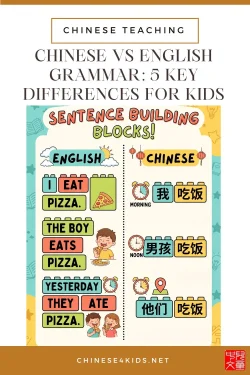
One of the first things parents notice when their child starts learning Mandarin is this: Chinese just works differently.
Not harder, necessarily. Just different — in ways that can quietly trip up a child who has only ever spoken English, if no one stops to explain what’s actually going on.
The good news? The core differences between Chinese and English grammar are surprisingly logical once you see them laid out. And for many children, understanding why Chinese works the way it does is the moment when the language stops feeling random and starts making sense.
Let’s through the five most important differences — with examples simple enough to explain to a child sitting next to you, and a few small tips for how to reinforce them at home.
At a Glance: Five Things Chinese Does Differently
Before we dig in, here’s the short version you can keep in your head:
| What changes in English | What Chinese does instead |
|---|---|
| Verbs conjugate (eat → eats → ate) | Verbs never change form |
| Tenses mark time (-ed, -ing, will) | Time words carry the meaning |
| Time/place sits at the end | Time and place come at the front |
| Word order flips to ask a question | Add 吗 to the end; done |
| Nouns are counted directly (two books) | A measure word sits between the number and the noun |
If that list already feels a little less intimidating than you expected — good. That’s the whole point. (If you want the bigger picture on this, Why Is Chinese Not So Difficult to Learn? is worth a read.)
1. No Verb Conjugation — Ever
In English, verbs change depending on who’s doing the action and when:
I eat → she eats
I walked → I will walk → I am walking
For a child learning a second language, verb conjugation is a real mental load. There are rules, and then there are the exceptions that break the rules, and then there are the irregular verbs that break everything.
In Chinese, verbs never change form. At all. The word 吃 (chī, “eat”) is 吃 whether you’re talking about yourself, your friend, your grandmother, something that happened yesterday, or something happening right now.
| I eat | 我吃 (wǒ chī) |
| English | Chinese |
| She eats | 她吃 (tā chī) |
| They ate | 他们吃 (tāmen chī) |
| We will eat | 我们吃 (wǒmen chī) |
How to explain it to a child:
“In Chinese, the verb never has to change its clothes. 吃 always looks the same, no matter who’s eating or when.”
This is one of the places where Chinese is genuinely simpler than English — and it’s worth pausing to celebrate with your child the moment they realise it. A small “wait, that’s it?” goes a long way toward building confidence.
2. No Tenses — Time Words Do the Work Instead
Closely related to the first point: Chinese has no past tense, no future tense, no present continuous. There are no verb endings like -ed or -ing to memorise.
Instead, Chinese uses time words to tell you when something happens. The verb itself stays the same.
| Time word | Meaning | Example |
|---|---|---|
| 昨天 (zuótiān) | yesterday | 昨天我吃苹果。I ate an apple yesterday. |
| 今天 (jīntiān) | today | 今天我吃苹果。I eat an apple today. |
| 明天 (míngtiān) | tomorrow | 明天我吃苹果。I will eat an apple tomorrow. |
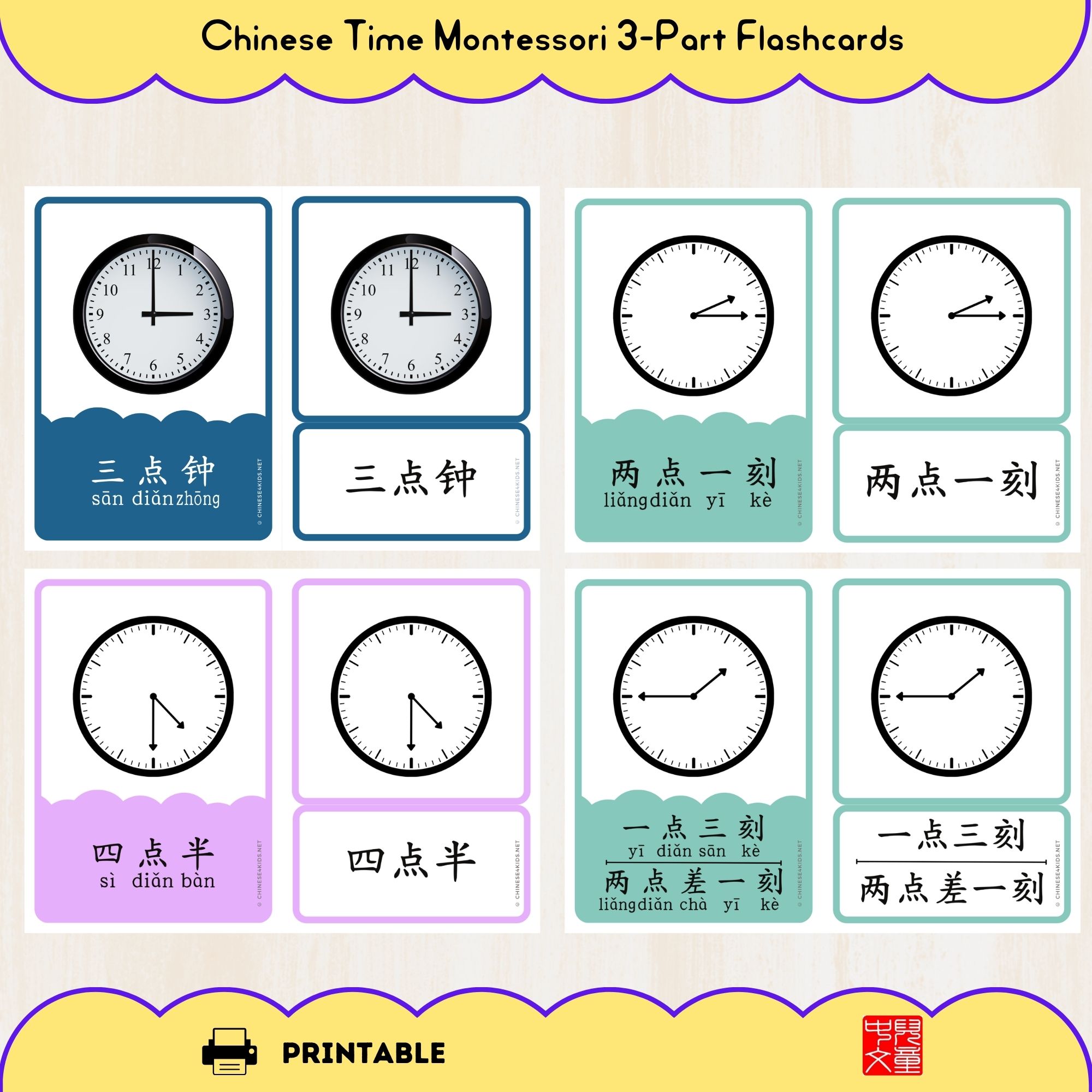
Notice that 吃 doesn’t change at all across these three sentences. Only the time word changes. (If your child is still getting comfortable with time-related vocabulary, How to Tell Time in Chinese is a good companion read.)
There is one small exception worth knowing: the particle 了 (le) is sometimes added after a verb to signal that an action has been completed — so you might hear 吃了 instead of just 吃. Even this isn’t a true tense marker; it’s more like a little flag that says “done.” Your child doesn’t need to master this immediately, but it’s useful to know why the sound occasionally appears.
How to explain it to a child:
“Chinese doesn’t change the verb to show time. Instead, it just says the time out loud — like putting a label on the sentence.”
Try this at home: Pick three time words — 昨天, 今天, 明天 — and ask your child to say the same simple sentence (我吃苹果) three times, swapping only the time word. Hearing the verb stay still while the time changes is the fastest way to make this rule click.
3. The Basic Sentence Order Is Familiar — but Time and Place Come Earlier
Here’s a relief: the basic sentence structure in Chinese is the same as in English.
Subject → Verb → Object
我 (wǒ) → 吃 (chī) → 苹果 (píngguǒ)
I → eat → apple
So far, so good. But when you add time or place to a sentence, Chinese puts them in a different position than English does.
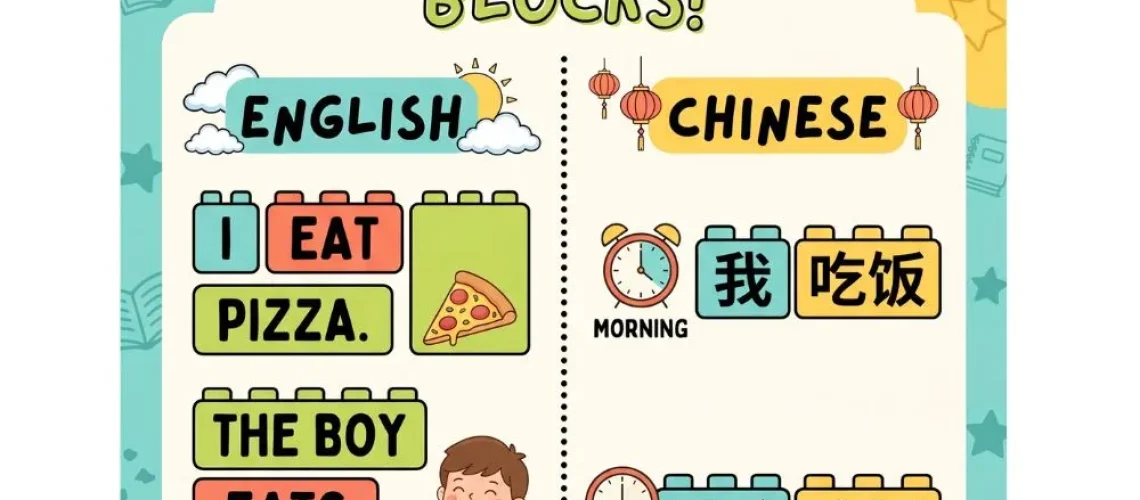
In English: I eat apples at school today. (我 + 吃苹果 + 在学校 + 今天 if we translate directly.)
In Chinese: 今天我在学校吃苹果。 (Today + I + at school + eat + apple)
The pattern in Chinese is:
Time → Subject → Place → Verb → Object
Think of it as setting the scene first — telling your listener when and where before getting to what’s happening. English tends to tack those details onto the end. Chinese front-loads them.
How to explain it to a child:
“In Chinese, you set the scene first — like a movie that shows you the time and place before the action starts.”
Once children understand this pattern, sentences that once looked scrambled suddenly have a logic to them. For a deeper dive into how to build sentences with your child step by step, see How to Teach Chinese Vocabulary: From Characters to Words to Sentences.
4. Questions Don’t Need Special Word Order
In English, forming a question usually means flipping the word order:
You are happy. → Are you happy?
She can swim. → Can she swim?
In Chinese, the word order doesn’t change at all. You simply add the particle 吗 (ma) to the end of a statement, and it becomes a question.
| Statement | Question |
|---|---|
| 你饿。(You are hungry.) | 你饿吗?(Are you hungry?) |
| 她会游泳。(She can swim.) | 她会游泳吗?(Can she swim?) |
| 他是学生。(He is a student.) | 他是学生吗?(Is he a student?) |
There’s also a second common question pattern, called A不A — essentially offering the positive and negative option side by side:
你饿不饿? (Hungry not hungry? = Are you hungry?)
你去不去? (Go not go? = Are you going?)
Both patterns work. 吗 is the easiest starting point for young learners; A不A tends to come naturally a bit later, once they’ve heard it in conversation.
How to explain it to a child:
“To ask a question in Chinese, you don’t move the words around — you just stick 吗 on the end, like a question mark that you actually say out loud.”
Try this at home: Pick five statements your child already knows (你好, 我饿, 她喜欢苹果…) and turn each one into a question by adding 吗. Five statements, five questions, no word-order gymnastics. This is often one of the fastest wins a beginner can have.
5. Measure Words: One for Every Category
This is the difference that surprises English speakers the most, and it’s worth spending a moment on.
In English, when you count nouns, you just put a number in front: one cat, two books, three apples.
In Chinese, you can’t do that. Between the number and the noun, you must insert a measure word (量词, liàngcí) — and different categories of nouns use different measure words.
| Measure word | Used for | Example |
|---|---|---|
| 个 (gè) | People and many general objects | 一个苹果 (one apple), 三个朋友 (three friends) |
| 本 (běn) | Books and bound items | 两本书 (two books) |
| 条 (tiáo) | Long, flexible things | 一条鱼 (one fish), 一条裤子 (one pair of trousers) |
| 只 (zhī) | Small animals | 两只猫 (two cats) |
| 张 (zhāng) | Flat things | 一张纸 (one piece of paper), 一张桌子 (one table) |
The most common measure word is 个 (gè), and children often overuse it at first — saying 一个鱼 instead of 一条鱼, for example. This is completely normal. Mastering measure words takes time and lots of exposure to natural Chinese.
The important thing is for children to understand why measure words exist — it isn’t arbitrary. Chinese is simply more precise about categorising the shape and nature of objects than English is.
How to explain it to a child:
“Chinese has special counting words for different types of things — like how in English you say ‘a slice of bread’ or ‘a piece of paper’ rather than just ‘one bread’. Chinese does this for everything.”
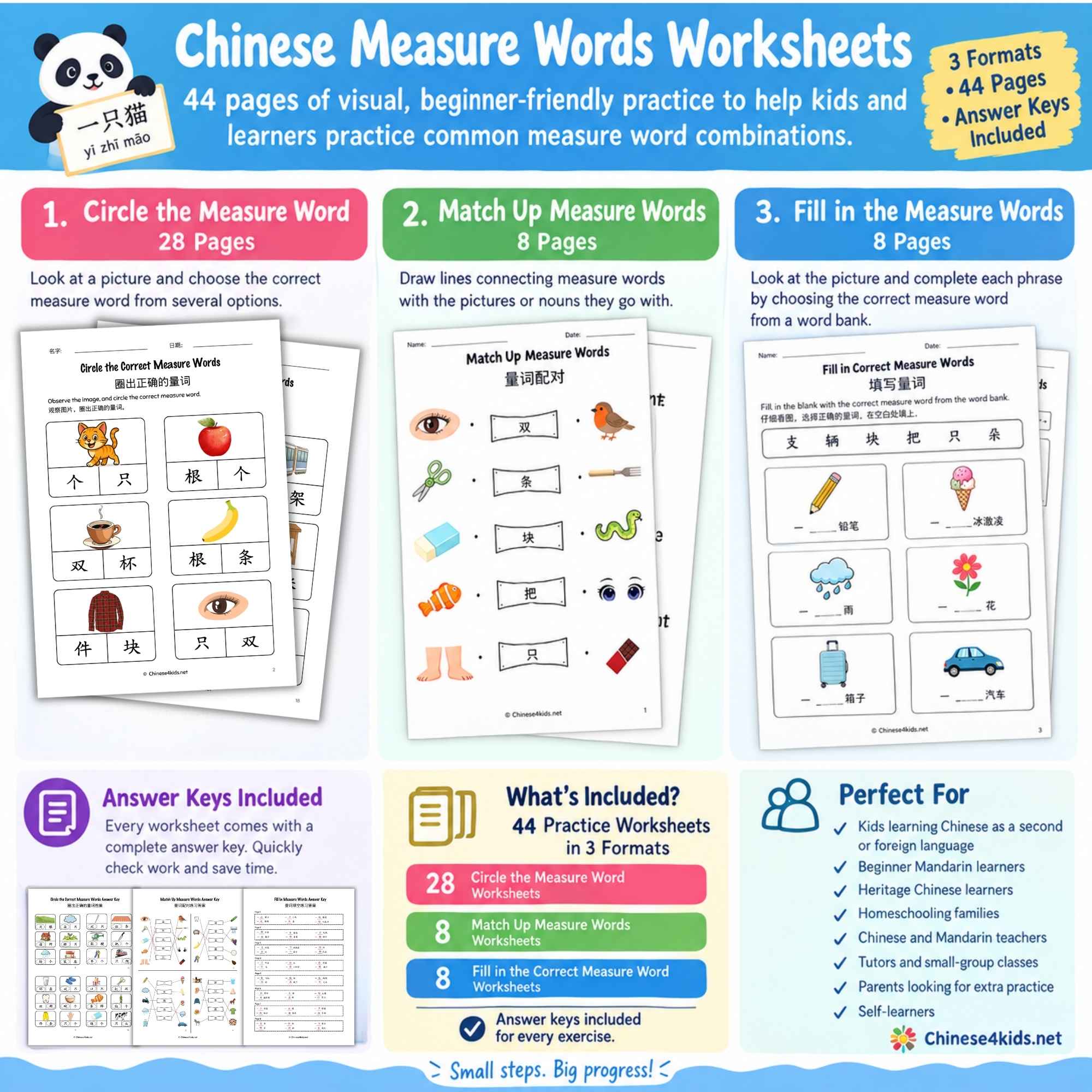
A note for parents: you don’t need to teach measure words all at once. It’s much more effective to learn them by category, alongside the vocabulary they go with. Chinese4kids has a whole library of themed measure-word guides to make this easier:
- Measure Words for People
- Measure Words for Animals
- Measure Words for Food
- Measure Words for Household Items
- Measure Words for Body Parts
- Measure Words for Tableware
- Measure Words for Transportation
Or browse the full measure words archive to pick whichever category fits what your child is learning this week.
Two Small Bonuses: No Plurals, No “a/an/the”
A couple of quick bonus differences that make Chinese a little kinder to beginners:
No plural forms.
Chinese nouns don’t change form to show plural. In English, one cat becomes two cats — the noun gains an -s. In Chinese, 猫 (māo) is cat whether you’re talking about one or ten. The number (and the measure word) tells you how many; the noun itself stays put.
一只猫 — one cat
十只猫 — ten cats
No articles.
Chinese also has no equivalent of a, an, or the. Children learning English as a second language often spend years wrestling with when to use which article; Chinese learners simply don’t have to. 我吃苹果 can mean “I eat an apple,” “I eat the apple,” or “I eat apples,” depending on context.
Small things, but they add up. Every rule a child doesn’t have to memorise is one less place for them to get stuck.
Why Understanding This Matters
Many children who struggle with Chinese aren’t struggling because the language is too hard. They’re struggling because they’re unconsciously trying to apply English rules to a language that works on different principles.
When a child understands that Chinese verbs don’t conjugate, that time words replace tenses, that 吗 turns statements into questions, that measure words exist for a reason — the language starts to feel logical rather than arbitrary. And a language that feels logical is a language a child can actually learn.
It also helps to remember that children learning a second language move through predictable stages of acquisition — from silent listening, to short phrases, to full sentences. Grammar mistakes along the way aren’t a sign that something’s wrong; they’re a sign that your child is doing exactly what they should be doing: noticing patterns and testing them out.
This big-picture understanding of how Chinese grammar works is something we build into the structure of Vocabulary Made Easy — because learning words in isolation is only part of the picture. Children need to see how those words fit together into real sentences, following patterns that make sense to them.
Further Reading on Chinese4kids
📖 Chinese Grammar Learning for Kids — explore individual grammar points including measure words, key particles, and common sentence patterns
📖 How to Teach Chinese Vocabulary: From Characters to Words to Sentences — a practical guide to building vocabulary in context
📖 Why Is Chinese Not So Difficult to Learn? — the big-picture case for why Chinese is more approachable than it looks
📖 5 Stages of Children’s Chinese Acquisition as a Second Language — what to expect at each stage, and how to support your child through it
📖 Measure Words Archive — themed guides for every category your child is likely to meet
If you like this article, share it.
Want to give your child a solid foundation in both Chinese vocabulary and the sentence patterns that hold it all together? Vocabulary Made Easy is a structured 12-week course designed for overseas learners aged 6–10 — covering the 300 most essential Chinese words in context, so kids learn real sentences, not just word lists.