
Quick answer:
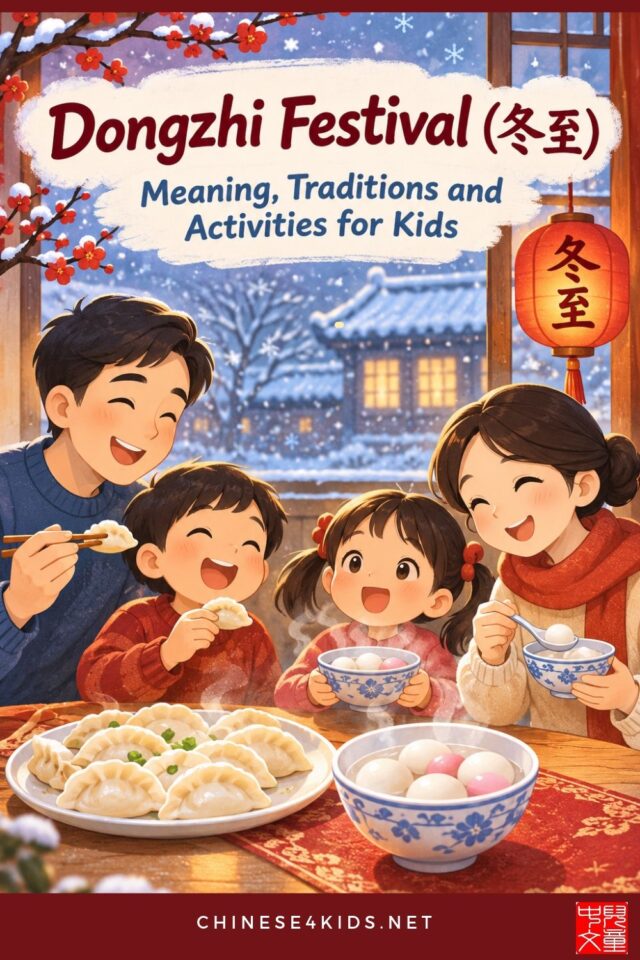
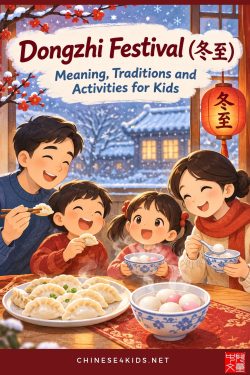
Dongzhi (冬至, dōngzhì) is the Chinese festival for the winter solstice. It marks the shortest day and longest night of the year in the Northern Hemisphere, usually on December 21 or 22. After Dongzhi, daylight slowly grows longer. Many families celebrate with a warm meal together, often dumplings (饺子, jiǎozi) or sweet rice balls (汤圆, tāngyuán).
Dongzhi (冬至, dōngzhì) is the Chinese festival for the winter solstice. It marks the shortest day and longest night of the year in the Northern Hemisphere, usually on December 21 or 22. After Dongzhi, daylight slowly grows longer. Many families celebrate with a warm meal together, often dumplings (饺子, jiǎozi) or sweet rice balls (汤圆, tāngyuán).
In 2026: the solstice happens on December 21 at 20:50 UTC. That is 3:50 p.m. in New York, 8:50 p.m. in London, and 4:50 a.m. on December 22 in Beijing. It is the same moment everywhere, so the calendar date depends on where you live.
Here is a fun way to think about Dongzhi: it is the day the sun “turns around.” For months, the nights have been getting longer. Then, on this one day, the trend flips, and the light slowly begins to come back.
This Dongzhi Festival for kids guide explains what Dongzhi means, shares two stories, and teaches simple Chinese words and sentences you can use at the table. Along the way, you will also find a nine-nines countdown craft and five easy activities for home or class. And if your Chinese is limited, don’t worry, because every Chinese word comes with pinyin and English.
What Does Dongzhi Mean?
The name has two characters. First, 冬 (dōng) means winter. Next, 至 (zhì) can mean “to arrive” or “to reach the extreme.” Put together, a child-friendly way to read it is “winter at its extreme point,” the darkest, shortest day.
Why does this happen? It all starts with Earth’s tilt. As Earth travels around the sun, the Northern Hemisphere leans away from it in December, so that part of the world gets less daylight. On Dongzhi, the sun reaches its lowest point in the midday sky for the whole year. After that, it begins to climb a little higher each day, and the days slowly grow longer.
Five Fun Facts About Dongzhi
- Dongzhi is one of 24 solar terms. The traditional Chinese calendar uses 24 jiéqì (节气) that follow the sun through the year. Dongzhi is number 22. Note that it marks the solstice, not the start of winter. In the solar-term calendar, winter begins earlier, with Lìdōng (立冬), usually around November 7 or 8.
- The shortest day is not the coldest day. Earth keeps losing heat for weeks after the solstice. That is why the coldest weather often arrives later, around January.
- Shadows at local solar noon are the longest of the year. In the Northern Hemisphere, the sun is at its lowest midday height, so shadows stretch out. In fact, ancient Chinese astronomers used a standing post and a flat measuring stone, called a guībiǎo (圭表), to measure shadows and track the seasons.
- Two old sayings. 冬至大如年 (dōngzhì dà rú nián) means “Dongzhi is as big as the New Year.” It shows how important the day could be, though traditions varied by place and time. 冬至一阳生 (dōngzhì yī yáng shēng) means “at Dongzhi, the first bit of yang is born.” Yang stands for light and warmth.
- The seasons flip around the world. In Australia, Brazil and South Africa, December 21 is the longest day of the year. Dongzhi is based on the seasons in China, but any family can celebrate it and talk about why the sun’s path looks different from place to place.
Stories and Traditions
The Dumpling That Warmed Frozen Ears (a legend)
This is a popular legend, not proven history. Please tell it as a story.
Long ago, a kind doctor named Zhāng Zhòngjǐng (张仲景) saw poor people with red, frozen ears in the cold winter. He wanted to help. He cooked lamb with warming herbs and wrapped the filling in dough shaped like little ears. Then he boiled the dumplings and shared them. After people ate the warm food, the story says, their ears got better.
Many people tell this story to explain why dumplings are linked with Dongzhi, especially in northern China. Next time you cook or eat dumplings, look at one together. Does it look a bit like an ear?
Why Round Rice Balls?
Tāngyuán (汤圆) are soft, round rice balls, often served in a sweet soup. The word sounds like tuányuán (团圆), which means “reunion.” On top of that, round shapes stand for a complete, happy family. So a bowl of tāngyuán is a little wish: “May our family stay together.” In some families, people even joke that eating tāngyuán makes you a year older.
What do people eat on Dongzhi?
Food depends on the place and the family. For example, in many northern homes, people eat jiǎozi, while in many southern homes, people eat tāngyuán. Some places also have wontons, rice cakes, or warming soups. Whichever dish a family picks, it is a normal choice. After all, the shared idea is simple: gather, eat something warm, and be together on the longest night.
Myth or Fact? A Guessing Game
Read each statement out loud. Ask your child to guess, then read the answer.
- “Dongzhi is the coldest day of the year.”
Myth. It is the shortest day in the Northern Hemisphere. The coldest weather usually comes later. - “Everyone in China eats dumplings on Dongzhi.”
Myth. Families have regional and personal traditions. Some eat dumplings, some eat tāngyuán, and some eat other foods. - “Dongzhi and Chinese New Year are the same festival.”
Myth. Dongzhi follows the sun and happens in December. Chinese New Year follows the Chinese lunar-solar calendar and falls in late January or February. Want to meet the second festival? Try our Chinese New Year chant. - “After Dongzhi, the days get longer.”
Fact, in the Northern Hemisphere. The change is small at first, but it begins right away.
Learn Dongzhi Words in Chinese
Start with the eight core words. Add the extension words when your child is ready. For more winter and festival words, visit our four seasons in Chinese guide.
Eight core words
| Chinese | Pinyin | English |
|---|---|---|
| 冬天 | dōngtiān | winter |
| 冷 | lěng | cold |
| 白天 | báitiān | daytime |
| 夜晚 | yèwǎn | night |
| 短 | duǎn | short |
| 长 | cháng | long |
| 饺子 | jiǎozi | dumplings |
| 汤圆 | tāngyuán | sweet rice balls |
Learning tip: Add a gesture to each word. Stretch your arms wide for 长 (cháng, long), bring your hands close together for 短 (duǎn, short), and pretend to shiver for 冷 (lěng, cold). Movement helps young learners remember.
Extension words
| Group | Chinese | Pinyin | English |
|---|---|---|---|
| Winter and nature | 冬至 | dōngzhì | winter solstice |
| Winter and nature | 太阳 | tàiyáng | sun |
| Winter and nature | 影子 | yǐngzi | shadow |
| Food | 圆 | yuán | round |
| Food | 甜 | tián | sweet |
| Food | 热 | rè | hot |
| Food | 好吃 | hǎochī | tasty |
| Family | 家人 | jiārén | family members |
| Family | 团圆 | tuányuán | reunion |
| Family | 冬至快乐 | dōngzhì kuàilè | Happy Dongzhi |
Use the words in short sentences
Words stick better inside a sentence. Try these patterns and swap in new words:
- 冬天很冷。(Dōngtiān hěn lěng.) Winter is cold.
- 白天很短。(Báitiān hěn duǎn.) The daytime is short.
- 夜晚很长。(Yèwǎn hěn cháng.) The night is long.
- 汤圆很甜。(Tāngyuán hěn tián.) Tāngyuán are sweet.
- 我喜欢吃饺子。(Wǒ xǐhuān chī jiǎozi.) I like eating dumplings.
Next, let your child pick a favorite food and make up a new sentence, such as 我喜欢吃汤圆 (Wǒ xǐhuān chī tāngyuán).
Measure words for the Dongzhi table
- 一碗汤圆 (yī wǎn tāngyuán): a bowl of tāngyuán
- 一盘饺子 (yī pán jiǎozi): a plate of dumplings
- 一个饺子 (yī gè jiǎozi): one dumpling
Teacher note: The tone of 一 (yī) changes depending on the word after it. Before a first, second or third tone, it is usually said yì, so you will hear yì wǎn and yì pán. Before a fourth tone, it is usually said yí, as in yí gè. The measure word 个 is also often said lightly, as ge. Beginners do not need to master these rules. Just let them hear and repeat the phrases. For more food-and-table practice, see our guides to Chinese measure words and measure words for tableware.
A short dinner table chat
Read this together. Take turns, or let your child lead.
| Speaker | Chinese | Pinyin | English |
|---|---|---|---|
| Grown-up | 今天是冬至。 | Jīntiān shì dōngzhì. | Today is Dongzhi. |
| Child | 今天白天最短吗? | Jīntiān báitiān zuì duǎn ma? | Is the daytime shortest today? |
| Grown-up | 对,夜晚最长。你想吃什么? | Duì, yèwǎn zuì cháng. Nǐ xiǎng chī shénme? | Yes, the night is longest. What would you like to eat? |
| Child | 我想吃汤圆! | Wǒ xiǎng chī tāngyuán! | I’d like tāngyuán! |
| Everyone | 冬至快乐! | Dōngzhì kuàilè! | Happy Dongzhi! |
The line 你想吃什么? works at any meal, so your child can reuse it all year.
The Nine-Nines Countdown (数九)
Now for the most unusual Dongzhi tradition. Starting around Dongzhi, people count “nines” (数九, shǔjiǔ). Each “nine” is a period of nine days, and there are nine of them, so the countdown lasts 81 days. For example, if you start on December 22, 2026, day 81 is March 12, 2027, when spring is close. Some families start counting on Dongzhi itself and others on the next day, so just pick a start date and stick with it.
Along the way, old folk rhymes describe how each stretch feels. The wording differs from region to region, but here are three popular lines:
一九二九不出手
yī jiǔ èr jiǔ bù chū shǒu
in the first and second nines, hands stay tucked away.三九四九冰上走
sān jiǔ sì jiǔ bīng shàng zǒu
in the third and fourth nines, people walk on the ice.九九加一九,耕牛遍地走
jiǔ jiǔ jiā yī jiǔ, gēngniú biàn dì zǒu
after the ninth nine, farm oxen are out in the fields.
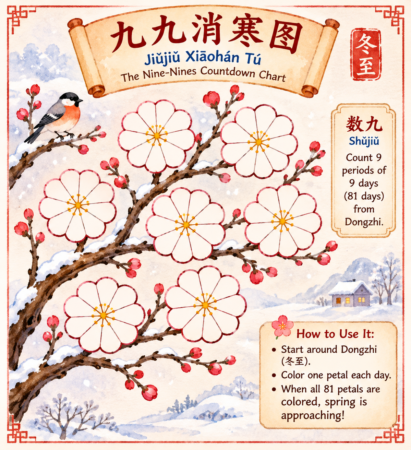
To keep track of the days, people also made a nine-nines chart (九九消寒图, jiǔjiǔ xiāohán tú). One popular kids’ version is a plum branch with 81 petals. Keep in mind that the chart is a cultural countdown, not a weather forecast, so it does not predict exactly when spring will arrive.
Make your own nine-nines chart
- Draw a plum branch on a large sheet of paper. Add nine flowers.
- Give each flower nine petals. That makes 81 petals in all.
- Starting on Dongzhi, color one petal each day. Say the day count in Chinese as you color.
- After each group of nine days, color the flower’s center and chant 一九, 二九, 三九 (yī jiǔ, èr jiǔ, sān jiǔ).
- When you finish the chart, the 81-day countdown is complete and spring is approaching.
Age: 5 and up, with help for younger children. Language practice: numbers 1 to 9 and 九. In a classroom, each child can color one petal, or the class can add one petal a day to a shared display.
Five Easy Dongzhi Festival Activities for Kids
1. Make the nine-nines chart
Materials: paper, crayons.
Ages: 5+.
Language: numbers, 九, 冷. See the full steps above.
2. Be a shadow detective
Materials: a straight stick or ruler, chalk or tape, a notebook.
Ages: 7+.
Language: 影子, 长, 短.
First, stand the stick upright in a sunny spot at local solar noon. That is when the sun is highest in the sky where you live, so it may not be 12:00 on the clock. Next, mark the shadow’s tip and measure it. Then record the date, time, weather, and shadow length in a simple table. After that, repeat every few weeks. Clouds and slightly different timing can change your results, so talk about why. Each time, say 影子很长 (Yǐngzi hěn cháng) or 影子很短 (Yǐngzi hěn duǎn) each time.
3. Cook something warm together
Materials: store-bought dumpling wrappers, or glutinous rice flour for tāngyuán dough (or a package of ready-made tāngyuán).
Ages: 5+ with an adult.
Language: 饺子, 汤圆, 热, 好吃.
An adult should handle all hot water and cooking, and the food should cool before children taste it. Meanwhile, children can fold, roll, and count. Name each step in Chinese as you go, and ask 你喜欢吃饺子吗? (Nǐ xǐhuān chī jiǎozi ma?) Do you like eating dumplings?
4. Taste and talk
Ages: 5+.
Language: 圆, 甜, 热, 好吃.
Compare tāngyuán and jiǎozi by shape, filling and flavor. If you only have one food, use pictures. Ask: 哪个是圆的? (Nǎge shì yuán de?) Which one is round? 甜吗? (Tián ma?) Is it sweet? 好吃吗? (Hǎochī ma?) Is it tasty? Let children answer in single words first, then in short sentences like 汤圆很甜. Want more food words for the table? See our guide to Chinese food and food words in Chinese.
5. Take a light-and-dark walk
Ages: all.
Language: 白天, 夜晚, 短, 长.
Go outside near sunset and notice how early it is getting dark. Ask: 白天短,夜晚长。对吗? (Báitiān duǎn, yèwǎn cháng. Duì ma?) Short day, long night. Right?
FAQ – Dongzhi Festival for Kids
When is Dongzhi in 2026?
The winter solstice is on December 21, 2026 at 20:50 UTC. That is December 21 in the Americas and Europe, and December 22 in China (about 4:50 a.m. in Beijing).
Is Dongzhi the first day of winter?
Not in the traditional Chinese solar-term calendar. Dongzhi is the winter solstice. Winter begins earlier, with Lìdōng (立冬) in early November. Many Western calendars, however, call the solstice the first day of astronomical winter.
What does Dongzhi mean?
冬 means winter and 至 can mean “to arrive” or “to reach the extreme.” Together, a child-friendly reading is winter at its extreme point.
Why do people eat dumplings on Dongzhi?
Many northern families eat jiǎozi at Dongzhi. A popular legend says a kind doctor used ear-shaped dumplings to warm people with frozen ears. It is a story, not proven history.
What is the difference between jiǎozi and tāngyuán?
Jiǎozi are savory dumplings with a meat or vegetable filling. Tāngyuán are sweet, round glutinous rice balls, often served in warm soup. Which one a family chooses depends on the region and family tradition.
Is Dongzhi a public holiday in China?
No. It is an important traditional festival, but it is not a day off work or school.
Do families outside China celebrate Dongzhi?
Yes. Many overseas families keep it simple: one warm meal, a few Chinese words, and time together. That is plenty.
How can I teach Dongzhi to young children?
Keep it hands-on. Cook something together, try the shadow game, and teach three words first: 冬天, 饺子, and 汤圆.
Keep Exploring
- What Are the Four Seasons in Chinese?: winter words, weather, clothes and festivals by season
- A Chinese chant to learn about Chinese New Year: meet the next big festival
- Celebrations, Festivals and Special Occasions in Chinese Culture
Want a ready-made way to practice winter words? Our winter Chinese Montessori 3-part flashcards bundle makes short daily review easy. And if you would like simple Chinese for family moments like this one, Speak Chinese with Kids gives you everyday phrases with audio, video and printable scripts, so you can speak first and your child can follow.
If you like this article, share it