
Quick answer:
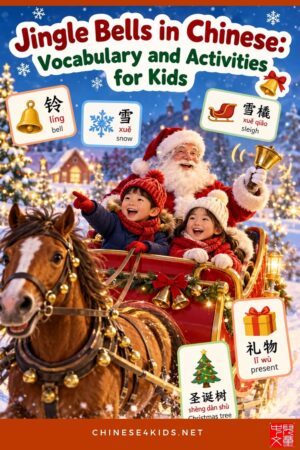
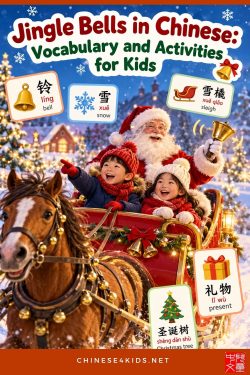
“Jingle Bells” is commonly known in Mandarin Chinese as 铃儿响叮当 (líng ér xiǎng dīng dāng). Some versions are called 叮叮当 (dīng dīng dāng). Children can use this familiar Christmas song to practise Mandarin pronunciation, learn winter and Christmas vocabulary, and enjoy simple language-learning activities. This guide includes 42 useful Chinese words with pinyin and English meanings, pronunciation tips, eight activities, and ready-to-use lesson plans for Chinese teachers and homeschooling parents.
“Jingle Bells” is commonly known in Mandarin Chinese as 铃儿响叮当 (líng ér xiǎng dīng dāng). Some versions are called 叮叮当 (dīng dīng dāng). Children can use this familiar Christmas song to practise Mandarin pronunciation, learn winter and Christmas vocabulary, and enjoy simple language-learning activities. This guide includes 42 useful Chinese words with pinyin and English meanings, pronunciation tips, eight activities, and ready-to-use lesson plans for Chinese teachers and homeschooling parents.
Children usually know the tune of “Jingle Bells” already. That means they can spend their energy on the Chinese: listening for new sounds, spotting words they know, and singing along.
Contents
hide
How Do You Say Jingle Bells in Chinese?
The most common Mandarin title is 铃儿响叮当 (líng ér xiǎng dīng dāng). It describes the sound of jingling bells.
| Chinese | Pinyin | Meaning |
|---|---|---|
| 铃 | líng | bell |
| 儿 | ér | part of 铃儿, often said smoothly as língr in everyday speech |
| 响 | xiǎng | to ring, to make a sound |
| 叮当 | dīng dāng | the “ding-dong” sound of bells |
You may also see 叮叮当 (dīng dīng dāng) as the title or as the chorus line. Both come from the same idea: the sound of bells.
Don’t worry if two recordings sound a little different. Chinese versions of “Jingle Bells” are adaptations, so the wording changes from one version to another. Choose one version and stick with it for your lesson, so children hear the same words each time.
A small note on pronunciation: in everyday speech, people often say 铃儿 as one smooth sound, close to “língr.” In a song, each syllable is usually sung separately. Either is fine for learners.
If your child or student uses traditional characters, the title is written 鈴兒響叮噹.
Listen to Jingle Bells in Chinese
Play the song once just for fun. Don’t ask children to do anything yet. Let them enjoy the tune and notice the Chinese.
Then play it a second time and ask one small question, such as “Which word did you hear again and again?” (The answer is almost always 叮叮当!)
Teaching tip:
If the recording uses different words from the ones you teach, children may feel lost. Stick to one version.
If the recording uses different words from the ones you teach, children may feel lost. Stick to one version.
Learn Chinese with Jingle Bells
You don’t need to learn the whole song to enjoy it in Chinese. Start by listening to a Mandarin recording of “Jingle Bells” and notice the sounds and words that repeat. If you want to follow the complete lyrics, use a reliable source that is authorised to share that version of the song.
For your Chinese lesson, begin with these four useful words:
- 铃 (líng): bell
- 叮当 (dīng dāng): the sound of bells ringing
- 快乐 (kuài lè): happy; happiness
- 雪橇 (xuě qiāo): sleigh
Listen for these words while the song plays. Ask children to point to a matching picture, make an action, or repeat a word when they hear it.
Teaching tip:
Different Mandarin recordings may use different lyrics. Choose one recording for your lesson and use it consistently, so children can connect what they hear with the vocabulary they are learning.
Different Mandarin recordings may use different lyrics. Choose one recording for your lesson and use it consistently, so children can connect what they hear with the vocabulary they are learning.
40+ Useful Chinese Words from Jingle Bells and Christmas
You don’t need to teach every word. Start with four to six words that children can see, touch or act out. Add more over several days.
Words from the song
| Chinese | Pinyin | English |
|---|---|---|
| 铃 | líng | bell |
| 叮当 | dīng dāng | jingling sound |
| 雪 | xuě | snow |
| 风雪 | fēng xuě | wind and snow |
| 雪橇 | xuě qiāo | sleigh |
| 马 | mǎ | horse |
| 坐 | zuò | to sit |
| 跑 | pǎo | to run |
| 快 | kuài | fast |
| 田野 | tián yě | field |
| 欢笑 | huān xiào | to laugh happily |
| 歌唱 | gē chàng | to sing |
| 快乐 | kuài lè | happy; happiness |
Winter words
| Chinese | Pinyin | English |
|---|---|---|
| 冬天 | dōng tiān | winter |
| 冷 | lěng | cold |
| 雪花 | xuě huā | snowflake |
| 雪人 | xuě rén | snowman |
| 下雪 | xià xuě | to snow |
| 帽子 | mào zi | hat |
| 围巾 | wéi jīn | scarf |
| 手套 | shǒu tào | gloves |
| 靴子 | xuē zi | boots |
| 外套 | wài tào | coat |
Christmas words
| Chinese | Pinyin | English |
|---|---|---|
| 圣诞节 | shèng dàn jié | Christmas |
| 圣诞快乐 | shèng dàn kuài lè | Merry Christmas |
| 圣诞树 | shèng dàn shù | Christmas tree |
| 圣诞老人 | shèng dàn lǎo rén | Santa Claus |
| 礼物 | lǐ wù | gift, present |
| 星星 | xīng xing | star |
| 铃铛 | líng dang | bell (the object) |
| 袜子 | wà zi | sock, stocking |
| 平安夜 | píng ān yè | Christmas Eve |
| 卡片 | kǎ piàn | card |
| 唱歌 | chàng gē | |
| 跳舞 | tiào wǔ | to dance |
Sound and action words
| Chinese | Pinyin | English |
|---|---|---|
| 摇 | yáo | to shake |
| 听 | tīng | to listen |
| 笑 | xiào | to laugh, to smile |
| 大声 | dà shēng | loudly |
| 小声 | xiǎo shēng | softly |
| 慢 | màn | slow |
| 开心 | kāi xīn | happy, glad |
That is 42 words in total. Some are used in the song itself. The rest are close neighbours that children will meet in Christmas books, cards and conversations.
How to teach the vocabulary
Younger children (ages 3–6): Choose four words and use real objects. Ring a bell for 铃. Pretend to sit in a sleigh for 坐. Run on the spot for 跑. Keep it playful and don’t ask for writing.
Children with some Chinese (ages 6–10): Ask them to match words to pictures, read the pinyin aloud, and use two or three words in a sentence.
Older children and teens: Ask them to sort the words by theme, find words they already know inside longer words (for example, 雪 in 雪人 and 雪花), and write a short Christmas message.
Short sentences to practise
- 我很快乐。(Wǒ hěn kuài lè.) I am happy.
- 马儿快快跑。(Mǎ er kuài kuài pǎo.) Horse, run fast!
- 铃儿响了。(Líng er xiǎng le.) The bell is ringing.
- 外面下雪了。(Wài miàn xià xuě le.) It is snowing outside.
- 我有一个铃铛。(Wǒ yǒu yí gè líng dang.) I have a bell.
- 我喜欢圣诞树。(Wǒ xǐ huan shèng dàn shù.) I like Christmas trees.
- 圣诞快乐!(Shèng dàn kuài lè!) Merry Christmas!
These sentences help children use the words outside the song. That is where real learning happens.
A quick link to measure words
Christmas vocabulary is a good time to notice measure words. We say 一个铃铛 (one bell), 一棵圣诞树 (one Christmas tree) and 一份礼物 (one gift). Don’t explain the rule. Just say these small phrases together, and the patterns will build with repetition.
Chinese Pronunciation Tips for Singing
Singing is a joyful way to practise Chinese. The tune can hide the tones, though, so it helps to say a few words in a normal speaking voice before you sing them. Keep it light. Children don’t need perfect tones to enjoy the song.
1. Say the bell sounds first
叮当 (dīng dāng) copies the sound of bells. Ring a real bell and let children copy it: softly, loudly, slowly, quickly. This builds a link between the sound and the word.
2. Listen for the tones
Mandarin has four tones and a neutral (light) tone. Here are some words from the song to practise as speech.
| Word | Pinyin | Tone | Hand movement idea |
|---|---|---|---|
| 铃 | líng | 2nd (rising) | hand goes up |
| 雪 | xuě | 3rd (dip) | hand dips down and up |
| 跑 | pǎo | 3rd (dip) | hand dips down and up |
| 快 | kuài | 4th (falling) | hand drops quickly |
| 当 | dāng | 1st (high, flat) | hand stays level |
| 快乐 | kuài lè | 4th + 4th | two quick drops |
Try this: say the word, show the hand movement, then say it again. Do this for one minute before singing.
3. Notice the light tone
In words like 铃铛 (líng dang), 袜子 (wà zi) and 帽子 (mào zi), the last syllable is short and light. Children pick this up by listening. You don’t need to explain it.
4. Use pinyin as a helper, not a crutch
Pinyin shows children how Chinese sounds. Use it, but point to the Chinese characters too, especially for words children see often, such as 雪 and 快乐.
5. Slow the song down
If a recording is too fast, find a slower version or sing without music. Children learn faster when they can hear each syllable. Sing the chorus at half speed first, then at normal speed.
Don’t overthink it. Mistakes with tones are normal for every learner. Repeat the word, smile, and move on.
How to Teach Jingle Bells in Chinese, Step by Step
A song is easier to learn in small pieces. This method works for a classroom, a small group, or one child at home.
- Listen first. Play the whole song once. No tasks, just listening.
- Start with the chorus. It repeats, so children hear it many times. Teach one line at a time.
- Use echo singing. You sing a line. Children sing it back. Keep your voice clear and a little slower than the recording.
- Add one action per key word. Wiggle your fingers for 雪, shake a bell for 叮当, run on the spot for 跑. Actions help children remember meaning without translating.
- Add the verses later. Teach one verse per session. There is no need to finish the whole song on day one.
- Sing with the music. When children know the chorus, sing along with the recording.
- Finish with a small task. Draw a picture, play a game, or say one sentence. This turns singing into learning.
Keep each singing block to 5 minutes. Short, frequent practice works better than one long session. Three short sessions in a week will do more than one 30-minute lesson.
Tips for mixed ages and levels
- Let older children lead. Ask them to be the “bell leader” who sets the speed and starts each line.
- Give different jobs. Younger children do actions. Older children read the pinyin. Advanced children read the characters.
- Make it a performance. A small family or class performance gives everyone a reason to practise.
If your child is shy about speaking Chinese
Singing is gentle. Children don’t need to speak alone, and they can join in at their own pace. Sing together with the recording, hum the tune, or do the actions first. Speaking often follows when children feel safe. You’re not alone in this: many heritage children understand more than they say, and songs help.
8 Jingle Bells Activities for Chinese Classrooms and Homeschooling
Choose one or two. Each activity takes 5–15 minutes and needs very little preparation.
Activity 1: Listen and Do
Ages 3–8. No materials needed.
Play the song. When children hear a word they know, they do an action.
- 雪 (xuě): wiggle fingers like falling snow
- 坐 (zuò): pretend to sit in a sleigh
- 跑 (pǎo): run on the spot
- 快乐 (kuài lè): make a happy face
- 叮当 (dīng dāng): shake imaginary bells
Repeat until children can do the actions without looking at you.
Activity 2: Bell Rhythm Game
Ages 3–10. Materials: small bells or shakers.
Let the kids follow the instructions: when you say 大声 (dà shēng, loudly, they shake the bell loudly. Say 小声 (xiǎo shēng, softly) and they shake it softly. They should change the speed when you say 慢 (màn, slow) or 快 (kuài, fast) . Then let a child be the leader and give the commands.
This game teaches four useful words and builds listening skills.
Activity 3: Sleigh Ride
Ages 4–9. Materials: chairs in rows, or a large cardboard box.
Children sit in a row as if in a sleigh. Call out commands:
- 坐好 (zuò hǎo): sit properly
- 快 (kuài): go fast
- 慢 (màn): go slowly
- 停 (tíng): stop
Add the line 马儿快快跑 (Mǎ er kuài kuài pǎo) and everyone bounces together. It is silly, active and easy to repeat.
Activity 4: Make a Chinese Christmas Vocabulary Wall
Ages 5–12. Materials: word cards, pictures, tape.
Write key words on cards and add a picture next to each. Start with four words and add two or three each day.
Extend the game: say a word and ask a child to find the card. Older learners can sort the cards into groups such as objects, actions and feelings.
Activity 5: Make Your Own Bells
Ages 4–10. Materials: small bells, red and yellow paper, string.
Let children make a bell decoration. Teach these words while they work:
- 铃铛 (líng dang): bell
- 红色 (hóng sè): red
- 黄色 (huáng sè): yellow
- 大 (dà): big
- 小 (xiǎo): small
Ask simple questions and let children answer at their own level:
- 这是什么?(Zhè shì shén me?) What is this?
- 这是铃铛。(Zhè shì líng dang.) This is a bell.
- 铃铛是什么颜色?(Líng dang shì shén me yán sè?) What colour is the bell?
Activity 6: Put the Story in Order
Ages 5–12. Materials: picture cards or small drawings, pencils.
Make four picture cards that show snow (雪), a horse (马), a sleigh (雪橇) and ringing bells (铃铛). Mix them up. Children listen to the song and arrange the cards to tell the story of a sleigh ride, then label each picture in Chinese.
For beginners, add pinyin and English labels. For stronger readers, use Chinese characters only. This activity practises listening, sequencing, vocabulary and memory.
Activity 7: Sing and Draw
Ages 4–12. Materials: paper and crayons.
Children draw a scene from the song. They may add snow, a horse, a sleigh, bells or happy people. Ask them to label three to five things in Chinese:
- 雪 (xuě): snow
- 马 (mǎ): horse
- 铃铛 (líng dang): bell
- 人 (rén): person
- 快乐 (kuài lè): happy
Older children can write one or two sentences about their picture.
Activity 8: Write a Christmas Card
Ages 6–14. Materials: folded paper or card templates.
Teach a short message that children can copy and decorate:
- 圣诞快乐!(Shèng dàn kuài lè!) Merry Christmas!
- 祝你快乐!(Zhù nǐ kuài lè!) Wishing you happiness!
- 爱你的 ______ (Ài nǐ de ______) From someone who loves you, then add the child’s name
Children can send the card to a grandparent or friend. A real reader gives them a real reason to write.
Ready-to-Use Lesson Plans
A 30-minute Chinese lesson for ages 5–10
This plan suits beginner Mandarin learners in a class or small group. Change the pace to fit your children.
| Time | Activity | Learning goal |
|---|---|---|
| 5 min | Listen to the song and ring a bell | Get used to the sound and rhythm |
| 5 min | Teach six words with pictures and actions | Recognise key words |
| 5 min | Say the words, show tone hand movements | Link sound and meaning |
| 10 min | Sing the chorus, then play Listen and Do | Practise listening and speaking |
| 5 min | Draw and label a picture | Review words on their own |
By the end of the lesson, children can:
- Recognise four to six Chinese words from the song
- Sing part of the chorus
- Link spoken words to actions or pictures
- Say one short sentence with a familiar word
Need extra support? Focus on listening, actions and repeating single words.
Ready for more? Ask children to read short phrases, explain a word, or write a two-line Christmas song with words they know.
A 5-day homeschool plan (10–15 minutes a day)
Short daily sessions suit homeschooling and busy families. Each day has one clear goal.
| Day | Focus | What to do |
|---|---|---|
| Day 1 | Listen | Play the song twice. Learn 叮当 and 铃. Ring a bell and say the word. |
| Day 2 | Chorus | Echo-sing the chorus line by line. Add the actions for 雪, 坐 and 跑. |
| Day 3 | Words | Learn six words from the song with pictures. Play the Bell Rhythm Game. |
| Day 4 | Create | Make a paper bell or draw a sleigh scene. Label three things in Chinese. |
| Day 5 | Share | Sing the chorus for a family member or send a video to a grandparent. |
No worksheet is needed. If a day is missed, simply repeat the last day and move on. Consistency matters more than finishing the plan.
A 4-week Christmas unit (for teachers)
If you teach weekly, spread the song over four weeks:
- Week 1: Listen, chorus, six song words
- Week 2: Verse one, winter words, bell game
- Week 3: Christmas words, vocabulary wall, short sentences
- Week 4: Cards, performance for families, review
Do Children in China Sing Jingle Bells? Christmas in Chinese-Speaking Places
Many do. 铃儿响叮当 is a familiar Christmas song in Mandarin, and children in Chinese-speaking communities may meet it at school, in shops or at Christmas events. Some people enjoy it as a winter song, whether or not their family celebrates Christmas.
Christmas (圣诞节, shèng dàn jié) is not a traditional Chinese festival. How people mark it depends on the place and the family:
- Mainland China: Christmas is not a public holiday. Many people enjoy decorations, music, shopping and meals with friends, and some attend church services. Schools and kindergartens often hold a small party or craft activity.
- Hong Kong: Christmas Day is a public holiday, and many families put up trees and exchange gifts.
- Chinese families abroad: Practice differs a lot. Some families celebrate fully, some combine Christmas with Chinese traditions, and some don’t celebrate at all.
A fun cultural fact: Christmas Eve apples
In mainland China, you may come across the custom of giving apples on Christmas Eve, known as 平安夜 (Píng’ān Yè). Some people call these apples 平安果 (píng’ān guǒ), a name associated with wishes for peace and safety. The name is a festive wordplay. It is a good small story to share with children, and an interesting example of how Chinese speakers enjoy playing with words and meanings.
Questions to ask your children
These questions help children link the song to their own lives. Ask them in English or Chinese, depending on level.
- What songs do you sing in winter?
- Can you sing the same song in two languages? Which words are different?
- Which holidays does our family celebrate?
- What is the biggest festival in China? (Chinese New Year, 春节, Chūn Jié)
There are no right or wrong answers. The goal is for children to see that people celebrate in different ways, and that songs travel between languages.
More Chinese Christmas Songs and Learning Resources
Ready to build a full Christmas unit? These resources go well with “Jingle Bells.”
Sing more
We Wish You a Merry Christmas in Chinese has Chinese lyrics and pinyin for another familiar carol. It is a good second song, because the tune is easy and the lines are short.
You can also browse our Chinese children’s songs for more music-based learning ideas, and read why songs work so well in our guide to singing children’s songs to learn Chinese.
Practise the vocabulary
Christmas Chinese Vocabulary Montessori 3-Part Flashcards help children learn Christmas words through matching, sorting and memory games. They work well after the Christmas words section on this page.
Build a complete unit
Christmas Theme Chinese Learning Pack is a printable pack with word walls, writing worksheets, colouring pages, Christmas card templates and memory-game materials. It saves you time if you want ready-made materials for a class or homeschool week.
Frequently Asked Questions
What is Jingle Bells called in Chinese?
The most common title is 铃儿响叮当 (líng ér xiǎng dīng dāng). Some versions use 叮叮当 (dīng dīng dāng). Both refer to the ringing sound of bells.
How do you say “Merry Christmas” in Chinese?
Say 圣诞快乐 (shèng dàn kuài lè). In traditional characters it is written 聖誕快樂.
Is Jingle Bells a good song for beginners learning Chinese?
Yes. The tune is familiar, the chorus repeats, and many key words are concrete, such as snow, bell and horse. Start with the chorus and four to six words rather than the whole song.
What age is this song suitable for?
It works from about age 3 up to teens. Younger children enjoy the actions and bells. Older children can read the pinyin and characters, learn the vocabulary, and write their own Christmas card.
How long does it take to learn the song?
Some children pick up the chorus quickly, while others need several short practice sessions. Teach the verses one at a time, at the pace that suits your child.
How can I teach Jingle Bells in a Chinese classroom?
Play the song, teach a small set of words with actions, practise the chorus line by line, and finish with a game, a drawing or a short sentence. A 30-minute lesson is enough for a good introduction. See the lesson plan above.
Can I use Jingle Bells for homeschooling?
Yes. A five-day plan of 10–15 minutes a day works well: listen, sing the chorus, learn words, make something, and share the song with family. Short, happy sessions are easier to keep up than a long lesson.
Do I need to speak Chinese to teach this song?
No. Use a clear recording, follow the pinyin, and learn the key words together with your child. Children enjoy seeing a parent or teacher learn too.
Why is the Chinese version different from the English words?
The Chinese lyrics are an adaptation, not a word-for-word translation. The aim is to keep the tune and the happy mood, so the Chinese words fit the rhythm. This is also why different versions can have different wording.
What can children learn from Jingle Bells in Chinese?
Children can practise Mandarin listening, pronunciation, tones and Christmas vocabulary through “Jingle Bells.” Teachers and parents can extend the song with other activities such as picture matching, movement games, character recognition and simple sentence-building activities.
What other Chinese Christmas songs can children learn?
“We Wish You a Merry Christmas” is a good next step, with its short lines and simple tune. You can also learn winter words, Christmas greetings and card messages to make a bigger seasonal unit.
Let’s Sing Jingle Bells in Chinese!
Learning Mandarin works best when it feels like play. A familiar song, a few bells and a bit of movement give children a happy way to hear and use Chinese.
Start small. First, sing the chorus, then, learn four words, and add one game. Come back to the song a few times during December, and let children notice how much they remember each time.
You don’t need to do it all. Even five minutes of singing together is a good Chinese lesson.
圣诞快乐!(Shèng dàn kuài lè!)
If you like this article, share it