Contents
hide
Quick answer: days of the week in Chinese
星期 (xīngqī) + a number = the day of the week
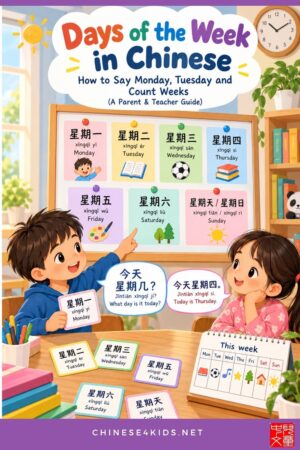
Monday is 星期一 (xīngqī yī), Tuesday is 星期二 (xīngqī èr), and the pattern continues through Saturday, 星期六 (xīngqī liù). Sunday is different: say 星期天 (xīngqī tiān) or 星期日 (xīngqī rì).
If your child knows the numbers one to six from the Chinese numbers guide, weekdays are a natural next step. The first six days follow one easy pattern, and Sunday has its own forms. Most weekday names can be learned quickly.
In this guide, you will learn all seven days, how to ask what day it is, how to count weeks, and how to practise with simple games at home or in class.
How to say Monday to Sunday in Chinese
In Chinese, Monday is “week + one.” Tuesday is “week + two,” and so on up to Saturday, “week + six.”
| English | Chinese | Pinyin | Pattern to remember |
|---|---|---|---|
| Monday | 星期一 | xīngqī yī | Week + one |
| Tuesday | 星期二 | xīngqī èr | Week + two |
| Wednesday | 星期三 | xīngqī sān | Week + three |
| Thursday | 星期四 | xīngqī sì | Week + four |
| Friday | 星期五 | xīngqī wǔ | Week + five |
| Saturday | 星期六 | xīngqī liù | Week + six |
| Sunday | 星期天 / 星期日 | xīngqī tiān / xīngqī rì | Special forms |
Now try asking the question children hear most often:
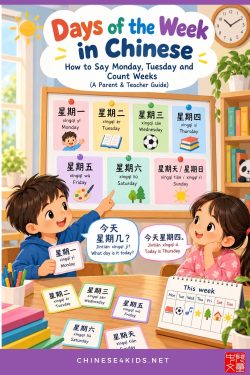
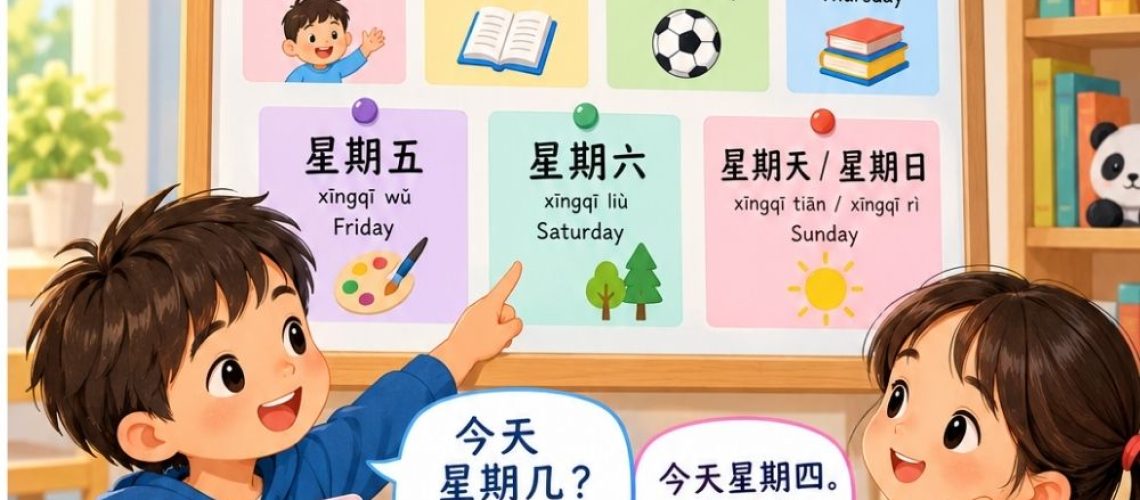
- 今天星期几? Jīntiān xīngqī jǐ? — What day is it today?
- 今天星期四。 Jīntiān xīngqī sì. — Today is Thursday.
Thursday is just an example. The answer changes with the real day.
How to remember the days of the week
Start with 星期一 to 星期六. Say the number after 星期 and use your fingers to count along. Then learn 星期天 as the special form for Sunday.
Try saying the days forward, then backward. After that, ask 今天星期几? and answer with the correct day.
Why Sunday is different
Sunday does not follow the number pattern. Teach 星期天 first, because its sound is friendly for young learners. Then introduce 星期日 as another common form.
The standard weekday names do not use 星期七 for Sunday. That is the one point to remember.
星期, 周, and 礼拜: what’s the difference?
Mandarin has three common ways to say “week”: 星期 (xīngqī), 周 (zhōu), and 礼拜 (lǐbài). You will see and hear all three. Their use can vary by region and situation.
For beginners, start with 星期. It is clear and widely taught. Later, help children recognize 周 and 礼拜 when they meet them.
| Word | Pinyin | Beginner-friendly explanation |
|---|---|---|
| 星期 | xīngqī | A common word for “week,” used in weekday names |
| 周 | zhōu | Another common word for “week,” often seen on calendars, as in 周一 |
| 礼拜 | lǐbài | A conversational alternative, also used in weekday names |
You may see these patterns in calendars, conversations, and learning materials. Which form people prefer can vary by region.
| Mon | Tue | Wed | Thu | Fri | Sat | Sun |
|---|---|---|---|---|---|---|
| 星期一 | 星期二 | 星期三 | 星期四 | 星期五 | 星期六 | 星期天 |
| 周一 | 周二 | 周三 | 周四 | 周五 | 周六 | 周日 |
| 礼拜一 | 礼拜二 | 礼拜三 | 礼拜四 | 礼拜五 | 礼拜六 | 礼拜天 |
Don’t overthink it. A grandparent may say 礼拜五 while the whiteboard says 星期五. It is the same Friday. Sunday has several established forms, so you don’t need to learn every variation at once.
How to count weeks in Chinese
To say “one week” or “two weeks,” Chinese uses a small word – measure word – between the number and 星期 or 礼拜. The word 周 can work as a unit on its own.
- 一个星期 (yí gè xīngqī) — one week
- 两个星期 (liǎng gè xīngqī) — two weeks
- 一个礼拜 (yí gè lǐbài) — one week
- 两个礼拜 (liǎng gè lǐbài) — two weeks
- 一周 (yì zhōu) — one week
- 两周 (liǎng zhōu) — two weeks
For these expressions, use 两 (liǎng) for “two”: 两个星期, 两个礼拜, and 两周. The word 二 (èr) is used in other number patterns, such as 星期二 (Tuesday). With 周, you usually say 一周 rather than 一个周.
This week, last week, next week
| English | Chinese | Pinyin |
|---|---|---|
| this week | 这个星期 / 这周 | zhè gè xīngqī / zhè zhōu |
| last week | 上个星期 / 上周 | shàng gè xīngqī / shàng zhōu |
| next week | 下个星期 / 下周 | xià gè xīngqī / xià zhōu |
The first week, the second week
Put 第 (dì) before the number. Use one pattern at first:
- 第一周 (dì yī zhōu) — the first week
- 第二周 (dì èr zhōu) — the second week
- 第三周 (dì sān zhōu) — the third week
Useful sentences for children
Word lists fade. Sentences stick. These patterns take children from naming a day to talking about their own week.
| Chinese | Pinyin | English |
|---|---|---|
| 今天星期几? | Jīntiān xīngqī jǐ? | What day is it today? |
| 今天星期三。 | Jīntiān xīngqī sān. | Today is Wednesday. |
| 明天星期几? | Míngtiān xīngqī jǐ? | What day is it tomorrow? |
| 明天星期四。 | Míngtiān xīngqī sì. | Tomorrow is Thursday. |
| 昨天星期二。 | Zuótiān xīngqī èr. | Yesterday was Tuesday. |
| 星期六我们去公园。 | Xīng qī liù wǒmen qù gōngyuán. | We go to the park on Saturday. |
| 我星期天不上学。 | Wǒ xīngqī tiān bú shàngxué. | I don’t go to school on Sunday. |
| 下周我去奶奶家。 | Xià zhōu wǒ qù nǎinai jiā. | Next week I’m going to Grandma’s house. |
When you say what you do on a certain day, you often put the weekday before the activity, as in 星期一我上学 (I go to school on Monday). Beginners can learn this pattern first. Whether 在 is used depends on the full sentence.
Common mistakes
- Saying 星期七 for Sunday. It is a logical guess, but the standard names are 星期天 and 星期日.
- Mixing up 二 and 两. Say 两个星期, not 二个星期.
- Choosing a pattern for counting weeks. Learn 一周, 两周 and 一个星期, 两个星期 first. These are natural, common expressions.
A 15-minute mini lesson
This plan works well for children aged 6–10, at home or in class.
- Minutes 1–3: numbers warm-up. Count 1 to 6 together with fingers or flashcards.
- Minutes 4–7: the pattern. Teach 星期 plus a number. Walk through Monday to Saturday. Pause at Sunday and explain the difference.
- Minutes 8–11: question and answer. Ask 今天星期几? Then ask 明天星期几? and 昨天星期几?
- Minutes 12–14: real sentences. Let your child say what they do on different days: 星期一我上学。 星期六我打篮球。
- Minute 15: review and praise. Say the seven days once more. Tomorrow at breakfast, ask 今天星期几? again.
Teaching tip:
Lesson 21 (Days of the Week) and Lesson 22 (Months of the Year) in our Chinese Lesson Plans are ready to use, as individual lessons or through the membership.
Lesson 21 (Days of the Week) and Lesson 22 (Months of the Year) in our Chinese Lesson Plans are ready to use, as individual lessons or through the membership.
Three easy practice games
- “Tomorrow is…?” chain. You say 今天星期一. Your child says 明天星期二. Then swap. Speed up, and add 昨天.
- Weekly timetable. Draw seven columns. Your child writes what they do each day, in Chinese.
- Day detective. Pick a day. Your child finishes the sentence 星期五我喜欢…
What to learn next
Weekday names fit straight into dates. Our guide to saying the year, month, and date in Chinese is the natural next step. After that, try how to tell time in Chinese, which uses the same number foundation.
Want to make Chinese part of the day? See Chinese immersion at home for easy daily routines. Asking 今天星期几? at breakfast is a good start.
Frequently asked questions
How do you say Monday in Chinese?
Monday is 星期一 (xīngqī yī). Add 星期 before the number one.
How do you say Sunday in Chinese?
Sunday is 星期天 (xīngqī tiān) or 星期日 (xīngqī rì). The standard weekday names do not use 星期七.
What is the difference between 星期 and 周?
Both mean “week.” 星期 is the form most beginners learn first. 周 is also common, for example on calendars, as in 周一 (Monday). Use can vary by region and situation.
How do you say next week in Chinese?
Say 下个星期 (xià gè xīngqī) or 下周 (xià zhōu). For example, 下周我去奶奶家 means “Next week I’m going to Grandma’s house.”
How do you count weeks in Chinese?
Say 一个星期, 两个星期, 三个星期, or use 周: 一周, 两周, 三周. Use 两, not 二, for “two weeks.”
Want ready-made practice? The Months-Weekdays Montessori 3-Part Chinese Flashcards give children printable cards for the seven days and the twelve months. Teaching a class? Lesson 21 (Days of the Week) and Lesson 22 (Months of the Year) in our Chinese Lesson Plans are ready to use, as individual lessons or through the membership.
If you find this article useful, share it