Quick Answer
The grass radical 艹(cǎo) sits at the top of characters like a little crown of leaves. It appears in characters related to plants, flowers, food, and medicine — making it especially useful for nature and kitchen vocabulary.
The grass radical 艹(cǎo) sits at the top of characters like a little crown of leaves. It appears in characters related to plants, flowers, food, and medicine — making it especially useful for nature and kitchen vocabulary.
艹
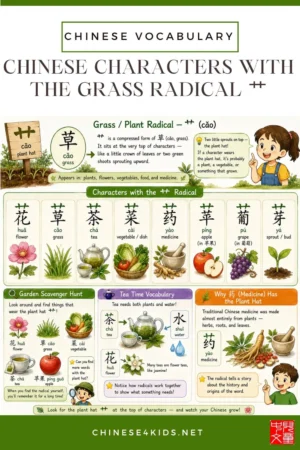
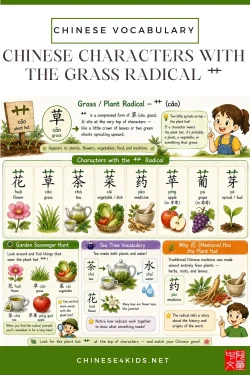
Grass / Plant Radical — 艹(cǎo)
Two sprouts side by side at the top of a character. Children often remember it as “the plant hat.”
Appears in: plants, flowers, vegetables, food, and medicine.
艹 is a compressed form of 草 (cǎo, grass)
艹 is a compressed form of 草 (cǎo, grass). It sits at the very top of characters — like a little crown of leaves or two green shoots sprouting upward.
Once children recognise 艹, they start spotting it everywhere — in nature words, food words, and even the word for medicine. This radical family is particularly rich for everyday vocabulary because so many common words involve plants.
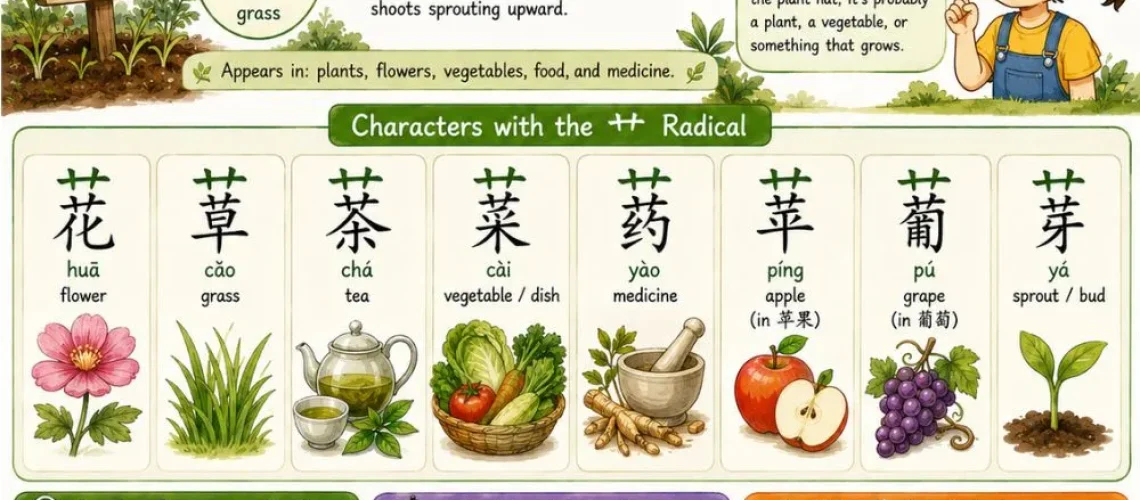
Chinese Characters with the艹Radical
| Character | Pinyin | Meaning | Connection to plants |
|---|---|---|---|
| 花 | huā | flower | A blooming plant |
| 草 | cǎo | grass | Low-growing plants |
| 茶 | chá | tea | Made from plant leaves |
| 菜 | cài | vegetable / dish | Plants we eat |
| 药 | yào | medicine | Traditionally made from plants |
| 苹 | píng | apple (in 苹果) | Fruit from a plant |
| 葡 | pú | grape (in 葡萄) | A climbing vine plant |
| 芽 | yá | sprout / bud | A new plant shoot |
💡 Say to kids:“Two little sprouts on top — the plant hat! If a character wears the plant hat, it’s probably a plant, a vegetable, or something that grows.”
Fun Activity:Garden and Kitchen Hunt
Garden Scavenger Hunt
Take children into a garden, park, or even just look at plants around the house. Point to a flower and say 花 (huā). Find grass and say 草 (cǎo). Look at vegetables in the kitchen or at the supermarket and say 菜 (cài). Hold up a tea bag: 茶 (chá). Hold up an apple: 苹果 (píng guǒ). The discovery of the plant hat 艹 in real-world objects makes the connection memorable. Children who find the radical themselves — rather than being told — remember it far longer.
Tea Time Vocabulary
Make a cup of tea together and talk about the characters involved: 茶 (tea), 花 (flower — some teas are flower teas like jasmine), 水 (water — which connects to the 氵radical). This cross-radical connection — noticing that tea needs both a plant (艹) and water (氵) — is a wonderful observation to make with older children. It shows them how radicals reveal the logic inside the language.
Why 药 (Medicine) Has the Plant Hat
Children sometimes wonder why medicine (药, yào) has the grass radical. The answer is historical: traditional Chinese medicine was made almost entirely from plants — herbs, roots, and leaves. The radical tells you something true about the origins of the word, even today.
This is a great example of how radicals are not just visual tricks — they carry cultural and historical meaning.
This article is about one of the most important Chinese Radicals for Children. Have a look at all the 30 Most Important Chinese Radicals and the posters that are good for both home and classroom use.
New to radicals? Learn the difference between piānpáng (偏旁) and bùshǒu (部首).
Further Reading
- Chinese characters with the 氵(water) radical →Full character family with examples and usage
- Chinese characters with the 木 (tree) radical →Full character family — trees, wood, and furniture
- Chinese characters with the 口 (mouth) radical →Full character family with examples and usage
- Chinese characters with the 女 (woman) radical →Full character family with examples and usage
- Chinese characters with the 亻(person) radical →Pronouns and everyday action words
- Chinese characters with the 扌(hand) radical →Action verbs — push, pull, hug, throw, and more
- Chinese characters with the 艹(grass) radical →Plants, flowers, vegetables, and nature vocabulary
- 30 Most Important Chinese Radicals for Kids →The complete guide — all 30 high-frequency radicals with examples and activities
- 30 Chinese Radical Family Poster Pack – 30 beautifully illustrated posters — one for every major Chinese radical.
If you like this post, PIN IT!