A Quick Answer
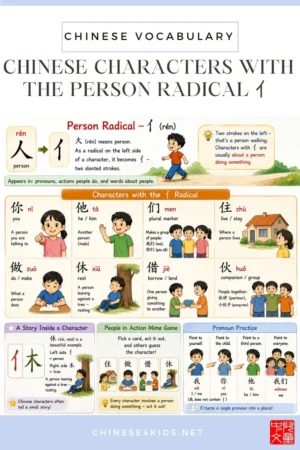
The person radical 亻(rén) appears in Chinese characters about people and the things people do. It contains some of the very first characters children learn — including you (你), he (他), and the plural marker (们).
The person radical 亻(rén) appears in Chinese characters about people and the things people do. It contains some of the very first characters children learn — including you (你), he (他), and the plural marker (们).
亻
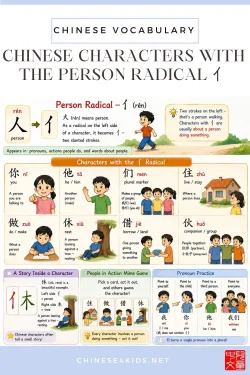
Person Radical — 亻(rén)
The standalone character 人 (rén) means person. As a radical on the left side of a character, it becomes 亻— two slanted strokes.
Appears in: pronouns, actions people do, and words about people.
人 (rén) means person.
人 (rén) means person. Look at the character — two strokes, like two legs walking. It is a simple, elegant picture of a person in motion.
When 人 becomes a radical inside another character, it slims down into 亻on the left side — two strokes pressed against the left edge. This is the signal: this character involves a person doing something.
The person radical family contains some of the most frequently used characters in Chinese — including three of the most common pronouns. Children almost certainly already know some of these words before they know the radical.
Chinese Characters with the 亻Radical
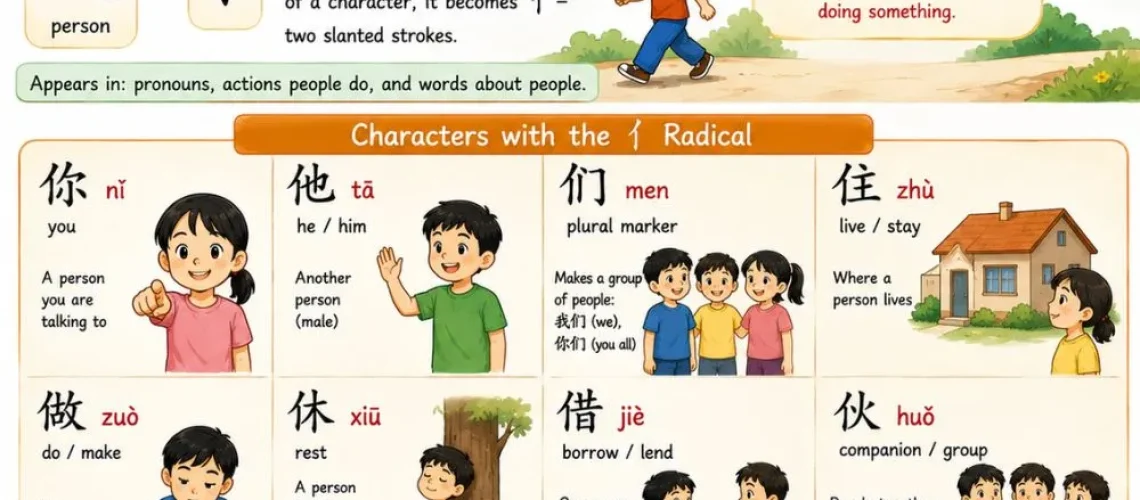
| Character | Pinyin | Meaning | Connection to person |
|---|---|---|---|
| 你 | nǐ | you | A person you are talking to |
| 他 | tā | he / him | Another person (male) |
| 们 | men | plural marker | Makes a group of people: 我们 (we), 你们 (you all) |
| 住 | zhù | live / stay | Where a person lives |
| 做 | zuò | do / make | What a person does |
| 休 | xiū | rest | A person leaning against a tree — resting |
| 借 | jiè | borrow / lend | One person giving something to another |
| 伙 | huǒ | companion / group | People together: 伙伴 (partner), 小伙子 (young man) |
💡 Say to kids: “Two strokes on the left — that’s a person walking. Characters with 亻are usually about a person doing something.”
A Story Inside a Character: 休
休 (xiū, rest) is a beautiful example of how Chinese characters can tell a small story. The left side is 亻(person). The right side is 木 (tree). A person leaning against a tree — resting. Children remember this character immediately once they see the picture.
Fun Activity:Water Play Vocabulary
People in Action Mime Game
Write each 亻character on a card. One player picks a card and acts out the meaning — resting (休), doing something (做), borrowing (借). Others guess the character in Chinese. Because every character involves a person doing something, the physical action cements the connection between the radical and the meaning. For younger children, focus on 你, 他, 们, 住, and 做 first — these are the most immediately useful.
Pronoun Practice
Point to yourself: 我 (wǒ, I/me — note: 我 does not contain 亻). Point to the child: 你 (nǐ, you). And point to a third person: 他 (tā, he). Then group everyone together: 我们 (wǒmen, we). This simple pointing game practises the most common pronouns in Chinese and shows children how 们 turns a single pronoun into a plural. No flashcards needed — just people in the room.
This article is about one of the most important Chinese Radicals for Children. Have a look at all the 30 Most Important Chinese Radicals and the posters that are good for both home and classroom use.
New to radicals? Learn the difference between piānpáng (偏旁) and bùshǒu (部首).
Further Reading
- Chinese characters with the 氵(water) radical →Full character family with examples and usage
- Chinese characters with the 木 (tree) radical →Full character family — trees, wood, and furniture
- Chinese characters with the 口 (mouth) radical →Full character family with examples and usage
- Chinese characters with the 女 (woman) radical →Full character family with examples and usage
- Chinese characters with the 亻(person) radical →Pronouns and everyday action words
- Chinese characters with the 扌(hand) radical →Action verbs — push, pull, hug, throw, and more
- Chinese characters with the 艹(grass) radical →Plants, flowers, vegetables, and nature vocabulary
- 30 Most Important Chinese Radicals for Kids →The complete guide — all 30 high-frequency radicals with examples and activities
- 30 Chinese Radical Family Poster Pack – 30 beautifully illustrated posters — one for every major Chinese radical.
If you like this post, PIN IT!