
Home » Teach Mandarin Chinese to Kids » Ni Wa Wa | Mud Doll 泥娃娃 — A Beloved Chinese Children’s Song
Ni Wa Wa | Mud Doll 泥娃娃 — A Beloved Chinese Children’s Song

Ni Wa Wa (泥娃娃) is one of the most loved Chinese children’s songs of the last fifty years. The title means “Mud Doll” or “Clay Doll.” The melody is gentle. The words are simple. And once you’ve heard it, it stays in your head for days.
For overseas Chinese-heritage families, Ni Wa Wa is a small gift. It uses easy, high-frequency words, and repeats them often. What’s more, it teaches body parts and family vocabulary without ever feeling like a lesson. And it gives your child something to sing — which is one of the best things any young learner can do in Chinese.
In this guide, you’ll find:
- A short story of where the song comes from
- The full lyrics in Chinese, pinyin, and English
- A YouTube video so your child can listen and sing along
- The vocabulary your child will learn from this one song
- Easy teaching activities for home or class
Let’s begin.
A Short History of Ni Wa Wa
Ni Wa Wa is a modern Chinese children’s song. It is not ancient — it became popular in the 1980s and 1990s and has been sung by children across the Chinese-speaking world ever since.
The song tells a quiet little story. A child has a mud doll. The doll has eyebrows and eyes — but the eyes cannot blink. It has a nose and a mouth — but the mouth cannot speak. The doll has no real mother or father. So the child decides: I’ll be her mother. I’ll be her father. I’ll love her forever.
That ending is what makes the song so memorable. It is sweet. It is tender. And it gives children a small lesson in kindness — without ever sounding like one.
Watch and Sing: Ni Wa Wa on YouTube
Listening is the easiest way to learn this song. Play the video once. Then play it again. By the third time, most children will be humming the chorus.
(Source: Little Dragon Tales — a beautifully produced version by the Shanghai Restoration Project.)
If you’d like an alternative, this animated version is a popular choice with younger children — bright visuals and clear pronunciation.
Ni Wa Wa — Full Lyrics in Chinese, Pinyin, and English
Below are the complete lyrics. Each verse is in Chinese characters, pinyin, and English translation — so you can sing, learn, or print them.
Verse 1
泥娃娃,泥娃娃
一个泥娃娃
也有那眉毛,也有那眼睛
眼睛不会眨Ní wáwá, ní wáwá
Yí gè ní wáwá
Yě yǒu nà méimáo, yě yǒu nà yǎnjīng
Yǎnjīng bú huì zhǎ
Mud doll, mud doll
A mud doll
She has eyebrows, she has eyes
But her eyes can’t blinkVerse 2
泥娃娃,泥娃娃
一个泥娃娃
也有那鼻子,也有那嘴巴
嘴巴不说话Ní wáwá, ní wáwá
Yí gè ní wáwá
Yě yǒu nà bízi, yě yǒu nà zuǐbā
Zuǐbā bù shuō huà
Mud doll, mud doll
A mud doll
She has a nose, she has a mouth
But her mouth can’t speakVerse 3
她是个假娃娃
不是个真娃娃
她没有亲爱的妈妈
也没有爸爸Tā shì ge jiǎ wáwá
Bú shì ge zhēn wáwá
Tā méi yǒu qīn’ài de māma
Yě méi yǒu bàba
She is a pretend doll
Not a real baby
She has no dear mother
And no father eitherVerse 4
泥娃娃,泥娃娃
一个泥娃娃
我做她妈妈
我做她爸爸
永远爱着她Ní wáwá, ní wáwá
Yí gè ní wáwá
Wǒ zuò tā māma
Wǒ zuò tā bàba
Yǒngyuǎn ài zhe tā
Mud doll, mud doll
A mud doll
I’ll be her mother
I’ll be her father
I’ll love her forever
What Your Child Will Learn from This One Song
Ni Wa Wa packs more learning into three minutes than most worksheets do in an hour. Here is what your child picks up just by singing it.
Body parts vocabulary
- 眉毛 (méimáo) — eyebrows
- 眼睛 (yǎnjīng) — eyes
- 鼻子 (bízi) — nose
- 嘴巴 (zuǐbā) — mouth
These are four of the most useful body-part words in Mandarin. They appear in everyday talk, in books, in flashcards, and across HSK 1.
Family vocabulary
- 妈妈 (māma) — mother
- 爸爸 (bàba) — father
- 娃娃 (wáwá) — doll / baby
Useful action and feeling words
- 眨 (zhǎ) — to blink
- 说话 (shuō huà) — to speak
- 爱 (ài) — to love
- 永远 (yǒngyuǎn) — forever
Sentence patterns
The song repeats two simple grammar patterns over and over:
- 也有 (yě yǒu) — “also has” — a useful way to add information
- 不会 / 不 (bú huì / bù) — how to say something can’t or doesn’t do something
This is exactly the kind of natural, repeated exposure that builds real fluency — far more effective than memorising rules.
5 Easy Teaching Activities for Home or Classroom
You don’t need a lesson plan to make the most of Ni Wa Wa. Here are five simple activities that work straight away.
1. Point and sing
While the song plays, point to each body part on your face as it’s mentioned — eyebrows, eyes, nose, mouth. Let your child copy you. By the second or third time, they will start pointing on their own. This is one of the fastest ways for young children to lock vocabulary into memory.
2. Make a real mud (or playdough) doll
Get out the playdough or modelling clay. Make a small doll together. As you shape it, name each part in Chinese: 这是眼睛 (this is the eye), 这是嘴巴 (this is the mouth). The physical act of making the doll anchors the vocabulary far better than a flashcard ever could.
3. Draw and label
For slightly older children, print or draw a simple doll shape. Let your child label the eyebrows, eyes, nose, and mouth in Chinese. This adds a small writing element without making it feel like work.
4. Fill-in-the-blank singing
Once your child knows the song well, leave gaps for them to fill in. Sing: “也有那 _____” and pause. Let them finish the line. This turns passive listening into active recall.
5. Family role-play
The end of the song is about being a mother and father to a doll. Use this for role-play. Let your child play “mother” or “father” to a toy, and prompt them in Chinese: 你的娃娃饿不饿?(Is your doll hungry?) 给娃娃喝水 (Give the doll some water). Songs that connect to real play stay with children for years.
Why Songs Are One of the Best Ways to Teach Mandarin
If you’ve ever wondered whether singing “really counts” as Chinese learning, the answer is yes — emphatically. Here’s why songs are so powerful for young learners.
1. Songs lock tones into memory. Mandarin is a tonal language, and tones are one of the hardest things for overseas learners. Songs carry tone patterns inside the melody, so children absorb them without effort.
2. Repetition feels natural. A child will happily listen to the same song twenty times. They would not sit through twenty rounds of a flashcard drill. Songs make repetition — the foundation of language learning — enjoyable.
3. They build emotional connection to the language. When Chinese is associated with warmth, fun, and shared moments, children stay motivated for longer. This is one of the most consistent findings in heritage-language research.
4. They give children something to “perform.” Singing a song to a grandparent over video call, or in front of a Chinese teacher, gives a child a small win in Chinese. Small wins build confidence. Confidence builds fluency.
For more on building Chinese into everyday life, see our guide to building a Chinese immersion environment at home.
What to Sing Next: More Classic Chinese Children’s Songs
Once your child loves Ni Wa Wa, here are a few more well-loved Mandarin songs to try:
- 小星星 (Xiǎo Xīngxīng) — Twinkle Twinkle Little Star, in Chinese. Familiar melody, simple Chinese words.
- 两只老虎 (Liǎng Zhī Lǎohǔ) — Two Tigers. Sung to the tune of Frère Jacques. A classroom classic.
- 小白兔 (Xiǎo Bái Tù) — Little White Rabbit. Short, sweet, and great for the youngest learners.
- 拔萝卜 (Bá Luóbo) — Pulling Up the Radish. Tells a fun group-effort story.
- 找朋友 (Zhǎo Péngyou) — Find a Friend. Action song, perfect for groups.
For more songs, rhymes, and tongue twisters that train pronunciation, see our guide to Chinese tongue twisters for children and our collection of fun Chinese riddles.
The Easiest Way to Bring More Chinese Songs into Your Home
If your child loves Ni Wa Wa, you’ll want more songs ready to go. The Chinese Children’s Songs eBook in our shop gives you 12 of the most loved Mandarin children’s songs — each with full lyrics, pinyin, English translation, and video links. It’s the simplest way to build a small home library of songs you and your child can sing together.
👉 See the Chinese Children’s Songs eBook here
For families who want to go beyond songs and build a real spoken-Chinese habit at home, Speak Chinese with Kids gives you ready-made daily-life dialogues — with audio and printable scripts — so you can start using Chinese in everyday moments, even if your own Mandarin isn’t fluent. It’s the natural next step from singing songs together.
Free Download: Top 100 Chinese Characters
The words in Ni Wa Wa — 我 (I), 是 (am), 有 (have), 不 (no), 爱 (love) — are some of the most common Chinese characters in the language. Once your child knows the top 100, songs like this one become much easier to follow.
👉 Download the free Top 100 Chinese Characters here
Print it. Stick it on the fridge. Tick off one character a day.
Final Thought
Ni Wa Wa is not a complicated song. That is exactly its strength. Two minutes of singing gives your child body parts, family words, simple grammar, tone practice — and a small, gentle story about love and care.
Play it tonight at bedtime. Sing it tomorrow at breakfast. Watch your child quietly start to hum the tune.
That is what learning Chinese is supposed to feel like.
Further Reading on Chinese4kids
- 📖 Chinese Riddles: A Fun Way to Learn the Chinese Language — another playful entry point into Mandarin
- 📖 Chinese Tongue Twisters for Children — train tones and pronunciation through play
- 📖 Building a Chinese Immersion Environment at Home — daily-life strategies for overseas families
- 📖 Chinese Learning Roadmap for Ages 0–6 — what to do at each stage
Recent Posts
FREE Chinese Lesson Sample
Enter your name and email to receive the free Chinese lesson sample
Thank you!
A Sample Chinese Lesson is on its way to your inbox. Make sure to check your email.
You May Also Be Interested:
- Chinese4kids Membership – a portal for busy Chinese teachers and parents
- Chinese learning flashcards Hive – a flashcards library that with regular additions of new quality Chinese learning flashcards
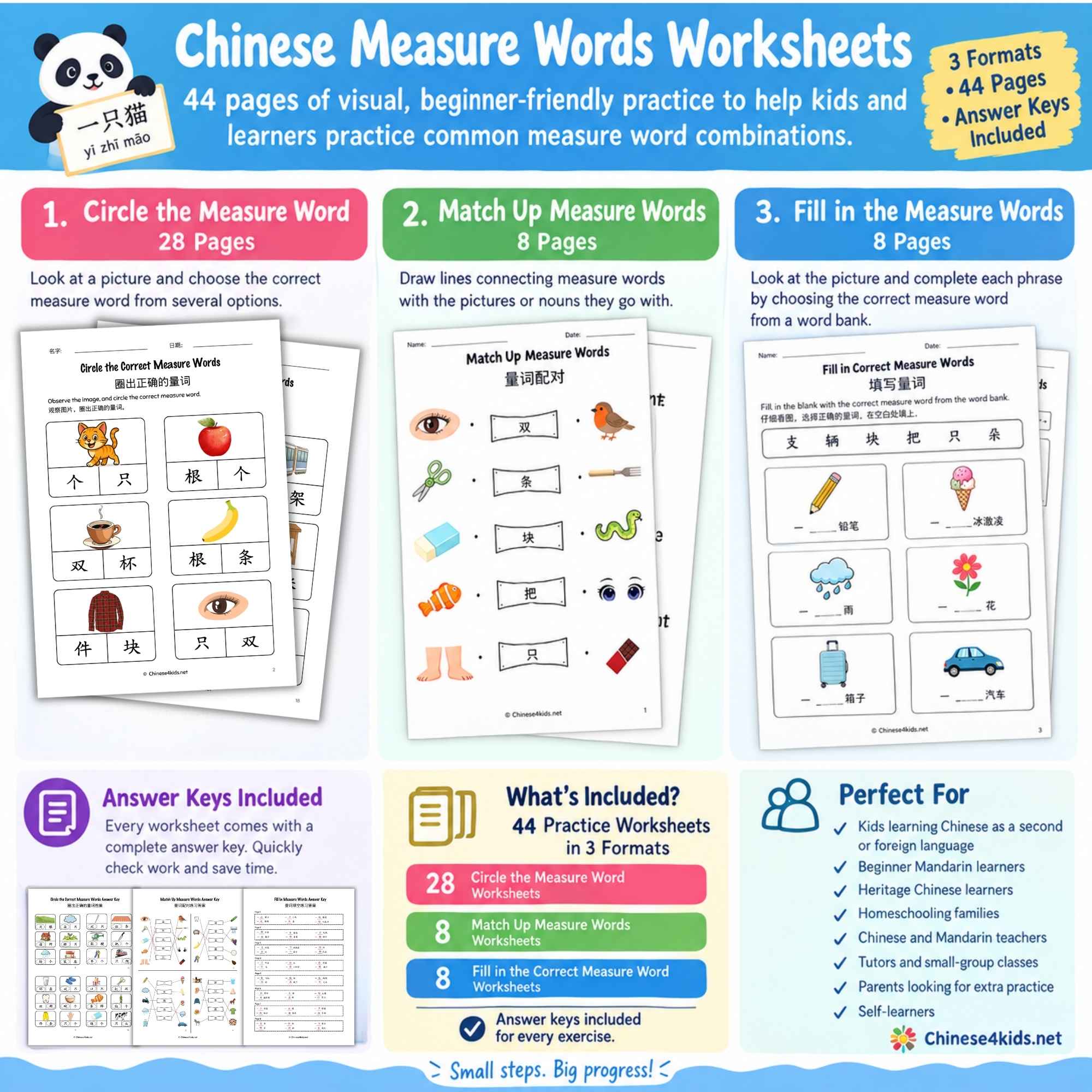
- Chinese learning worksheets collection – Also a part of Chinese4kids membership, this collection is for teachers and parents who want to have access to engaging worksheets and activity sheets created for kids learning Mandarin Chinese as an additional language
- Speak Chinese with Kids Course
- Chinese Vocabulary Made Easy Course
Join Our Membership
Enroll to A Course
Buy An eBOOK
Thinking About Learning Chinese, But Not Sure Where to Start?
This free Top 100 Commonly Used Chinese Character List is a must to have.
Thank you!
Your download is on its way to your inbox!
Our Posts
