Ask any learner what is hardest about Mandarin. You will hear two answers: characters, and Chinese pronunciation.
Getting the sounds right takes time. It takes practice. And for adults, some sounds feel almost impossible. But here is the good news for parents:
children learn Chinese pronunciation far more easily than adults do. If your child starts young, native or near-native pronunciation is well within reach.
This article explains why — and what you can do to help. You’ll find:
- Why children have a natural advantage
- The Chinese sounds that are hardest to master
- A simple guide to the four tones
- 5 fun activities to train your child’s ear and mouth
- The best free and paid resources to support you
Let’s begin.
Why Children Learn Chinese Pronunciation So Easily
All languages are easy for babies. A young child listens to the language around them. Their brain slowly learns which sounds matter — and quietly ignores the rest.
This is the key idea. The younger the child, the easier it is to learn new sounds. As a child grows, the brain becomes more “tuned” to their first language. Sounds outside that language get harder to hear and harder to copy.
That is why some Chinese sounds feel impossible for adult learners. By adulthood, the ear has stopped noticing them. A child’s ear has not.
There is a physical side too. A child’s vocal cords are flexible. Once a child hears a sound often enough, they can usually copy it with little effort. Research from the University of British Columbia found that children are especially good at picking up new sounds — but this ability fades with age.
The takeaway for parents is simple and encouraging: your child has a window of opportunity. The best time to build good Chinese pronunciation is now.
For more on why early years matter, see our guide to the best age for children to learn Chinese.
The Tricky Sounds: What Makes Chinese Pronunciation Hard
Most Chinese sounds are not difficult. But a few give learners trouble — especially adults. It helps to know which ones, so you can give them a little extra attention.
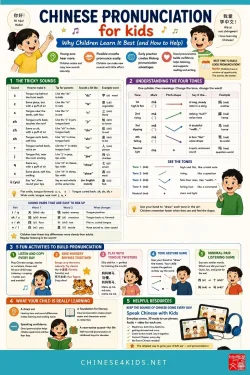
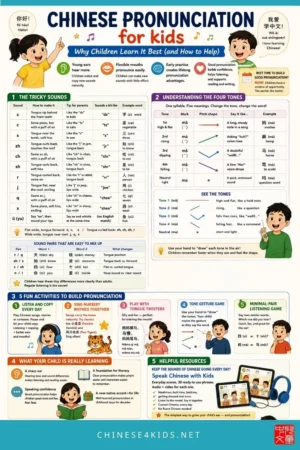
The tricky sounds — and how to pronounce them
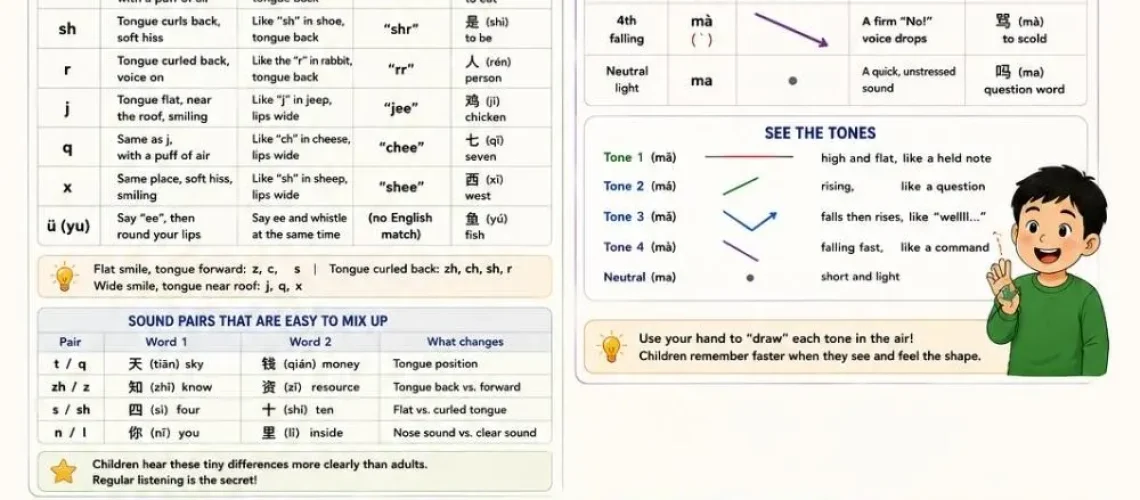
The table below shows the sounds that confuse learners most. Each row gives a simple tip and an English “sounds like” guide.
| Sound | How to make it | Tip for parents | Sounds a bit like | Example word |
| z | Tongue tip behind the front teeth | Like the “ds” in kids | “dz”> | 字 (zì) — word |
| c | Same place, but with a puff of air | Like the “ts” in cats | “ts” | 菜 (cài) — vegetable |
| s | Tongue near the teeth, soft hiss | Like the “s” in see | “s” | 三 (sān) — three |
| zh | Tongue curls back, touches the roof | Like the “j” in ja, tongue back> | “jr” | 知 (zhī) — to know |
| ch | Same as zh, with a puff of air | Like “ch” in chair, tongue back | “chr” | 吃 (chī) — to eat> |
| sh | Tongue curls back, soft hiss | Like “sh” in shoe, tongue back | “shr” | 是 (shì) — to be |
| r | Tongue curled back, voice on | Like the “r” in >rabbit, tongue back | “rr” | 人 (rén) — person |
| j | Tongue flat, near the roof, smiling> | Like “j” in jeep, lips wide | “jee” | 鸡 (jī) — chicken |
| q | Same as j, with a puff of air | Like “ch” in cheese, lips wide | “chee” | 七 (qī) — seven |
| x | Same place, soft hiss, smiling | Like “sh” in sheep, lips wide | “shee” | 西 (xī) — west |
| ü (yu) | Say “ee”, then round your lips | Say ee and whistle at the same time | (no English match) | 鱼 (yú) — fish |
A quick way to feel the difference: z, c, s are made with a flat smile and the tongue forward. zh, ch, sh, r are made with the tongue curled back. j, q, x are made with a wide smile and the tongue near the roof of the mouth.
Sound pairs that are easy to mix up
The hardest part is hearing the difference between two similar sounds. These pairs catch learners out most often:
| Pair | Word 1 | Word 2 | What changes |
| t / q | 天 (tiān) — sky | 钱 (qián) — money | Tongue position |
| zh / z | 知 (zhī) — know | 资 (zī) — resource | Tongue back vs. forward |
| s / sh | 四 (sì) — four | 十 (shí) — ten | Flat vs. curled tongue |
| n / l | 你 (nǐ) — you | 里 (lǐ) — inside | Nose sound vs. clear sound |
For an adult, these differences feel tiny. For a child who hears them often, they become clear and natural. This is exactly why regular listening matters more than any rule.
Understanding the Four Tones
In Chinese, a word is not just made of consonants and vowels. It also has a tone. The tone is the pitch — the way the voice rises or falls.
 Mandarin has four main tones, plus one neutral tone. The same syllable said with a different tone becomes a completely different word.
The classic example is ma. One syllable, said five ways, makes five different words. The table below shows each tone, its mark, the pitch shape, and a simple way to say it.
| Tone | Mark | Pitch shape | Say it like… | Example |
| 1st — high & flat | mā ( ¯ ) | →→→ stays high | A long, steady note in a song | 妈 (mā) — mother |
| 2nd — rising | má ( ´ ) | ↗ goes up | Asking “huh?” — voice rises | 麻 (má) — hemp |
| 3rd — dipping | mǎ ( ˇ ) | ↘↗ down then up | A doubtful “wellll…” | 马 (mǎ) — horse |
| 4th — falling | mà ( ` ) | ↘ drops sharply | A firm “No!” — voice drops | 骂 (mà) — to scold |
| Neutral — light | ma | • short & soft | A quick, unstressed sound | 吗 (ma) — question word |
A simple picture helps children “see” the tones:
Tone 1 (mā) ¯¯¯¯¯¯ high and flat, like a held note
Tone 2 (má) ╱ rising, like a question
Tone 3 (mǎ) ╲╱ falls then rises, like “wellll…”
Tone 4 (mà) ╲ falling fast, like a command
Neutral (ma) · short and light
One syllable. Five meanings. This is why tones matter so much — a wrong tone can change “mother” into “horse.”
A useful tip for parents:
Use your hand to “draw” each tone in the air as you say it. Flat hand for tone 1. Hand rising for tone 2. A dip for tone 3. A sharp drop for tone 4. Children remember tones much faster when they can see and feel the shape.
The good news, again: children pick up tones through songs, rhymes, and everyday speech — without ever studying them. Tones live inside the melody of the language. The more your child hears, the more natural their tones become.
For more, see our guide on why pinyin is essential for kids learning Chinese abroad.
5 Fun Activities to Build Chinese Pronunciation
You do not need to be fluent to help your child. You just need to give them sound — lots of it — in a fun, low-pressure way. Here are five activities that work.
1. Listen and copy, every day
The single most powerful tool is listening. Play Chinese songs, audio stories, or cartoons. Then pause and let your child copy a word or line. Copying a real voice trains both the ear and the mouth at once.
2. Sing nursery rhymes together
Songs are perfect for pronunciation. The melody carries the tones, so children absorb them naturally. Classics like 小星星 (Twinkle Twinkle) and 两只老虎 (Two Tigers) are great places to start. Sing them often — repetition is the goal.
3. Play with tongue twisters
Chinese tongue twisters (绕口令) are made to train the mouth. They are silly, fun, and brilliant for pronunciation. Try this simple one: 妈妈骑马,马慢,妈妈骂马 (Māma qí mǎ, mǎ màn, māma mà mǎ). See our full guide to Chinese tongue twisters for children.
4. The “tone gesture” game
Use your hand to “draw” each tone in the air. Flat hand for first tone. Rising hand for second. A dip for third. A sharp drop for fourth. Let your child copy the gesture as they say the word. Linking sound to movement helps tones stick.
5. The minimal-pair listening game
Say two similar words — 四 (sì) and 十 (shí), or 妈 (mā) and 马 (mǎ). Ask your child which one you said. Make it a quick game. This trains the ear to hear small differences, which is the heart of good pronunciation.
What Your Child Is Really Learning
Pronunciation practice does far more than make a child “sound nice.” Here is what it really builds:
- A sharp ear. A child who can hear tone and sound differences will find listening and reading easier later.
- Speaking confidence. When a child knows their pronunciation is good, they are far more willing to open their mouth and speak.
- A foundation for literacy. Clear pronunciation makes pinyin easier to learn and characters easier to remember.
- A near-native accent — for life. Pronunciation learned well in childhood tends to stay. This is a gift that lasts decades.
Helpful Resources for Chinese Pronunciation
A good audio reference is valuable — it lets you and your child hear the correct sound quickly. Listening to native speakers, again and again, is the surest path to natural pronunciation.
The challenge for many overseas families is keeping that listening consistent. Parents who aren’t fluent often run out of Chinese to say, and the daily sound input quietly stops.
This is exactly the problem Speak Chinese with Kids was built to solve. Each everyday scene — mealtimes, bath time, bedtime, getting dressed — comes with 30 ready-to-use phrases, delivered with audio and video. You don’t need perfect pronunciation yourself. You and your child listen to the model voice, then say the phrase together. Your child hears correct Chinese every day, and the sound input never breaks.
It is the simplest way to keep your child’s ear — and pronunciation — growing, even if your own Mandarin isn’t fluent.
Final Thought
Chinese pronunciation is hard for adults. For children, it is one of the easiest parts of the language — if they hear enough of it.
You do not need to teach rules. You do not need to be fluent. You just need to fill your child’s days with the sounds of Chinese: songs, stories, simple phrases, playful games.
Play one Chinese song tonight. Sing along, even badly. Your child’s ear is listening — and learning — every single time.
— updated in 2026
If you like this article, share it!
Further Reading on Chinese4kids
- 📖 The Best Age for Children to Learn Chinese — the research behind the early-years advantage
- 📖 Chinese Tongue Twisters for Children — playful pronunciation practice
- 📖 How to Master Chinese Pronunciation as a Beginner: 7 Tips — practical, step-by-step advice
- 📖 Building a Chinese Immersion Environment at Home — daily-life strategies that build listening and speaking