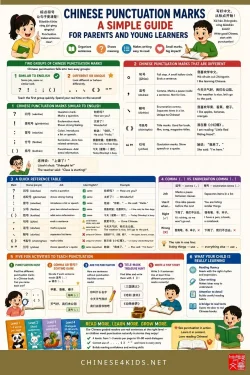
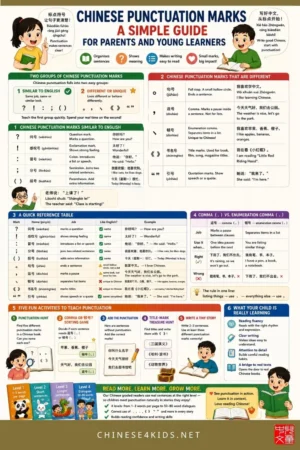
When a child starts to read and write Chinese, they meet more than just characters. They also meet Chinese punctuation marks — the small symbols that organise a sentence.
Punctuation makes writing clear. It shows where a sentence ends, marks a question, and separates items in a list. Without it, a page of Chinese characters would be very hard to read.
The good news? Chinese punctuation (标点符号 — biāodiǎn fúhào) is mostly simple. Many marks work just like English ones. A few look different. And only a small number are truly unique to Chinese.
In this guide, you’ll find:
- The Chinese punctuation marks that work like English
- The marks that look or behave differently
- Clear examples of each
- 5 fun teaching activities for home and classroom
Two Groups of Chinese Punctuation Marks
Here is the helpful idea that makes this topic easy.
Chinese punctuation was shaped, in part, by Western punctuation. So the marks fall neatly into two groups:
- Marks that are similar to English — same job, same or similar look.
- Marks that are different or unique to Chinese — these need a little extra attention.
Teach the first group quickly. Spend your real teaching time on the second. Let’s look at each.
Group 1: Chinese Punctuation Marks Similar to English
These marks do the same job in Chinese as in English. If your child knows them in English, they already understand them in Chinese.
- ?(问号 — wènhào) — question mark. Marks a question.
- !(感叹号 — gǎntànhào) — exclamation mark. Shows strong feeling.
- :(冒号 — màohào) — colon. Introduces a list or speech.
- ;(分号 — fēnhào) — semicolon. Joins two related sentences.
- ( )(括号 — kuòhào) — parentheses. Add extra information.
A quick example with a colon and an exclamation mark:
老师说:“上课了!”
Lǎoshī shuō: “Shàngkè le!”
The teacher said: “Class is starting!”
Easy. These five rarely cause trouble.
Group 2: Chinese Punctuation Marks That Are Different
Now the important part. These marks either look different from English, or work in their own special way. This is where your child needs the most help.
The full stop — 。(句号 — jùhào)
The Chinese full stop is not a dot. It is a small, hollow circle: 。
It does the same job as an English period — it ends a sentence. But the shape is different. Children must learn to write the little circle, not a dot.
我喜欢学中文。
Wǒ xǐhuān xué Zhōngwén.
I like learning Chinese.
The comma — ,(逗号 — dòuhào)
The Chinese comma marks a pause inside a sentence. It works much like the English comma — with one important exception.
The Chinese comma cannot be used to list things. For lists, Chinese uses a different mark. That mark is next.
The enumeration comma — 、(顿号 — dùnhào)
This mark is unique to Chinese. English has nothing like it.
The 顿号 is a short stroke. It is used to separate items in a list — words of a similar kind.
我喜欢苹果、香蕉、橙子和葡萄。
Wǒ xǐhuān píngguǒ, xiāngjiāo, chéngzi hé pútáo.
I like apples, bananas, oranges and grapes.
This is the single most common mistake learners make. They use a normal comma for lists. Teach your child: lists use 、 not ,
Title marks — 《 》(书名号 — shūmínghào)
These marks mean “book name mark.” English would use italics or “quotation marks” for a title. Chinese uses these special angle brackets instead.
They go around the titles of books, magazines, newspapers, films, and songs.
我在看《小红帽》。
Wǒ zài kàn “Xiǎo Hóng Mào”.
I am reading “Little Red Riding Hood”.
Quotation marks — “ ” (引号 — yǐnhào)
In simplified Chinese, quotation marks look the same as English ones: “ ”. They show speech or a quote. Simple.
(Note: traditional Chinese uses different marks — 「 」 — but most overseas learners of simplified Chinese can use the familiar “ ”.)
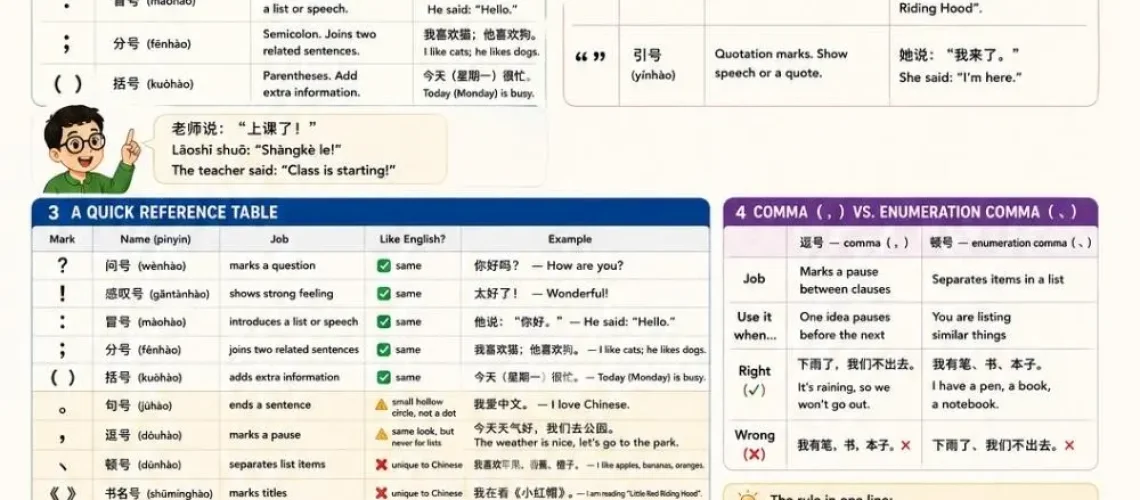
A Quick Reference Table
Here is every mark in one place — with an example sentence for each.
| Mark | Name (pinyin) | Job | Like English? | Example |
| ? | 问号 (wènhào) | marks a question | ✅ same | 你好吗? — How are you? |
| ! | 感叹号 (gǎntànhào) | shows strong feeling | ✅ same | 太好了! — Wonderful!< |
| : | 冒号 (màohào) | introduces a list or speech | ✅ same | 他说:“你好。” — He said: “Hello.” |
| ; | 分号 (fēnhào) | joins two related sentences | ✅ same | 我喜欢猫;他喜欢狗。 — I like cats; he likes dogs. |
| ( ) | 括号 (kuòhào) | adds extra information | ✅ same | 今天(星期一)很忙。 — Today (Monday) is busy. |
| 。 | <句号 (jùhào) | ends a sentence | ⚠️ small hollow circle, not a dot | 我爱中文。 — I love Chinese. |
| , | 逗号 (dòuhào) | marks a pause | ⚠️ same look, but never for lists | 今天天气好,我们去公园。 — The weather is nice, let’s go to the park. |
| 、 | 顿号 (dùnhào) | separates list items | ❌ unique to Chinese | 我喜欢苹果、香蕉、橙子。 — I like apples, bananas, oranges. |
| 《 》 | 书名号 (shūmínghào) | marks titles | ❌ unique to Chinese | 我在看《小红帽》。 — I am reading “Little Red Riding Hood”. |
| “ ” | 引号 (yǐnhào) | shows speech or a quote | ✅ same (simplified) | 她说:“我来了。” — She said: “I’m here.” |
The most important difference: comma (,) vs. enumeration comma (、)
This is the single most common mistake. The table below makes the rule clear.
| 逗号 — comma (,) | 顿号 — enumeration comma (、) | |
| Job | Marks a pause between clauses | Separates items in a list |
| Use it when… | One idea pauses before the next | You are listing similar things |
| Right | 下雨了,我们不出去。<br>It’s raining, so we won’t go out. | 我有笔、书、本子。<br>I have a pen, a book, a notebook. |
| Wrong | 我有笔,书,本子。 ❌ | 下雨了、我们不出去。 ❌ |
The rule in one line: listing things → use 、 — everything else → use ,
5 Fun Activities to Teach Chinese Punctuation Marks
Punctuation can feel dry. These activities make it active and fun.
1. Punctuation hunt
Open any Chinese book together. Ask your child to find and point to five different punctuation marks. Can they name each one? A simple hunt turns reading into a game.
2. The “comma or 顿号?” sorting game
Write several short sentences — some with a pause, some with a list. Ask your child: does this need 逗号 (,) or 顿号 (、)? This drills the single most common mistake in a fun, low-pressure way.
3. Add the punctuation
Write a few sentences with no punctuation. Let your child add the marks. Where does the sentence end? Is it a question? This shows your child what punctuation is for.
4. Title-mark treasure hunt
Look for book titles, film titles, and song names. Ask your child to write each one with proper title marks 《 》. This makes a unique Chinese mark feel useful and real.
5. Write a tiny story
Ask your child to write two or three sentences — a tiny story. The rule: it must use at least three different punctuation marks correctly. Writing their own sentences is the best practice of all.
What Your Child Is Really Learning
Learning Chinese punctuation marks teaches far more than a set of symbols. Here is what your child really gains:
- Reading fluency. A child who knows punctuation reads with the right rhythm — pausing, stopping, and questioning in the right places.
- Clear writing. Correct punctuation makes a child’s written
Chinese easy for others to understand. - Attention to detail. Noticing the difference between 。 and a dot, or 、 and ,, builds careful reading habits.
- A bridge to real texts. Punctuation is the doorway to reading real Chinese books, not just word lists.
For more on how reading develops, see our guide to> building a Chinese immersion environment at home.
The Easiest Way to Support Reading and Writing at Home
Punctuation makes most sense when a child meets it inside real sentences — in real books, at the right level.
Our Chinese graded readers are designed exactly for overseas learners. They move through four levels — from one to three words per page, up to short dialogues of 50–80 words. As your child moves up the levels, they meet punctuation naturally: full stops, commas, question marks, and 顿号, all used correctly in stories built for their reading stage.
Children learn punctuation best by seeing it work — not by memorising rules. Levelled stories give them that, page after page.
Final Thought
Chinese punctuation marks are not difficult. Most of them work just like English. Only a few — the circle full stop 。, the list-mark 顿号 、, and the title marks 《 》 — need real attention.
Teach those few well. Practise them through play, not drills. And let your child meet them again and again in real Chinese stories.
Open a Chinese book tonight. Find one full stop together. That small circle is the start of reading real Chinese.
— updated in 2026
If you like this article, share it!
Further Reading on Chinese4kids
- 📖 Building a Chinese Immersion Environment at Home — daily-life strategies for reading and writing
- 📖 Chinese Pronunciation for Kids — the spoken side of learning Chinese
- 📖 5 Phases of Chinese Literacy Development — how reading ability grows, phase by phase
- 📖 Tips for Kids Learning to Read Chinese Books — choosing the right books and building reading habits