Quick answer
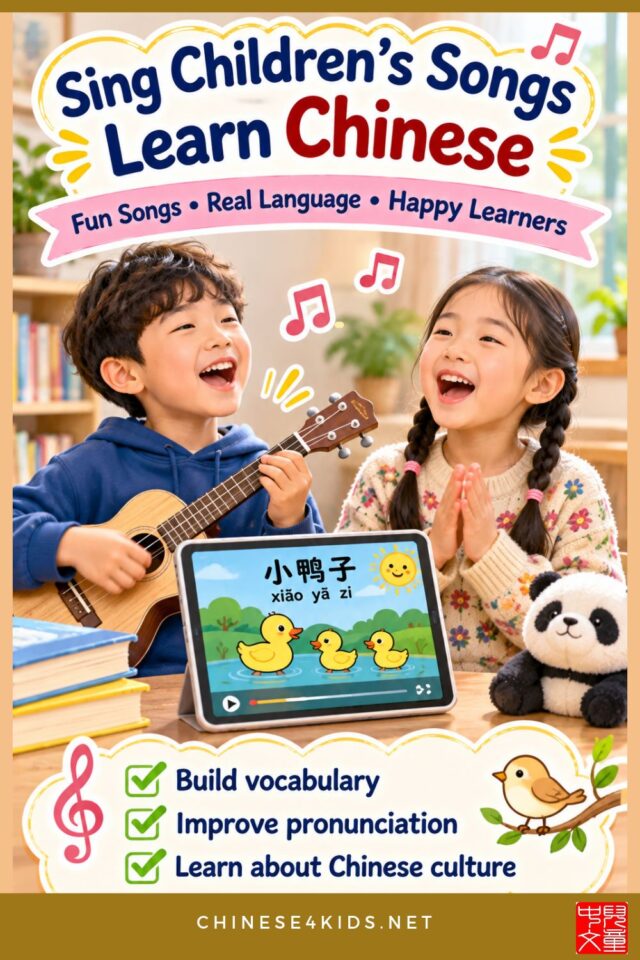
Chinese children’s songs are a fun and easy way to help children practise Mandarin. Short, repetitive songs let children hear and say new words again and again, while the music makes practice feel like play. Start with a familiar song such as 两只老虎 (Two Tigers). Introduce a few key words, add some actions and sing together. Just remember that songs are best combined with spoken practice, because the melody can change how Mandarin tones sound.
Children love to sing, and music is a lovely way to introduce the sounds of another language. If your child is learning Chinese, a familiar tune can make Mandarin feel much less like a lesson. A few repeated lines, some simple actions and plenty of encouragement are often all you need. Before long, your child may be humming Chinese words around the house!
In this guide, we’ll explore why songs help children learn Chinese, which songs are good to start with and how to teach a new song in five simple steps. You’ll also find ideas for making singing part of everyday Mandarin practice, at home or in the classroom.
Contents
hide
Why Singing Helps Children Learn Chinese
Music and rhythm give children something to hold on to when they are learning new words. A familiar tune helps them recognise repeated phrases, while the lyrics give them several chances to hear and practise the same expressions. Over time, words that once sounded unfamiliar can begin to feel natural.
Research points in the same direction, although with some limits. In one experiment, adults listened to short Hungarian phrases and then either spoke or sang them back. The study, published in 2014, found that singing helped the adults recall the phrases. It was a small, short-term study with adults and a different language, so it does not prove that songs alone will teach a child Chinese. Even so, it supports an idea many parents and teachers recognise: singing can make new words easier to remember.
What Children Can Learn From Chinese Songs
Children’s songs can support language learning in several ways. Here are four benefits worth keeping in mind.
- Listening. Children hear the same sounds, syllables and phrases again and again. As they listen to a favourite song, they become more familiar with how Mandarin sounds.
- Vocabulary. Many songs focus on familiar topics such as animals, body parts, numbers or feelings. Children meet these words repeatedly and begin to connect them with pictures, actions and experiences.
- Speaking confidence. Singing gives children a chance to practise complete phrases without having to think of every word themselves. Once they feel comfortable with the lyrics, they can try saying the phrases without music, or using the words in everyday conversation.
- Useful phrases and sentence patterns. Repeated lyrics introduce children to common expressions and simple sentence structures. They can begin by singing the whole phrase, then use part of it in a new situation. For example, 祝你生日快乐 (zhù nǐ shēngrì kuàilè, “happy birthday”) contains the useful pattern 祝你…… (“wishing you…”), so children can later try other simple wishes, such as 祝你快乐 (zhù nǐ kuàilè, “wishing you happiness”) or 祝你健康 (zhù nǐ jiànkāng, “wishing you good health”). Likewise, 如果开心你就跟我拍拍手 introduces 如果……就…… (“if… then…”).
Can Children Learn Mandarin Tones Through Songs?
Songs are a wonderful way to become familiar with Chinese sounds, but there’s one thing to keep in mind: melody can change the pitch of a syllable. The musical notes don’t always follow the natural tones of spoken Mandarin.
So enjoy singing together, but don’t rely on songs alone for tone practice. After singing, pause the music and say a few important words aloud in their normal speaking tones. This helps children hear how spoken Mandarin differs from the melody.
Here is a simple routine to try:
- Play the song and let your child enjoy singing.
- Choose two or three important words from the lyrics.
- Say each word slowly in its normal spoken tone.
- Let your child listen and repeat without the music.
If you’d like to practise tones through games and simple activities, see our guide to Chinese tones for kids. For playful spoken practice that goes beyond the melody, Chinese tongue twisters for children are another fun option.
Chinese Children’s Songs and Rhymes to Start With
Now that we know why songs can help, let’s look at a few good ones to start with. They are short, familiar and easy to act out.
| Song | Best for practising |
|---|---|
| 两只老虎 (Liǎng zhī lǎohǔ) – Two Tigers | Beginner vocabulary: animals and body parts |
| 五指歌 (Wǔ zhǐ gē) – Finger Song | Fingers, numbers and counting |
| 泥娃娃 (Ní wáwa) – Ni Wa Wa | Body parts and family words, with a simple story to follow |
| 祝你生日快乐 (Zhù nǐ shēngrì kuàilè) – Happy Birthday | Birthday wishes and the 祝你…… pattern |
| 如果开心你就跟我拍拍手 (Rúguǒ kāixīn nǐ jiù gēn wǒ pāi pāi shǒu) – If You’re Happy, Clap With Me | Feelings, actions and the 如果……就…… pattern |
If your child is completely new to Mandarin, start with songs that have repeated words, clear actions and familiar topics. Older beginners may enjoy songs with longer phrases and more varied vocabulary.
Seasonal Songs and Nursery Rhymes
Chinese songs are also a lovely way to explore festivals and seasons.
- Christmas: Learn We Wish You a Merry Christmas in Chinese or Jingle Bells in Chinese (铃儿响叮当, Líng ér xiǎng dīngdāng).
- Winter: Try 下雪了 (It’s Snowing), a short rhyme about a snowy day.
How to Teach a Chinese Song in Five Steps
Once you’ve chosen a song, how do you help your child learn it? Try this simple five-step routine. You don’t need to be a great singer or speak perfect Mandarin to enjoy Chinese songs with your child. Keep things simple, have fun and let the children learn at their own pace. You can even spread the five steps over several days.
- Start with a few key words. Before playing the song, choose a handful of important words or phrases. Show your child a picture or demonstrate an action for each one. Say the words together and make sure your child has a general idea of what they mean.
- Add actions to the lyrics. Give each line a simple gesture or movement. Actions help children understand what they’re singing about and give them another way to remember the words. There’s no need to translate every line before you begin. Pictures, gestures and repetition can do much of the work.
- Sing together. Play the song and join in. Sing slowly if your child needs more time, and don’t worry about getting every word right. The important thing is to enjoy singing together.
- Sing along with the music. Once the lyrics become familiar, try an instrumental version if one is available. Without the original singer, children can practise remembering the words and singing independently. You’ll often find that they know more of the song than they realise!
- Make up your own version. When your child knows the song, have some fun changing a word or a line. Replace one animal with another, change an action or invent a new verse. Older children might even enjoy writing their own lyrics. It’s a lovely way to use familiar Chinese words creatively.
A little encouragement goes a long way: Don’t expect children to sing the whole song perfectly. Joining in with a few words, gestures or repeated phrases is already a good start, especially for children who feel shy about speaking Chinese.
Example: Teaching 两只老虎 (Two Tigers)
What do those steps look like in practice? Here is one way to use Two Tigers, a familiar and repetitive song, to teach animal words and simple body-part vocabulary.
| Learning stage | What to do |
|---|---|
| Before singing | Introduce 老虎 (tiger), 两只 (two animals), 耳朵 (ears) and 尾巴 (tail) with pictures or gestures. |
| First listen | Play the song once. Let children listen and watch the actions. |
| Sing together | Sing one line at a time and invite children to copy the movements. |
| Practise the words | Show pictures of two tigers, one without ears and one without a tail. Pause and ask: 老虎在哪里? (Where is the tiger?) or 这只老虎有尾巴吗? (Does this tiger have a tail?) Let children answer with 有 (has) or 没有 (doesn’t have). |
| Extend the activity | Let children draw a tiger, label its body parts or change the animal in a new version of the song. |
Notice how the lesson moves from listening and singing to real spoken Mandarin. The same pattern works for almost any song.
Tips for Making Chinese Songs Part of Everyday Life
The five steps above give you a starting point. A few small changes to your daily routine can make singing even more effective, and you don’t have to set aside a special lesson every time. Small moments throughout the day can be just as useful.
- Keep it short. Five to ten minutes is plenty for young learners. Rather than moving to a new song every day, try singing the same one for several days. Familiarity helps children feel more confident.
- Choose songs they enjoy. Look for simple melodies, repeated lines and words children can picture. Even better, let your child help choose the next song.
- Use everyday moments. Play a favourite song in the car, at bath time or while tidying up. You might be surprised how quickly children start joining in.
- Check videos first. YouTube videos can help children hear the melody and pronunciation. Watch them before sharing to make sure the singing is clear and suitable for your child.
- Connect singing with speaking. After the song, ask a simple question in Chinese about what happened or which words your child remembers. You could also record your child singing or speaking. Our guide to recording Chinese speaking practice shows how to make this a useful learning activity.
How to Tell If Your Child Is Learning From a Song
You don’t need a test or worksheet every time your child sings. Instead, look for small signs of progress.
- Recognition: Can your child point to a picture when they hear a word in the song?
- Understanding: Can they show the meaning of a phrase through an action?
- Recall: Can they remember a few words when the music stops?
- Speaking: Can they use one of the words or phrases in a different situation?
- Independence: Can they sing part of the song without help?
For example, after learning 两只老虎, ask your child to point to a tiger, name its ears or tail, or use 老虎 in a simple sentence. These small moments tell you much more about learning than whether a child can sing every line perfectly.
Get Chinese Children’s Song Lyrics in One Convenient Collection
Once your child has found a few favourite Chinese songs, having the lyrics ready makes it easier to sing together regularly.
Our Chinese Children’s Song Lyrics Book is a printable PDF collection of more than a dozen familiar Mandarin children’s songs, including 找朋友, 小星星, 两只老虎 and 五指歌.
You can use it to:
- Keep the lyrics together for easy reference.
- Follow the words while listening to the songs, using the video links.
- Print individual lyrics for classroom activities or home practice.
- Revisit familiar songs to reinforce vocabulary and expressions.
The individual song articles mentioned above, including Ni Wa Wa and the Christmas songs, are additional online resources. They are not included in the printable book.
Explore the Chinese Children’s Song Lyrics Book and find your next song to sing together!
Frequently Asked Questions
Here are a few questions parents and teachers often ask about using songs to teach Chinese.
Do songs really help children learn Chinese?
Yes. Songs give children repeated exposure to Mandarin sounds, words and phrases. Music can also make practice enjoyable and help children remember what they hear. However, singing works best alongside listening, speaking, reading and other activities.
Which Chinese children’s song should we learn first?
For beginners, 两只老虎 (Two Tigers) is a good starting point because it has a familiar melody, repeated lyrics and simple vocabulary. 如果开心你就跟我拍拍手 (If You’re Happy, Clap With Me) is another lovely choice, especially for children who enjoy movement and actions.
Can my child learn Mandarin tones by singing?
Songs help children become familiar with Mandarin sounds, but musical notes can change the pitch of syllables. After singing, practise a few important words without music so children can hear and repeat their normal spoken tones.
My child cannot read Chinese yet. Can we still use songs?
Absolutely! Children don’t need to read Chinese characters to enjoy Mandarin songs. Play the audio, use pictures and gestures, and sing together. They can begin by listening and joining in with repeated words. Reading the lyrics can come later.
How long should we practise a song?
For young children, five to ten minutes is usually enough. You can sing the same song over several days, allowing your child to become familiar with the words before moving on. Follow their interest, though. If they’re enjoying the song, there’s no need to stop just because the timer has run out!
How can teachers use Chinese songs in the classroom?
Songs work well as warm-ups, vocabulary introductions, movement activities, listening tasks and speaking follow-ups. Here is a simple 10-minute activity using Two Tigers: (1) spend two minutes introducing 老虎, 耳朵 and 尾巴 with pictures and gestures; (2) play the song once while children watch and listen; (3) sing together with actions for about three minutes; (4) finish with a few minutes of speaking, asking 老虎在哪里? or 这只老虎有尾巴吗? and letting children answer by pointing or with 有 or 没有. Follow up another day by having children draw a tiger and label its parts.
If you like this article, share it