Quick Answer
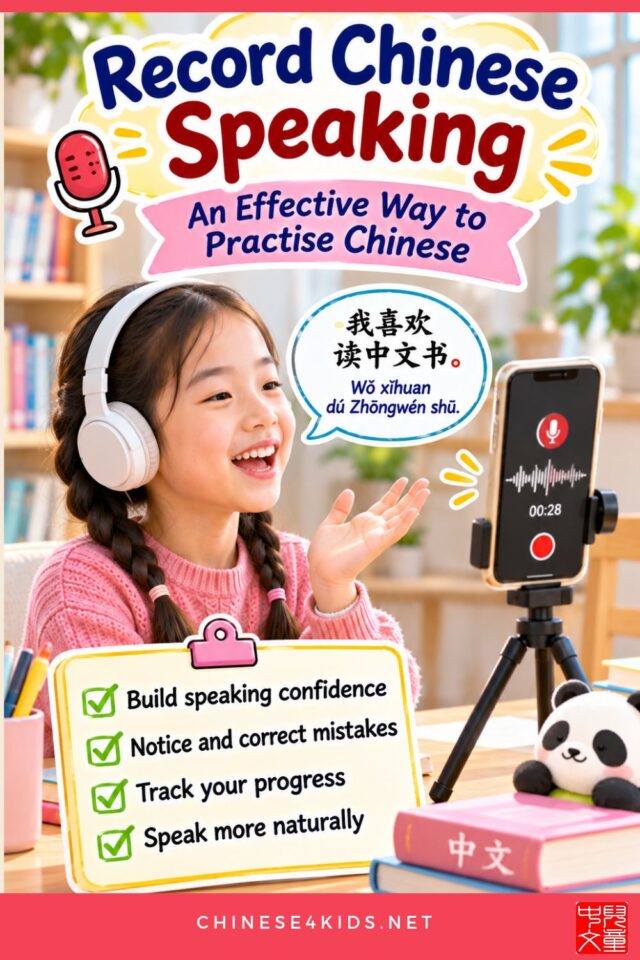
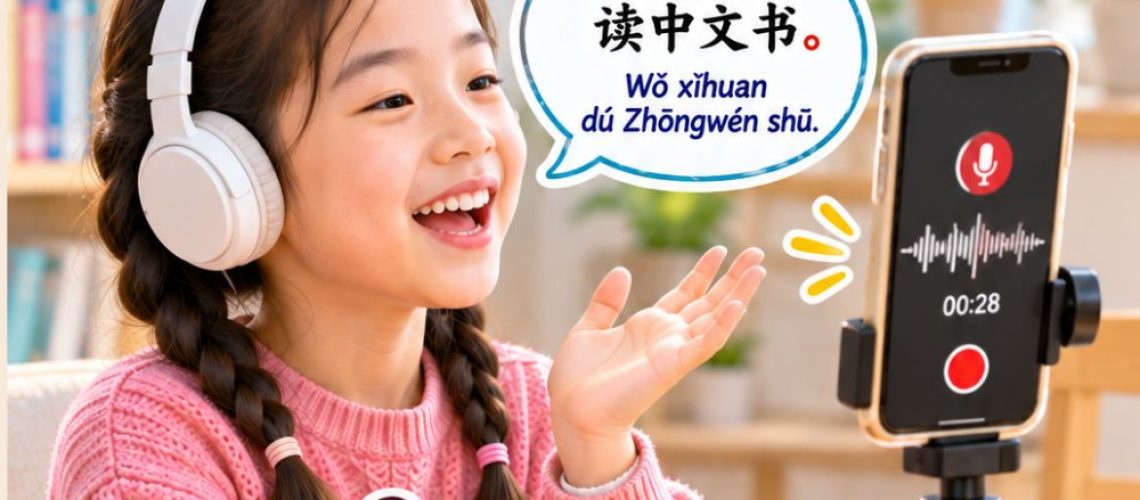
Recording your child’s Mandarin gives them a chance to hear themselves speak. The real learning happens afterwards, when you listen together, choose one thing to improve, practise it with a good model and record again. This guide shares a simple five-step routine and five easy recording activities.
If your child spends most of the day using another language, finding regular opportunities to practise Chinese can be difficult. There may be few people to talk to, and little chance to hear Mandarin outside the home or classroom. So how can children get more speaking practice and see how they’re progressing?
One simple way to create more speaking practice is to record your child. A short recording on a phone or tablet gives children a chance to listen, try again and notice their progress. In this guide, you’ll find a five-step routine for using recordings well, five activities to try, and a few tips for keeping practice relaxed and fun.
Contents
hide
Why Record Your Child Speaking Chinese?
When we speak, we hear our own voices differently from how they sound in a recording. Listening back can help children notice things they may have missed while speaking, such as a difficult word, an unfinished sentence or a tone they want to practise.
Recording can also help children:
- Listen more carefully to pronunciation, tones and sentence rhythm.
- Practise speaking in longer sentences, rather than relying on single words.
- Build confidence, as they become more comfortable speaking and notice improvements over time.
- See their progress, especially when you keep a few recordings and compare them after a few weeks.
Research has also explored how learners can use recordings of their own voices to improve Chinese pronunciation. A study first published online in 2023 investigated audio self-modelling with 26 learners of Chinese as a foreign language over six weeks. The researchers found that learners who worked with recordings of their own pronunciation made greater improvements in producing Chinese tones than those who followed the comparison approach. The study focused on word-level tone pronunciation, rather than children’s general conversational skills. Still, it offers encouraging evidence that listening to and working with your own recordings can be a useful part of pronunciation practice.
There is one important limit. Listening to yourself doesn’t automatically show you what is correct. A beginner may not know whether a tone sounds right, so children need a good spoken model to compare with, and sometimes a little feedback from a teacher or a confident speaker. That’s why the routine below includes a listening step.
What Should Children Record?
Choose something short and familiar. A recording of 30 seconds to one minute is plenty. Good options include reading aloud, a short talk, a role-play, a picture description or a retelling of a story. You’ll find ideas for each below.
How to Practise with Recordings: Five Steps
- Choose a short speaking task. Pick a familiar topic, a page from a book, a picture or a simple role-play.
- Record the first attempt. Let your child speak without interrupting or correcting every mistake.
- Listen together. Play the recording and ask two simple questions: “What sounded good?” and “What was hard to say?”
- Choose one thing to improve. It might be a tone, a word, a sentence ending or a pause. Avoid trying to fix everything at once. For example, if your child says a word with the wrong tone, play the correct version and let them listen. Then practise that word in a short phrase before recording the whole sentence again.
- Practise and record again. Let your child listen to a clear Mandarin model, such as you, a teacher or a reliable audio recording. Practise the tricky part together, then make a second recording.
If there’s one step worth making time for, it’s the last one. A second attempt helps children see how practice can make a difference, and they usually enjoy hearing the difference.
What Should Children Listen For?
With younger children, keep it very simple: “Can I understand you?” and “Which word was tricky?” As children grow, you can ask them to listen for:
- Clear pronunciation, especially sounds they find difficult. Our guide to Chinese pronunciation for kids explains the main sounds in more detail.
- Tones, particularly in words they often mix up.
- Complete sentences, rather than single words.
- Smooth, steady speech, with natural pauses.
Five Recording Activities
1. Read a Chinese book aloud
Reading aloud is a good activity for beginning readers. Choose a short book your child has already read or heard before, and record one page or a short section. Younger learners can listen to you read a sentence first and then repeat it. Older children can read on their own. Keep in mind that reading aloud practises pronunciation and fluency, but it doesn’t show everything about a child’s spontaneous speaking. If you need books at the right level, take a look at our Chinese reading books for kids.
2. Give a short talk
A short talk works best when children already know some everyday vocabulary. Choose a simple topic, such as:
- 我的家人 (Wǒ de jiārén), my family
- 我最喜欢的动物 (Wǒ zuì xǐhuan de dòngwù), my favourite animal
- 我的周末 (Wǒ de zhōumò), my weekend
- 我最喜欢的食物 (Wǒ zuì xǐhuan de shíwù), my favourite food
- 我的学校 (Wǒ de xuéxiào), my school
Give beginners a few words or sentence starters to lean on. More confident children can speak for 30 seconds to one minute without a script.
3. Practise a role-play
Role-play is a lovely way to practise real conversation. Children can order food, shop, meet a friend or ask for directions. For example:
| Chinese | Pinyin | English |
|---|---|---|
| 你想吃什么? | Nǐ xiǎng chī shénme? | What would you like to eat? |
| 我想吃面条。 | Wǒ xiǎng chī miàntiáo. | I’d like noodles. |
| 你要喝什么? | Nǐ yào hē shénme? | What would you like to drink? |
| 我要一杯水。 | Wǒ yào yì bēi shuǐ. | I’d like a glass of water. |
Record both roles, then listen together. Ask whether the conversation sounded natural, and whether there is another way to say the same thing. For more scenarios, see our Chinese role play activities for kids.
4. Describe a picture
Show your child a picture and ask them to say what they see. Beginners might say:
- 这是一个公园。(Zhè shì yí ge gōngyuán.) This is a park.
- 有三个孩子。(Yǒu sān ge háizi.) There are three children.
- 一个女孩在跑步。(Yí ge nǚhái zài pǎobù.) A girl is running.
- 他们在公园里玩。(Tāmen zài gōngyuán lǐ wán.) They are playing in the park.
Older children can describe what is happening, say how the people might feel, or invent a short story about the picture.
5. Retell a story or talk about your day
After reading a story together, ask your child to tell you what happened in their own words. Or ask them to describe something they did that day. Both activities help children move beyond memorised sentences and encourage more spontaneous speech. If your child needs a little help, offer a starter such as 今天我… (Jīntiān wǒ…, “Today I…”).
Ideas for Different Ages and Levels
The following are general suggestions. Choose activities according to your child’s Chinese level, confidence and interests rather than age alone.
Younger children (about 4 to 6) usually enjoy repeating short phrases after you, naming things in a picture and recording a single sentence. Older children (about 7 and up) can read a page aloud, give a short talk, take part in a longer role-play or retell a story. Whatever the age, keep each recording short.
If you’d like more pronunciation fun, a Chinese tongue twister makes a great quick recording. For a wider choice of speaking games, see our Chinese conversation activities for kids.
Common Mistakes to Avoid
- Correcting everything. Too much correction can make children feel nervous about speaking. Choose one small improvement at a time.
- Choosing a topic that is too difficult. If children don’t know the words, the recording will be stressful. Start with familiar vocabulary.
- Practising without a model. Children need to hear what good Mandarin sounds like, otherwise they may simply repeat the same mistake.
- Focusing only on speed. Clear, steady speech matters more than fast speech.
- Turning it into a test. Don’t ask children to repeat the same sentence until it’s perfect. Praise what they communicated well, and let them decide whether they want to share their recording with others.
Some children laugh or feel shy when they hear their own voices. That’s perfectly normal. With time, many children become more comfortable hearing their own voices. Keep the mood light and you’ll find most children soon enjoy it.
One practical point: voice recordings can contain personal information. Store them securely, follow your school’s recording and sharing policies, and get appropriate permission before sharing them with others.
How Often Should Children Record?
Short, regular sessions work better than a long one now and then. Once or twice a week is a good starting point. Some children may enjoy recording more often, while others will prefer a little more time between sessions. The important thing is to keep the practice short and regular. Every few weeks, play an earlier recording next to a new one so children can hear how far they’ve come. You could also keep a simple practice log with the date, the topic, one thing your child did well and one thing they would like to improve. For example: Monday, 我的家人, “I spoke in complete sentences”, “Practise the tone in 妈妈”.
Frequently Asked Questions
Do I need special equipment to record my child speaking Chinese?
No. A phone, tablet or computer with a built-in microphone is enough. Choose a quiet spot and keep the device close to your child.
How long should each recording be?
Between 30 seconds and one minute is a good length. Beginners can record a single sentence. Short recordings are easier to listen to, and easier to improve.
What if my child doesn’t know whether the pronunciation is correct?
That’s common, especially for beginners. Listening to a recording helps children notice differences, but they need a good model to compare with. Play a clear recording of a fluent Mandarin speaker, or say the word yourself, and let your child try again. A teacher or confident speaker can also give feedback.
What if my child feels shy hearing their own voice?
Many children do. Start with something very short and silly, such as a tongue twister, and listen together with a smile. Never force a child to listen, and let them choose whether anyone else hears the recording.
Can recording replace speaking with other people?
No. Recording is a useful extra, but children also need real conversation and feedback. Use recordings alongside speaking with family, friends or a teacher.
Keep Practising
Recording works best when children have good models and phrases to use. If you’d like help with everyday phrases and speaking practice, our Speak Chinese with Kids course offers useful sentences and speaking models to learn from and record.
Start small. Pick one short task this week, record it, listen together, and then try again. A few minutes of relaxed practice can help your child feel more confident about speaking Mandarin.
If you like this article, share it