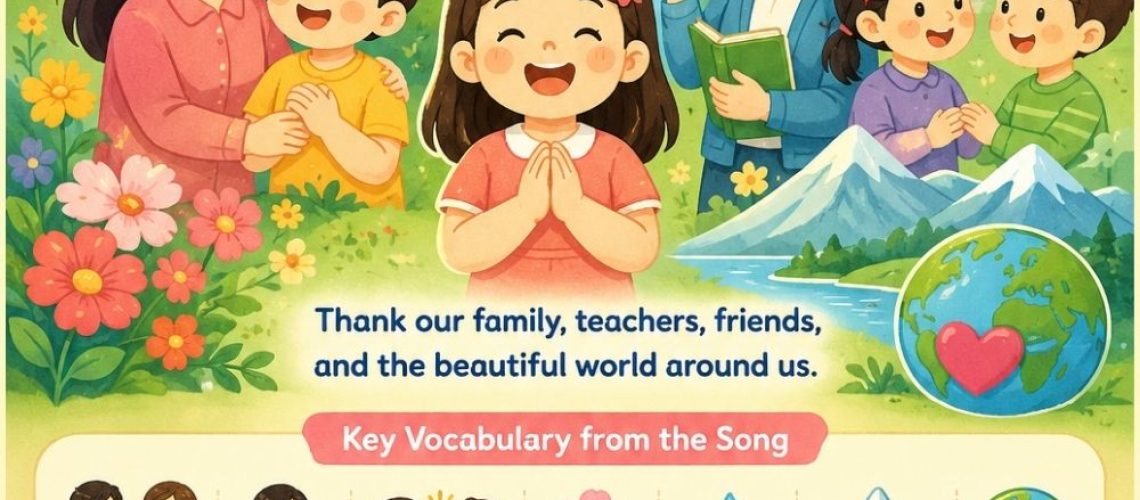
What is a good Chinese gratitude song for kids?
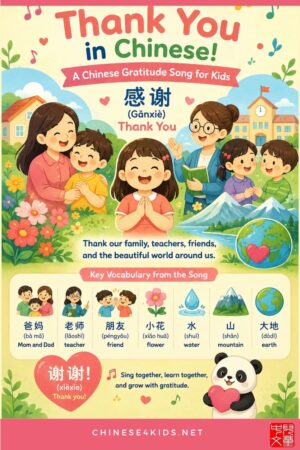
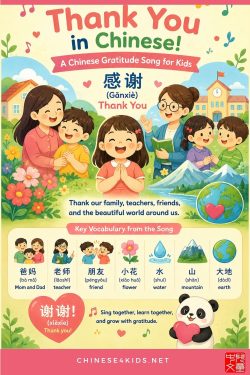
“感谢” (Gǎnxiè), meaning “Thank You,” is a Chinese children’s song about gratitude. It introduces young learners to useful vocabulary like 谢谢 (thank you), 爸妈 (Mom and Dad), 老师 (teacher), 朋友 (friend), 小花小草 (flowers and grass), 水 (water), 山 (mountains), and 大地 (earth). Parents and teachers use this song to teach beginner Chinese vocabulary, listening skills, pronunciation, and the cultural value of gratitude—all while helping children practice words they hear and use every day.
Chinese Gratitude Song at a Glance
| Aspect | Details |
|---|---|
| Song Title | 感谢 (Gǎnxiè) — Thank You |
| Composer & Lyricist | 洪予彤 (Hóngyǔtóng) |
| Language | Mandarin Chinese |
| Best For | Young Chinese learners (ages 3+) |
| Main Theme | Gratitude & appreciation |
| Topics Covered | Family, teachers, friends, nature |
| Key Vocabulary | 谢谢, 爸妈, 老师, 朋友, 陪伴, 长大 |
| Skills | Listening, pronunciation, vocabulary, speaking |
| Classroom Use | Circle time, music lessons, cultural activities |
Why Teach Gratitude Through Chinese?
When you teach gratitude through Chinese music, you’re doing two things at once:
1. Building language skills.
Children practice listening and pronunciation in a meaningful context. The song repeats useful vocabulary naturally.
2. Teaching cultural values.
Chinese culture emphasizes respect, appreciation, and awareness of those around us. This song models that beautifully for young learners.
For Chinese heritage families, this song bridges language and identity. For international students, it provides authentic cultural content that makes learning more engaging.
How to Say Thank You in Chinese
The most common way to say thank you in Chinese is:
谢谢 (xièxie) — thank you (everyday, conversational)
Children also learn these variations:
| Chinese | Pinyin | English | When to Use |
|---|---|---|---|
| 谢谢 | xièxie | Thank you | Every day, with anyone |
| 谢谢你 | xièxie nǐ | Thank you | To one specific person |
| 谢谢您 | xièxie nín | Thank you | Respectfully, to elders or in formal settings |
| 谢谢大家 | xièxie dàjiā | Thank you, everyone | Addressing a group |
| 感谢 | gǎnxiè | To thank / express gratitude | Written or formal speech; often followed by a noun or person |
Key difference: 谢谢 is what children use every day. 感谢 is more formal and appears more often in written Chinese or formal speech.
➜ Want to learn more natural ways to express thanks in Chinese? Read our complete guide: How to Say Thank You in Chinese Like a Native.
Listen to the Chinese Gratitude Song
The song is easy to follow and perfect for children ages 3 and up. Even if kids don’t understand every word, the melody and repetition help them absorb vocabulary naturally.
About the Song: 感谢 (Gǎnxiè)
This children’s song celebrates six types of gratitude:
- Parents — who provide home and care
- Teachers — who teach and guide
- Friends — who share life’s journey
- Nature — flowers, grass, storms
- The Elements — water and mountains
- The Earth — sky and world
Each verse follows a similar structure, making it easy for children to predict and learn the pattern.
Chinese Gratitude Vocabulary from the Song
Use this table to teach vocabulary before, during, or after learning the song.
| Chinese | Pinyin | English | Example from Song |
|---|---|---|---|
| 感谢 | gǎnxiè | to thank / gratitude | Song title |
| 谢谢 | xièxie | thank you | Final line |
| 亲爱的 | qīn’ài de | dear / beloved | 亲爱的爸妈 |
| 爸妈 | bà mā | Mom and Dad | Verse 1 |
| 家 | jiā | home | 给我的家 |
| 挡风遮雨 | dǎngfēng zhēyǔ | shelter from wind and rain | Verse 1 |
| 饭菜 | fàncài | food / dishes | 做饭菜 |
| 老师 | lǎoshī | teacher | Verse 2 |
| 知识 | zhīshi | knowledge | 教知识 |
| 朋友 | péngyou | friend | Verse 3 |
| 分享 | fēnxiǎng | to share | 分享生活 |
| 世界 | shìjiè | world | 浩瀚世界 |
| 小花 | xiǎohuā | little flower | Verse 4 |
| 小草 | xiǎocǎo | grass | Verse 4 |
| 风景 | fēngjǐng | scenery / landscape | Verse 4 |
| 水 | shuǐ | water | Verse 5 |
| 山 | shān | mountain | Verse 5 |
| 大地 | dàdì | earth | Verse 6 |
| 平安 | píng’ān | peace / safety | 平安的每一天 |
| 陪伴 | péibàn | to accompany / be there for | Repeated throughout |
| 长大 | zhǎngdà | grow up | Repeated throughout |
Verse by Verse: Learning From the Song
Verse 1: Thanking Parents 感谢爸妈
感谢亲爱的爸妈
Gǎnxiè qīn’ài de bà mā
Thank you, dear Mom and Dad.给我挡风遮雨的家
Gěi wǒ dǎngfēng zhēyǔ de jiā
You give me a home sheltering me from wind and rain.为我做香喷喷饭菜
Wèi wǒ zuò xiāngpēnpēn fàncài
You cook me delicious food.陪伴我长大
Péibàn wǒ zhǎngdà
You accompany me as I grow up.
Key Words:
· 爸妈 (parents)
· 家 (home)
· 饭菜 (food)
· 陪伴 (accompany)
· 长大 (grow up)
Teaching Point:
This verse introduces the family context and the verb 陪伴 (to accompany/be with), which appears throughout the song. Help children connect the words to their own homes and families.
This verse introduces the family context and the verb 陪伴 (to accompany/be with), which appears throughout the song. Help children connect the words to their own homes and families.
Verse 2: Thanking Teachers 感谢老师
感谢亲爱的老师
Gǎnxiè qīn’ài de lǎoshī
Thank you, dear teachers.教导我无穷尽知识
Jiàodǎo wǒ wú qióngjìn zhīshi
You teach me endless knowledge.指引人生迷惘方向
Zhǐyǐn rénshēng míwǎng fāngxiàng
You guide me through life’s confusion.陪伴我长大
Péibàn wǒ zhǎngdà
You accompany me as I grow up.
Key Words:
· 老师 (teacher)
· 知识 (knowledge)
· 指引 (guide/direct)
· 方向 (direction)
Teaching Point:
Children learn that teachers do more than share facts—they also guide children’s growth. This is a good place to ask: “What has your teacher taught you besides Chinese?”
Children learn that teachers do more than share facts—they also guide children’s growth. This is a good place to ask: “What has your teacher taught you besides Chinese?”
Verse 3: Thanking Friends 感谢朋友
感谢亲爱的朋友
Gǎnxiè qīn’ài de péngyou
Thank you, dear friends.分享生活苦辣酸甜
Fēnxiǎng shēnghuó kǔ là suān tián
You share with me all the flavors of life.一起探索这浩瀚世界
Yīqǐ tànsuǒ zhè hàohàn shìjiè
We explore this vast world together.陪伴我长大
Péibàn wǒ zhǎngdà
You accompany me as I grow up.
Key Words:
· 朋友 (friend)
· 分享 (share)
· 生活 (life)
· 探索 (explore)
· 世界 (world)
Teaching Point:
“苦辣酸甜” literally means “bitter, spicy, sour, sweet”—the full range of tastes and experiences. It’s a poetic way to say “everything good and bad.”
“苦辣酸甜” literally means “bitter, spicy, sour, sweet”—the full range of tastes and experiences. It’s a poetic way to say “everything good and bad.”
The rest verses are not listed here. Watch the video for details.
What Children Can Learn From This Chinese Gratitude Song
This song teaches multiple skills at once:
- Thank you expressions — 谢谢 and 感谢
- Family vocabulary — 爸妈, 家
- School vocabulary — 老师, 知识, 朋友
- Nature vocabulary — 花, 草, 水, 山, 大地
- Useful verbs — 做 (make), 给 (give), 陪伴 (accompany), 分享 (share), 教 (teach)
- Adjectives — 亲爱的 (dear), 香喷喷 (delicious), 伟大 (magnificent)
- Chinese sentence patterns — particularly the 感谢…
- structureListening and pronunciation — through song
- Cultural values — respect, gratitude, community
Chinese Sentence Patterns for Gratitude
Use these patterns to create new sentences with your child.
感谢 + person
感谢爸妈。
Gǎnxiè bà mā.
Thank you, Mom and Dad.感谢老师。
Gǎnxiè lǎoshī.
Thank you, teacher.感谢朋友。
Gǎnxiè péngyou.
Thank you, friend.
谢谢 + person + 的 + noun
谢谢你的帮助。
Xièxie nǐ de bāngzhù.
Thank you for your help.谢谢妈妈的饭菜。
Xièxie māmā de fàncài.
Thank you, Mom, for the food.谢谢老师的教导。
Xièxie lǎoshī de jiàodǎo.
Thank you, teacher, for your guidance.
我很感谢 / 非常感谢 + person
我很感谢我的朋友。
Wǒ hěn gǎnxiè wǒ de péngyou.
I’m very grateful for my friend.非常感谢你的时间。
Fēicháng gǎnxiè nǐ de shíjiān.
Thank you very much for your time.
5 Concrete Gratitude Activities for Chinese Learners
Activity 1: Gratitude Circle (谢谢圈)
Objective: Practice saying 谢谢 in a group setting.
How to do it:
- Sit in a circle.
- Each child completes this sentence: 谢谢_____。
Examples:
谢谢妈妈。(Thank you, Mom.)
谢谢老师。(Thank you, teacher.)
谢谢我的朋友。(Thank you, my friend.)
- For younger kids: Show pictures of family members or teachers. Point and say the phrase together.
- For older kids: Ask for two things they’re grateful for and create sentences:
- 谢谢爸爸的帮助。(Thank you, Dad, for your help.)
Activity 2: Gratitude Drawing & Writing (感谢画)
Objective: Combine drawing with Chinese writing.
How to do it:
- Ask your child: 你想谢谢谁? (Who do you want to thank?)
- Have them draw that person.
- Together, write: 谢谢____! (Thank you, ____!)
Variations:
- Younger kids: Color the picture and practice writing one character.
- Older kids: Write a full sentence with a reason:
- 谢谢妈妈做饭。(Thank you, Mom, for cooking.)
- 谢谢老师教我。(Thank you, teacher, for teaching me.)
Classroom idea: Display these drawings with labels in your Chinese learning space.
Activity 3: Gratitude Matching Cards (感谢配对卡)
Objective: Build vocabulary associations.
How to do it:
- Create cards that match Chinese words to pictures or English:
- 老师→teacher
- 朋友→friend
- 爸妈→parents
- 家→home
- 知识→knowledge
- 水→water
- 山→mountain
How to play:
- Shuffle cards.
- Children match Chinese to pictures or English.
- Say the word aloud as they match.
Extension: After matching, sing the verse that contains that word from the song.
Activity 4: Gratitude Charades (感谢表演)
Objective: Associate gratitude actions with vocabulary.
How to do it:
One child acts out a gratitude action. Others guess who deserves the thank you.
Actions to act out:
- Cooking (做饭) → 谢谢妈妈
- Teaching (教书) → 谢谢老师
- Playing together (一起玩) → 谢谢朋友
- Giving a hug (拥抱) → 谢谢爸爸
- Listening (听) → 谢谢大家
- Helping (帮助) → 谢谢你
How to play:
- One child silently acts out the scene.
- Other children raise their hands and say: 谢谢_____。
For teachers: This works great after learning the song—kids already know the vocabulary.
Activity 5: Create Your Own Gratitude Verse (写你自己的感谢诗)
Objective: Personalize the song structure with their own gratitude.
For older children (age 6+):
Show them the song structure:
感谢亲爱的____
陪伴我长大
Let them fill in their own person and reasons. For example:
感谢亲爱的奶奶
给我讲故事
做我最爱的饺子
陪伴我长大
(Thank you, dear Grandma, for telling me stories, making my favorite dumplings, and being with me as I grow up.)
How to support them:
- Provide a word bank from the song vocabulary.
- Help them rhyme or create a rhythm.
- Practice singing their new verse together.
Classroom use: Have each student create a verse about a different person or role in their life.
Make Gratitude Learning Hands-On
After learning the song, help children practice gratitude vocabulary through activity. Our Thank You Coloring Cards are perfect for this—young learners color pictures of parents, teachers, and friends while practicing Chinese vocabulary.
→ Explore the Thank You Coloring Cards
Learn Chinese Gratitude Through Proverbs & Culture
Chinese culture has many traditional sayings about gratitude, kindness, and remembering those who have helped us. Continue the lesson with our article on Chinese Proverbs About Gratitude to deepen cultural understanding.
Or display our Chinese Gratitude Proverb Posters in your classroom—they combine Chinese characters, pinyin, English meanings, and colorful designs perfect for cultural lessons.
How Parents Can Use This Song
Routine singing:
- Play the song during dinner or bedtime.
- Sing one verse a day for a week, then review all six.
- Make it a weekly family ritual.
Connection to real life:
- After listening: “Who did you say thank you to today?”
- Point to family members when you hear their roles (爸妈, 老师).
- Create a gratitude jar and use phrases from the song.
Language practice:
- Pause the song and have your child repeat words.
- Ask simple questions: “谁是老师?” (Who is the teacher?) while listening.
- Encourage children to hum the melody and learn the rhythm before full lyrics.
For heritage families:
- Use this song to connect language and cultural values.
- Ask grandparents if they know the song or similar ones.
- Create traditions around gratitude in Chinese at home.
- How Teachers Can Use This Song
Circle time:
- Play during opening or closing circle.
- Ask children to share one person they’re grateful for.
- Sing together as a community-building activity.
Music curriculum:
- Teach one verse per week.
- Focus on pronunciation and listening comprehension.
- Perform at school events or parent celebrations.
Integrated lessons:
- Chinese class: Teach vocabulary and sentence patterns.
- Music class: Learn the melody, discuss rhythm and instruments.
- Values/character ed: Discuss gratitude and appreciation.
- Art class: Create gratitude drawings using vocabulary labels.
Cultural events:
- Thanksgiving or gratitude day programs.
- Year-end celebrations.
- International family days.
- Chinese New Year events.
- Adaptations for Different Ages
Preschool/Toddler
- Listen to the song 1-2 times per week.
- Learn 2-3 key words: 谢谢, 爸妈, 妈妈
- Simple movement: clap when they hear 谢谢
- No need to sing full verses yet.
Kindergarten/Early Elementary
- Learn 1-2 verses by heart.
- Practice 5-10 vocabulary words from the song.
- Simple gratitude activities: drawing and coloring.
- Begin matching words to pictures.
Ages 7-9 (Early Elementary)
- Learn 3-4 verses.
- Practice sentence patterns: 谢谢你的____
- Create simple gratitude cards with sentences.
- Play matching games and charades.
Late Elementary/Middle School
- Learn the full song.
- Create new verses about people in their lives.
- Research the composer and song history.
- Discuss cultural values of gratitude in Chinese society.
- Write reflections: Why is each person important?
- More Chinese Gratitude Expressions
Beyond the song, teach these useful phrases:
Simple Thanks
谢谢。(Thank you.)
谢谢你。(Thank you.)
谢谢大家。(Thank you, everyone.)
Thankful Statements
我很感谢你。(I’m very grateful for you.)
非常感谢你。(Thank you very much.)
谢谢你的帮助。(Thank you for your help.)
谢谢你的时间。(Thank you for your time.)
Polite Responses to Thank You
不客气。(You’re welcome.)
没关系。(No problem / It’s okay.)
应该的。(It’s what I should do.)
Who Can Use This Chinese Gratitude Song?
This song works well for:
- Parents teaching Chinese at home — It’s simple enough for children to learn but meaningful enough to create family conversations about gratitude.
- Chinese heritage language learners — Connects language to cultural values important in their family identity.
- Beginners learning Mandarin — Perfect starter song with repetition and useful vocabulary.
- Preschool and elementary Chinese classes — Easy to teach and fun for young learners.
- Homeschool families — Works as a standalone lesson or part of a larger curriculum.
- International schools — Teaches Mandarin to students without Chinese background.
- Chinese community schools — Ideal for diaspora education programs.
- Children’s cultural programs — Great for performances or cultural events.
- Music and language teachers — Natural integration point for both subjects.
Frequently Asked Questions
What is the Chinese word for thank you?
谢谢 (xièxie) is the most common way to say “thank you” in Mandarin Chinese. It’s casual and conversational—the phrase children hear and use most often.
How do children say thank you in Chinese?
Young children can simply say 谢谢 (xièxie). As they progress, they learn 谢谢你 (thank you, to one person), 谢谢大家 (thank you, everyone), and eventually 感谢 (a more formal expression of gratitude).
What is a Chinese gratitude song?
A Chinese gratitude song is a children’s song that uses Mandarin to express appreciation for the people, nature, experiences, and things that matter in a child’s life.
What Chinese song teaches gratitude?
《感谢》 (Gǎnxiè), composed by 洪予彤, is a popular children’s song centered on gratitude. It thanks parents, teachers, friends, nature, and the world around us.
Is 谢谢 the same as 感谢?
Both express thanks, but they’re used differently. 谢谢 is the everyday expression children hear and use most often. 感谢 is used to express or describe gratitude more formally or in writing. In the song, 感谢 is used to begin each verse (感谢爸妈 = thanking/expressing gratitude for parents) while 谢谢 appears at the very end as the casual conclusion.
How can I teach gratitude in Chinese?
Use songs, picture cards, role-play, drawing activities, and simple sentence frames such as 谢谢妈妈 and 谢谢老师. Make it personal by asking children who they want to thank and why. Gratitude habits build through repetition and real-life connection.
How long does it take children to learn this song?
Young children can learn the main chorus in 1-2 weeks of regular listening. Learning all six verses typically takes 3-4 weeks with weekly practice. The melody is simple and the lyrics repeat, so children pick it up faster when they hear it regularly.
Can older kids (ages 10+) learn this song?
Yes. Older children can learn all verses and explore the deeper meanings. They can also create their own verses, research the composer, or discuss what gratitude means in Chinese culture.
What skills does this song teach?
Language skills: Listening, pronunciation, vocabulary, sentence patterns, and basic speaking. Cultural skills: Understanding Chinese values around gratitude, respect, and community. Social-emotional skills: Recognizing kindness, expressing appreciation, and building awareness of people around them.
Where can I find more Chinese children’s songs?
Check our Chinese Children’s Songs Lyrics eBook, which includes 50+ songs with full translations.
Is this song copyrighted?
Yes, 《感谢》 is a copyrighted song. We recommend listening to the official version on YouTube and using the vocabulary and teaching activities we’ve provided here. For copyright reasons, we don’t reproduce the complete lyrics on this page—the video above gives you access to the full song.
Can I use this song in my classroom or performances?
Yes. This is an educational song perfect for classroom use, school performances, cultural events, and family celebrations. Make sure you’re using or linking to an authorized version (such as the official YouTube video).
Gratitude is more than a feeling—it’s a practice. And music is one of the best ways to practice it.
Whether you’re a parent, teacher, heritage language educator, or global family learning together, you’re giving children a gift that lasts far beyond language. You’re teaching them to notice kindness, appreciate those around them, and express gratitude across cultures.
Related Chinese Learning Resources
Gratitude & Emotions
- Chinese Proverbs on Gratitude
- Chinese Proverbs on Friendship
- How to Say Thank You in Chinese Like a Native
Songs & Music
Activities & Classroom Resources
Learning Programs
- Speak Chinese with Kids Course — Full lessons with songs, stories, and activities
- Chinese Vocabulary Made Easy Course — Learn useful words and phrases
- Chinese4kids Membership — Access to lesson plans, worksheets, and song collections
Share with other Chinese-teaching parents and educators