Quick Answer
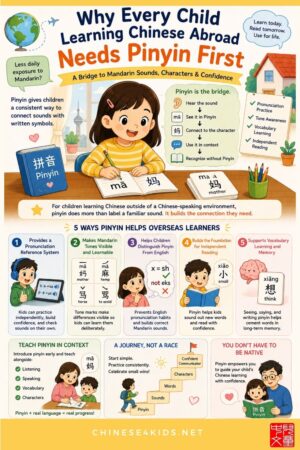
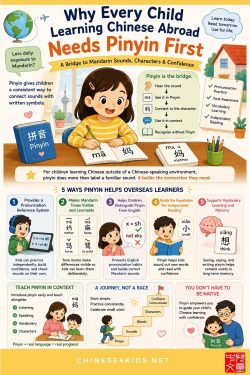
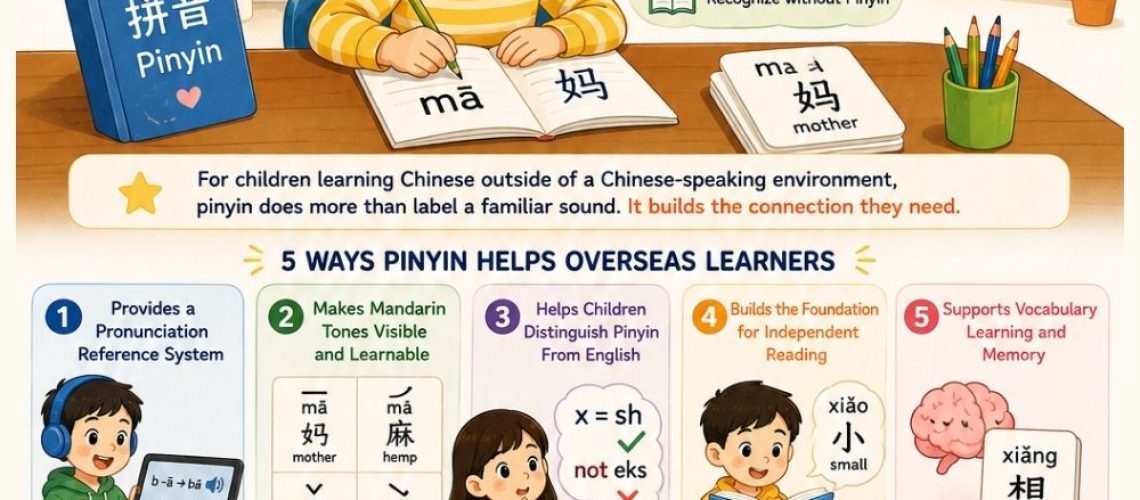
Pinyin gives children learning Mandarin outside a Chinese-speaking environment a consistent way to connect Mandarin sounds with written symbols. Because overseas learners often have less daily exposure to Mandarin than children growing up in China, Pinyin can support pronunciation practice, tone awareness, vocabulary learning, and independent reading. It should be introduced early and taught alongside listening, speaking, vocabulary, and characters—not treated as an isolated foundation that must be completed before any Chinese learning begins.
Pinyin gives children learning Mandarin outside a Chinese-speaking environment a consistent way to connect Mandarin sounds with written symbols. Because overseas learners often have less daily exposure to Mandarin than children growing up in China, Pinyin can support pronunciation practice, tone awareness, vocabulary learning, and independent reading. It should be introduced early and taught alongside listening, speaking, vocabulary, and characters—not treated as an isolated foundation that must be completed before any Chinese learning begins.
Your child is learning Mandarin in an English-speaking environment. Maybe they take classes twice a week. Maybe they hear it at home but spend most of their day in English. Maybe they’re a heritage learner with minimal family language exposure.
You’ve heard that pinyin is important. But here’s the real question parents ask:
If pinyin is just Latin letters, and my child will eventually read Chinese characters, why invest time in it at all?
This article answers that question. More importantly, it explains why pinyin’s role is different for children learning Chinese abroad than for children immersed in Mandarin.
Why Pinyin Matters for Kids Learning Chinese Abroad
The Immersion Difference
Children in China learn Mandarin constantly. They hear it at home, in shops, on television, at school, in the street. That massive daily exposure means they naturally absorb the sounds of Mandarin long before they ever encounter pinyin in a classroom.
For a child in China, pinyin is layered onto a large existing base of listening experience. Pinyin labels sounds they already know well.
The reality for overseas learners is fundamentally different.
An overseas child might be:
- A complete beginner hearing Mandarin for the first time in a classroom
- A heritage learner hearing Mandarin at home but living in English for most of their day
- Attending Chinese school once or twice a week
- Hearing Mandarin during annual family visits
- Learning from parents who aren’t native speakers
- Growing up in a multilingual household
What distinguishes many overseas learners is that Mandarin may occupy only part of their daily language environment, rather than being the dominant language surrounding them.
When exposure is limited, pinyin serves a different purpose. For an overseas learner, pinyin does more than label a familiar sound. It gives them a visual system for connecting unfamiliar Mandarin sounds with written language.
This distinction is not trivial. It fundamentally changes how you should teach pinyin to overseas children.
<h2″>Pinyin Is a Bridge Between Mandarin Sounds and Chinese Characters
Think of pinyin’s role this way:
👂 Hear an unfamiliar Mandarin sound
↓
🔤 See it represented in Pinyin
↓
🀄 Connect it to the Chinese character
↓
💬 Use it in context
↓
📖 Eventually recognize the character without Pinyin support
For overseas learners, pinyin is the middle step that would otherwise be missing.
In immersion contexts, children’s ears do that middle work naturally. In non-immersion contexts, pinyin does it systematically.
Pinyin is not the destination. It’s the bridge.
5 Ways Pinyin Helps Overseas Chinese Learners
1. Provides a Pronunciation Reference System
>Once your child learns pinyin, they can look at any syllable and have a consistent way to access its sound — without relying on you to model it perfectly every time.
This sounds simple, but it’s powerful. It means:
- Your child can practice independently
- You can help with pronunciation without needing to be a perfect speaker yourself
- Your child builds confidence (“I can decode this on my own”)
- Mispronunciations can be corrected by checking the pinyin, not just by listening again
This is essential for overseas learners, who don’t have constant native speaker input to correct subtle pronunciation errors.
2. Makes Mandarin Tones Visible and Learnable
Mandarin is a tonal language. The same syllable with different tones means different words:
- mā (妈) — mother
- má (麻) — hemp
- mǎ (马) — horse
- mà (骂) — to scold
A child immersed in Mandarin hears these tone differences thousands of times and internalizes them naturally. An overseas child doesn’t.
Pinyin’s tone marks — the small lines above vowels — make tone differences visible. This is crucial for overseas learners who need explicit instruction on something immersed children absorb implicitly.
With pinyin, you can point to the tone mark and say: “This mark means the sound goes up like a question.” Children can see and practice tone patterns deliberately, not just hope they pick them up by ear.
3. Helps Children Distinguish Pinyin From English
Your child sees Latin letters: p-i-n-y-i-n.
Their English-trained brain automatically wants to read them as English. This is the biggest source of mispronunciation for English-speaking learners.
They see “x” and think “eks.” Wrong. In Mandarin, x is roughly similar to the “sh” sound in she, but produced with a different tongue position.
They see “q” and think “kyoo.” Wrong again. In Mandarin, q is roughly like the “ch” in cheese, but with a different tongue position and lighter, more strongly aspirated sound.
They see “zh” and guess it’s “zee-aitch.” Not quite. In Mandarin, zh is similar to the “j” sound in jump, but produced farther back in the mouth.
If a child learns pinyin while defaulting to English pronunciation, those errors compound. A child who says xue (学, to study) as “eks-oo-ay” instead of “shoo-eh” will keep saying it that way. Correcting embedded pronunciation errors is much harder than teaching it correctly from the start.
This is why teaching pinyin as a separate system from English — explicitly, from day one — is so important for overseas learners. You’re not just introducing a romanization tool. You’re teaching children that these familiar letters represent unfamiliar sounds.
4. Supports More Independent Learning
Most beginner Chinese materials use pinyin as pronunciation support. Leveled readers for young learners, vocabulary lists, beginner textbooks — they include pinyin specifically because it’s essential for non-native learners.
A child who understands pinyin can use a much wider range of these materials independently. They can:
- Read simple books with pinyin support
- Learn new vocabulary from worksheets
- Practice from online resources
- Work without constant adult guidance
A child without pinyin access is limited to materials their parent or teacher specifically prepares, or materials with audio components. That’s restrictive.
5. Gives Pronunciation Practice More Structure
Pinyin helps represent pronunciation. It doesn’t teach pronunciation by itself.
Children still need to hear Mandarin, imitate native or high-quality models, practice tones, and receive feedback. Pinyin gives them a visual representation of what they hear and a consistent way to revisit it.
With pinyin, pronunciation practice becomes more systematic and independently accessible. Your child isn’t just repeating after you—they’re building their own understanding of how Mandarin sounds work.
Why English-Speaking Children Often Struggle With Pinyin
This deserves its own section because it’s so common and so fixable.
Pinyin uses the English alphabet, but pinyin is not English.
This is not obvious to English-speaking children. They see familiar letters and naturally default to familiar sounds.
The solution is explicit teaching from day one:
“This is pinyin. It uses English letters, but the sounds are Mandarin, not English. These letters sound completely different from what you know.”
Then demonstrate:
- Show “x” — “In English we don’t really have this sound. In Mandarin it’s like ‘sh’, but different.”
- Show “q” — “This is NOT ‘kyoo’ like in English. In Mandarin it’s more like ‘ch’.”
- Show “zh” — “Nothing like ‘zee’ and ‘aitch.’ It’s a sound kind of like ‘j’.”
The key is making this distinction explicit and frequent. Don’t assume children will figure it out. They won’t.
Should Kids Learn Pinyin Before Chinese Characters?
Here’s the honest answer: It depends on your learning model.
If your goal is:
- Independent early reading
- Building confidence with pronunciation first
- Preparing for character learning
Then: Introduce pinyin early and build it systematically alongside initial vocabulary and characters.
If your goal is:
- Natural, immersion-like learning
- Connecting sounds, characters, and meaning from day one
- Avoiding abstract prerequisites
Then: Teach pinyin as a support that runs alongside character and vocabulary learning from the start, not as a separate sequential stage.
The worst approach is treating pinyin as a boring prerequisite that must be completed before “real” Chinese learning begins. That creates resistance and misses the opportunity to make pinyin meaningful.
The best approach: Introduce Pinyin early, but teach it alongside real Chinese.
How to Teach Pinyin at Home
If you’re a parent, here are practical strategies:
1. Frame pinyin as a separate system, not English.
On day one, explicitly tell your child: “Pinyin uses English letters, but it’s not English. These letters sound different in Mandarin. We’re learning a new pronunciation system.”<
This single framing prevents months of confusion.
2. Use a visual reference constantly.
Post the Hanyu Pinyin Syllables Table Poster somewhere visible. Use it daily:
- Point to syllables while saying them aloud
- Have your child find syllables on the chart
- Use it as a reference when uncertain about pronunciation
A good visual reference removes guesswork and builds pattern recognition.
3. Connect pinyin to characters and meaning immediately.
Don’t teach pinyin in isolation. As soon as your child learns a pinyin sound, connect it:
- Learn mā (pinyin) → connect to 妈 (character) → learn it means “mother”
- Learn bà (pinyin) → connect to 爸 (character) → learn it means “father”
This gives pinyin real-world meaning and motivates continued practice.
4. Practice pronunciation actively.
Watching videos with pinyin is helpful but not enough. Your child needs to:
- Speak pinyin aloud every practice session
- Say the sounds repeatedly
- Compare their pronunciation to a model (you, a video, an audio resource)
Speaking is what builds the mouth muscle memory needed for accurate Mandarin pronunciation.
5. Keep sessions short and frequent.
For young learners, 10–15 minute sessions work better than long blocks. Frequent, short practice builds habits better than occasional long sessions.
How Teachers Can Teach Pinyin in the Classroom
If you’re a teacher in an English-speaking environment:
1. Address the English interference directly.
Dedicate 10 minutes of your first pinyin lesson to showing students that pinyin ≠ English. Show the most confusing letters:
- “x” — not “eks,” it’s like “sh”
- “q” — not “kyoo,” it’s like “ch”
- “zh” — not “zee-aitch,” it’s like “j”
Make this explicit. Don’t assume students will figure it out.
2. Provide multiple reference materials.
Different learners need different formats:
- A wall poster (Hanyu Pinyin Syllables Table Poster in A3 size works well)
- Handouts students keep in their notebooks
- Digital files they can access from home
Having multiple formats means no student is stuck without a reference.
3. Connect pinyin to characters and vocabulary from the start.
Don’t teach pinyin in isolation. Introduce pinyin alongside simple Chinese words, characters, and meaningful contexts.
4. Build tone awareness early.
Introduce the four tones and tone marks from your first lesson:
- Show how the same syllable with different tones means different words
- Have students practice saying the four tones of common syllables
- Use visual aids (draw the tone shapes, show the tone marks)
Overseas learners need this foundational understanding of tone early so they build correct pronunciation habits.
Who Benefits Most From Pinyin?
Pinyin can be especially useful for children who:
- Learn Mandarin only a few hours per week
- Live primarily in an English-speaking environment
- Don’t have a Mandarin-speaking adult available for daily correction
- Are beginning to read Chinese
- Struggle with tones or pronunciation
- Frequently transfer English pronunciation to Pinyin
- Want to practice Chinese independently
In short: Children with less daily Mandarin exposure benefit most from Pinyin’s systematic reference structure.
Children with strong Mandarin immersion may use Pinyin differently because they already have extensive listening experience. But even in immersion contexts, Pinyin supports phonological awareness and literacy development.
Common Questions About Pinyin for Overseas Learners
Is pinyin really necessary? Can’t children learn Chinese without it?
In short: Children can learn Chinese without formal pinyin instruction, especially in immersion settings. But in non-immersion contexts, pinyin provides a consistent pronunciation reference that would otherwise require constant adult modeling.
Does pinyin help with correct pronunciation?
In short: Pinyin provides a consistent written representation of Mandarin pronunciation. Knowing pinyin doesn’t automatically mean a child will pronounce sounds perfectly — they still need listening, modeling, and practice. But pinyin gives them a reference system to check themselves and practice deliberately.
Won’t learning pinyin confuse English speakers?
It might, temporarily, if pinyin is taught as if it’s English. That’s why the “Pinyin ≠ English” distinction is so important. When taught clearly as a separate system, most children adapt quickly.
Can children learn pinyin and characters at the same time?
Yes. In fact, that’s often the most effective approach. Learning pinyin alongside characters and vocabulary creates more meaningful connections than learning pinyin in isolation.
Does pinyin slow down character learning?
Skipping Pinyin may appear to save time at first, but it can leave overseas learners with fewer tools for decoding unfamiliar words independently. Pinyin can actually support faster path to independent reading.
What Comes After Pinyin?
Once your child has a solid pinyin foundation and can reliably pronounce Mandarin sounds:
Next step: High-frequency vocabulary
Move into learning the most essential Chinese words. This is where pinyin becomes truly valuable — your child can now practice pronunciation with actual vocabulary rather than abstract syllables.
Then: Leveled reading with pinyin support
With pronunciation and vocabulary confidence, your child can read beginner Chinese materials with pinyin support. This is a major milestone because it means independent reading practice is possible.
Leveled readers are specifically designed for this stage:
- Each book targets specific HSK levels (usually Level 1–2 to start)
- Vocabulary is controlled and repetitive (your child sees new words multiple times)
- Illustrations support comprehension (your child can guess meaning from context)
- Pinyin support is included (no need to guess pronunciation)
- Stories are age-appropriate and engaging (not boring drills)
A child at this stage can:
- Read a complete story independently
- Practice pronunciation in context
- Encounter new vocabulary naturally
- Build reading confidence
- See that Chinese is a real communication tool, not just an exercise
Then: Character recognition grows
As your child reads more, character recognition builds naturally. Gradually, pinyin support becomes less necessary. By this stage, pinyin has done its job.
Pinyin Resources for Kids
Learn How Pinyin Works
An Introduction to Hanyu Pinyin
If you need to understand how the pinyin system actually works — the initials, finals, syllable patterns, the core rules — this is your complete technical guide. It’s useful for parents who want to understand what they’re teaching, and for teachers building comprehensive curriculum.
Key Reference Tool
Hanyu Pinyin Syllables Table Poster
A3 and A4 printable reference showing the complete pinyin system. Post it in your classroom or home study space and reference it daily. This single tool removes a lot of the confusion around which pinyin combinations are possible.
Want to Go Deeper Into Mandarin Pronunciation and Tones?
Chinese Pronunciation for Kids
Understand how Mandarin pronunciation works and why tones matter. This complements pinyin learning with tone-specific guidance and pronunciation strategies.
Next Step: Build Vocabulary
Once pinyin pronunciation is solid, this course helps children (ages 6–10) build the most essential Chinese words aligned with HSK 1–2. This is where pinyin becomes truly functional — your child applies their pronunciation skills to actual vocabulary and characters.
Then: Start Reading With Leveled Readers
Leveled Chinese Readers (HSK 1–2 Level)
Once your child has vocabulary and pronunciation confidence, leveled readers are the natural next step. These books:
- Use high-frequency vocabulary your child already knows
- Include pinyin support (making reading independent and confident)
- Have illustrations that support comprehension
- Tell simple, engaging stories that keep kids motivated
- Create the bridge between learning words and reading real Chinese
Leveled readers turn pinyin from a learning tool into a gateway to actual Chinese literature. This is where your child experiences real reading success.
Supporting Materials
Chinese4kids Membership — Access lesson plans, worksheets, and teaching materials designed for overseas Chinese teachers and heritage families
Pinyin Handwriting Workbook (Amazon) — Optional resource for structured pinyin handwriting practice
Pinyin Flashcards (Amazon) — Optional resource for repetition-based pinyin learning
What Research Says About Pinyin
Research on Chinese literacy development has found meaningful relationships between Pinyin knowledge and phonological awareness in Chinese schoolchildren. Studies involving Chinese immersion learners also found that Pinyin skill facilitates subsequent Chinese word reading — suggesting pinyin’s value extends across different learning contexts.
References:
- Studies on phonological awareness and Pinyin knowledge in Mandarin-speaking children show strong correlations with later reading success
- Research on Chinese immersion programs demonstrates that explicit Pinyin instruction supports the development of phonological awareness and word-reading skills
- Emerging research with English-speaking elementary students in bilingual settings suggests Pinyin learning contributes meaningfully to literacy development in non-immersion contexts
The broader point: Pinyin’s educational value is not just intuition or marketing. It has research support as a legitimate literacy development tool.
The Bottom Line
Learning Mandarin without constant immersion in a Chinese-speaking environment is harder than learning in China. It’s slower. It requires more structure, more planning, and more intentional teaching.
But it’s absolutely doable if you start with the right approach.
Pinyin is not a magic solution or a prerequisite that must be completed before real learning begins.
Instead, pinyin is a bridge that helps overseas learners connect unfamiliar Mandarin sounds with written Chinese.
For children without constant Mandarin exposure, this bridge serves a real educational purpose:
✓ It makes pronunciation practice more independent and systematic
✓ It builds tone awareness explicitly
✓ It enables more independent learning and practice
✓ It provides access to beginner reading materials
✓ It builds confidence (“I can decode this myself”)
Start here. Teach pinyin as a separate pronunciation system, not as English. Connect it to real characters and vocabulary from the beginning. Use visual references constantly. Then progress into vocabulary, reading, and character recognition.
Pinyin is a foundation, not a destination.
Your child can build genuine Mandarin ability, even without daily immersion.
It starts with understanding that pinyin has a different role for overseas learners — and teaching it strategically.
Related Articles and Resources from Chinese4kids
- 📖 An Introduction to Hanyu Pinyin — Complete guide to pinyin’s technical structure
- 📚 Chinese Pronunciation for Kids — Deep dive into Mandarin pronunciation and tones
- 💬 Speak Chinese with Kids Course — Conversational practice paired with pronunciation work
- 📝 Chinese Learning Worksheets — Printable pinyin and pronunciation practice
Has this article helped clarify pinyin’s role for overseas learners? Share it with parents and teachers supporting children learning Mandarin abroad.